Bank Of Shanghai(601229)

Search documents
银行行业资金流入榜:中国银行等5股净流入资金超亿元
Zheng Quan Shi Bao Wang· 2025-11-19 09:28
Core Viewpoint - The banking sector experienced a rise of 0.92% on November 19, with a net inflow of 1.265 billion yuan in main funds, indicating positive investor sentiment towards the sector [1][2]. Market Performance - The Shanghai Composite Index increased by 0.18% on the same day, with 10 out of 28 sectors showing gains. The top-performing sectors included non-ferrous metals and petroleum & petrochemicals, which rose by 2.39% and 1.67%, respectively [1]. - The banking sector's performance was bolstered by a net inflow of 1.265 billion yuan, with 33 out of 42 banking stocks rising [2]. Fund Flow Analysis - The defense and military industry led the net inflow of main funds, attracting 3.610 billion yuan, while the banking sector followed with a net inflow of 1.265 billion yuan [1]. - The electronic industry faced the largest net outflow, with 7.580 billion yuan leaving the sector, followed by the computer industry with a net outflow of 6.941 billion yuan [1]. Individual Stock Performance - Among banking stocks, China Bank saw the highest net inflow of 375 million yuan, followed by Ping An Bank and China Merchants Bank with inflows of 234 million yuan and 185 million yuan, respectively [2]. - The stocks with the largest net outflows included Agricultural Bank, Shanghai Bank, and Construction Bank, with outflows of 85.029 million yuan, 74.060 million yuan, and 32.577 million yuan, respectively [2][3].




科创集市启航!上海交易集团与嘉定携手打造科技金融生态
Sou Hu Cai Jing· 2025-11-17 15:21
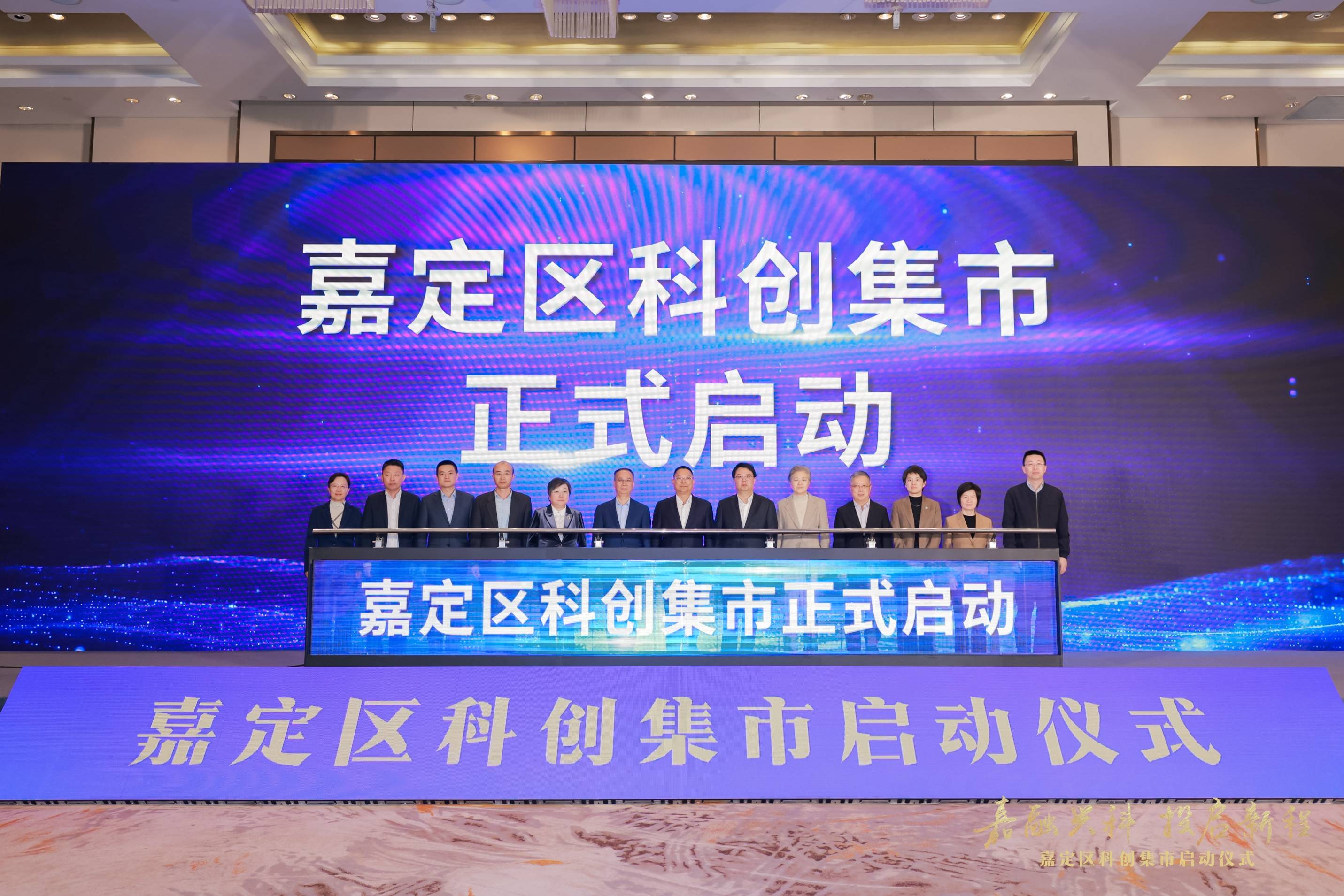
Core Viewpoint - The Shanghai Trading Group and the Jiading District of Shanghai have launched an online section for the "Science and Technology Innovation Market," aiming to bridge the gap between technology and finance, facilitating a comprehensive service platform for information release, resource connection, and policy services [2][5]. Group 1: Platform and Services - The online section is the first of its kind on the Shanghai Trading Group's website, designed to create a "one-stop" service loop that integrates industry layout, support policies, institutional resources, technology projects, and financial support [5]. - The "Science and Technology Innovation Market" will break down information barriers and establish a digital bridge for efficient project-capital connections, accelerating the transformation and implementation of technological achievements [5]. Group 2: Ecosystem and Collaboration - The "Ecological Cooperation Partner Community" of the Jiading District Science and Technology Innovation Market was officially established, focusing on innovation entities such as technology teams and startups, as well as specialized and innovative enterprises throughout their lifecycle [5][8]. - Jiading aims to leverage a dual-driven approach of "city-level platform + district-level ecosystem" to enhance the development of technology-driven enterprises [5][8]. Group 3: Financial Support and Partnerships - The Shanghai Trading Group has developed a one-stop professional service system for technology enterprises, covering financing services, patent and qualification operations, and listing cultivation services [9]. - A total of 10.52 billion yuan in credit was signed on-site between four banks and eight enterprises, indicating strong financial backing for the innovation market [9][12]. - Investment institutions signed agreements with technology companies, with a cumulative signing amount of 3.25 billion yuan, showcasing active capital engagement in the region [12]. Group 4: Investment and Growth - Jiading District has optimized its technology financial service system, focusing on the financial needs throughout the entire lifecycle of enterprises, with a cumulative investment of approximately 8 billion yuan in 93 sub-funds [18]. - The district has 1,343 specialized and innovative enterprises and 36 listed companies, ranking third in Shanghai, with three new companies listed this year [18].



30年,突破60万亿!
中国基金报· 2025-11-17 15:09
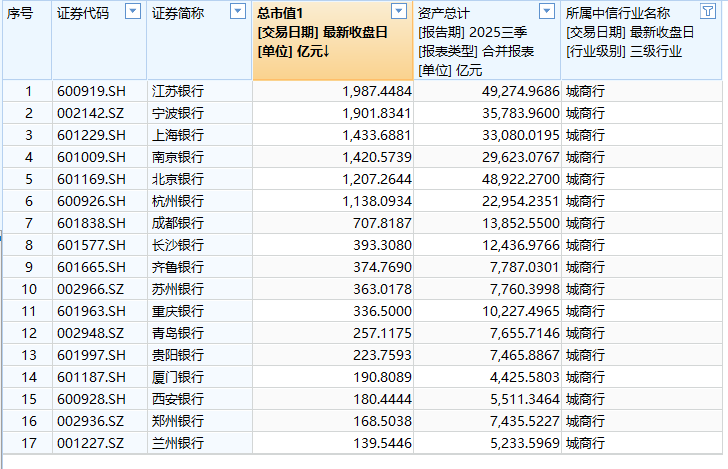
Core Viewpoint - The asset scale of urban commercial banks in China has surpassed 60 trillion yuan, marking significant growth over the past 30 years, with a 134-fold increase since 1995, and now accounting for 13.53% of the total assets of banking financial institutions [2][4]. Development of Urban Commercial Banks - Urban commercial banks have evolved into a crucial part of China's multi-tiered financial system since their establishment in 1995, with a focus on serving urban residents, small and medium-sized enterprises, and local economies [4]. - Key financial indicators for urban commercial banks show stable profitability, improved asset quality, a non-performing loan rate of 1.76%, a provision coverage ratio of 188.08%, and a capital adequacy ratio of 12.97% as of the end of 2024 [4]. Market Position and Performance - As of 2024, there are 12 urban commercial banks with asset scales exceeding 1 trillion yuan, and 5 of these banks are classified as systemically important banks in China [4]. - The market share of urban commercial banks has increased by 8.24 percentage points over the years, reflecting their growing significance in the banking sector [4]. Financial Resource Allocation - Urban commercial banks have strategically focused on high-quality development areas and sectors that align with their capabilities, continuously exploring differentiated and specialized development paths [5]. Market Capitalization of Listed Banks - Among the 17 urban commercial banks listed on the A-share market, Jiangsu Bank, Ningbo Bank, and Shanghai Bank have the highest market capitalizations, with Jiangsu Bank nearing 200 billion yuan and Ningbo Bank at 190.2 billion yuan [7][8].






30年,突破60万亿!
Zhong Guo Ji Jin Bao· 2025-11-17 14:02
Core Insights - The asset scale of urban commercial banks in China has surpassed 60 trillion yuan, reaching 60.15 trillion yuan by the end of 2024, marking a 134-fold increase since 1995 and accounting for 13.53% of the total assets of banking financial institutions [1][2] Development of Urban Commercial Banks - Urban commercial banks have evolved over 30 years, becoming a crucial part of China's multi-tiered financial system, with stable profitability and improving asset quality [2] - Key financial metrics include a non-performing loan ratio of 1.76%, a provision coverage ratio of 188.08%, and a capital adequacy ratio of 12.97% [2] - There are 12 urban commercial banks with assets exceeding 1 trillion yuan, and 5 of them are classified as systemically important banks [2] Market Position and Performance - Among the 17 urban commercial banks listed on the A-share market, Jiangsu Bank, Ningbo Bank, and Shanghai Bank have the highest market capitalizations, with Jiangsu Bank nearing 200 billion yuan [4][5] - Jiangsu Bank and Beijing Bank both have asset scales of approximately 4.9 trillion yuan, while Ningbo Bank and Shanghai Bank exceed 3 trillion yuan [4][5] Strategic Focus - Urban commercial banks have focused on serving urban and rural residents, small and medium-sized enterprises, and local economies, enhancing their service channels and offering diverse financial products [2][3] - They have aligned their financial resources with high-quality development strategies and key sectors, exploring differentiated and specialized development paths [3]
上海银行(601229) - 上海银行关于赎回优先股的第二次提示性公告
2025-11-17 09:00
证券代码:601229 证券简称:上海银行 公告编号:临2025-064 优先股代码:360029 优先股简称:上银优1 可转债代码:113042 可转债简称:上银转债 上海银行股份有限公司 关于赎回优先股的第二次提示性公告 上海银行股份有限公司(以下简称"公司")董事会及全体董事保证本公告 内容不存在任何虚假记载、误导性陈述或者重大遗漏,并对其内容的真实性、准 确性和完整性承担法律责任。 五、赎回程序 公司 2016 年度股东大会审议通过了《关于上海银行股份有限公司非公开发 行优先股方案的提案》,授权公司董事会在本次优先股的赎回期内,根据相关法 律法规要求、银行业监督管理机构的批准以及市场情况,决定并全权办理与赎回 一、赎回规模 公司拟赎回全部 2 亿股本次优先股,每股面值人民币 100 元,总规模人民币 200 亿元。 二、赎回价格 本次优先股的赎回价格为票面金额加当期已宣告但尚未支付的股息。 三、赎回时间 2025 年本次优先股派息日,即 2025 年 12 月 19 日。 四、付款时间及方法 公司于 2025 年 12 月 19 日向本次优先股股东支付其所持有的优先股票面金 额和 2024 年 12 ...
上海银行董事会秘书李晓红:未来三年现金分红比例不低于30%
Xin Hua Cai Jing· 2025-11-17 08:16
Core Viewpoint - Shanghai Bank emphasizes its commitment to shareholder returns and maintains a stable and sustainable dividend policy, highlighting its focus on creating value for investors [1] Dividend Policy - Since its IPO, Shanghai Bank has implemented and announced cumulative cash dividends exceeding 52 billion, nearly five times its IPO financing scale [1] - The bank has consistently increased its cash dividend ratio and frequency, with cash dividend rates of 30.06%, 30.67%, and 31.22% for the years 2023, 2024 interim, and 2024 respectively [1] - The recently implemented cash dividend ratio for the 2025 interim profit distribution has been further raised to 32.22%, positioning it at a relatively high level among listed banks [1] Future Outlook - Looking ahead, Shanghai Bank plans to maintain a stable dividend policy, providing investors with predictable and attractive returns [1] - The bank has established a valuation enhancement plan, committing to a cash dividend ratio of no less than 30% for each year from 2025 to 2027 [1] - The bank's strong capital adequacy provides robust support for the implementation of its stable dividend policy [1]
本周各银行在售“固收+”产品哪家强?
2 1 Shi Ji Jing Ji Bao Dao· 2025-11-17 01:20
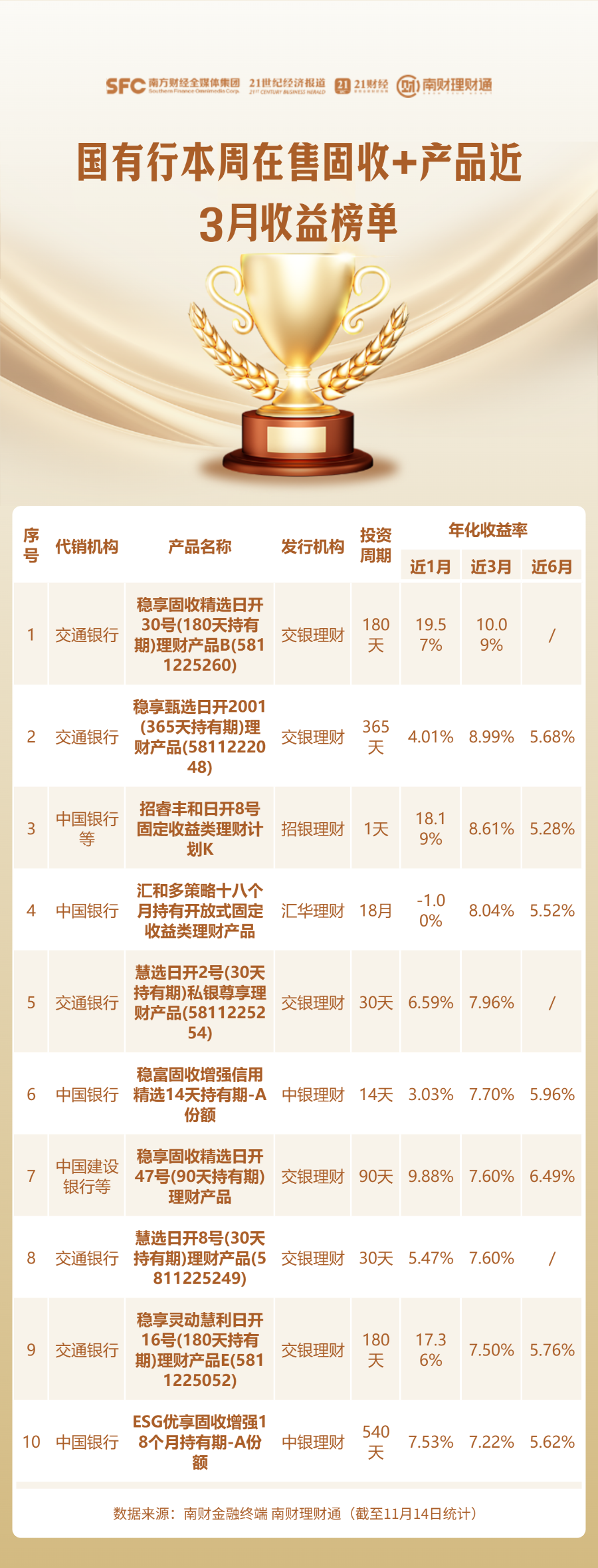
Core Viewpoint - The article emphasizes the importance of selecting suitable wealth management products, particularly "fixed income+" products, from various banks, highlighting the need for investors to discern among numerous similar offerings [1][5]. Summary by Category Performance Ranking - The article presents a performance ranking of wealth management products based on their annualized returns over the past month, three months, and six months, with a focus on the three-month annualized yield for recent market performance [1][5]. Institutions Involved - A total of 28 banks are involved in the distribution of these wealth management products, including major institutions such as Industrial and Commercial Bank of China, Bank of China, Agricultural Bank of China, and others [1]. Product Selection - The ranking aims to assist investors in identifying high-performing products, with specific attention to the "fixed income+" category, which has gained popularity among investors seeking stable returns [1][5]. Market Dynamics - The article notes that the availability of these products may vary due to factors such as sold-out quotas or differences in product listings across banks, suggesting that investors should verify product availability through the respective bank's app [1].





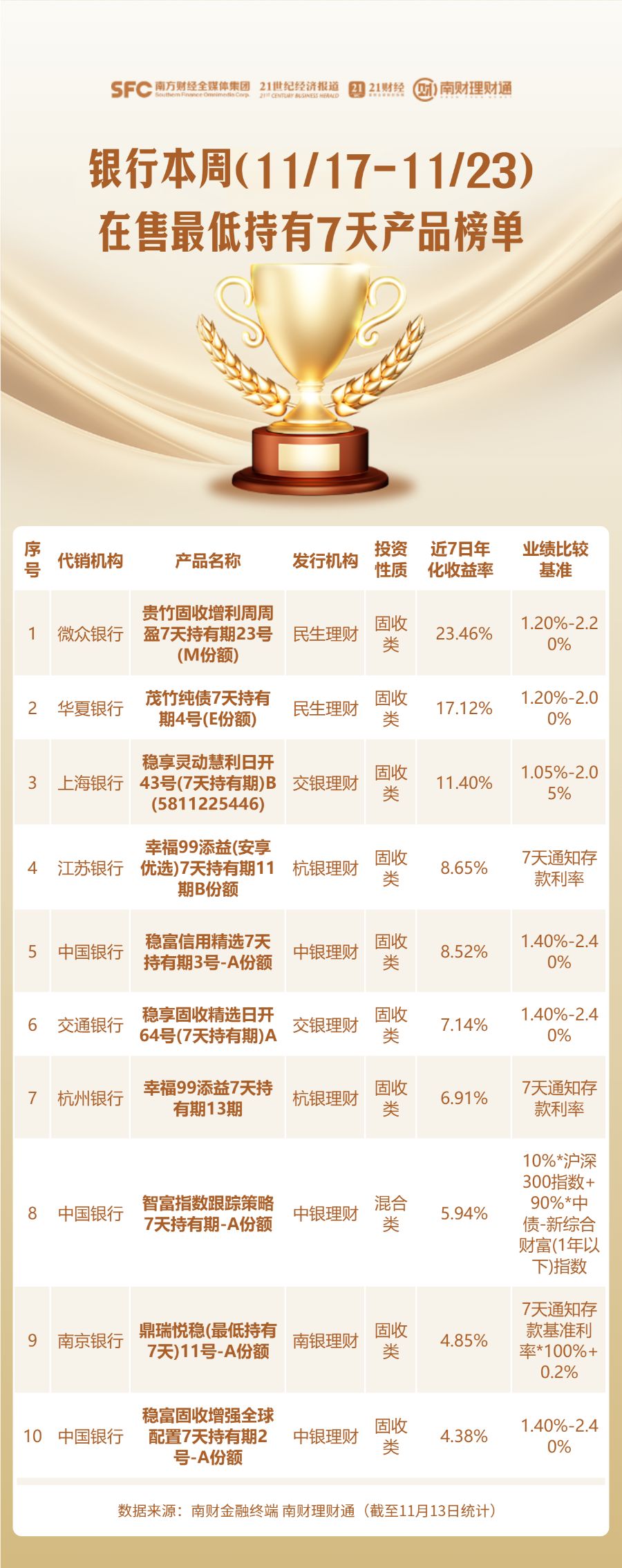
最低持有期榜单出炉!互联网银行7天持有期代销产品收益最高
2 1 Shi Ji Jing Ji Bao Dao· 2025-11-17 01:20
Core Insights - The article focuses on the performance of bank wealth management products with varying minimum holding periods, aiming to help investors identify and select high-performing products [1][5][12] Summary by Category Performance Rankings - The article provides a ranking of wealth management products based on their annualized returns for different holding periods: 7 days, 14 days, 30 days, and 60 days [1][5][12] - For the 7-day holding period, the top-performing product is from Minsheng Bank with an annualized return of 17.12% [4] - For the 14-day holding period, Minsheng Bank's product also leads with a return of 19.88% [6] - In the 30-day category, Minsheng Bank again tops the list with a return of 21.98% [10] - The 60-day holding period shows a leading return of 9.74% from Minsheng Bank [13] Product Categories - The products are categorized into fixed income and mixed types, with specific focus on their respective annualized returns and performance benchmarks [4][10][13] - The rankings are based on data from 28 distribution institutions, including major banks like ICBC, Bank of China, and Agricultural Bank of China [1] Investor Guidance - The article emphasizes the importance of checking the actual availability of products on bank apps, as some may be sold out or not displayed uniformly across different clients [1] - It aims to reduce the selection cost for investors by providing a clear performance overview of available products [1][5]
恒生电子中标:上海银行2025-2028年度基金代销(FSB)系统维保及零星需求开发人天服务采购采购信息公示
Sou Hu Cai Jing· 2025-11-15 03:56
Group 1 - The core point of the article is that Hengsheng Electronics Co., Ltd. has won the bid for the maintenance and development services of the Shanghai Bank's fund distribution system for the years 2025-2028 [1][3] - The procurement announcement was made by the Shanghai Bank's General Procurement Center on November 12, 2025 [3] - Hengsheng Electronics has invested in 132 companies and participated in 6,836 bidding projects, indicating its active engagement in the market [1] Group 2 - The company holds 910 trademark registrations, 537 patents, and 1,135 copyright registrations, showcasing its strong intellectual property portfolio [1] - Additionally, Hengsheng Electronics has obtained 243 administrative licenses, reflecting its compliance and operational capabilities [1]

瑞丰银行、郑州银行等多家银行撤销监事会获监管核准
2 1 Shi Ji Jing Ji Bao Dao· 2025-11-14 10:33
Core Viewpoint - The recent approval by regulatory authorities for banks to abolish their supervisory boards and transfer their functions to the audit committee of the board is a significant shift in corporate governance within the banking sector in China [1][2][3] Group 1: Regulatory Changes - Over ten banks have announced the approval to abolish their supervisory boards, including prominent banks such as Wuxi Rural Commercial Bank, Changshu Bank, Zhengzhou Bank, and Shanghai Bank [1] - The new Company Law, effective from July 1, 2024, allows joint-stock companies to establish an audit committee composed of directors to perform the functions of the supervisory board, eliminating the need for a supervisory board [2] - The National Financial Supervision Administration's notification in December 2025 further clarifies that financial institutions can set up an audit committee in accordance with their articles of association, thereby not requiring a supervisory board [2] Group 2: Historical Context and Implications - The supervisory board system was introduced in the 1990s in China's banking sector, modeled after the German system, to establish an independent supervisory layer [3] - The original intent of the supervisory board was to act as a supervisor in corporate governance, ensuring compliance and asset safety, but it has often struggled to fulfill this role effectively [3] - The transition to an audit committee, typically composed of directors with financial and risk management backgrounds, is expected to enhance governance efficiency by integrating supervisory functions into the decision-making core of the board [3]