
PICC(601319)

Search documents
青海监管局同意中国人保财险 西堡镇营销服务部变更营业场所
Jin Tou Wang· 2025-08-08 04:01
2025年7月31日,青海金融监管局发布批复称,《关于中国人民财产保险股份有限公司西宁市湟中支公 司西堡镇营销服务部变更营业场所的请示》(宁人保财险发〔2025〕39号)收悉。经审核,现批复如 下: 二、中国人民财产保险股份有限公司应按照有关规定及时办理变更及许可证换领事宜。 一、同意中国人民财产保险股份有限公司西堡镇营销服务部将营业场所变更为:青海省西宁市湟中区多 巴镇新墩村407号。 ...

涪陵监管分局同意中国人保财险涪陵支公司新妙营销服务部变更营业场所
Jin Tou Wang· 2025-08-08 03:29
Core Points - The National Financial Supervision Administration of Fuling approved the request from China People's Property Insurance Company Limited Chongqing Branch regarding the relocation of its Fuling Sub-branch's Xinmiao Marketing Service Department [1] Summary by Sections - Approval of Relocation: The approval allows the Xinmiao Marketing Service Department to change its business location to specific addresses in Fuling District, Chongqing [1] - Compliance Requirement: China People's Property Insurance Company is required to handle the change and obtain the necessary permits in accordance with relevant regulations [1]
立体化网络构建专业化保障
Jin Rong Shi Bao· 2025-08-08 02:29
Group 1 - The 12th World Games, also known as Chengdu World Games, opened on August 7, with over 4,000 athletes from more than 100 countries and regions participating [1] - China Pacific Insurance (601319) is the official insurance partner for the Chengdu World Games, providing comprehensive risk management services [1] - The company promises seamless protection and zero-delay claims during the event, aiming to present a vibrant sports festival to the world [1] Group 2 - A service team from China Pacific Insurance was deployed on August 2 to begin practical training and ensure effective event support [2] - The company formed a "Pioneer Team" of over a hundred members to meet the highest service standards, focusing on accurate responses to inquiries, efficient claims processing, and seamless foreign communication [2] - Specialized training and drills were conducted in collaboration with the event's organizing committee, covering insurance service, emergency response, and event rules [2] Group 3 - China Pacific Insurance developed a customized three-tier insurance plan to cover personal safety, public liability, and operational risks for the event, ensuring adequate coverage and precise responsibility [3] - A dedicated insurance center was established for resource coordination, with 33 specialized claims vehicles ensuring full coverage across 27 competition venues and the athletes' village [3] - Medical claims specialists were stationed at designated hospitals to streamline the medical claims process, enhancing service convenience [3] Group 4 - The company utilizes intelligent risk control technology to enhance service efficiency, conducting comprehensive safety assessments across all venues [4] - A bilingual service window was set up to assist athletes with insurance inquiries, claims, and other services in multiple languages [4] - The claims team has undergone specialized training, achieving a 100% proficiency rate in skills necessary for effective event support [4]
“红包雨”来了!A股五大上市险企去年分红落袋
Guo Ji Jin Rong Bao· 2025-08-07 14:36
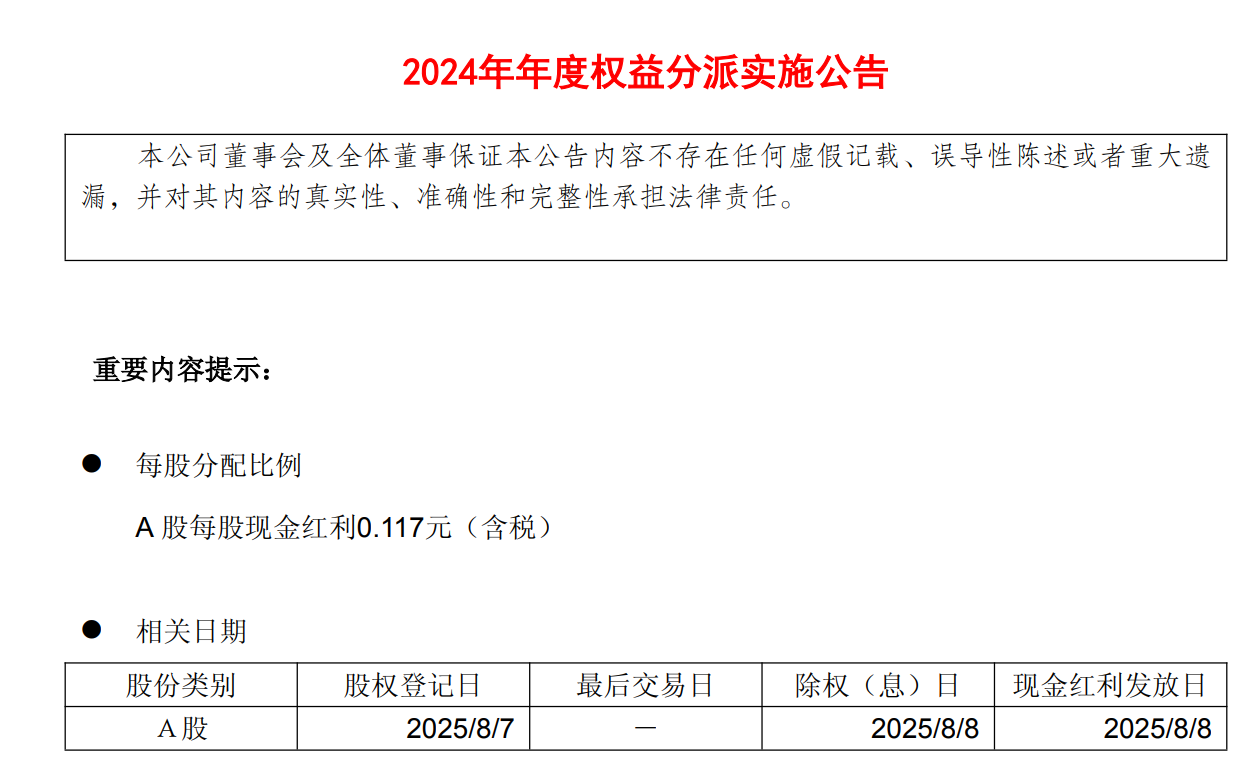
Core Viewpoint - The five major listed insurance companies in A-shares are set to distribute cash dividends for the year 2024, with total dividends exceeding 900 billion yuan, reflecting a significant increase in shareholder returns [1][2][3] Dividend Distribution - China Life and New China Life have announced their dividend plans, with New China Life distributing 1.99 yuan per share, totaling 62.08 billion yuan, and China Life distributing 0.117 yuan per share, totaling 51.74 billion yuan [2] - The total cash dividends for the five major listed insurance companies in A-shares for 2024 amount to 638.26 billion yuan, with a cumulative total of 907.89 billion yuan when including previously distributed dividends, marking a year-on-year increase of 20.21% [3] Market Performance - The insurance sector in A-shares has shown strong performance, with the sector index rising over 11% as of August 6, 2023, and New China Life leading with a 36.82% increase [4] - Analysts believe there is still significant upward potential for insurance stock valuations, driven by economic recovery and improvements in both liability and investment sides [4] Premium Income - For the first half of the year, New China Life reported premium income of 121.26 billion yuan, a year-on-year increase of 23%, while China Pacific Insurance reported premium income of 282.01 billion yuan, a 5.9% increase [5]




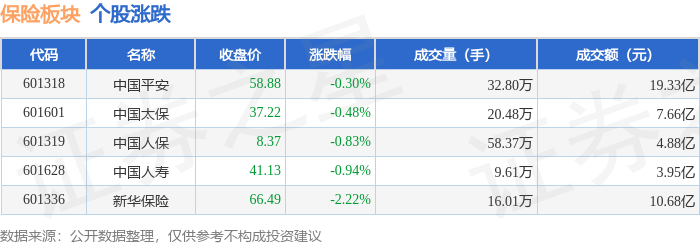
保险板块8月7日跌0.77%,新华保险领跌,主力资金净流出3039.84万元
Zheng Xing Xing Ye Ri Bao· 2025-08-07 08:27
证券之星消息,8月7日保险板块较上一交易日下跌0.77%,新华保险领跌。当日上证指数报收于 3639.67,上涨0.16%。深证成指报收于11157.94,下跌0.18%。保险板块个股涨跌见下表: | 代码 | 名称 | 收盘价 | 涨跌幅 | 成交量(手) | 成交额(元) | | | --- | --- | --- | --- | --- | --- | --- | | 601318 | 中国平安 | 58.88 | -0.30% | 32.80万 | | 19.33 Z | | 601601 | 中国太保 | 37.22 | -0.48% | 20.48万 | | 7.66亿 | | 61319 | 中国人保 | 8.37 | -0.83% | 58.37万 | | 4.88亿 | | 601628 | 中国人寿 | 41.13 | -0.94% | 9.61万 | | 3.95亿 | | 601336 | 新华保险 | 66.49 | -2.22% | 16.01万 | | 10.68亿 | | 代码 | 名称 | 主力净流入 (元) | 主力净占比 游资净流入 (元) | | 游资净占比 散户净流入 ...

中国人保护航成都世运会
Zheng Quan Ri Bao Wang· 2025-08-07 06:45
在世运会执委会保障部指导下,中国人保聚焦赛事规则、保险服务、应急处置三大维度开展专业培训和 实战演练,系统覆盖体育赛事特约条款解析、标准化理赔流程、重大案件应急响应及涉外服务能力提升 等核心领域,确保赛会期间各类保险理赔工作高效、规范、有序进行。 据介绍,中国人保选拔上百人组成"世运会保险服务先锋队",参照赛事最高服务标准开展岗位大练兵, 确保实现"常见咨询精准应答、理赔服务高效处置、涉外沟通全无障碍"三大核心目标。在27个比赛场馆 和世运村内,服务团队已全员到位,随时准备为来自全球各地的运动员提供保险咨询、投保、理赔等各 项服务。 世运会期间,中国人保将依托专业化团队、标准化流程、数字化工具,为赛会筑起风险防控屏障,全力 以赴兑现"无缝隙保障、零延误理赔"的承诺。 本报讯 (记者冷翠华)8月7日至8月17日,2025年第12届世界运动会(简称"成都世运会")在四川成都 举行。中国人保(601319)世运服务队日前正式进驻世运会各竞赛场馆及世运村,标志着中国人保作为 官方合作伙伴,全面开启赛时保障服务的"实战化"阶段。 为践行"简约、安全、精彩"的办赛要求,中国人保组织专业风险减量专家团队,运用"保险+风险减 ...
两家险企分红,派发红利超百亿元
Huan Qiu Wang· 2025-08-07 04:45
Group 1 - The insurance industry reported a total asset of 39.22 trillion yuan in the first half of 2025, reflecting a year-on-year growth of 16.05% [2] - The original insurance premium income reached 3.74 trillion yuan, with a year-on-year increase of 5.31% [2] - The life insurance sector generated original premium income of 2.96 trillion yuan, up by 5.64%, while the property insurance sector saw a premium income of 774.4 billion yuan, growing by 4.06% [2] Group 2 - Insurance stocks have shown strong performance in the capital market, with the insurance index rising over 11% as of August 6 [3] - Xinhua Insurance led the gains among major listed insurance companies, with a remarkable increase of 36.82% [3] - Current valuations of listed insurance companies are within the range of 12.7% to 53.3% since 2012, with China Pacific Insurance being relatively undervalued [3] Group 3 - The adjustment of the upper limit of the life insurance interest rate is expected to help insurance companies mitigate long-term interest spread loss risks in a low-interest environment [3] - The transformation towards participating insurance is seen as a trend in the industry, with leading insurance companies likely to benefit more [3] - The development of participating insurance is viewed as a positive cycle that optimizes liability structure, enhances investment capability, and stabilizes the capital market [3]
C 位之争:传统保险公司线上平台如何守住阵地?
Zhong Guo Chan Ye Jing Ji Xin Xi Wang· 2025-08-07 00:15
Core Insights - The traditional insurance companies' online channels are facing significant competition from internet insurance intermediaries, which are growing at a faster rate in terms of purchase rates [2][3] - Despite traditional insurers' advantages in brand credibility and customer base, they must adapt and learn from the strategies of internet insurance platforms to maintain competitiveness [3][4] Group 1: Market Dynamics - Internet insurance intermediaries have increased their purchase rates by 20 percentage points from 2023 to 2024, significantly outpacing the 11 percentage point growth of traditional insurers' online channels [2] - Traditional insurers have relied on their established networks and authority but are now challenged by the more agile and innovative approaches of internet platforms [2][3] Group 2: Competitive Advantages - Traditional insurers like China Life and Ping An benefit from strong brand recognition, which helps reduce customer acquisition costs and creates scale effects [3] - China Life's app has surpassed 50 million downloads in 2024, showcasing the positive impact of brand effect on user engagement [3] Group 3: Strategic Recommendations - Traditional insurers need to transform their online channels from passive customer acquisition to proactive engagement through social media and targeted marketing [2][3] - China Life has initiated various product differentiation strategies, including tailored services for new citizens and specific insurance products, but still lacks in brand awareness compared to successful intermediary products [4] - The company should enhance its product branding and marketing strategies to improve market recognition and competitiveness [4] Group 4: Service and Technology Integration - China Life's app has implemented features like intelligent customer service and expert consultations to address complex insurance terms and improve user decision-making [4] - The company is also working on integrating online and offline services, such as an "online business hall" for traditional services and localized service areas [5] - A comprehensive strategic overhaul is necessary for traditional insurers to evolve into customer-centric insurance service centers, ensuring long-term viability in the internet insurance era [5]
人保、新华派息超百亿元 五大险企“现金红包” 陆续到账
Zhong Guo Zheng Quan Bao· 2025-08-06 22:10
Group 1 - China Pacific Insurance and New China Life Insurance announced their 2024 annual A-share dividend distribution, with a total payout exceeding 10 billion yuan, scheduled for August 8 [1][2] - The cumulative dividend for the five major listed insurance companies in 2024 is 90.789 billion yuan, representing a year-on-year increase of over 20% [2][3] - The life insurance product interest rate will be lowered in September, which is expected to reduce the cost of liabilities for insurance companies and alleviate pressure from interest margin losses, potentially driving a recovery in insurance stock valuations [1][3] Group 2 - The insurance industry reported total assets of 39.22 trillion yuan in the first half of 2025, a year-on-year increase of 16.05%, with original insurance premium income reaching 3.74 trillion yuan, up 5.31% [3][4] - The life insurance sector saw original premium income of 2.96 trillion yuan, growing by 5.64%, while the property insurance sector reported 774.4 billion yuan, an increase of 4.06% [3][4] - Several insurance companies reported positive operating results for the first half of 2025, with significant growth in total assets and premium income [4] Group 3 - The insurance index has risen over 11% year-to-date as of August 6, with New China Life Insurance leading the gains at 36.82% [5] - Analysts believe that the upcoming reduction in life insurance product interest rates will help insurance companies lower their liability costs, alleviating pressure from interest margin losses and providing upward potential for stock valuations [5][6] - The maximum interest rate for ordinary life insurance products will be adjusted to 2.0%, while the maximum for participating insurance products will be set at 1.75% [6]
人保、新华派息超百亿元 五大险企“现金红包”陆续到账
Zhong Guo Zheng Quan Bao· 2025-08-06 21:09
Group 1 - The core viewpoint of the articles highlights that the five major listed insurance companies in China will complete their 2024 annual dividend distribution, with a total dividend amount exceeding 90.79 billion yuan, representing a year-on-year increase of over 20% [1][2] - China Life Group reported a year-on-year revenue growth of 8.4% for the first half of 2025, with total assets surpassing 8 trillion yuan, while China Pacific Insurance and China Insurance also reported significant asset growth [3] - The insurance industry saw a total asset increase of 16.05% year-on-year, with original insurance premium income reaching 3.74 trillion yuan, a growth of 5.31% [2][3] Group 2 - The adjustment of the predetermined interest rate for personal insurance products is expected to reduce the cost of liabilities for insurance companies, alleviating pressure from interest rate differentials and driving valuation recovery for insurance stocks [1][4] - The insurance sector has shown positive performance in the first half of the year, with significant growth in premium income driven by factors such as declining bank interest rates and increased sales of insurance savings products [2][3] - The insurance stock index has risen over 11% year-to-date, with individual stocks like New China Life Insurance seeing a remarkable increase of 36.82% [3]