PICC(601319)

Search documents
越来越多的人跑去香港买保险
吴晓波频道· 2026-01-26 00:29
Core Viewpoint - The insurance sector is becoming increasingly attractive to investors, with significant growth in both the A-share market and the Hong Kong insurance market, driven by lower interest rates and a shift of capital from traditional savings to higher-yielding insurance products [3][4][5]. Group 1: Insurance Market Performance - As of January 25, 2026, the A-share market's three-year return is 31.01%, while the insurance industry index has achieved a return of 51.75% [4]. - In the first three quarters of 2025, the five major listed insurance companies in A-shares reported a total net profit of 426 billion yuan, marking a year-on-year increase of 33.5% [5]. - Major insurance companies such as China Life and Ping An have shown substantial growth in both revenue and net profit, with China Life's net profit increasing by 60.5% year-on-year [6]. Group 2: Hong Kong Insurance Market Dynamics - The Hong Kong insurance market has seen a surge in mainland Chinese investors, with 50.5% year-on-year growth in new policy premiums in the first half of 2025, and 29% of new policies purchased by mainland visitors [10]. - Hong Kong's insurance products offer greater flexibility and higher investment returns compared to mainland products, attracting more sophisticated mainland investors [10][11]. - The majority of new policies in Hong Kong are denominated in US dollars (79.8%), highlighting the preference for foreign currency products among investors [12]. Group 3: Investment Opportunities in Hong Kong Insurance - Hong Kong's dividend insurance products have a much higher expected return compared to mainland products, with potential returns reaching 4%-6% over 30 years [20][21]. - The advantages of Hong Kong's critical illness insurance include higher leverage, multiple payout options, and broader coverage compared to mainland offerings [26][30]. - Innovative financial strategies, such as leveraging loans to invest in high-yield insurance products, are being explored by investors, although they carry significant risks [32][33]. Group 4: Broader Investment Trends - The Hong Kong stock market is becoming a preferred destination for mainland companies, with a record IPO financing amount of 286.3 billion HKD in 2025, indicating a robust market environment [34][35]. - The average daily trading volume in the Hong Kong stock market increased by 90% in 2025, reflecting heightened investor interest and market activity [38]. - The Hang Seng Index rose by 25.77% in 2025, showcasing strong performance amid favorable market conditions [39]. Group 5: Strategic Importance of Hong Kong - Nearly 80% of mainland enterprises are choosing Hong Kong as their global expansion starting point, benefiting from its financial services and strategic location [42]. - Hong Kong's unique position as a free trade port allows for flexible currency transactions, making it an attractive option for businesses looking to mitigate exchange rate risks [43]. - The presence of a large pool of professional service providers in Hong Kong supports mainland companies in navigating international markets effectively [46].





24%高息产品被叫停,两大平台业务关停退场
21世纪经济报道· 2026-01-25 12:52
Core Viewpoint - The recent regulatory changes in the small loan sector have led to significant disruptions in the credit guarantee insurance business, with major players like Dadi Insurance and Sunshine Insurance halting their financing guarantee services due to increased compliance pressures and risk management challenges [1][5][13]. Group 1: Regulatory Changes and Business Impact - The annualized interest rate cap for small loans has been set at 24%, leading to the cessation of products exceeding this rate [1][9]. - Dadi Insurance and Sunshine Insurance have announced the closure of their financing guarantee business, with Dadi stopping new business from the end of 2025 and Sunshine closing its related offline outlets and systems [1][4]. - The financing guarantee insurance business, which previously accounted for over 90% of the credit guarantee insurance market, is experiencing a significant contraction due to stricter regulations and the need for strategic focus [5][7][10]. Group 2: Industry Trends and Player Responses - Major players in the credit guarantee insurance sector, including Dadi and Sunshine, are not alone in their exit; other companies like Pacific Insurance have also withdrawn from this business segment [7][8]. - The industry has seen a clear trend of consolidation, with leading firms focusing on lower-risk insurance products such as health and auto insurance, while scaling back on high-risk financing guarantee services [8][12]. - The shift in focus is driven by the need to optimize resources and reduce capital occupation associated with high-risk financing guarantee insurance [8][14]. Group 3: Market Dynamics and Future Outlook - The financing guarantee insurance business is fundamentally linked to credit risk, which has been exacerbated by economic fluctuations and rising default rates among borrowers [8][14]. - The tightening of regulations is expected to reshape the credit landscape, leading to a potential consolidation of smaller players and a focus on high-quality borrowers [15][16]. - The overall impact of these regulatory changes is anticipated to lead to a more sustainable credit environment, aligning with the needs of the real economy [15].

非银金融行业周报:4Q25非银板块边际迎来显著增配,业绩快报释放高增长信号-20260125
Shenwan Hongyuan Securities· 2026-01-25 08:11
Investment Rating - The report indicates a positive outlook for the brokerage sector, suggesting that it is currently in a phase of fundamental and valuation mismatch, with expectations for improvement in the first half of the year [2][6]. Core Insights - The brokerage sector has seen a significant increase in allocation by active equity funds, with a quarter-over-quarter increase of 102 basis points, surpassing the three-year average [2]. - The report highlights strong earnings forecasts for 2025, with notable increases in net profits for several brokerages, including a projected 405.3% increase for Guolian Minsheng [2][16]. - The insurance sector is expected to stabilize, with a forecasted recovery in the predetermined interest rate for life insurance products, anticipated to rise to 1.96% in Q1 2026 [2][28]. Summary by Sections Market Review - The Shanghai Composite Index closed at 4,702.50 with a decline of 0.62%, while the non-bank index fell by 1.45% [6]. - The brokerage, insurance, and diversified financial indices reported changes of -0.61%, -4.02%, and +3.10%, respectively [6]. Non-Banking Sector Insights - The report notes that the China Securities Regulatory Commission has introduced new guidelines for performance benchmarks for publicly offered securities investment funds, aiming to enhance transparency and accountability [8][10]. - Key announcements from individual companies include China Pacific Insurance reporting an 8.1% increase in premium income for 2025, and Guolian Minsheng forecasting a significant profit increase due to business integration [12][16]. Investment Analysis Recommendations - For brokerages, the report recommends focusing on firms with strong competitive positions, such as Guotai Junan and Citic Securities, as well as those with high earnings elasticity like Huatai Securities [2]. - In the insurance sector, the report maintains a positive medium-term outlook, recommending companies like China Life and Ping An Insurance [2]. Key Data Tracking - As of January 23, 2026, the average daily trading volume was reported at 30,388.36 billion [32]. - The margin trading balance stood at 27,249.13 billion [38].




保险Ⅱ行业点评报告:政策引导+行协牵头,保险业布局康养领域进程再加速
Soochow Securities· 2026-01-24 02:20
Investment Rating - The report maintains an "Overweight" rating for the insurance industry [1] Core Insights - The insurance industry is accelerating its layout in the health and wellness sector, driven by policy guidance and industry association leadership [1] - The average annual compound growth rate of commercial health insurance has exceeded 20% over the past decade, with over 11,000 medical insurance products currently available [4] - The report anticipates that insurance institutions will further accelerate their investments in the health and wellness sector, leveraging policy support to create a second growth curve through the "insurance products + health services" model [4] Industry Trends - The China Insurance Industry Association held a seminar focusing on the high-quality development of commercial health insurance, discussing the integration of commercial insurance with the medical field [4] - The Shanghai Financial Regulatory Bureau has released a plan for the high-quality development of pension finance, proposing 20 measures to support the pension industry [4] - Major insurance companies are establishing specialized health management subsidiaries to build a comprehensive health and wellness service ecosystem [4] Financial Performance - The report indicates that both the liability and asset sides of the insurance companies are continuously improving, with significant upward valuation potential [4] - The market demand remains strong, and the reduction in the preset interest rate along with the transformation of participating insurance will optimize liability costs [4] - As of January 23, 2026, the insurance sector's valuation is projected at 0.61-0.83 times PEV and 1.10-2.19 times PB, which is at a historical low [4]


中国人民保险集团(01339.HK):1月23日南向资金减持24万股
Sou Hu Cai Jing· 2026-01-23 19:24
Group 1 - The core point of the article highlights that southbound funds have reduced their holdings in China People's Insurance Group (01339.HK) by 240,000 shares on January 23, with a total net reduction of 6.6355 million shares over the last five trading days and 77.7542 million shares over the last 20 trading days [1] - As of now, southbound funds hold 2.55 billion shares of China People's Insurance Group, accounting for 29.22% of the company's total issued ordinary shares [1] Group 2 - China People's Insurance Group Co., Ltd. is a holding company primarily providing insurance products, including property insurance, health insurance, life insurance, reinsurance, Hong Kong insurance, and pension insurance [1] - The property insurance business includes products for both companies and individuals, such as motor vehicle insurance, agricultural insurance, property insurance, and liability insurance [1] - The health insurance business focuses on health and medical insurance products, while the life insurance business includes various life insurance products such as participating, whole life, annuity, and universal life insurance [1] - The Hong Kong insurance business encompasses property insurance operations in Hong Kong, and the pension insurance business includes corporate annuities and occupational annuities [1]

拒收现金?央行点名:罚!
Sou Hu Cai Jing· 2026-01-23 14:03
Core Viewpoint - The People's Bank of China has imposed economic penalties on two entities for refusing to accept cash payments, emphasizing the importance of respecting consumer payment choices and maintaining the legal status of the Renminbi [1] Group 1: Penalties Imposed - Jiangsu Urban Space Operation Management Co., Ltd. received a warning and a fine of 20,000 yuan for refusing cash payments for parking fees, with the responsible manager fined 2,000 yuan [1] - China Pacific Insurance Co., Ltd. Ningbo Beilun Branch was fined 30,000 yuan for refusing cash payments for insurance services, with the responsible manager fined 8,000 yuan [1] Group 2: Regulatory Intent - The People's Bank of China aims to strengthen legal awareness among businesses and promote a harmonious cash circulation environment [1] - Ongoing efforts will be made to address the refusal of cash payments to protect consumer rights and uphold the legal status of the Renminbi [1]
保险板块1月23日跌1.95%,中国太保领跌,主力资金净流出2.49亿元
Zheng Xing Xing Ye Ri Bao· 2026-01-23 09:04
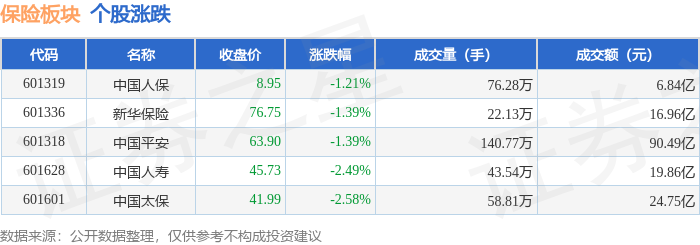
Core Viewpoint - The insurance sector experienced a decline of 1.95% on January 23, with China Pacific Insurance leading the drop, while the overall market indices showed slight gains [1]. Group 1: Market Performance - The Shanghai Composite Index closed at 4136.16, up 0.33% [1]. - The Shenzhen Component Index closed at 14439.66, up 0.79% [1]. Group 2: Individual Stock Performance - China Life Insurance (601628) closed at 45.73, down 2.49% with a trading volume of 435,400 shares [1]. - China Pacific Insurance (601601) closed at 41.99, down 2.58% with a trading volume of 588,100 shares [1]. - China Ping An (601318) closed at 63.90, down 1.39% with a trading volume of 1,407,700 shares [1]. - New China Life Insurance (601336) closed at 76.75, down 1.39% with a trading volume of 221,300 shares [1]. - China Reinsurance (601319) closed at 8.95, down 1.21% with a trading volume of 762,800 shares [1]. Group 3: Capital Flow Analysis - The insurance sector saw a net outflow of 249 million yuan from institutional investors and 278 million yuan from retail investors, while retail investors had a net inflow of 527 million yuan [1]. - China Life Insurance had a net inflow of 126 million yuan from institutional investors, but a net outflow of 124 million yuan from retail investors [2]. - China Pacific Insurance had a net inflow of 112 million yuan from institutional investors, with a net outflow of 1.42 million yuan from retail investors [2]. - China Ping An experienced a significant net outflow of 546 million yuan from institutional investors [2].
国信证券:新能源车险长期增长空间与战略价值明确 传统龙头更有望享受超额成长
智通财经网· 2026-01-23 07:54
Core Viewpoint - The new energy vehicle insurance sector is transitioning from initial rapid growth to a high-quality competitive stage centered on technology and ecology, with clear long-term growth potential despite short-term profitability pressures [1] Group 1: Industry Cycle and Growth - The new energy vehicle insurance market in China has entered a "golden development period" characterized by simultaneous increases in volume and price, driven by national strategies and policy incentives [2] - By 2024, the sales of new energy vehicles are expected to account for 40.9% of total new car sales, with retail penetration nearing 50%, significantly outpacing traditional fuel vehicles [2] - The penetration of Advanced Driver Assistance Systems (ADAS) exceeding 50% and the adoption of Usage-Based Insurance (UBI) are reshaping risk management and pricing logic in the insurance industry [2] Group 2: Challenges and Cost Pressures - The high growth in new energy vehicle insurance is accompanied by significant "high cost, high claim" pressures, stemming from the fundamental differences in risk structure between new energy vehicles and traditional fuel vehicles [3] - The costs associated with the "three electric systems" (battery, motor, and electronic control) are high, and the complexity of accident liability due to smart components leads to increased claim frequency [3] - The industry is projected to face an underwriting loss of 5.7 billion yuan in 2024, highlighting the mismatch between traditional insurance models and the structural characteristics of new energy vehicles [3] Group 3: Industry Profitability Model and Competitive Barriers - The profitability model of the industry needs reconstruction, focusing on risk reduction, ecological integration, and international standardization to build competitive barriers [4] - Leading insurance companies, represented by the "old three" (Ping An, PICC, and China Life), are developing risk reduction services to enhance risk management and optimize operational efficiency [4] - Strategic collaborations between insurance companies and manufacturers are evolving from zero-sum games to symbiotic relationships, addressing data silos and repair cost challenges [4] - Chinese insurance companies are expanding internationally, leveraging domestic data and risk management capabilities to support the global expansion of local new energy vehicle brands [4]

央行对两家拒收人民币现金单位作出处罚
Jin Rong Shi Bao· 2026-01-23 01:32
Core Viewpoint - The People's Bank of China has imposed economic penalties on two entities for refusing to accept cash payments, emphasizing the importance of cash as a legal tender and its role in supporting the real economy and financial stability [1][3]. Group 1: Penalties Imposed - Jiangsu Urban Space Operation Management Co., Ltd. received a warning and a fine of 20,000 yuan for refusing cash payments for parking fees, with the responsible manager fined 2,000 yuan [1]. - China Pacific Insurance Co., Ltd.'s Ningbo Beilun branch was fined 30,000 yuan for refusing cash payments for insurance services, with the responsible manager fined 8,000 yuan [1]. Group 2: Regulations on Cash Payments - The newly established "Regulations on Cash Payment and Service" will be implemented to ensure cash payment acceptance in various scenarios, including face-to-face services and online transactions completed offline [2]. - Entities using self-service models must clearly indicate payment methods and cash acceptance policies, while fully respecting the public's right to know and choose payment options [2]. Group 3: Banking Sector Requirements - Financial institutions are required to provide cash deposit and withdrawal services at their branches and ensure that the layout of ATMs meets the needs of different customer groups [3]. - Banks must also manage cash circulation properly to prevent the distribution of unfit currency and support cash acceptance when acting as payment agents [3].
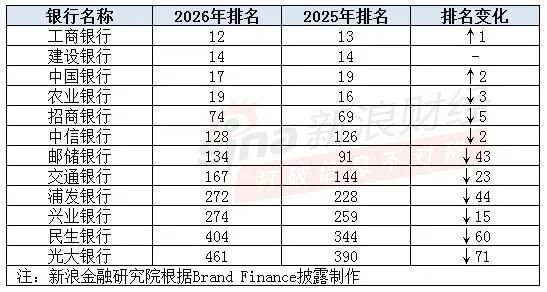
谁能跻身全球品牌价值500强?光大银行下滑71名,民生银行降60名
Xin Lang Cai Jing· 2026-01-23 01:08
Group 1: Core Insights - The Brand Finance 2026 Global Brand Value 500 report was released, highlighting the performance of various banks and insurance companies [1][7] - Chinese brands have shown a double-digit growth in total value, indicating strong resilience and potential for future growth [7] Group 2: Banking Sector Summary - Major Chinese banks included in the ranking are Industrial and Commercial Bank of China (ICBC) at 12th, China Construction Bank at 14th, and Bank of China at 17th, with ICBC holding a brand value of $90.88 billion and a brand strength index of 91.5 [2][3] - China Bank surpassed Agricultural Bank, which dropped to 19th place, while China Merchants Bank ranked 74th as the highest among joint-stock banks [3][4] - Notable declines were observed for China Everbright Bank, which fell 71 places to 461st, and Minsheng Bank, which dropped 60 places to 404th [1][4] Group 3: Insurance Sector Summary - Among the insurance companies, Ping An Insurance ranked 32nd globally, being the only Chinese insurer in the top 100, with a brand strength rating of AAA- [5][6] - Other insurers like China Life and China Pacific Insurance also maintained positions within the top 200, while Prudential Insurance saw a significant drop of 117 places to 350th [5][6] - Notably, Cathay Life Insurance improved its ranking by 180 places to 407th [6] Group 4: Overall Brand Performance - The report indicates that 12 Chinese brands made it to the top 50 globally, with Douyin's brand value increasing by 45.1% to $153.54 billion, ranking 6th [7] - State Grid Corporation achieved a brand value of $102.44 billion, ranking first in the global utility sector, with a 19.6% increase in brand value [8]