BANK COMM(601328)

Search documents
政银企研协同发力 交通银行打造养老金融体系赋能银发经济
Huan Qiu Wang· 2025-11-13 03:23
Core Insights - The conference held on November 8 in Shanghai focused on the integration of pension finance and the silver economy, aiming to enhance the quality of China's pension services through financial support [1][3] Group 1: Conference Overview - The event was co-hosted by the Bank of Communications, the Ministry of Civil Affairs, the Shanghai Pudong New Area Government, and the China Aging Industry Association, emphasizing the theme "New Era of Elderly Care: Collaborative Development of Industry and Finance" [1] - Key discussions included addressing population aging, upgrading the pension industry, and innovating financial services, with a consensus on the development framework of "Policy Guidance - Financial Empowerment - Industry Upgrade" [3] Group 2: Financial Innovations by Bank of Communications - The Bank of Communications introduced the "Jiaoyin Pension" brand and launched the comprehensive service management system for pension funds and the "Pension e-Loan" product, aiming to provide specialized financial solutions for an aging society [4] - The "Jiaoyin Pension" brand is built on the core values of "Stability, Assurance, Warmth, Happiness," establishing a reliable service system through professional financial management and risk control [4] Group 3: Addressing Regulatory Challenges - The "Jiaoyin Pension Fund Comprehensive Service Management System" was developed to enhance the regulation of prepayment fees in pension institutions, ensuring safety, transparency, and efficiency in fund management [5] - The "Pension e-Loan" product addresses financing challenges faced by pension institutions, utilizing a "government-bank cooperation" model to create a specialized risk assessment framework for loan processing [5] Group 4: Strategic Collaborations - Two significant strategic cooperation agreements were signed during the conference, marking a new phase in the collaboration between government and financial institutions to promote the development of the pension industry [6] - The Bank of Communications and the Ministry of Civil Affairs signed an agreement to leverage their respective strengths in policy, resources, and services to enhance financial support for the pension sector [6] - A partnership was also established between the Bank of Communications and the Pudong New Area Government to jointly advance the high-quality development of the pension industry and the silver economy [6]


国有六大行前三季度业绩改善,银行ETF天弘(515290)年内份额增近40%,机构:红利价值持续凸显
2 1 Shi Ji Jing Ji Bao Dao· 2025-11-13 02:38
Group 1 - The bank ETF Tianhong (515290) has seen a year-to-date share growth rate of 39.92%, with the latest scale at 6.291 billion and circulating shares at 4.145 billion [1] - The Hong Kong Stock Connect Central Enterprise Dividend ETF Tianhong (159281) has experienced net inflows for two consecutive trading days, indicating strong investor interest [1] - The performance of the dividend sector, including banks, has been strong, with major banks like Agricultural Bank of China showing significant stock price increases [2] Group 2 - The six major state-owned banks reported double growth in revenue and net profit for the first three quarters of the year, with net profits for major banks ranging from 699.94 million to 2,699.08 million, reflecting a year-on-year growth of 0.33% to 3.03% [2] - The banking sector's performance is supported by stable growth in scale, improved net interest income, and a recovery in non-interest income, with asset quality remaining stable [3] - The policy environment is conducive to optimizing bank credit structures and protecting interest margins, which enhances the growth potential for non-interest income [3]



多家银行上调积存金起点
2 1 Shi Ji Jing Ji Bao Dao· 2025-11-13 00:24
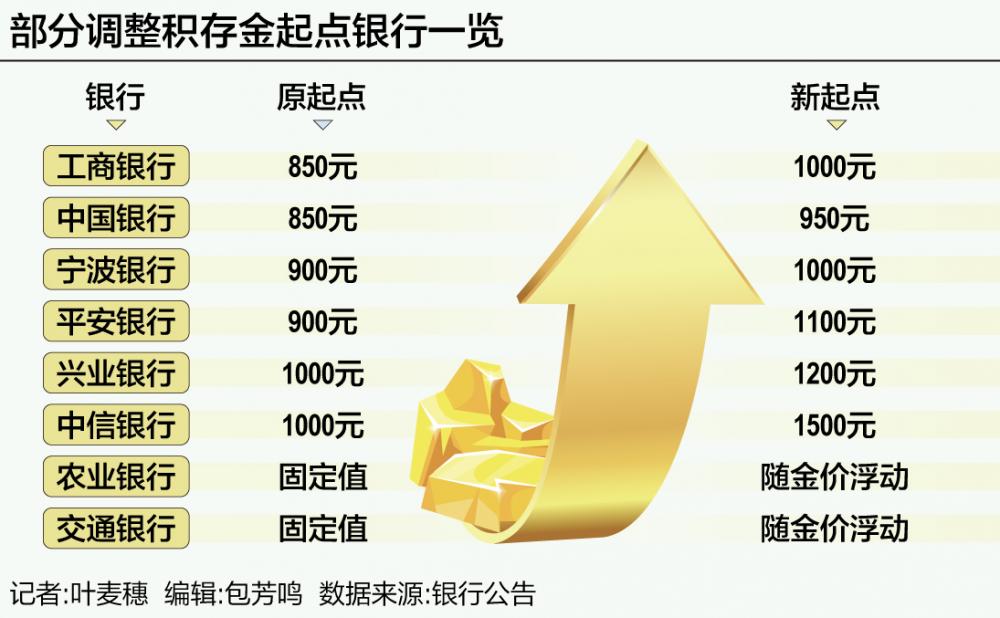
Core Viewpoint - The international gold price has returned to $4100 per ounce, prompting banks to raise the minimum investment threshold for gold accumulation, with some banks adjusting the starting point to a historical high of 1500 yuan [1][3]. Summary by Sections Bank Adjustments - Several banks have raised their gold accumulation thresholds, with notable changes including: - ICBC from 850 yuan to 1000 yuan - Bank of China from 850 yuan to 950 yuan - Ningbo Bank from 900 yuan to 1000 yuan - Ping An Bank from 900 yuan to 1100 yuan - Industrial Bank from 1000 yuan to 1200 yuan - CITIC Bank from 1000 yuan to 1500 yuan - Agricultural Bank and Bank of Communications have switched to a "floating with gold price" mechanism [2][3]. Investment Mechanism Changes - Some banks, like Agricultural Bank and Bank of Communications, have implemented a "floating with gold price" mechanism to avoid frequent adjustments, allowing the minimum investment amount to vary with market prices [4][5]. - This approach aims to provide flexibility for investors and better align with market dynamics [4]. Market Analysis - The gold price has seen significant volatility, with a rise of over 60% this year, peaking above $4300 per ounce before experiencing a sharp decline [6][7]. - Analysts have differing views on future gold prices, with predictions ranging from $3650 to $5000 per ounce by the end of 2026, influenced by various economic factors [7][8]. - The outlook remains optimistic for gold due to factors such as a weakening dollar and inflation risks, which could sustain investment demand [7][8]. Risk Awareness - In response to the volatile gold market, banks and regulatory bodies have increased risk awareness efforts, advising investors to recognize the inherent risks in precious metal investments [5].


交通银行深圳分行深入推进民法典学习宣传,助力营造良好法治环境
Zheng Quan Shi Bao· 2025-11-12 18:31
Core Viewpoint - The Bank of Communications Shenzhen Branch is actively promoting legal education and compliance through innovative initiatives, focusing on the implementation of the Civil Code and enhancing the legal environment for business operations [1][2][4]. Group 1: Legal Education Initiatives - The bank is implementing a special action plan to integrate the Civil Code into enterprises, parks, and factories, providing accessible legal guidance through knowledge handbooks and interactive sessions [2]. - A series of videos and themed comics have been created to broaden the outreach of the Civil Code, emphasizing its principles such as equality, voluntariness, fairness, and integrity [3]. Group 2: Employee Training and Development - The bank places significant importance on the legal education of its employees, organizing lectures by renowned professors and ensuring that legal concepts are deeply understood and integrated into daily operations [4]. - Future plans include continuous innovation in legal education methods and expanding outreach to support high-quality economic and social development [4].
企业出海的金融“神助攻”
Guang Xi Ri Bao· 2025-11-12 16:02
Core Viewpoint - The article highlights the innovative financial services provided by the Guangxi branch of Bank of Communications, which support the international expansion of AI companies in Guangxi, particularly through tailored offshore financing solutions [1] Financial Innovation - The Guangxi branch of Bank of Communications has been recognized for its innovative case in facilitating AI companies' overseas operations by offering a combination of offshore direct loans, foreign exchange hedging, and convenience services [1] - The bank's approach leverages its comprehensive operational advantages in both domestic and foreign currencies, enhancing the financial support for local AI enterprises [1] Case Study: Runjian Co., Ltd. - Runjian Co., Ltd. has successfully utilized the bank's services, receiving a $13.5 million offshore direct loan, which significantly reduced their financing costs by 50 basis points compared to market rates [1] - The bank's financial solutions have enabled Runjian to efficiently convert funds into RMB, addressing their capital needs for international projects [1] Market Engagement - The Guangxi branch actively participates in various facilitation pilot programs initiated by the People's Bank of China and the State Administration of Foreign Exchange, aiming to innovate financial services targeting ASEAN markets [1] - The establishment of the "Hui Xiaer" foreign exchange financial service team in 2024 is part of the bank's strategy to explore new financial business models for AI companies [1] Comprehensive Financial Services - The bank offers a one-stop integrated financial service solution that includes cross-border fund payments, trade settlement financing, exchange rate risk management, and offshore financing, catering to the diverse needs of AI companies [1] - As of September 2025, the Guangxi branch has issued over $1.2 billion in cross-border direct loans, helping 25 local enterprises reduce costs and improve efficiency [1]
有银行积存金起点涨至1500元,为历史最高
2 1 Shi Ji Jing Ji Bao Dao· 2025-11-12 14:28
Core Viewpoint - The international gold price has returned to $4,100 per ounce, prompting banks to raise the minimum investment threshold for gold accumulation, with some banks adjusting the starting point to a historical high of 1,500 yuan [1][5]. Group 1: Bank Adjustments - Citic Bank has raised the minimum investment amount for its gold accumulation plan from 1,000 yuan to 1,500 yuan, effective from November 15 [5]. - Construction Bank has revised its gold accumulation plan, increasing the minimum investment amount from 1,000 yuan to 1,200 yuan, marking the second increase this year [5]. - Several banks, including Agricultural Bank, have adopted a "floating mechanism" for gold accumulation, allowing the minimum investment to adjust according to real-time gold prices [6]. Group 2: Market Dynamics - The gold price has experienced significant volatility, with a rise of over 60% this year, peaking above $4,300 per ounce before a sharp decline [8]. - Analysts predict that while short-term fluctuations may occur due to factors like interest rate expectations and a stronger dollar, the medium-term outlook remains optimistic, with potential for gold prices to reach $4,500 to $5,000 per ounce [8][9]. - The World Gold Council maintains a positive outlook for the gold market, citing factors such as a weakening dollar and inflation risks that could support gold investment demand [8]. Group 3: Institutional Perspectives - Various financial institutions have differing forecasts for gold prices by the end of 2025, ranging from $4,200 to $4,600 per ounce, with long-term views suggesting gold retains its value as a safe-haven asset [9]. - Bank of America highlights that non-traditional policies in the U.S. will continue to favor gold, driven by factors like rising fiscal deficits and inflation [9]. - Citigroup anticipates a potential decline in gold prices to $3,650 per ounce by 2026, arguing that improving economic conditions may reduce gold's appeal as a safe-haven asset [9].

有银行积存金起点涨至1500元,为历史最高
21世纪经济报道· 2025-11-12 13:40
Core Viewpoint - The article discusses the recent adjustments in the minimum investment thresholds for gold accumulation plans by various banks in response to fluctuating international gold prices, which have seen significant volatility this year, particularly after surpassing $4000 per ounce [1][4][8]. Summary by Sections Investment Threshold Adjustments - Several banks, including Citic Bank and China Construction Bank, have raised their minimum investment amounts for gold accumulation plans, with Citic Bank increasing it from 1000 RMB to 1500 RMB, marking the highest threshold in history [4]. - China Construction Bank has also revised its minimum investment amount from 1000 RMB to 1200 RMB, indicating a trend of increasing thresholds across the banking sector [4][5]. Floating Investment Mechanism - To avoid frequent adjustments, some banks, such as Bank of Communications and Agricultural Bank of China, have implemented a "floating" investment mechanism where the minimum investment amount is tied to real-time gold prices [5]. - This approach allows investors to adjust their investment amounts based on market conditions, providing greater flexibility amid price volatility [5]. Market Volatility and Risk Awareness - The article highlights the significant fluctuations in gold prices, with a peak of over $4300 per ounce followed by a drop below $4100, emphasizing the need for investors to be aware of the associated risks [8][9]. - Regulatory bodies and banks are increasing their risk awareness efforts, advising investors to recognize the uncertainties in the gold market [6]. Future Price Predictions - Analysts have differing views on future gold prices, with some predicting a potential rise to $5000 per ounce due to factors like inflation and fiscal policies, while others foresee a decline to around $3650 per ounce as economic conditions improve [9][10]. - The overall sentiment remains optimistic regarding gold's long-term value as a safe-haven asset, despite short-term volatility [9][10].

门槛有点高!有银行积存金起点“三连涨”,最高达到1500元
2 1 Shi Ji Jing Ji Bao Dao· 2025-11-12 11:37
Core Viewpoint - The international gold price has returned to $4,100 per ounce, prompting banks to raise the minimum investment threshold for gold accumulation, with some banks adjusting the starting point to a historical high of 1,500 yuan [1][3] Summary by Sections Investment Threshold Adjustments - On November 11, Citic Bank raised the minimum investment amount for its gold accumulation plan from 1,000 yuan to 1,500 yuan, effective from November 15 [3] - China Construction Bank revised its gold accumulation plan, increasing the minimum investment amount from 1,000 yuan to 1,200 yuan, marking the second increase this year [3] - Other banks, such as Agricultural Bank and Bank of Communications, have also implemented a "floating mechanism" for gold accumulation thresholds, allowing the starting point to adjust with market gold prices [4][5] Market Volatility and Risk Management - The gold price has experienced significant fluctuations, with a rise of over 60% this year, followed by a sharp decline [7] - Regulatory bodies and banks are enhancing risk warnings due to the volatile gold market, urging investors to be aware of potential risks [6] - Analysts suggest that the floating mechanism for investment thresholds allows for better alignment with market changes and provides investors with more flexibility [5] Future Price Predictions - Various institutions predict that gold prices could range from $4,200 to $4,600 per ounce by the end of 2025, with some forecasts suggesting prices could reach as high as $5,000 per ounce [8] - The outlook for gold remains optimistic due to factors such as a weakening dollar and inflation risks, although short-term volatility is expected [7][8]

18.10亿元资金今日流入银行股
Zheng Quan Shi Bao Wang· 2025-11-12 09:28
Market Overview - The Shanghai Composite Index fell by 0.07% on November 12, with 11 sectors rising, led by household appliances and comprehensive sectors, which increased by 1.22% and 1.05% respectively [1] - The banking sector rose by 0.50%, while the power equipment and machinery sectors experienced declines of 2.10% and 1.23% respectively [1] Fund Flow Analysis - The main funds in the two markets saw a net outflow of 58.897 billion yuan, with five sectors experiencing net inflows, led by the pharmaceutical and biological sector, which saw a net inflow of 2.402 billion yuan and a rise of 0.61% [1] - The banking sector had a net inflow of 1.810 billion yuan, with a daily increase of 0.50% [1] Banking Sector Performance - In the banking sector, 42 stocks were tracked, with 26 stocks rising and 12 stocks falling [2] - The top three stocks with the highest net inflow were Agricultural Bank of China (4.56 billion yuan), China Merchants Bank (2.49 billion yuan), and Bank of China (2.14 billion yuan) [2] - The stocks with the highest net outflow included Nanjing Bank (56.415 million yuan), China Construction Bank (38.058 million yuan), and Qingdao Bank (23.4865 million yuan) [2] Individual Stock Performance - Agricultural Bank of China had a daily increase of 3.49% with a turnover rate of 0.16% and a main fund flow of 456.41 million yuan [3] - China Merchants Bank saw a slight decrease of 0.07% with a main fund flow of 249.21 million yuan [3] - Bank of China increased by 1.41% with a main fund flow of 214.05 million yuan [3] Additional Stock Insights - Other notable performers included Industrial and Commercial Bank of China (0.37% increase, 201.69 million yuan flow) and Bank of Communications (0.81% increase, 161.39 million yuan flow) [3] - Several banks experienced negative fund flows, including Xiamen Bank (-73.02 thousand yuan) and Chongqing Bank (-938.65 thousand yuan) [4]


国有大型银行板块11月12日涨1.82%,农业银行领涨,主力资金净流入11.17亿元
Zheng Xing Xing Ye Ri Bao· 2025-11-12 08:44
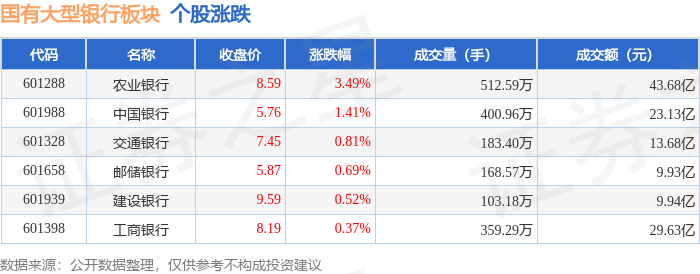
Core Insights - The state-owned large bank sector experienced a rise of 1.82% on November 12, with Agricultural Bank leading the gains [1] - The Shanghai Composite Index closed at 4000.14, down 0.07%, while the Shenzhen Component Index closed at 13240.62, down 0.36% [1] Bank Performance - Agricultural Bank (601288) closed at 8.59, up 3.49% with a trading volume of 5.1259 million shares [1] - Bank of China (601988) closed at 5.76, up 1.41% with a trading volume of 4.0096 million shares [1] - Bank of Communications (601328) closed at 7.45, up 0.81% with a trading volume of 1.8340 million shares [1] - Postal Savings Bank (601658) closed at 5.87, up 0.69% with a trading volume of 1.6857 million shares [1] - China Construction Bank (666109) closed at 9.59, up 0.52% with a trading volume of 1.0318 million shares [1] - Industrial and Commercial Bank (601398) closed at 8.19, up 0.37% with a trading volume of 3.5929 million shares [1] Capital Flow - The state-owned large bank sector saw a net inflow of 1.117 billion yuan from institutional investors, while retail investors experienced a net outflow of 769 million yuan [1] - Agricultural Bank had a net inflow of 506 million yuan from institutional investors, while retail investors had a net outflow of 303 million yuan [2] - Industrial and Commercial Bank had a net inflow of 214 million yuan from institutional investors, with retail investors experiencing a net outflow of 177 million yuan [2] - Bank of China had a net inflow of 203 million yuan from institutional investors, with retail investors seeing a net outflow of 113 million yuan [2] - Bank of Communications had a net inflow of 166 million yuan from institutional investors, while retail investors had a net outflow of 917.7 million yuan [2] - China Construction Bank experienced a net outflow of 22.94 million yuan from institutional investors, but had a net inflow of 606.79 million yuan from speculative funds [2]