
BANK COMM(601328)

Search documents
AI走进指数投资,大模型青睐银行股、“易中天”
Di Yi Cai Jing Zi Xun· 2025-11-12 07:49
Core Insights - The integration of AI technology into the securities industry is accelerating, with a focus on utilizing large language models for investment decision-making and risk management [1][4] - The "Large Model Stable 50" index, launched by GaoHua Securities, has achieved a cumulative return of 23.2% since its inception, outperforming other indices [1][2] - The index primarily includes banking stocks, indicating a preference for stable, dividend-paying companies [2][6] Index Performance - The "Large Model Stable 50" index reached a point of 2007.24, with a monthly increase of 3.75% and a year-to-date increase of 16.8%, reflecting a historical annualized return of 20.5% [2] - The "Large Model New Quality Productivity" index, focusing on sectors like semiconductors and AI, has a year-to-date increase of 41.28% and a historical annualized return of 17.61% [2] - The top ten constituents of the "Large Model Stable 50" index are predominantly banks, with over 40% of the index's weight in the financial sector [2][3] Sector Focus - The "Large Model New Quality Productivity" index has a high concentration of technology stocks, with the top three constituents being New Yi Sheng, Hikvision, and Tianfu Communication [2][3] - The information technology sector comprises over half of the companies in the index, followed by communication services and industrial sectors [3] Investment Themes - The themes of dividends and growth are highlighted as significant for A-share investments, with a noted increase in the popularity of dividend-focused strategies over the past few years [6][7] - The integration of AI in investment strategies is expected to strengthen as the trend of index-based investing continues to grow [4][5] - The use of AI models for portfolio adjustments is based on comprehensive assessments of market data, fundamentals, and sentiment, ensuring a systematic approach to risk management [7]




首破3万亿!A股“市值王”再刷新记录
Ge Long Hui· 2025-11-12 06:53
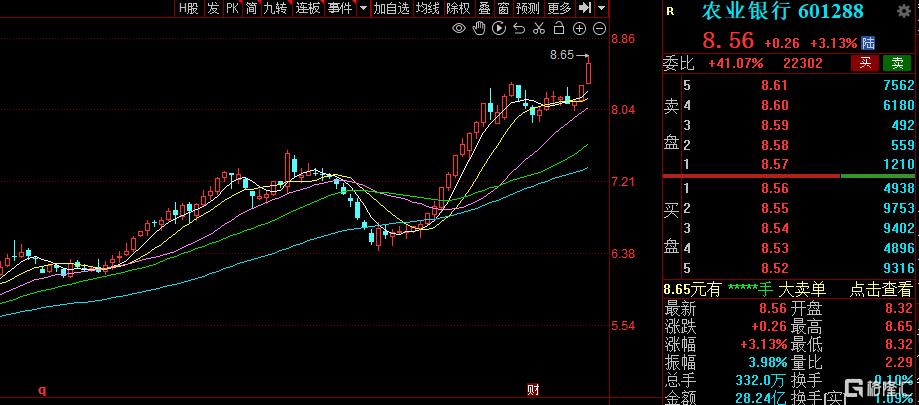
Core Insights - The banking sector showed resilience with Agricultural Bank and Industrial and Commercial Bank reaching historical highs in stock prices, with Agricultural Bank's A-shares up 3.13% to 8.65 yuan and H-shares up nearly 3% to 6.4 HKD, marking year-to-date increases of over 68% and 51% respectively [1][2] - The total market capitalization of Agricultural Bank surpassed 3 trillion yuan [1] Financial Performance - The six major state-owned banks reported a combined operating revenue of 27,205.35 billion yuan for the first three quarters of 2025, reflecting a year-on-year growth of 1.87%, and a net profit of 10,723.43 billion yuan, also up 1.22% year-on-year [5][6] - Agricultural Bank led the net profit growth among the six banks with a year-on-year increase of 3.03%, while other banks showed varying growth rates [5][6] Investment Trends - Insurance capital has increased its holdings in several major banks, with Postal Savings Bank seeing the largest increase in shares, while Industrial and Commercial Bank and Agricultural Bank also saw insurance capital enter their top ten shareholders [8][9] - Analysts suggest that with policy support for long-term capital entering the market, insurance capital is expected to increase its allocation to bank stocks, enhancing their investment value [9]





已有7家银行私银客户超10万户
2 1 Shi Ji Jing Ji Bao Dao· 2025-11-12 05:45
Core Insights - The private banking sector has seen significant growth in the first three quarters of this year, with seven listed banks reporting over 100,000 private banking clients as of September 30, 2023, indicating a rising demand for wealth management services among high-net-worth individuals [2][4][5] Group 1: Growth in Private Banking Clients - Multiple banks reported a client growth rate exceeding 10%, with Minsheng Bank, Beijing Bank, and Nanjing Bank showing increases over 15% [4] - Minsheng Bank had the fastest growth, reaching 73,409 private banking clients, an increase of 18.21% from the end of last year [5] - Beijing Bank reported 20,586 private banking clients, up 17.9%, and an asset under management (AUM) of 224 billion yuan, a 14.39% increase [5][6] Group 2: Market Position of Major Banks - State-owned banks continue to dominate the private banking market, with Agricultural Bank of China leading at 279,000 clients, followed by China Construction Bank and Bank of China [6] - China Merchants Bank and Ping An Bank have also joined the "100,000 club," with Ping An Bank reaching 103,300 clients, marking its first entry into this category [6][7] Group 3: Challenges and Opportunities in Wealth Management - The growth in private banking clients is attributed to the expanding base of high-net-worth individuals and the upgrading of banking services [9] - The Hu Run Wealth Report indicates that the total wealth of China's 6 million affluent families has reached 150 trillion yuan, with ultra-high-net-worth families holding 87 trillion yuan, an increase from 56% to 58% of total wealth [9] - The private banking sector is facing challenges such as economic shifts, declining risk-free returns, and reduced investor confidence, necessitating a transformation in wealth management services [10][11]



已有7家银行私银客户超10万户
21世纪经济报道· 2025-11-12 05:38
Core Insights - The private banking business has seen significant growth in the first three quarters of this year, with seven listed banks surpassing 100,000 private banking clients as of September 30, 2023, driven by the increasing number of high-net-worth individuals and evolving wealth management needs [1][3][6] Growth of Private Banking Clients - Several banks reported a client growth rate exceeding 10%, with Minsheng Bank, Beijing Bank, and Nanjing Bank showing increases over 15%. Minsheng Bank led with an 18.21% growth, reaching 73,409 clients [3][6] - Beijing Bank's private banking clients grew by 17.9% to 20,586, with total assets under management (AUM) increasing by 14.39% to 224 billion yuan [3][6] - Nanjing Bank also reported a 15.43% increase in private banking clients [3] Dominance of State-Owned Banks - State-owned banks continue to lead in absolute numbers, with Agricultural Bank of China having 279,000 clients, followed by China Construction Bank with 265,500 clients [4] - China Merchants Bank and Ping An Bank have also joined the "100,000 club," with Ping An Bank reaching 103,300 clients, marking its first time surpassing this threshold [4][6] Market Dynamics and Competition - The private banking market is characterized by a competitive landscape where state-owned banks leverage their scale, while joint-stock banks focus on differentiated services and operational efficiency [7] - The growth of high-net-worth individuals is expected to drive competition towards service quality and asset allocation capabilities [7] Challenges in Wealth Management - The wealth management sector faces three main challenges: economic growth slowdown, declining risk-free returns, and reduced investor confidence [10][11] - Banks are urged to upgrade their wealth management services to meet clients' real needs and utilize various financial tools for comprehensive solutions [11] Changing Client Demographics - The core client base for private banking is shifting from traditional business owners to new economy groups, with a notable increase in demand for comprehensive wealth management services [9] - Banks are redefining their target clients based on their strengths, with some focusing on family wealth transfer and others on retirement financial management [9]




银行股、消费股逆势走强 农行总市值突破3万亿元 三元股份3连板
2 1 Shi Ji Jing Ji Bao Dao· 2025-11-12 04:52
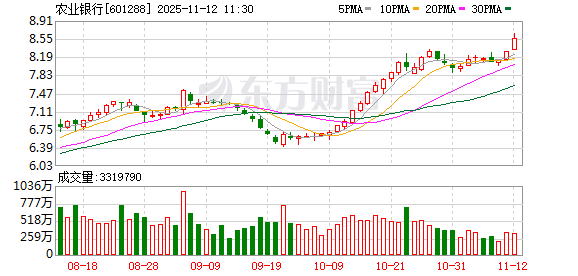
Market Overview - The A-share market experienced a decline in early trading on November 12, with the Shanghai Composite Index down by 0.23%, the Shenzhen Component Index down by 1.07%, and the ChiNext Index down by 1.58% [1][2] - The market's half-day trading volume reached 1.27 trillion, with over 4,000 stocks declining [1][2] Index Performance - Shanghai Composite Index: 3993.35, down 9.40 points (-0.23%) - Shenzhen Component Index: 13146.42, down 142.59 points (-1.07%) - ChiNext Index: 3084.70, down 49.62 points (-1.58%) - Other indices such as the CSI 300 and CSI 500 also showed declines [2] Sector Performance - The banking sector showed resilience, with Agricultural Bank of China and Industrial and Commercial Bank of China reaching historical highs. Agricultural Bank's market capitalization surpassed 3 trillion [3] - Notable stock performances included Agricultural Bank up over 3%, Bank of China up over 2%, and other banks like Industrial and Commercial Bank and Postal Savings Bank up over 1% [3][4] - The consumer sector, particularly food and beverage stocks, was active, with companies like Zhongrui and Sanyuan showing significant gains due to supportive policies aimed at boosting domestic demand [4] Economic Insights - An economist noted that the consumer sector's activity is supported by positive macroeconomic data, including favorable inflation rates in October, which has provided a basis for the rise in consumer stocks [4] - The technology sector, particularly in computing power, robotics, and AI, remains a key focus of the current bull market, despite some short-term corrections [5] - The ongoing demand for computing power from companies like OpenAI indicates that the market for AI-related technologies may continue to thrive [5]

银行股、消费股逆势走强,农行总市值突破3万亿元,三元股份3连板
21世纪经济报道· 2025-11-12 04:13
Market Overview - The A-share market experienced a decline in early trading on November 12, with the Shanghai Composite Index down 0.23%, the Shenzhen Component Index down 1.07%, and the ChiNext Index down 1.58% [1][2] - The total trading volume reached 1.27 trillion yuan, with over 4,000 stocks declining [1][2] Index Performance - Shanghai Composite Index: 3993.35, down 9.40 points (-0.23%) [2] - Shenzhen Component Index: 13146.42, down 142.59 points (-1.07%) [2] - ChiNext Index: 3084.70, down 49.62 points (-1.58%) [2] - The trading volume was predicted to be 1.98 trillion yuan, a decrease of 34 billion yuan from previous estimates [2] Sector Performance - The oil and gas, insurance, and pharmaceutical sectors showed strong gains, while the banking sector also performed well [2][3] - Notable stocks included Agricultural Bank of China, which saw its market capitalization exceed 3 trillion yuan, and both Agricultural Bank and Bank of China experienced significant price increases [3][4] Consumer Sector Activity - The consumer sector, particularly food and beverage stocks, was active, with companies like Zhongrui Co. and San Yuan Co. achieving consecutive gains [4] - Economic scholar Pan Helin noted that the consumer sector's activity is supported by positive policy signals aimed at boosting domestic demand and favorable macroeconomic data from October [4] Technology Sector Insights - Pan Helin emphasized that technology sectors such as computing power, robotics, and AI remain the main focus of the current bull market, despite recent pullbacks [5] - The valuation of computing power is considered high, but demand for computing chips remains strong, particularly from companies like OpenAI [5]

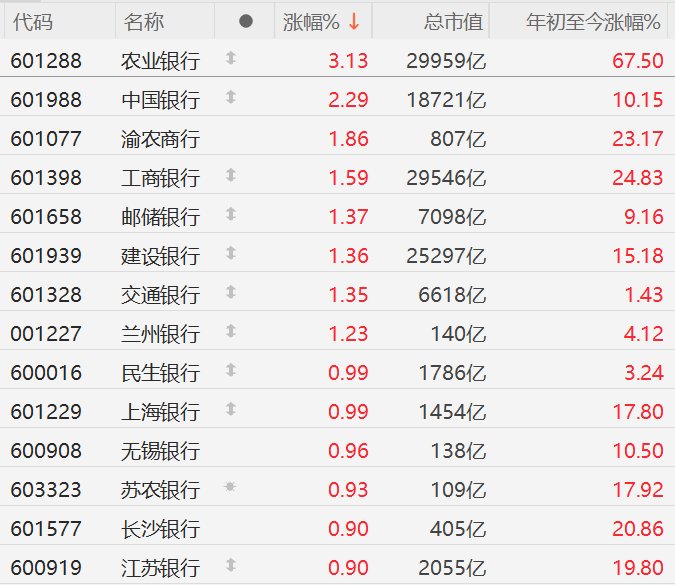
银行股强势!农行、工商均再创历史新高
Ge Long Hui A P P· 2025-11-12 04:13
Core Insights - The A-share market has seen a strong performance in bank stocks, with Agricultural Bank leading the gains, rising over 3% [1] - Major banks such as Industrial and Commercial Bank of China also reached historical highs [1] Summary by Category Stock Performance - Agricultural Bank: Increased by 3.13%, total market value at 299.59 billion, year-to-date increase of 67.50% [2] - Bank of China: Increased by 2.29%, total market value at 187.21 billion, year-to-date increase of 10.15% [2] - Chongqing Rural Commercial Bank: Increased by 1.86%, total market value at 8.07 billion, year-to-date increase of 23.17% [2] - Industrial and Commercial Bank: Increased by 1.59%, total market value at 295.46 billion, year-to-date increase of 24.83% [2] - Postal Savings Bank: Increased by 1.37%, total market value at 70.98 billion, year-to-date increase of 9.16% [2] - Construction Bank: Increased by 1.36%, total market value at 252.97 billion, year-to-date increase of 15.18% [2] - Transportation Bank: Increased by 1.35%, total market value at 66.18 billion, year-to-date increase of 1.43% [2] - Lanzhou Bank: Increased by 1.23%, total market value at 1.40 billion, year-to-date increase of 4.12% [2] - Minsheng Bank: Increased by 0.99%, total market value at 17.86 billion, year-to-date increase of 3.24% [2] - Shanghai Bank: Increased by 0.99%, total market value at 14.54 billion, year-to-date increase of 17.80% [2] - Yuanxi Bank: Increased by 0.96%, total market value at 1.38 billion, year-to-date increase of 10.50% [2] - Sunong Bank: Increased by 0.93%, total market value at 1.09 billion, year-to-date increase of 17.92% [2] - Changsha Bank: Increased by 0.90%, total market value at 4.05 billion, year-to-date increase of 20.86% [2] - Jiangsu Bank: Increased by 0.90%, total market value at 20.55 billion, year-to-date increase of 19.80% [2]

交通银行打造养老金融体系赋能银发经济
Huan Qiu Wang· 2025-11-12 01:04
Core Insights - The conference held on November 8 in Shanghai focused on the integration of pension finance and the silver economy, aiming to enhance the quality of China's pension services through financial support [1][2] Group 1: Key Themes and Discussions - The event gathered government, banking, enterprise, and academic representatives to discuss aging population responses, pension industry upgrades, and financial service innovations, fostering a consensus on "policy guidance - financial empowerment - industry upgrading" [2] - Traffic Bank's president emphasized the bank's commitment to exploring new service models for the pension industry, including innovative financial products, ecosystem construction, and enhanced fund supervision [2] Group 2: Financial Innovations and Solutions - Traffic Bank introduced the "Jiaoyin Pension" brand and launched the comprehensive service management system and "Pension e-loan" product, aiming to provide specialized financial solutions for the aging society [3] - The "Jiaoyin Pension Comprehensive Service Management System" addresses the regulatory challenges of prepayment in pension institutions, ensuring safety, transparency, and efficiency in fund management [4] - The "Pension e-loan" product was developed to tackle financing issues faced by pension service providers, utilizing a government rating and subsidy model for risk assessment [4] Group 3: Strategic Collaborations - Two significant strategic cooperation agreements were signed to enhance the collaboration between government and financial institutions in promoting the pension industry [5] - Traffic Bank and the Ministry of Civil Affairs signed a cooperation agreement to leverage their respective strengths in policy, resources, and services to improve financial service accessibility for the elderly [5] - A strategic cooperation agreement was also signed between Traffic Bank and the Pudong New Area government to jointly promote high-quality development in the pension sector and silver economy [6]
股市必读:交通银行(601328)11月11日主力资金净流入5992.8万元,占总成交额7.12%
Sou Hu Cai Jing· 2025-11-11 17:06
Group 1 - The core point of the article is that the Ministry of Finance has increased its shareholding in Bank of Communications to 35.02%, becoming the controlling shareholder after the completion of the acquisition process [2][3]. - As of November 11, 2025, Bank of Communications' stock closed at 7.39 yuan, with a slight increase of 0.27% and a trading volume of 1.14 million hands, resulting in a total transaction amount of 842 million yuan [1]. - The net inflow of main funds on November 11 was 59.92 million yuan, accounting for 7.12% of the total transaction amount, while retail investors experienced a net outflow of 35.05 million yuan, representing 4.16% of the total transaction amount [2][3]. Group 2 - The acquisition process has been disclosed, and the share registration has been completed, although the business registration change is still pending [2]. - The Ministry of Finance has committed to not transferring the acquired shares for five years and has not violated any commitments or harmed the interests of the listed company during the supervision period [2].
监管研究系列三:存款非银化对流动性风险指标的影响与测算
KAIYUAN SECURITIES· 2025-11-11 14:12
Investment Rating - The investment rating for the banking industry is "Positive" (maintained) [1] Core Insights - The report highlights the ongoing trend of deposit non-bankization, which is leading to a marginal decline in liquidity indicators for banks. This trend is particularly pronounced among large banks, with a notable increase in the proportion of non-bank deposits [12][16] - The liquidity coverage ratio (LCR) and net stable funding ratio (NSFR) are critical indicators for banks, and the report provides quantitative assessments of how deposit non-bankization impacts these metrics. The effects are manageable for major banks, with LCR expected to remain above 120% even under significant conversion scenarios [4][34] Summary by Sections 1. Deposit Non-Bankization and Liquidity Management - The process of deposit non-bankization is intensifying the demand for banks to manage liquidity indicators more stringently. Since May 2025, the growth rate of personal fixed deposits has been declining, with large banks showing a decrease in monthly increments compared to the same period in 2024 [12][16] - The report quantifies the impact of deposit non-bankization on LCR and NSFR for major banks, indicating that even with a 70% conversion of personal fixed deposits to non-bank deposits, the LCR for most large banks is expected to remain above 120% [4][34] 2. Liquidity Indicator Management - The management of LCR focuses on maintaining liquidity asset reserves, while NSFR management emphasizes improving the liability structure. Issuing long-term interbank certificates of deposit is highlighted as an effective method to optimize these liquidity indicators [5][22] - The report details how the conversion of personal fixed deposits to non-bank deposits affects various liquidity risk indicators, with specific calculations provided for LCR and NSFR under different conversion scenarios [18][23] 3. Investment Recommendations - The report suggests a tiered investment strategy: - Core holdings should focus on large state-owned banks, benefiting from institutions like Agricultural Bank of China and Industrial and Commercial Bank of China - Core allocations should include leading comprehensive banks such as China Merchants Bank and CITIC Bank - Flexible allocations can target regional banks like Jiangsu Bank and Chongqing Bank [6][19]