
BANK COMM(601328)

Search documents
交通银行,被罚没超6800万元
Zhong Guo Ji Jin Bao· 2025-12-19 14:59
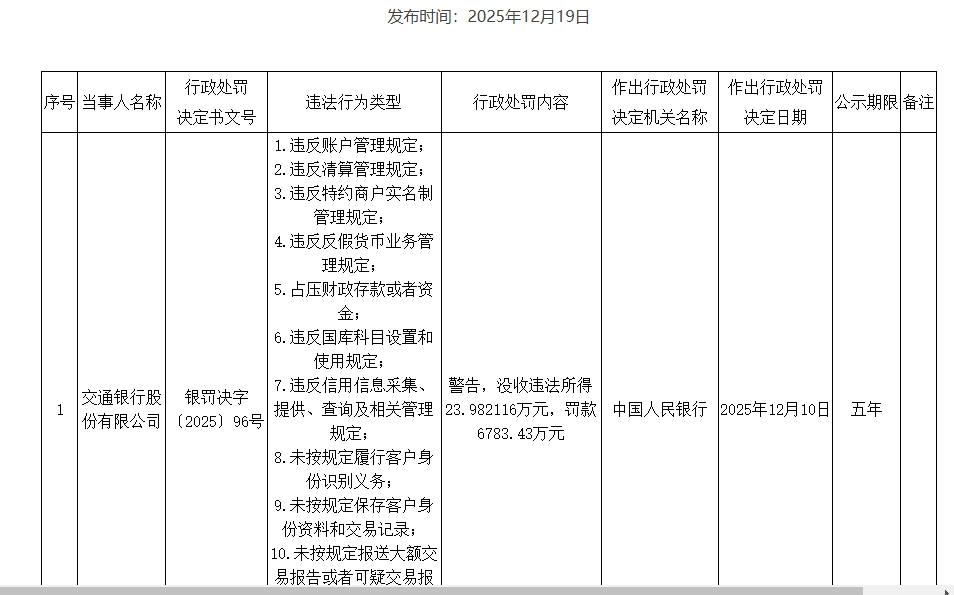
中国基金报记者 嘉合 12月19日,中国人民银行披露一批行政处罚公告。其中,交通银行因涉及11项违法违规行为,被中国人民银行处以警告、没收违法所得23.98万元,罚款 6783.43万元。 具体来看,交通银行主要涉及以下违法行为:违反账户管理规定;违反清算管理规定;违反特约商户实名制管理规定;违反反假货币业务管理规定;占压 财政存款或者资金;违反国库科目设置和使用规定;违反信用信息采集、提供、查询及相关管理规定;未按规定履行客户身份识别义务;未按规定保存客 户身份资料和交易记录;未按规定报送大额交易报告或者可疑交易报告;与身份不明的客户进行交易或者为客户开立匿名账户、假名账户。 | 序号 当事人名称 | | 行政处罚 | 违法行为类型 | 行政处罚内容 | 作出行政处罚 | 作出行政处罚 | 公示期限 备注 | | --- | --- | --- | --- | --- | --- | --- | --- | | | | 决定书文号 | | | 决定机关名称 決定日期 | | | | | | | 1. 违反账户管理规定; | | | | | | | | | 2. 违反清算管理规定; | | | | | | | ...


2025年,村镇银行加速“减量”
Jing Ji Guan Cha Wang· 2025-12-19 14:56
Group 1 - The core viewpoint of the articles highlights the acceleration of mergers and acquisitions among rural banks, with over 200 banks involved since 2025, marking a significant increase compared to 2024 [1] - As of the end of 2024, the total number of rural banks in China was 1,538, a decrease of 98 banks from the end of 2023 [1] - Various reform and restructuring methods have emerged, including "village to branch" and "village to division" models, primarily initiated by local rural commercial banks and supported by state-owned banks [2][3] Group 2 - The first state-owned bank to engage in the "village to branch" model was the Industrial and Commercial Bank of China, which completed its acquisition of Chongqing Bishi Rural Bank in June 2025 [2] - Other state-owned banks, such as Agricultural Bank of China and Bank of Communications, have also been involved in acquiring rural banks throughout 2025 [2] - Analysts suggest that the participation of state-owned banks in rural bank reforms is crucial for risk management and reflects their responsiveness to regulatory requirements [3] Group 3 - The financial indicators of state-owned banks are currently stable, and their involvement in rural bank reforms is expected to have minimal impact on their operations [3] - The bankruptcy of rural banks is rare, with only two instances reported by 2025, indicating ongoing challenges in risk management within this sector [4][5] - The Dalian Jinzhou Lianfeng Rural Bank was approved for bankruptcy proceedings in July 2025, becoming the second rural bank to do so, with its deposits being taken over by Dalian Rural Commercial Bank [5] Group 4 - The ongoing reform of rural banks aims to address issues such as deteriorating asset quality and increasing credit risks, particularly in economically weaker regions [7] - The China Banking Association's report indicates that rural banks are facing multiple challenges, including intensified regulatory compliance and competition, necessitating urgent reforms [7] - The restructuring of rural banks is being pursued through mergers, acquisitions, and dissolutions, with a notable reduction of 99 banks in 2024, accounting for nearly 50% of the total reduction in banking institutions that year [7] Group 5 - Employees of merged rural banks have reported changes in job roles but generally view the transitions positively, indicating a degree of stability post-merger [8] - For initiating banks, the restructuring can present opportunities for growth, as seen with Changshu Bank, which has actively pursued mergers to enhance its market presence [8] - The central economic work conference emphasized the importance of reducing and improving the quality of small financial institutions to mitigate financial risks in the coming year [8]
一大行被罚没超6800万元
中国基金报· 2025-12-19 14:44
具体来看,交通银行主要涉及以下违法行为:违反账户管理规定;违反清算管理规定;违反 特约商户实名制管理规定;违反反假货币业务管理规定;占压财政存款或者资金;违反国库 科目设置和使用规定;违反信用信息采集、提供、查询及相关管理规定;未按规定履行客户 身份识别义务;未按规定保存客户身份资料和交易记录;未按规定报送大额交易报告或者可 疑交易报告;与身份不明的客户进行交易或者为客户开立匿名账户、假名账户。 | 序号 当事人名称 | | 行政处罚 | 违法行为类型 | 行政处罚内容 | 作出行政处罚 | 作出行政处罚 | 公示期限 备注 | | --- | --- | --- | --- | --- | --- | --- | --- | | | | 决定书文号 | | | 决定机关名称 | 決定日期 | | | | | | 1. 违反账户管理规定; | | | | | | | | | 2. 违反清算管理规定; | | | | | | | | | 3. 违反特约商户实名制 | | | | | | | | | 管理规定; | | | | | | | | | 4. 违反反假货币业务管 | | | | | | | | | 理规 ...

交通银行回应遭央行处罚6783.43万元
Zheng Quan Shi Bao Wang· 2025-12-19 13:56
转自:证券时报 交通银行对此回应称,2022年11月至2023年4月,中国人民银行对交通银行开展综合执法检查。本次处 罚是基于上述执法检查发现的问题作出的,处罚所涉问题均发生在2023年以前。"交行对此诚恳接受、 高度重视,已完成整改工作,并以问题整改为契机,认真举一反三,不断优化长效机制。本行将持续强 化内控合规管理,厚植稳健审慎经营文化,不断提升经营管理水平,推动高质量发展取得新成效。"该 行称。 人民财讯12月19日电,12月19日,中国人民银行发布行政处罚信息显示,交通银行因违反账户管理规定 等被处以警告,同时被没收违法所得23.982116万元,罚款6783.43万元。 ...
交行回应被罚6783.43万元:诚恳接受、高度重视,已完成整改工作
Xin Lang Cai Jing· 2025-12-19 12:54
对此,交通银行回应称,2022年11月至2023年4月,中国人民银行对交通银行开展综合执法检查。本次 处罚是基于上述执法检查发现的问题作出的,处罚所涉问题均发生在2023年以前。交行对此诚恳接受、 高度重视,已完成整改工作,并以问题整改为契机,认真举一反三,不断优化长效机制。交通银行表 示,本行将持续强化内控合规管理,厚植稳健审慎经营文化,不断提升经营管理水平,推动高质量发展 取得新成效。 责任编辑:李琳琳 12月19日金融一线消息,央行今日发布行政处罚公示显示,交通银行存在违反账户管理规定等11项违法 行为类型,受到警告,被没收违法所得23.982116万元,罚款6783.43万元。【相关阅读:交通银行因违 法账户管理规定等被罚6783.43万元 13名责任人被罚92.9万元】 对此,交通银行回应称,2022年11月至2023年4月,中国人民银行对交通银行开展综合执法检查。本次 处罚是基于上述执法检查发现的问题作出的,处罚所涉问题均发生在2023年以前。交行对此诚恳接受、 高度重视,已完成整改工作,并以问题整改为契机,认真举一反三,不断优化长效机制。交通银行表 示,本行将持续强化内控合规管理,厚植稳健审慎经 ...
两国有大行同日合计被罚上亿元
Bei Jing Shang Bao· 2025-12-19 12:39
北京商报讯(记者 孟凡霞 周义力)12月19日,中国人民银行发布行政处罚信息显示,交通银行因"违反 账户管理规定;违反清算管理规定;违反特约商户实名制管理规定;违反反假货币业务管理规定;占压 财政存款或者资金;违反国库科目设置和使用规定;违反信用信息采集、提供、查询及相关管理规定; 未按规定履行客户身份识别义务;未按规定保存客户身份资料和交易记录;未按规定报送大额交易报告 或者可疑交易报告;与身份不明的客户进行交易或者为客户开立匿名账户、假名账户"等违法行为,被 警告,没收违法所得23.982116万元,罚款6783.43万元;13名相关责任人均被罚。 同日,中国人民银行披露的另一则行政处罚信息显示,工商银行因"违反金融统计相关规定;违反账户 管理规定;违反清算管理规定;违反特约商户实名制管理规定;违反反假货币业务管理规定;违反信用 信息采集、提供、查询及相关管理规定;未按规定履行客户身份识别义务;未按规定保存客户身份资料 和交易记录;未按规定报送大额交易报告或者可疑交易报告;与身份不明的客户进行交易"等违法行 为,被警告,没收违法所得434.570857万元,罚款3961.5万元;17名相关责任人合计被罚1 ...

“金融+文旅”双向赋能 交通银行推出海南文旅主题信用卡
Zhong Guo Jin Rong Xin Xi Wang· 2025-12-19 12:28
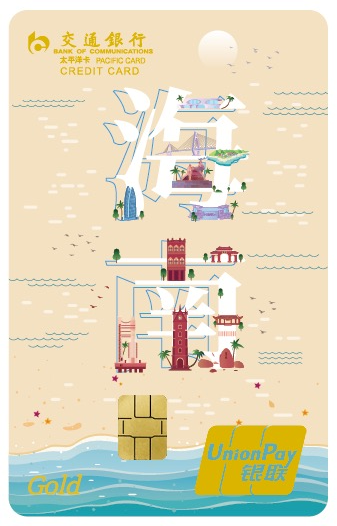
Core Viewpoint - The launch of the Hainan cultural tourism-themed credit card by Bank of Communications Hainan Branch aims to stimulate economic growth through the integration of finance and tourism, responding to national policies promoting consumption and supporting the construction of Hainan as an international tourism consumption center [1][6]. Group 1: Credit Card Features - The credit card features two designs: "Hainan Style" and "Aerospace Technology," reflecting Hainan's cultural and natural landmarks [3]. - The "Hainan Style" card design incorporates local architectural elements and ecological symbols, creating a beach-themed aesthetic [3]. - The "Aerospace Technology" card design balances technological elements with cultural motifs, showcasing Hainan's unique charm [3]. Group 2: Benefits for Cardholders - Cardholders can enjoy various benefits, including a 50 yuan red envelope for travel-related purchases and discounts on scenic tickets and local products [4]. - The card offers exclusive tax-free shopping benefits, including monthly limited-time discounts at designated duty-free stores [4]. - Daily consumption benefits extend to dining, entertainment, and local services, enhancing the overall travel experience [4]. Group 3: Strategic Importance - The launch of the credit card is a strategic move by Bank of Communications to align with national consumption policies and support Hainan's free trade port development [6]. - The initiative aims to enhance cultural confidence and the collectible value of the card while boosting consumer activity [6]. - Future plans include the introduction of a senior-themed credit card, further expanding the bank's offerings in the cultural tourism sector [7].
交通银行海南省分行发布“文旅大戏”宣传片 以金融之力激活海南文旅消费新动能
Xin Lang Cai Jing· 2025-12-19 12:15
Core Insights - The China International Tourism Trade Fair 2025 was held in Haikou, Hainan, where the Bank of Communications Hainan Branch launched a plan to support cultural and tourism consumption, along with a promotional video showcasing the integration of finance and tourism services [1][3] - Hainan Free Trade Port has officially started its full island closure, becoming the largest free trade port globally, with significant policy benefits including an increase in zero-tariff goods from over 1,900 to 6,600, covering more than 70% of products [3] - The Bank of Communications Hainan Branch aims to activate new consumption momentum through financial innovation, enhancing the shopping experience for global tourists in Hainan [3][5] Financial Support and Initiatives - The bank is actively involved in financing infrastructure and industry upgrades in Hainan's tourism sector, supporting key projects like those of Hainan Airport Group and Hainan Tourism Investment Group [3] - A comprehensive "promote consumption" system has been established, focusing on two financial carriers, four consumption scenarios, and one promotional matrix, with a special emphasis on a Hainan-themed credit card [4] Consumer Engagement Strategies - The Hainan-themed credit card is designed to enhance consumer experiences in duty-free shopping, dining, hotel stays, and travel, offering discounts, rewards, and exclusive benefits [4] - The bank's promotional video features iconic Hainan landscapes and highlights the benefits of the credit card, emphasizing convenience and savings for cardholders [4] Future Outlook - The bank plans to continue focusing on emerging consumption scenarios such as duty-free shopping, high-end hotels, and cruise tourism, aiming to create a one-stop service ecosystem that benefits both local residents and global tourists [5]

交通银行因违法账户管理规定等被罚6783.43万元 13名责任人被罚92.9万元
Xin Lang Cai Jing· 2025-12-19 11:09
Core Viewpoint - The People's Bank of China has issued an administrative penalty against China Communications Bank for multiple violations, resulting in a warning, confiscation of illegal gains amounting to 239,821.16 yuan, and a fine of 67,834,300 yuan [1]. Summary by Category Violations - The bank was found to have committed 11 types of violations, including: 1. Violating account management regulations 2. Violating clearing management regulations 3. Violating special merchant real-name system management regulations 4. Violating counterfeit currency business management regulations 5. Misappropriating fiscal deposits or funds 6. Violating treasury account setup and usage regulations 7. Violating credit information collection, provision, inquiry, and related management regulations 8. Failing to fulfill customer identity verification obligations as required 9. Failing to retain customer identity information and transaction records as required 10. Failing to report large transactions or suspicious transaction reports as required 11. Conducting transactions with unidentified customers or opening anonymous or pseudonymous accounts for customers [1][11][12]. Penalties - The total penalties imposed include: - Confiscation of illegal gains: 239,821.16 yuan - Total fines: 67,834,300 yuan - Specific fines for responsible individuals include: - Shen Mouliang: 10,000 yuan - Du Moubin: 100,000 yuan - Liang: 100,000 yuan - Mo Mouhua: 100,000 yuan - Tao Moukun: 4,000 yuan - Wang Moudong: 170,000 yuan - Zhu: 165,000 yuan - Chen Moumei: 65,000 yuan - Wu: 40,000 yuan - Xu: 35,000 yuan - Zhou: 35,000 yuan - You: 35,000 yuan - Zou: 70,000 yuan [1][2][3][9][10].
央行对交通银行罚没6800万元 包含11项违法行为类型
Ge Long Hui· 2025-12-19 10:35
格隆汇12月19日|根据中国人民银行行政处罚公示,交通银行股份有限公司被处以警告,没收违法所得 23.98万元,罚款6783.43万元。违法行为类型:1.违反账户管理规定;2.违反清算管理规定;3.违反特约 商户实名制管理规定;4.违反反假货币业务管理规定;5.占压财政存款或者资金;6.违反国库科目设置 和使用规定;7.违反信用信息采集、提供、查询及相关管理规定;8.未按规定履行客户身份识别义务; 9.未按规定保存客户身份资料和交易记录;10.未按规定报送大额交易报告或者可疑交易报告;11.与身 份不明的客户进行交易或者为客户开立匿名账户、假名账户。作出行政处罚决定日期为2025年12月10 日。 ...