
BANK OF CHANGSHA(601577)

Search documents
银行业 2026 年经营展望:资产负债篇:到期存款流向是资负格局的关键
Guoxin Securities Hongkong· 2026-01-13 05:12
Investment Rating - The report maintains an "Outperform" rating for the banking sector [6] Core Insights - The expected M2 growth rate for 2026 is approximately 7.5%, with credit growth around 6.0% and social financing growth at about 8.0%. This aligns with the goal of stabilizing economic growth and ensuring reasonable price recovery [2][18][19] - The banking sector is expected to see a structural differentiation in retail credit, with corporate lending remaining the primary contributor to new loans, accounting for approximately 80% to 85% of new loans [33][37] - The report highlights the importance of deposit flows, particularly the trend of deposits moving from large banks to smaller banks, which will influence the asset-liability gap for large banks in 2026 [3][41] Summary by Sections M2 and Credit Growth - The M2 increment for 2026 is estimated at about 25.4 trillion yuan, with fiscal net injection contributing approximately 12.0 trillion yuan and bank credit (including write-offs and ABS) contributing around 16.8 trillion yuan [2][29][24] - The anticipated new social financing for 2026 is about 35.3 trillion yuan, reflecting a growth rate of approximately 8.0% [30][32] Credit Allocation - Corporate lending is expected to remain strong, while retail lending will show structural improvements, contributing about 10% to 15% of new loans [33][37] - The report notes that retail credit is likely to experience a slight positive growth, particularly in quality consumption scenarios and personal operating loans [33][37] Asset-Liability Dynamics - The asset-liability gap for large banks is projected to continue, with marginal changes primarily driven by the liability side, influenced by deposit flows [3][41] - The report estimates that the maturity of fixed-term deposits for the six major banks in 2026 will be around 57 trillion yuan, with 2-year and longer-term deposits accounting for 27 to 32 trillion yuan [49][52] Investment Recommendations - The report recommends focusing on high-quality stocks with improving fundamentals, specifically highlighting Ningbo Bank and Changshu Bank, while also suggesting attention to Changsha Bank and Chongqing Rural Commercial Bank for potential excess returns [4] - Additionally, it emphasizes the value of stable, high-dividend stocks, recommending China Merchants Bank, Industrial and Commercial Bank of China, and Jiangsu Bank [4]




长沙银行将承办湖南省2026年贺岁币和贺岁钞预约、兑换工作
Jin Tou Wang· 2026-01-13 03:37
2026年贺岁币每枚面值为10元,每人预约、兑换限额为20枚。 一、预约兑换网点及额度 2026年贺岁钞每张面值为20元,每人预约、兑换限额为20张。 长沙银行湖南省辖内共47个营业网点承担此次"2026年贺岁币"和"2026年贺岁钞"的预约兑换工作,请您 查询公告附件,了解预约兑换网点地址及可预约额度、周末营休信息。 二、预约兑换安排 按照人民银行安排,"2026年贺岁币"和"2026年贺岁钞"采用核查机制,具体核查规定详见中国人民银行 公告〔2019〕第26号。 (一)预约期 2026年贺岁币线上预约期:2026年1月13日22时至1月14日24时。 2026年贺岁钞线上预约期:2026年1月13日22时30分至1月14日24时。 2026年1月9日,长沙银行(601577)发布公告称,根据中国人民银行相关工作安排,长沙银行将承办湖 南省内13个地区的2026年贺岁普通纪念币和2026年贺岁纪念钞(以下简称"2026年贺岁币"和"2026年贺 岁钞")的预约、兑换工作,现将有关事项公告如下: 三、温馨提示 (一)根据中国人民银行公告〔2019〕第26号,普通纪念币预约、核实和兑换的有效身份证件必须为第 二 ...
城商行板块1月8日跌0.89%,重庆银行领跌,主力资金净流入673.97万元
Zheng Xing Xing Ye Ri Bao· 2026-01-08 08:56
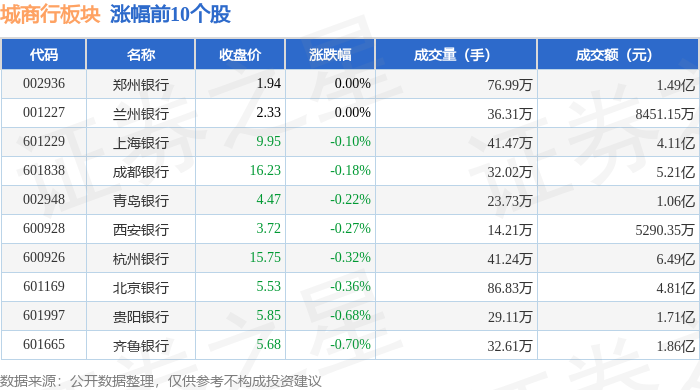
Market Overview - The city commercial bank sector experienced a decline of 0.89% on January 8, with Chongqing Bank leading the drop [1] - The Shanghai Composite Index closed at 4082.98, down 0.07%, while the Shenzhen Component Index closed at 13959.48, down 0.51% [1] Individual Stock Performance - Zhengzhou Bank closed at 1.94 with no change, while Lanzhou Bank also remained unchanged at 2.33 [1] - Shanghai Bank closed at 9.95, down 0.10%, and Chengdu Bank closed at 16.23, down 0.18% [1] - Chongqing Bank saw a significant decline of 2.70%, closing at 10.45, with a trading volume of 99,000 shares [2] Trading Volume and Turnover - The trading volume for Zhengzhou Bank was 769,900 shares with a turnover of 149 million yuan, while Lanzhou Bank had a trading volume of 363,100 shares and a turnover of 84.51 million yuan [1] - The highest turnover was recorded for Nanjing Bank at 1.342 billion yuan with a trading volume of 1,217,000 shares [2] Capital Flow Analysis - The city commercial bank sector saw a net inflow of 6.7397 million yuan from institutional investors, while retail investors experienced a net outflow of 70.5351 million yuan [2] - Chengdu Bank had a net inflow of 87.0825 million yuan from institutional investors, but a net outflow of 46.0321 million yuan from retail investors [3] Summary of Capital Flows - Institutional investors showed a positive net flow for several banks, including Hangzhou Bank with 77.8301 million yuan and Qingdao Bank with 8.4480 million yuan [3] - Conversely, Chongqing Bank had a negative net flow of 535,600 yuan from institutional investors, indicating a lack of confidence [3]



长沙银行金芙蓉2026年长福净值01期理财1月8日起发行,业绩比较基准2.25%-3.05%
Cai Jing Wang· 2026-01-08 08:03
1月8日,据长沙银行(601577)披露,该行发行的金芙蓉2026年长福净值01期封闭式净值型理财产品认 购期为2026年1月8日—2026年1月14日。认购起点金额为1万元,发行规模下限为2000万元,上限为10亿 元。产品类型为固定收益类,内部风险评级为中等风险,产品期限448天,业绩比较基准为 2.25%-3.05%。 以上理财产品信息仅供参考,具体应以《产品说明书》等销售文件为准。本文不构成任何投资建议,投 资者据此操作,风险自担。 注:业绩比较基准不是预期收益率,不代表产品的未来表现和实际收益,不构成对产品收益的承诺。 ...
城商行板块1月7日涨0%,杭州银行领涨,主力资金净流出1.7亿元
Zheng Xing Xing Ye Ri Bao· 2026-01-07 08:58
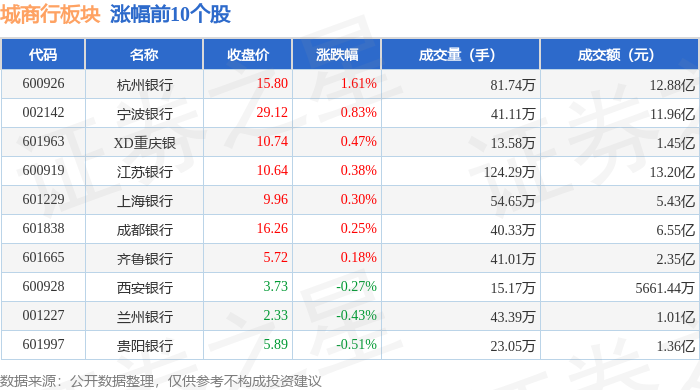
Market Performance - The city commercial bank sector experienced a slight increase of 0.0% on January 7, with Hangzhou Bank leading the gains [1] - The Shanghai Composite Index closed at 4085.77, up 0.05%, while the Shenzhen Component Index closed at 14030.56, up 0.06% [1] Individual Stock Performance - Hangzhou Bank (600926) closed at 15.80, with a rise of 1.61% and a trading volume of 817,400 shares [1] - Ningbo Bank (002142) closed at 29.12, up 0.83%, with a trading volume of 411,100 shares [1] - Other notable performances include Jiangsu Bank (601963) at 10.64 (+0.38%) and Shanghai Bank (601229) at 9.96 (+0.30%) [1] Capital Flow Analysis - The city commercial bank sector saw a net outflow of 170 million yuan from institutional investors, while retail investors contributed a net inflow of 188 million yuan [2] - The overall capital flow indicates a mixed sentiment, with institutional investors withdrawing funds while retail investors increased their positions [2] Detailed Capital Flow by Bank - Jiangsu Bank had a net inflow of 123 million yuan from institutional investors, while retail investors saw a net outflow of 27 million yuan [3] - Hangzhou Bank experienced a net inflow of 84 million yuan from institutional investors, but retail investors had a significant outflow of 132 million yuan [3] - Chengdu Bank recorded a net inflow of 55 million yuan from institutional investors, with retail investors also experiencing a net outflow [3]



银行业 2026 年经营展望:资产负债篇到期存款流向是资负格局的关键
Guoxin Securities· 2026-01-07 07:12
Investment Rating - The report maintains an "Outperform the Market" rating for the banking sector [4][5]. Core Insights - The banking industry is expected to see a reasonable M2 growth target of approximately 7.5%, with credit growth around 6.0% and social financing growth at about 8.0% for 2026. This aligns with the anticipated nominal GDP growth of about 5.0% and actual GDP growth of approximately 4.9% [1][15][21]. - The report highlights that the flow of deposits will be a key factor affecting the asset-liability structure of banks in 2026, with a significant amount of term deposits maturing, estimated at around 57 trillion yuan [3][49]. - The credit allocation is expected to show strong support for corporate lending, contributing approximately 80% to 85% of new loans, while retail lending is projected to improve marginally, contributing about 10% to 15% [2][36]. Summary by Sections M2 and Credit Growth - The M2 growth target for 2026 is set at approximately 7.5%, with an expected M2 increment of about 25.4 trillion yuan, driven by fiscal net injection of around 12.0 trillion yuan and bank credit issuance of about 16.8 trillion yuan [1][21][22]. - The anticipated credit growth for 2026 is around 6.0%, with new social financing expected to reach approximately 35.3 trillion yuan, reflecting an 8.0% growth rate [21][26][30]. Deposit Flow and Asset-Liability Structure - The report indicates that the flow of deposits from large banks to smaller banks will be a critical factor in determining the marginal changes in the asset-liability gap for large banks in 2026. The pressure from deposit migration is expected to ease somewhat [2][41][54]. - The maturing term deposits for the six major banks are estimated to be between 27 trillion and 32 trillion yuan, with a significant portion being long-term deposits [3][49][50]. Investment Recommendations - The report suggests focusing on two main lines for investment in 2026: high-quality companies with improving fundamentals, such as Ningbo Bank and Changshu Bank, and stable high-dividend stocks like China Merchants Bank and Industrial and Commercial Bank of China [3][4].
银行业2026年经营展望:资产负债篇:期存款流向是资负格局的关键
Guoxin Securities· 2026-01-07 05:15
Investment Rating - The report maintains an "Outperform the Market" rating for the banking sector [4][5]. Core Insights - The banking sector is expected to see a reasonable M2 growth target of approximately 7.5%, with credit growth around 6.0% and social financing growth at about 8.0% for 2026. This aligns with the goal of stabilizing economic growth and ensuring reasonable price recovery [1][21]. - The report highlights that the flow of deposits will be a key factor affecting the asset-liability structure of banks in 2026, with a significant amount of term deposits maturing, estimated at around 57 trillion yuan [3][49]. - The credit allocation is expected to remain strong for corporate lending, contributing approximately 80% to 85% of new loans, while retail lending is anticipated to show marginal improvement, contributing about 10% to 15% [2][36]. Summary by Sections Economic Outlook - The actual GDP growth target for 2026 is estimated at 4.9%, with a nominal GDP growth target of about 5.0%, which corresponds to a reasonable M2 growth target of 7.5% [1][15]. - The projected M2 increment for 2026 is approximately 25.4 trillion yuan, with fiscal net M2 injection around 12.0 trillion yuan and bank credit (including write-offs and ABS) contributing about 16.8 trillion yuan [21][22]. Credit Allocation - Corporate lending is expected to remain the primary support for new loans, while retail lending will experience structural differentiation, with personal operating loans maintaining good growth and housing loans likely showing slight positive growth [2][36]. - The report indicates that the flow of deposits from large banks to smaller banks will be a critical factor in the marginal changes in the asset-liability gap for large banks in 2026 [3][41]. Investment Recommendations - The report suggests focusing on two main lines for investment in 2026: high-quality companies with improving fundamentals, such as Ningbo Bank and Changshu Bank, and stable high-dividend stocks like China Merchants Bank and Industrial and Commercial Bank of China [4][5].
2025年消费金融公司增资潮涌动
Jin Rong Shi Bao· 2026-01-07 02:15
Group 1 - The core point of the news is that the consumption finance industry in China is experiencing a capital increase trend, particularly among bank-affiliated consumption finance companies, driven by regulatory policies and competitive pressures [1][4][6] Group 2 - Beijing Bank's major shareholder, Beiyin Consumer Finance, has been approved to increase its registered capital by 150 million yuan, raising it from 850 million yuan to 1 billion yuan, making it the first consumption finance company approved for capital increase in 2026 [1] - In December 2025, Changsha Bank announced plans to increase its capital in Hunan Changyin 58 Consumer Finance by up to 1.55 billion yuan to enhance its capital strength and risk resilience [2] - Another bank-affiliated company, Nan Yin Fa Ba Consumer Finance, increased its registered capital from 5.215 billion yuan to 6 billion yuan, ranking fourth among 31 licensed consumption finance companies in China [3] - A total of eight institutions, including Ningyin Consumer Finance and Hubei Consumer Finance, completed or disclosed capital increase measures in 2025, surpassing the total for the entire year of 2024, indicating a strong enthusiasm for capital increase in the industry [3] - Bank-affiliated consumption finance companies account for 75% of the capital increase activities, highlighting their dominance in this trend [3] Group 3 - The increase in capital is driven by regulatory policies that have raised the minimum registered capital requirement from 300 million yuan to 1 billion yuan, emphasizing the importance of capital strength in the industry [4] - Different strategies for capital increase are observed among institutions, with smaller firms focusing on compliance and larger firms aiming to expand their scale and consolidate their market position [5] - As of January 5, 2026, four consumption finance companies still have registered capital below 1 billion yuan, indicating ongoing challenges for some institutions in meeting regulatory requirements [5][6] Group 4 - Analysts predict that the trend of capital increases will continue into 2026, as competition intensifies and regulatory frameworks improve, making capital strength a key indicator of core competitiveness in the industry [6]
城商行板块1月5日涨0.26%,杭州银行领涨,主力资金净流入3.8亿元
Zheng Xing Xing Ye Ri Bao· 2026-01-05 09:09
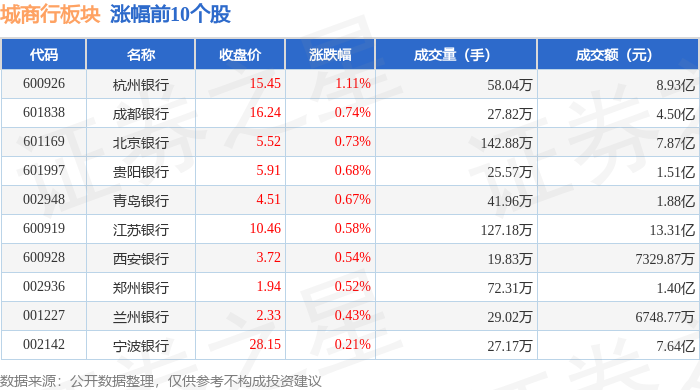
Market Overview - The city commercial bank sector increased by 0.26% on January 5, with Hangzhou Bank leading the gains [1] - The Shanghai Composite Index closed at 4023.42, up by 1.38%, while the Shenzhen Component Index closed at 13828.63, up by 2.24% [1] Individual Bank Performance - Hangzhou Bank (600926) closed at 15.45, with a rise of 1.11% and a trading volume of 580,400 shares, amounting to a transaction value of 893 million yuan [1] - Chengdu Bank (601838) closed at 16.24, up by 0.74%, with a trading volume of 278,200 shares and a transaction value of 450 million yuan [1] - Beijing Bank (601169) closed at 5.52, increasing by 0.73%, with a trading volume of 1,428,800 shares and a transaction value of 787 million yuan [1] - Guizhou Bank (601997) closed at 5.91, up by 0.68%, with a trading volume of 255,700 shares and a transaction value of 151 million yuan [1] - Qindao Bank (002948) closed at 4.51, increasing by 0.67%, with a trading volume of 419,600 shares and a transaction value of 188 million yuan [1] - Jiangsu Bank (616009) closed at 10.46, up by 0.58%, with a trading volume of 1,271,800 shares and a transaction value of 1.331 billion yuan [1] - Xian Bank (600928) closed at 3.72, increasing by 0.54%, with a trading volume of 198,300 shares and a transaction value of 73.3 million yuan [1] - Zhengzhou Bank (002936) closed at 1.94, up by 0.52%, with a trading volume of 723,100 shares and a transaction value of 140 million yuan [1] - Lanzhou Bank (001227) closed at 2.33, increasing by 0.43%, with a trading volume of 290,200 shares and a transaction value of 67.5 million yuan [1] - Ningbo Bank (002142) closed at 28.15, up by 0.21%, with a trading volume of 271,700 shares and a transaction value of 764 million yuan [1] Capital Flow Analysis - The city commercial bank sector saw a net inflow of 380 million yuan from main funds, while retail funds experienced a net outflow of 134 million yuan [2] - The main funds' net inflow and outflow for individual banks include: - Jiangsu Bank (600919) had a net inflow of 10.4 million yuan, with a 7.78% share of main funds [3] - Shanghai Bank (601229) had a net inflow of 87.04 million yuan, with a 13.64% share of main funds [3] - Hangzhou Bank (600926) had a net inflow of 79.04 million yuan, with an 8.86% share of main funds [3] - Nanjing Bank (600000) had a net inflow of 67.86 million yuan, with a 9.68% share of main funds [3] - Ningbo Bank (002142) had a net inflow of 58.14 million yuan, with a 7.61% share of main funds [3] - Qilu Bank (601665) had a net inflow of 57.72 million yuan, with a 14.60% share of main funds [3] - Qingdao Bank (002948) had a net inflow of 22.18 million yuan, with an 11.82% share of main funds [3] - Suzhou Bank (002966) had a net inflow of 6.29 million yuan, with a 2.71% share of main funds [3] - Xiamen Bank (601187) had a net inflow of 520,450 yuan, with a 5.25% share of main funds [3] - Xian Bank (600928) had a net inflow of 287,550 yuan, with a 3.92% share of main funds [3]


长沙银行股份有限公司2025年第二次临时股东会决议公告
Shang Hai Zheng Quan Bao· 2026-01-05 00:30
Meeting Overview - The second extraordinary general meeting of shareholders for Changsha Bank was held on December 31, 2025, at the bank's headquarters in Changsha, Hunan Province [1] - The meeting was convened by the board of directors and chaired by Director Zhang Man, utilizing a combination of on-site and online voting methods, in compliance with the Company Law and the Articles of Association [1] Attendance - Out of 10 current directors, 3 attended the meeting, while several independent directors were absent due to business commitments [2] - The bank's secretary and chief risk officer, Peng Jing'en, attended the meeting along with some senior executives [2] Resolutions - Two non-cumulative voting proposals were presented and approved: 1. Issuance of non-capital financial bonds by Changsha Bank [3] 2. Capital increase for Hunan Changyin 58 Consumer Finance Co., Ltd. [3] - The first proposal required a special resolution with over two-thirds approval from voting shareholders, while the second required a simple majority [4] Voting Restrictions - Certain shareholders were restricted from voting due to holding more than 50% of their shares in pledge or having overdue loans with the bank, and these shareholders did not attend the meeting [5] Legal Verification - The meeting was witnessed by Hunan Hanjun Cheng Law Firm, and the lawyers confirmed that the procedures, attendance, and voting results complied with relevant laws and regulations, deeming the resolutions legal and valid [6]