CPIC(601601)

Search documents
太平洋产险中卫中心支公司被罚20.8万元:编制或者提供虚假报告、报表、文件、资料等
Xin Lang Cai Jing· 2026-02-26 12:42
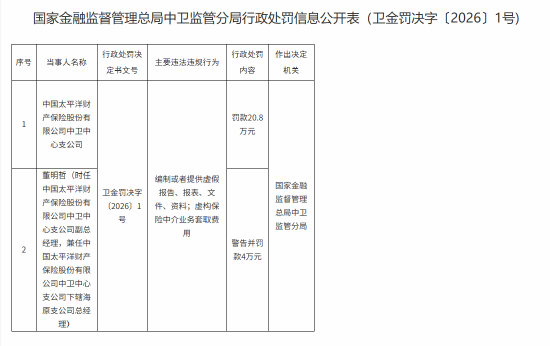
| 序号 | 当事人名称 | 行政处罚决 | 主要违法违规行为 | 行政处罚 | 作出决定 | | --- | --- | --- | --- | --- | --- | | | | 定书文号 | | 内容 | 机关 | | 1 | 中国太平洋财 产保险股份有 限公司中卫中 心支公司 | | | 罚款20.8 力元 | | | | 董明哲(时任 中国太平洋财 产保险股份有 限公司中卫中 心支公司副总 | 卫会罚决字 (2026) 1 号 | 编制或者提供虚假 报告、报表、文 件、资料;虚构保 险中介业务意取费 | | 国家会験 监督管理 总局中卫 监管分局 | | | | | 用 | | | | 2 | 经理,兼任中 | | | 警告并罚 | | | | 国大平洋财产 | | | 款4万元 | | | | 保险股份有限 | | | | | | | 公司中卫中心 | | | | | | | 支公司下辖海 | | | | | | | 原支公司总经 | | | | | | | 理) | | | | | 责任编辑:王馨茹 | 序号 | 当事人名称 | 行政处罚决 | 主要违法违规行为 | 行政处罚 | 作出决定 | ...



26年险资配置调查结果出炉,增配权益而久期策略不变
GF SECURITIES· 2026-02-26 08:47
Core Insights - The report indicates that insurance assets are expected to steadily increase their allocation to equities in 2026, while maintaining their duration strategy unchanged [6] - The survey conducted by the China Banking and Insurance Asset Management Association reflects the industry's expectations regarding market trends and allocation strategies for 2026 [6] Asset Allocation - In terms of major asset allocation, stocks and securities investment funds are generally favored by insurance institutions for domestic investments in 2026, with some institutions planning to slightly increase their stock investments [6] - The allocation ratios for bank deposits and bonds are expected to remain stable compared to 2025 [6] - Most insurance institutions hold a neutral outlook on the bond market for 2026, with the overall duration strategy expected to remain unchanged [6] - The yield on 10-year government bonds is anticipated to be in the range of 1.8%-1.9%, while 30-year government bonds are expected to yield between 2.2%-2.4% [6] - Over half of the insurance institutions predict that the yield center for high-grade credit bonds will be around 2.0%-2.5%, with credit spreads expected to show a fluctuating trend [6] A-Share Market Outlook - Most insurance institutions maintain an optimistic view of the A-share market for 2026, with plans to slightly increase their allocation to A-shares [6] - The sectors favored include technology, non-ferrous metals, power equipment, computers, communications, pharmaceuticals, and basic chemicals, with a focus on themes such as semiconductors, defense, AI, robotics, and high-dividend stocks [6] Overseas Investment - Hong Kong stocks are the most favored overseas investment option for insurance institutions in 2026, with half of the asset management institutions planning to slightly increase their allocation to Hong Kong stocks [6] - Gold and US stocks are also receiving considerable attention from insurance institutions [6] Company Recommendations - The report suggests that the insurance sector's equity elasticity is expected to continue improving, with a favorable long-term trend for the insurance premium difference [6] - Specific companies recommended for investment include China Ping An (A/H), China Life (A/H), China Taiping (H), New China Life (A/H), China Pacific Insurance (A/H), China People’s Insurance Group (H), and AIA Group (H) [6]




人形机器人上保险 风险轮廓还需摸得清
Zhong Guo Zheng Quan Bao· 2026-02-25 20:54
Core Viewpoint - The discussion around humanoid robots remains active during the Spring Festival, with advancements in embodied intelligence technology pushing these robots from laboratories into everyday life. The insurance industry is beginning to adapt by offering tailored insurance products for humanoid robots, which is seen as a way to support the healthy development of the robot industry and enhance the integration of finance and innovation [1][2]. Group 1: Insurance Offerings - Major insurance companies are developing customized insurance plans for humanoid robots, focusing on two main areas: body loss insurance and third-party liability insurance [2]. - China Pacific Insurance has launched a specialized insurance product called "Smart Insurance" designed for the commercial application of humanoid robots, covering risks across the entire production, sales, rental, and usage chain [3]. - Ping An Insurance has introduced a comprehensive financial solution for embodied intelligence, integrating various risk scenarios into tailored insurance products to encourage R&D and pilot applications [3]. Group 2: Challenges in Risk Assessment - The lack of historical data and the rapid technological evolution in the humanoid robot sector pose significant challenges for insurance companies in pricing and claims processing [4]. - Insurers are establishing dynamic risk assessment systems to better quantify risks associated with humanoid robots, utilizing diverse methods to gather more reference data [4][5]. - The insurance industry is encouraged to enhance its risk identification and assessment capabilities through collaboration with government and industry associations to build a comprehensive risk database [7]. Group 3: Future of Technology Insurance - The insurance sector is expected to increasingly integrate with cutting-edge technology industries, including humanoid robots, driven by policy support and rising industry demand [7][8]. - Local governments are promoting technology insurance, encouraging insurance institutions to innovate products for emerging technologies like humanoid robots and quantum technology [8]. - The development of new technology insurance products is anticipated to transition from merely risk coverage to providing deeper empowerment for industries [8].

人形机器人上保险风险轮廓还需摸得清
Zhong Guo Zheng Quan Bao· 2026-02-25 20:22
Core Insights - The discussion around humanoid robots remains high during the Spring Festival, with advancements in embodied intelligence technology pushing these robots from laboratories into everyday life. Concurrently, the demand for insurance coverage for these robots is increasing, with several major property insurance companies entering this market [1] Group 1: Insurance Development for Humanoid Robots - Major insurance companies are developing customized insurance plans for humanoid robots, focusing on two main areas: physical damage insurance and third-party liability insurance [1][2] - China Pacific Insurance has launched a specialized insurance product called "Smart Insurance" designed for the commercial application of humanoid robots, providing integrated coverage for physical damage and third-party liabilities [3] - Ping An Property & Casualty has introduced a comprehensive financial solution for embodied intelligent robots, integrating various risk scenarios into tailored insurance products [2][4] Group 2: Challenges in Risk Assessment - The lack of historical data and the rapid technological evolution in the humanoid robot sector pose significant challenges for insurance companies in pricing and claims processing [3][5] - Insurers are establishing dynamic risk assessment systems to better quantify risks associated with humanoid robots, employing diverse methods to gather more reference data [3][4] Group 3: Future Directions and Recommendations - Experts suggest enhancing data sharing and standardization between industries, academia, and insurance sectors to improve risk monitoring and assessment services [5][6] - The insurance industry is expected to evolve with the integration of new technologies, leading to the development of innovative insurance products tailored for cutting-edge sectors like humanoid robotics [6]
给人形机器人上保险!险企布局新赛道
Zhong Guo Zheng Quan Bao - Zhong Zheng Wang· 2026-02-25 13:05
Core Viewpoint - The rapid development of embodied intelligence technology is driving humanoid robots from laboratory settings to commercial applications, leading to a surge in demand for corresponding insurance products [1] Group 1: Industry Developments - Multiple insurance companies are entering the humanoid robot insurance market, with customized insurance solutions being developed for companies in the sector [2][4] - The insurance products cover traditional risks such as natural disasters and operational errors, as well as new risks like malware attacks and hacking [3] Group 2: Insurance Product Features - The insurance solutions include coverage for both the physical robot and associated equipment, as well as third-party liability insurance for damages caused by robot malfunctions [3] - Insurance companies are innovating products that provide comprehensive risk coverage across the entire lifecycle of humanoid robots, including research, production, and operation [4] Group 3: Market Support and Policy Initiatives - Various local governments are implementing measures such as premium subsidies to stimulate market demand for humanoid robot insurance [6] - Policies include subsidies of up to 50% of actual premiums for companies insuring humanoid robots, with annual caps on the total subsidy amount [6] Group 4: Challenges and Recommendations - The insurance industry faces challenges in pricing and claims processing due to the lack of historical data and the rapidly evolving nature of humanoid robot technology [6][7] - Experts suggest that insurance companies should enhance data sharing and standardization efforts to improve risk assessment and monitoring [7]
基于新业务恢复增长、利率敏感性减弱和审慎的精算假设角度:从友邦保险经验比较,看好中资保险估值有望提升
Hua Yuan Zheng Quan· 2026-02-25 07:32
Investment Rating - The industry investment rating is "Positive" (maintained) based on the recovery of new business growth, reduced interest rate sensitivity, and prudent actuarial assumptions [5][30]. Core Viewpoints - The report highlights that the valuation of Chinese insurance companies is expected to improve, drawing comparisons with AIA Group's strong performance since its listing. AIA's embedded value (PEV) multiple was approximately 1.48 times at the end of 2025, indicating high growth potential and lower sensitivity to interest rates, which could benefit the valuation of Chinese insurers [5][6]. - The new business value (NBV) of Chinese life insurance companies is recovering rapidly, driven by improved distribution channels and product offerings, with expectations for continued growth in 2026 [5][13]. - Effective asset-liability duration management and the transformation towards participating insurance have reduced the sensitivity of Chinese insurers' values to interest rates, which is favorable for valuation [15][17]. - Prudent adjustments to actuarial assumptions have brought Chinese insurers' assumptions closer to those of AIA, enhancing the credibility of their valuations [22][30]. Summary by Sections Section 1: AIA's Performance and Valuation - AIA has shown strong stock performance since its listing, with a PEV multiple of approximately 1.48 times at the end of 2025, indicating a favorable outlook for valuation improvements in Chinese insurers [5][6]. Section 2: Recovery of New Business and Growth Indicators - Chinese life insurance companies are experiencing a rapid recovery in new business growth, with NBV for AIA increasing by 18% year-on-year to USD 4.314 billion in the first three quarters of 2025. The NBV for 2024 was approximately 113% of the 2019 figure, indicating strong growth potential [8][13]. - Major Chinese insurers are expected to see NBV growth of 30%-80% in 2025, with positive growth in CSM for China Life and Ping An in the first half of 2025 [13][18]. Section 3: Interest Rate Sensitivity and Actuarial Assumptions - The sensitivity of Chinese insurers' values to interest rates has decreased due to effective duration management and a successful shift towards participating insurance. For instance, AIA's NBV only decreased by 1.9% with a 50 basis point drop in interest rates [15][17]. - Chinese insurers have made prudent adjustments to their actuarial assumptions, aligning them more closely with AIA's, which enhances the reliability of their valuations. For example, China Life's investment return assumption has been adjusted to 4% from 5% [22][30].

保险行业周报(20260209-20260213):25Q4险资运用:权益配置维持历史高位
Huachuang Securities· 2026-02-25 04:20
Investment Rating - The industry investment rating is "Recommended," indicating an expected increase in the industry index exceeding the benchmark index by more than 5% in the next 3-6 months [21]. Core Insights - The insurance sector's asset management balance reached approximately 38.5 trillion yuan by the end of Q4 2025, reflecting a year-to-date growth of 15.70% [2][4]. - The average comprehensive solvency adequacy ratio for insurance companies stands at 181.1%, with life insurance companies at 169.3% and property insurance companies at 243.5% [2]. - The industry is experiencing a shift in dividend insurance products, with a notable decrease in the preset interest rate to 1.25%, down from the previous cap of 1.75% [2]. - The overall premium income for the industry in 2025 is projected to be 6.12 trillion yuan, with a high fund conversion rate of 85% [4]. Summary by Sections Asset Management - As of Q4 2025, the asset management balance of insurance companies is nearly 38.5 trillion yuan, with life insurance companies holding 34.66 trillion yuan and property insurance companies 2.42 trillion yuan [2][4]. - The fund conversion rate for life insurance companies is exceptionally high at 108%, while property insurance companies have a much lower rate of 11% [4]. Equity Allocation - The allocation of equity and fund assets in the industry reached 5.70 trillion yuan, accounting for approximately 15.4% of total assets, maintaining a historical high [5]. - The stock assets alone amount to 3.73 trillion yuan, representing 10.1% of total assets, with a year-on-year increase of 2.5% [5]. Investment Recommendations - The report suggests that the insurance sector is currently in a correction phase, primarily influenced by liquidity conditions around the Spring Festival [5]. - The report recommends specific companies for investment, including China Pacific Insurance, China Life Insurance, and New China Life Insurance, with respective PEV valuations [6][10].
保险行业周报(20260209-20260213):25Q4险资运用:权益配置维持历史高位-20260225
Huachuang Securities· 2026-02-25 03:42
Investment Rating - The industry investment rating is "Recommended," indicating an expected increase in the industry index exceeding the benchmark index by more than 5% in the next 3-6 months [21]. Core Insights - The insurance sector's total asset allocation reached approximately 38.5 trillion yuan by the end of Q4 2025, reflecting a year-to-date growth of 15.7%, with a net increase of over 5 trillion yuan throughout the year [2][4]. - The average comprehensive solvency adequacy ratio for insurance companies stands at 181.1%, with life insurance companies at 169.3% and property insurance companies at 243.5% [2]. - The industry is experiencing a shift in dividend insurance products, with a notable decrease in the preset interest rate to 1.25%, down from the previous cap of 1.75% [2]. - The overall premium income for the industry in 2025 is projected to be 6.12 trillion yuan, with a high fund conversion rate of 85% [4]. Summary by Sections Market Performance - The insurance index decreased by 2.52%, underperforming the market by 2.88 percentage points, with significant variations in individual stock performances [1]. Asset Allocation - The allocation of equity and fund assets in the insurance sector reached 5.70 trillion yuan, accounting for approximately 15.4% of total assets, maintaining a historical high [5]. - The stock assets alone amounted to 3.73 trillion yuan, representing 10.1% of total assets, with a year-on-year increase of 2.5% [5]. Company Performance and Valuation - The estimated PEV (Price to Embedded Value) for major life insurance companies is as follows: China Life at 0.89x, New China Life at 0.85x, Ping An at 0.78x, and China Pacific at 0.69x [6]. - The recommended order for investment in major companies is China Pacific, Ping An, China Life H, and China Property Insurance [6]. Future Outlook - The report anticipates that dividend insurance will attract household savings during the interest rate decline cycle, supporting growth in new premium income and net profit value (NBV) for life insurance [5]. - The long-term interest rates are expected to stabilize and rise, which may positively influence the PEV towards 1x [5].
中国保险业 2025 财年预览- 寿险新业务价值稳健,财险综合成本率改善;尽管四季度面临挑战,盈利与每股派息依然稳固-China Insurance FY25E Preview Life NBV Robust PC CoR Improved Earnings DPS Solid Despite Challenges in 4Q25
2026-02-24 14:19
Summary of Key Points from the Conference Call Industry Overview - The conference call focuses on the insurance industry in China, particularly life and property & casualty (P&C) insurers, with key players including China Life, Ping An, PICC, and CPIC. Core Insights and Arguments Life Insurance Sector - **New Business Value (NBV) Growth**: For FY25E, robust NBV growth is expected for major life insurers, with estimates of 38% for China Life, 32% for Ping An, and 28% for CPIC on a like-for-like basis. NCI is anticipated to grow by 35%, Taiping Life by 12%, and PICC Life by 70% [2][8]. - **Demand Drivers**: The growth is attributed to rising demand driven by strong bancassurance sales and household wealth reallocation, with margins expanding year-on-year due to product repricing [2][8]. - **Future Outlook**: Continued double-digit NBV growth is expected in FY26E, supported by increased liquidity from maturing bank deposits [2][8]. Property & Casualty (P&C) Insurance Sector - **Claims Ratio (CoR) Improvement**: The top three P&C insurers (PICC, Ping An, CPIC) are forecasted to report improved CoR at 97.3%, 97.1%, and 98.0% respectively for FY25E, compared to FY24's figures [3][9]. - **Regulatory Impact**: The improvement is attributed to regulatory anti-involution measures and reduced natural catastrophe losses, despite challenges such as heavy rains affecting agriculture insurance profitability [3][9]. - **ZhongAn's Performance**: ZhongAn is expected to enhance its CoR to 96.5% in FY25E, despite disruptions in its consumer finance business [3][9]. Earnings and Dividend Growth - **Earnings Growth Estimates**: Solid earnings growth is projected for FY25E, with estimates of 47% for China Life, 33% for New China Life, 29.5% for PICC P&C, and 16% for CPIC. Ping An is expected to see a 6% increase [4][10]. - **Dividend Payouts**: Dividend per share (DPS) growth is anticipated to be strong, with forecasts of 30% for China Life and NCI, and 7% for Ping An, reflecting better investment results [4][10]. Additional Important Insights - **Target Price Adjustments**: Target prices for various insurers have been fine-tuned to reflect the latest estimates, with China Life's target price raised to HK$40 from HK$38, and CPIC's to HK$44.90 from HK$44.40 [29][31]. - **Investment Strategy**: A pair trade strategy is initiated, overweighting China Life and underweighting New China Life, based on valuation metrics and expected performance [11][12]. - **Risks**: Potential risks include strong A-share performance affecting New China Life more significantly due to its higher sensitivity to capital market movements [14][47]. Conclusion - The insurance sector in China is poised for robust growth in both life and P&C segments, driven by favorable market conditions and regulatory support. Key players are expected to deliver solid earnings and dividend growth, although certain risks could impact performance.
Orange Facts E202601| 全球甜橙简报:橙汁消费增量 引领全球橙类行情回暖
Xin Lang Cai Jing· 2026-02-24 13:12
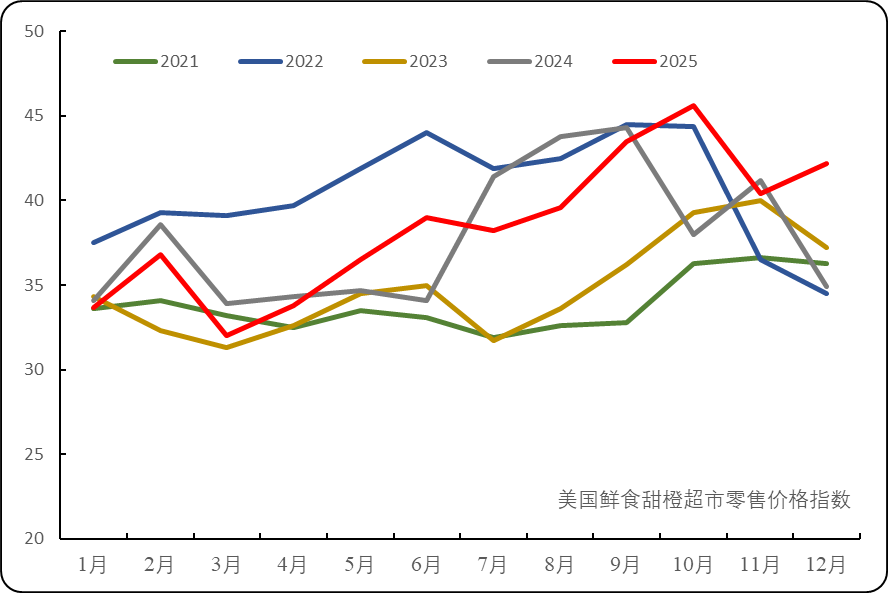
Group 1 - The global orange juice production and sales have shown significant growth in January, driven by festive demand, leading to a slight recovery in fresh orange market prices [1] - The differences in import and export trade among major markets are key factors affecting fresh orange market price fluctuations [1] - The U.S. fresh orange market is experiencing a strong price trend due to increased export expectations, while the EU market is facing downward pressure from low-priced Egyptian oranges [1][2] Group 2 - The USDA-FAS reports that U.S. orange juice consumption is expected to rise to 440,000 tons in the 2025/2026 season, a 6.80% increase from the previous year, while fresh orange exports are projected to reach 330,000 tons, up 0.92% [2] - The average retail price of fresh sweet oranges in the U.S. increased by 4.46% month-on-month and 20.92% year-on-year as of December [2] - Global orange juice production is forecasted at 1.351 million tons for the 2025/2026 season, a modest increase of 1.10 million tons, while consumption is expected to rise by 44,000 tons to 1.168 million tons [3] Group 3 - The EU's import of sweet oranges surged by 420.15% month-on-month in January, primarily due to increased imports from Egypt, although year-on-year figures remain low [5][7] - The wholesale average price of fresh sweet oranges in the EU was €94.00 per 100 kg in January, reflecting a 1.05% decrease month-on-month but a 1.84% increase year-on-year [7] - The EU's internal supply of sweet oranges remains dominant, with imports primarily aimed at addressing regional shortages [10] Group 4 - In China, the fresh orange market saw a temporary price increase leading up to the Spring Festival, with the wholesale price of citrus fruits rising by 3.74% month-on-month [11] - The out-of-factory price index for frozen concentrated orange juice in China increased by 6.33% during the month, indicating a strengthening market [11] - The search index for orange juice products has shown a positive trend, suggesting a potential increase in consumer demand [12][14]