
China Life(601628)

Search documents
中国人寿(601628):盈利超预期高增,NBV增幅进一步走阔:——中国人寿(601628.SH、2628.HK)2025年三季报点评
EBSCN· 2025-10-31 03:08
Investment Rating - The report maintains a "Buy" rating for both A-shares and H-shares of the company [1][6]. Core Views - The company reported a significant increase in profit, with a net profit of 167.8 billion yuan for the first three quarters of 2025, representing a year-on-year growth of 60.5% [4]. - The new business value (NBV) showed a robust year-on-year increase of 41.8%, indicating strong growth potential [5]. - The company is focusing on value creation and transformation, with ongoing marketing system reforms and a shift towards floating income-type products [6]. Financial Performance - For the first three quarters of 2025, the company achieved an operating income of 537.9 billion yuan, up 25.9% year-on-year [4]. - The return on equity (ROE) reached 29.3%, an increase of 9.3% compared to the previous year [4]. - The annualized total investment return rate improved by 1.0 percentage point to 6.4% [5]. Business Development - The company’s premium income for the first three quarters was 669.65 billion yuan, reflecting a 10.1% increase year-on-year [5]. - The new single premium income was 218.03 billion yuan, with a year-on-year growth of 10.4% [5]. - The company’s sales force remained robust, with a total of 657,000 sales personnel, maintaining its leading position in the industry [4]. Profit Forecast and Valuation - The profit forecast for the company has been revised upwards, with expected net profits of 173.8 billion yuan, 189.4 billion yuan, and 206.7 billion yuan for 2025, 2026, and 2027 respectively [6][8]. - The current price-to-earnings (P/E) ratio for A-shares is 7.22, while for H-shares it is 3.75, indicating attractive valuation levels [8].

中国人寿(601628)3Q25业绩回顾:投资领跑、负债结构优化、净资产大幅增长
Xin Lang Cai Jing· 2025-10-31 02:27
Core Viewpoint - China Life's performance in the first three quarters of 2025 exceeded expectations, driven by significant gains in equity investment returns and a strong increase in net profit [1][2]. Financial Performance - For the first nine months of 2025, the company's net profit attributable to shareholders increased by 60.5% year-on-year to 167.8 billion yuan, with a corresponding increase of 91.5% year-on-year in Q3 2025 to 126.87 billion yuan [1][2]. - The total investment return rate for the company reached 6.42%, an increase of 1.04 percentage points year-on-year [2]. Business Development Trends - New business value saw a significant increase, with new single premiums rising by 10.4% year-on-year to 218.034 billion yuan, and comparable new business value (NBV) increasing by 41.8% [2]. - The proportion of floating income products in the first-year premium income rose significantly by over 45 percentage points, indicating a rapid transition towards dividend insurance [2]. - The individual insurance sales workforce stabilized, with 607,000 sales personnel in Q3 2025, reflecting a recovery trend compared to earlier in the year [2]. Profit Forecast and Valuation - China Life A/H shares are currently trading at 0.80x/0.41x 2025e P/EV. The earnings forecast for 2025 and 2026 has been raised by 122.4% and 77.9% to 176.12 billion yuan and 140.56 billion yuan, respectively [3]. - The target price for A/H shares has been increased by 21% and 41% to 46.6 yuan and 34.4 HKD, respectively, indicating potential upside of 5.0% and 39.2% from current prices [3].
中国人寿(601628.SH):2025年三季报净利润为1678.04亿元、同比较去年同期上涨60.54%
Xin Lang Cai Jing· 2025-10-31 01:56
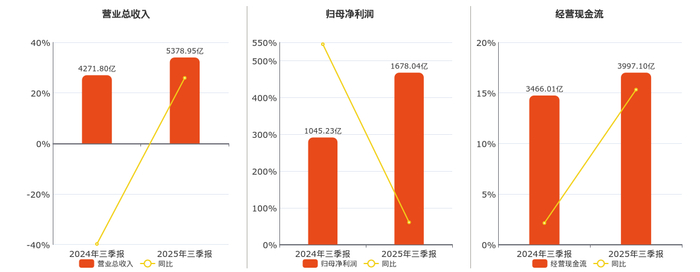
2025年10月31日,中国人寿(601628.SH)发布2025年三季报。 公司最新资产负债率为91.39%,较上季度资产负债率减少1.27个百分点。 公司最新ROE为26.81%,在已披露的同业公司中排名第2,较去年同期ROE增加8.37个百分点。 公司摊薄每股收益为5.94元,在已披露的同业公司中排名第2,较去年同报告期摊薄每股收益增加2.24 元,实现2年连续上涨,同比较去年同期上涨60.54%。 公司最新总资产周转率为0.08次,较去年同期总资产周转率增加0.01次,同比较去年同期上涨7.67%。 公司营业总收入为5378.95亿元,在已披露的同业公司中排名第2,较去年同报告期营业总收入增加 1107.15亿元,实现2年连续上涨,同比较去年同期上涨25.92%。归母净利润为1678.04亿元,在已披露 的同业公司中排名第1,较去年同报告期归母净利润增加632.81亿元,实现3年连续上涨,同比较去年同 期上涨60.54%。经营活动现金净流入为3997.10亿元,在已披露的同业公司中排名第1,较去年同报告期 经营活动现金净流入增加531.09亿元,实现5年连续上涨,同比较去年同期上涨15.32%。 公司 ...

中国人寿(601628):净利润和NBV环比显著提速 业务结构持续优化
Xin Lang Cai Jing· 2025-10-31 00:30
Core Insights - China Life Insurance reported strong performance for 9M25, with net profit reaching 167.8 billion yuan, a year-on-year increase of 60.5% [1][2] - The company's net assets at the end of 9M25 were 625.8 billion yuan, reflecting a 22.8% increase from the beginning of the year [1][2] - New Business Value (NBV) grew by 41.8% year-on-year, driven by a significant increase in new premium sales [2] Financial Performance - The net profit for 3Q25 was 126.87 billion yuan, marking a 91.5% year-on-year increase, attributed to market gains and effective investment strategies [1] - Total investment income for 9M25 was 137.1 billion yuan, a substantial increase of 454% year-on-year, with an overall investment return rate of 6.42%, up by 1.04 percentage points [1][2] - Total premiums reached 669.65 billion yuan, a 10.1% year-on-year increase, with new premiums at 218 billion yuan, up 10.4% [1][2] Business Development - The company’s product structure is diversifying, with the proportion of new premiums from life, annuity, and health insurance being 31.95%, 32.47%, and 31.15% respectively [2] - The share of flexible premium products in first-year premiums increased by over 45 percentage points year-on-year, indicating a shift towards more balanced business operations [2] Capital Position - The net assets increased by 22.8% year-to-date and 19.5% quarter-on-quarter, supported by rising interest rates that released insurance contract liabilities [2] - The core and comprehensive solvency ratios were 137.5% and 183.94% respectively, showing stability despite slight declines [2] Investment Outlook - The company maintains a strong buy recommendation, with projected net profits for 2025-2027 of 178.7 billion yuan, 181.5 billion yuan, and 184.7 billion yuan, reflecting growth rates of 67.1%, 1.5%, and 1.8% respectively [3] - Expected NBV for the same period is 46.9 billion yuan, 51.2 billion yuan, and 54.4 billion yuan, with growth rates of 39.3%, 9.1%, and 6.3% [3] - The current closing price corresponds to dynamic P/EV ratios of 0.75, 0.67, and 0.60 for 2025-2027 [3]
4260亿元,历史新高!五大险企盈利,劲升超千亿
证券时报· 2025-10-31 00:11
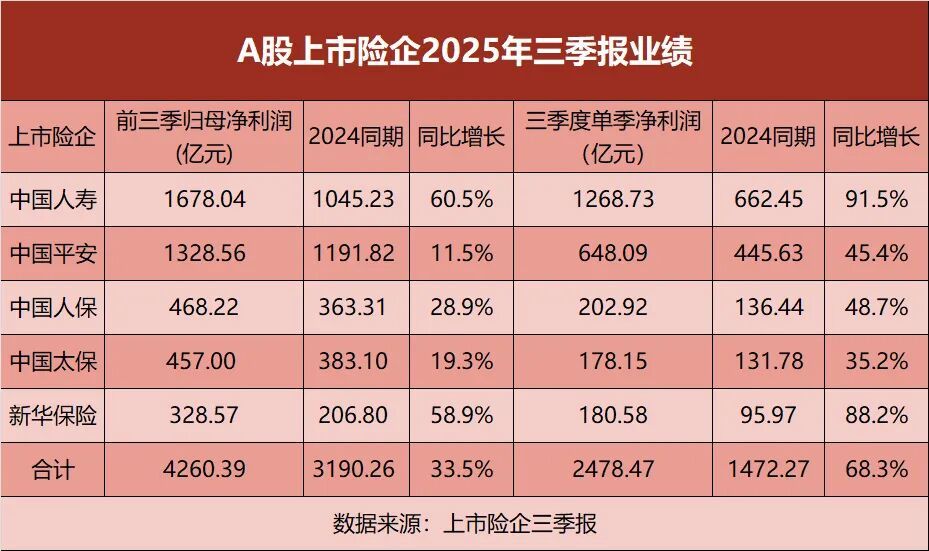
Core Viewpoint - The profitability of major listed insurance companies in China has reached a record high, with a significant increase in net profit for the first three quarters of 2025 compared to the previous year, driven by strong investment returns and stable performance in the liability sector [1][3][4]. Group 1: Profit Performance - The five major listed insurance companies achieved a total net profit of 426.04 billion yuan in the first three quarters of 2025, an increase of over 100 billion yuan, representing a growth rate of 33.5% compared to the same period last year [1][6]. - In the third quarter alone, the net profit of these companies grew by 68.3% year-on-year, showcasing a remarkable performance [2][4]. - Individual company performances include: - China Life: 167.80 billion yuan, up 60.5% [3][6]. - New China Life: 32.86 billion yuan, up 58.9% [3][6]. - China Pacific: 45.70 billion yuan, up 19.3% [3][6]. - China Ping An: 132.86 billion yuan, up 11.5% [3][6]. - China Property: 46.82 billion yuan, up 28.9% [3][6]. Group 2: Investment Returns - The primary driver of the strong profit performance is the significant increase in investment returns, with companies actively increasing their equity investments to capitalize on favorable market conditions [7][8]. - China Life reported total investment income of 368.55 billion yuan, a year-on-year increase of 41.0% [7]. - China Ping An's investment portfolio achieved a non-annualized comprehensive investment return rate of 5.4%, up 1.0 percentage points year-on-year [7]. - New China Life reported an annualized total investment return rate of 8.6% for the first three quarters [8]. Group 3: Liability Sector Stability - The stability in the liability sector has also contributed to the overall performance, with China Life achieving total premiums of 669.65 billion yuan, a growth of 10.1% [9]. - New business value for Ping An's life and health insurance segment increased by 46.2% [9]. - The shift towards floating income products is expected to enhance investment strategies and improve future profitability [9].





投资负债两端发力 五大上市险企前三季净利同比增逾三成
Zhong Guo Zheng Quan Bao· 2025-10-30 23:26
Core Insights - The five major listed insurance companies in A-shares reported impressive results for the third quarter, with a combined net profit exceeding 420 billion yuan, representing a nearly 34% year-on-year growth [1] Group 1: Profit Growth - All five major listed insurance companies achieved positive growth in net profit for the first three quarters, with specific figures as follows: China Life 167.8 billion yuan (up 60.5%), Ping An 132.9 billion yuan (up 11.5%), PICC 46.8 billion yuan (up 28.9%), China Pacific 45.7 billion yuan (up 19.3%), and New China Life 32.9 billion yuan (up 58.9%) [2] - In the third quarter alone, China Life reported a net profit of 126.9 billion yuan, marking a 91.5% increase, the highest among the five companies, while New China Life's net profit reached 18.1 billion yuan, up 88.2% [2] Group 2: Investment Performance - New China Life achieved an annualized total investment return of 8.6% and a comprehensive investment return of 6.7% for the first three quarters, while China Life's total investment income was 368.6 billion yuan, up 41.0%, with a total investment return rate of 6.42% [3] - PICC reported a total investment income of 86.3 billion yuan, up 35.3%, with a total investment return rate of 5.4% [3] Group 3: Asset Allocation - By the end of the third quarter, the total investment assets of the five major listed insurance companies exceeded 20 trillion yuan, with each company showing growth compared to the beginning of the year [4] - China Life's investment assets reached 7.28 trillion yuan, up 10.2%; Ping An's investment assets exceeded 6.41 trillion yuan, up 11.9%; and PICC's total investment assets were 1.83 trillion yuan, up 11.2% [4] Group 4: Business Transformation - The insurance companies are actively promoting product and business structure transformation, with significant improvements in new business value. For instance, China Life's new business value increased by 41.8% year-on-year [6] - New China Life reported a 50.8% increase in new business value, driven by growth in first-year premium income and improved business quality [6] Group 5: Property Insurance Performance - In the property insurance sector, several companies reported improved underwriting profits and optimized comprehensive cost ratios. For example, PICC's property insurance achieved an underwriting profit of 14.9 billion yuan, up 130.7%, with a comprehensive cost ratio of 96.1%, down 2.1 percentage points [7] - Ping An's property insurance reported a comprehensive cost ratio of 97.0%, improving by 0.8 percentage points, with an operating profit of 15.1 billion yuan, up 8.3% [7]
中国人寿:10月30日召开董事会会议
Mei Ri Jing Ji Xin Wen· 2025-10-30 23:02
Group 1 - The core point of the article is that China Life Insurance (SH 601628) held its 21st meeting of the 8th Board of Directors on October 30, 2025, in Beijing, where it reviewed the proposal for the company's Q3 2025 report [1] - For the first half of 2025, the revenue composition of China Life Insurance is as follows: life insurance business accounted for 183.56%, health insurance business accounted for 33.0%, and accident insurance business accounted for 2.92% [1]
资负联动深化 中国人寿前三季度归母净利润同比增长60.5%
Zhong Guo Jing Ying Bao· 2025-10-30 22:50
Group 1 - The core viewpoint of the report indicates that China Life achieved significant growth in revenue and net profit for the first three quarters of 2025, with operating income reaching 537.895 billion yuan, a year-on-year increase of 25.9%, and net profit attributable to shareholders amounting to 167.804 billion yuan, up 60.5% [1][4] - Total premium income for the first three quarters of 2025 reached 669.645 billion yuan, reflecting a year-on-year growth of 10.1%. This includes renewal premiums of 451.611 billion yuan, up 10.0%, and new single premiums of 218.034 billion yuan, which increased by 10.4% [1] - The total investment income for the first three quarters of 2025 was 368.551 billion yuan, an increase of 107.132 billion yuan compared to the same period in 2024, representing a growth rate of over 40%. The total investment return rate was 6.42%, up 104 basis points year-on-year [1] Group 2 - China Life has been actively reforming its marketing system, focusing on the professionalization and vocational transformation of its sales team. As of September 30, 2025, the total sales force reached 657,000, with individual insurance sales personnel numbering 607,000, maintaining the largest scale in the industry [1] - The company has established three major elderly care product lines, including CCRC elderly communities, urban elderly apartments, and health tourism products. As of June 30, 2025, it has launched 19 institutional elderly care projects across 15 cities and introduced four "flexible living" travel products [2]
4260亿元,历史新高,五大险企盈利劲升超千亿
Zheng Quan Shi Bao· 2025-10-30 22:34
Core Insights - The five major A-share listed insurance companies in China achieved a record net profit of 426.04 billion yuan in the first three quarters of 2025, marking a year-on-year increase of over 100 billion yuan and a growth rate of 33.5% [1][3] - The net profit for the third quarter alone saw a remarkable year-on-year growth of 68.3% [1][3] Financial Performance - China Life reported a net profit of 167.80 billion yuan for the first three quarters, up 60.5% year-on-year, with a third-quarter profit of 126.87 billion yuan, reflecting a 91.5% increase [3][4] - Ping An's net profit for the first three quarters was 132.86 billion yuan, a growth of 11.5%, with a third-quarter profit of 64.81 billion yuan, up 45.4% [3][4] - China Pacific Insurance achieved a net profit of 45.70 billion yuan, growing 19.3% year-on-year, with a third-quarter profit of 17.82 billion yuan, up 35.2% [3][4] - New China Life reported a net profit of 32.86 billion yuan, a 58.9% increase, with a third-quarter profit of 18.06 billion yuan, reflecting an 88.2% growth [3][4] - China Property & Casualty Insurance's net profit was 46.82 billion yuan, up 28.9%, with a third-quarter profit of 20.29 billion yuan, a 48.7% increase [3][4] Investment Performance - The significant increase in profits is attributed to a surge in investment income, with China Life reporting total investment income of 368.55 billion yuan, a year-on-year increase of 41.0% [5][6] - Ping An's investment portfolio achieved a non-annualized comprehensive investment return of 5.4%, up 1.0 percentage points year-on-year [6][7] - China Property & Casualty Insurance reported total investment income of 86.25 billion yuan, a 35.3% increase [6][7] - New China Life's annualized total investment return was 8.6%, with a comprehensive investment return of 6.7% [7] Premium Growth - China Life's total premium income reached 669.65 billion yuan, a 10.1% increase, with all premium categories showing double-digit growth [8] - Ping An's new business value in life and health insurance was 35.72 billion yuan, up 46.2% year-on-year [8] - China Pacific Insurance's total premium income was 263.86 billion yuan, a 14.2% increase, with new business value growing by 7.7% [8]
五大上市险企前三季净利同比增逾三成
Zhong Guo Zheng Quan Bao· 2025-10-30 21:12
Core Insights - The five major listed insurance companies in A-shares reported a significant increase in net profit for the first three quarters, achieving a total of over 420 billion yuan, representing a year-on-year growth of nearly 34% [1][2] Investment Performance - The five major insurance companies saw positive growth in net profit, with China Life, Ping An, PICC, China Pacific, and New China Life reporting net profits of 167.8 billion yuan, 132.9 billion yuan, 46.8 billion yuan, 45.7 billion yuan, and 32.9 billion yuan respectively, with year-on-year growth rates of 60.5%, 11.5%, 28.9%, 19.3%, and 58.9% [1][2] - In Q3 alone, China Life achieved a net profit of 126.9 billion yuan, marking a year-on-year increase of 91.5%, the highest among the five companies [1] Investment Strategy - The five major insurance companies increased their investment in the equity market, with total investment assets exceeding 20 trillion yuan by the end of Q3, showing growth from the beginning of the year [2][3] - China Life's investment assets reached 7.28 trillion yuan, up 10.2% from the start of the year, while Ping An's investment portfolio exceeded 6.41 trillion yuan, growing by 11.9% [2] Asset Allocation - Companies optimized their asset allocation in response to market conditions, increasing long-duration bond investments and focusing on undervalued, high-dividend, and growth-oriented equity investments [3][4] - China Ping An emphasized a disciplined approach to strategic asset allocation while flexibly adjusting tactical strategies to enhance long-term investment returns [3] New Business Value - The new business value in life insurance continued to improve, with China Life reporting a 41.8% year-on-year increase in new business value, while New China Life saw a 50.8% increase due to growth in first-year premiums and improved business quality [4][5] - The proportion of participating insurance products increased significantly, with China Life reporting a substantial rise in floating income-type business in first-year premiums [5] Property Insurance Performance - The comprehensive cost ratio for property insurance improved, leading to enhanced underwriting profits. For instance, PICC's property insurance achieved an underwriting profit of 14.9 billion yuan, a year-on-year increase of 130.7% [5]