China Life(601628)

Search documents
日赚超6亿,“寿险一哥”中国人寿是怎么做到的?
Jing Ji Guan Cha Bao· 2025-10-31 06:43
Core Insights - China Life Insurance Company reported a strong growth in new business value by 41.8% for the first three quarters of 2025, with net profit exceeding 167.8 billion yuan, marking a 60.5% increase year-on-year [1][2] Group 1: Financial Performance - The company achieved a daily profit of 614 million yuan during the first three quarters [2] - Total premium income reached 669.645 billion yuan, reflecting a year-on-year growth of 10.1%, with renewal premiums at 451.611 billion yuan and new single premiums at 218.034 billion yuan, both showing positive growth [4][5] - Total investment income for the first three quarters was 368.551 billion yuan, an increase of 40% compared to the same period in 2024, with an investment yield of 6.42% [6] Group 2: Business Strategy - The significant increase in net profit is attributed to the diversification of liability-side business and enhanced investment income from the asset side [3] - The company has focused on floating income products, which have increased their share in first-year premiums by over 45 percentage points compared to the previous year, helping to lower liability costs [6] - The company has actively invested in the equity market, which has contributed to the overall increase in investment income, coinciding with a 15.84% rise in the Shanghai Composite Index [6]

中国人寿(601628):9M25业绩点评:利润激增价值加速资负改善弹性充足
ZHONGTAI SECURITIES· 2025-10-31 06:33
Investment Rating - The report maintains a "Buy" rating for the company, indicating an expected relative performance increase of over 15% against the benchmark index in the next 6 to 12 months [22] Core Insights - The company achieved a significant increase in net profit for the first nine months of 2025, reaching 167.8 billion yuan, a year-on-year growth of 60.5%, which aligns with previous expectations [6][21] - The report highlights that the company's insurance service income increased by 2.3% year-on-year, while the insurance service performance saw a substantial growth of 73.8% compared to the previous year [6] - The report emphasizes the improvement in investment returns, with an annualized total investment return rate of 6.42%, up by 104 basis points year-on-year, and total investment income increasing by 41.0% [6][21] - The company is actively enhancing its asset allocation structure and increasing equity investments to capitalize on market opportunities, which has led to a significant rise in investment income [6][21] Summary by Sections Financial Performance - The company reported a net profit of 167.8 billion yuan for 9M25, reflecting a 60.5% increase year-on-year [6] - The net profit for 2025 is projected to be 99.44 billion yuan, with a year-on-year growth rate of -7.0% for 2025, followed by 19.8% and 18.6% in 2026 and 2027 respectively [4][21] - The earnings per share (EPS) for 2025 is estimated at 3.52 yuan, with a projected increase to 5.00 yuan by 2027 [4][21] Investment Strategy - The company is focusing on long-term investments and optimizing its asset allocation to enhance returns, particularly in equity markets [6] - The report notes a significant increase in new business value (NBV), with a year-on-year growth of 41.8% for 9M25, driven by a 10.4% increase in new single premiums [6][21] Market Context - The report indicates that the A-share market has shown a "slow bull" trend since April 2025, with the CSI 300 index rising approximately 18% in the first nine months of 2025 [6] - The company’s net assets reached 625.83 billion yuan, marking a 22.8% increase from the beginning of the year, attributed to the continuous release of net profits and improvements in the evaluation of contract liabilities [6][21]
中国人寿(601628)9M25业绩点评:利润激增价值加速资负改善弹性充足
Xin Lang Cai Jing· 2025-10-31 06:30
Core Viewpoint - China Life Insurance reported a significant increase in net profit for Q3 2025, achieving 167.8 billion yuan, a year-on-year growth of 60.5%, aligning with previous forecasts of a 50% to 70% increase [1] Group 1: Financial Performance - In the first nine months of 2025, the company saw insurance service revenue increase by 2.3%, with a substantial year-on-year growth of 73.8% in insurance service performance, recovering from a decline of 18.1% in the first half of 2025 [3] - The annualized total investment return for the first nine months of 2025 was 6.42%, an increase of 104 basis points year-on-year, with total investment income rising by 41.0% [3] - The company's net assets reached 625.83 billion yuan, marking a year-to-date increase of 22.8% and a 19.5% increase compared to the first half of 2025, the highest since the implementation of new accounting standards [3] Group 2: Investment Strategy - The company is actively increasing equity investments and optimizing asset allocation to capture market opportunities, leading to a significant rise in investment income [4] - The company has focused on enhancing value creation and efficiency, with a notable improvement in the new business value (NBV), which grew by 41.8% year-on-year in the first nine months of 2025 [5] Group 3: Sales and Marketing - The company achieved new single premium income of 218.03 billion yuan, a year-on-year increase of 10.4%, with a quarterly growth rate of 52.5% in Q3 2025, attributed to the release of customer demand and proactive product launches [5] - The total sales force was 657,000, showing a year-on-year decrease of 5.3% but a quarter-on-quarter increase of 2.5%, indicating stability in the sales team [5] Group 4: Future Outlook - Based on the Q3 performance, the company has adjusted its profit forecasts for 2025-2027, expecting net profits of 99.44 billion, 119.10 billion, and 141.24 billion yuan, with year-on-year growth rates of -7.0%, 19.8%, and 18.6% respectively [6]
中国人寿发布三季报,总资产、投资资产双双超过7.2万亿
Huan Qiu Wang· 2025-10-31 06:30
Core Viewpoint - China Life Insurance Company reported strong growth in new business value and net profit for the first three quarters of 2025, demonstrating resilience and market leadership in the insurance sector [1][2]. Financial Performance - New business value increased by 41.8% year-on-year - Net profit attributable to shareholders exceeded 167.8 billion yuan, a 60.5% increase from the previous year - Shareholder equity reached 625.83 billion yuan, up 22.8% from the end of the previous year - Total assets amounted to 7.42 trillion yuan, with investment assets growing by 10.2% to 7.28 trillion yuan [1][2]. Business Growth - Total premiums reached 669.65 billion yuan, a 10.1% increase year-on-year, with new single premiums at 218.03 billion yuan, up 10.4% - The company achieved double-digit growth in total premiums, new single premiums, and renewal premiums, setting a historical high for the same period [2]. Asset and Liability Management - The company focused on value creation and efficiency, enhancing asset-liability management - Total investment income for the first three quarters was 368.55 billion yuan, an increase of 107.13 billion yuan, with an investment return rate of 6.42%, up 104 basis points year-on-year [3][4]. Product and Service Innovation - China Life diversified its product offerings, with new single premium contributions from life insurance, annuities, and health insurance at 31.95%, 32.47%, and 31.15% respectively - The company introduced various innovative insurance products targeting health and retirement needs, including long-term disability income insurance and specialized products for small businesses [5][6]. Digital Transformation - The company is advancing its digital strategy, enhancing customer experience through a revamped app and intelligent claims processing - The digital claims service saw over 4.8 million claims paid, with a total payout of 160.9 billion yuan, and a significant portion of claims processed through digital means [6][7][8]. ESG and Sustainable Development - China Life integrates ESG principles into its operations, focusing on environmentally friendly investments and social responsibility - The company received an upgraded ESG rating from MSCI, reflecting its commitment to sustainable practices and governance [8][9].
大行评级丨瑞银:中国人寿首九个月新业务价值超预期 评级“买入”
Ge Long Hui· 2025-10-31 06:21
瑞银发表研究报告指,中国人寿首九个月新业务价值按年升42%,好过市场预期;除税后净利润增61% 至1680亿元,处于早前盈利预告的中位。该行表示,随着今年新业务价值增长强劲,国寿对明年的前景 持更建设性态度。该行予其"买入"评级,H股目标价为29港元。 ...
中国人寿:前三季度新业务价值强劲增长41.8%
Ren Min Wang· 2025-10-31 04:01
Core Insights - China Life Insurance Company reported strong performance in the first three quarters of 2025, with a significant increase in new business value and net profit, indicating robust business growth and operational efficiency [1][2] Financial Performance - New business value grew by 41.8% year-on-year - Net profit attributable to shareholders exceeded 167.8 billion yuan, a 60.5% increase from the previous year - Shareholder equity reached 625.83 billion yuan, up 22.8% from the end of the previous year - Total assets amounted to 7,417.98 billion yuan, with investment assets at 7,282.98 billion yuan, reflecting growth of 9.6% and 10.2% respectively [1][2] Business Growth - Total premium income reached 669.65 billion yuan, a year-on-year increase of 10.1% - New single premium income was 218.03 billion yuan, up 10.4% - All premium categories, including total premium, new single premium, and renewal premium, achieved double-digit growth [2] Asset-Liability Management - The company focused on value creation and efficiency improvement, enhancing the linkage between assets and liabilities - New single premium proportions for life insurance, annuity insurance, and health insurance were 31.95%, 32.47%, and 31.15% respectively, indicating balanced development - Total investment income reached 368.55 billion yuan, an increase of 107.13 billion yuan, with an investment yield of 6.42% [3] Product and Service Development - China Life introduced various innovative insurance products, including long-term disability income insurance and maternal and infant disease insurance - The company expanded its commercial annuity product system to meet diverse retirement needs, providing risk coverage of approximately 27 trillion yuan for small and micro enterprises and individual businesses [4] Customer Experience Enhancement - The company developed a comprehensive digital claims service system, with over 48 million claims processed in the first half of 2025 - The introduction of AI-driven services improved underwriting efficiency and customer service response rates [6][7] Digital Transformation - China Life is advancing its digital strategy, enhancing its data management capabilities and achieving international standards in data center operations - The company received multiple accolades for its innovation in financial technology and data management [8] ESG Governance - The company integrates ESG principles into its operations, focusing on sustainable development and green finance - Investments in green projects and the promotion of inclusive insurance products are part of its strategy to support national economic and social transformation [9]
中国人寿:拟出资20亿元投资股权投资计划
Cai Jing Wang· 2025-10-31 03:55
Group 1 - The core point of the article is that China Life Insurance announced plans to invest a total of RMB 2.01 billion in the establishment of the Guoshou Investment-Yuan Zhi Fund Equity Investment Plan, aimed at enhancing investment returns from insurance funds while supporting the real economy [1] Group 2 - China Life and Guoshou Industrial Investment Co., Ltd. will subscribe RMB 2 billion and RMB 10 million respectively to the equity investment plan [1] - The total amount raised for the equity investment plan is RMB 2.01 billion, with a duration of 6 years and a possible extension of 2 years [1] - The funds will primarily be invested in limited partnership shares within enterprises focusing on sectors such as semiconductors, digital energy, and smart electric vehicles [1] - The main objective of this transaction is to implement the decisions of the central government, providing financial services to the real economy and improving the investment returns of insurance funds [1]


中国人寿(601628):盈利超预期高增,NBV增幅进一步走阔:——中国人寿(601628.SH、2628.HK)2025年三季报点评
EBSCN· 2025-10-31 03:08
Investment Rating - The report maintains a "Buy" rating for both A-shares and H-shares of the company [1][6]. Core Views - The company reported a significant increase in profit, with a net profit of 167.8 billion yuan for the first three quarters of 2025, representing a year-on-year growth of 60.5% [4]. - The new business value (NBV) showed a robust year-on-year increase of 41.8%, indicating strong growth potential [5]. - The company is focusing on value creation and transformation, with ongoing marketing system reforms and a shift towards floating income-type products [6]. Financial Performance - For the first three quarters of 2025, the company achieved an operating income of 537.9 billion yuan, up 25.9% year-on-year [4]. - The return on equity (ROE) reached 29.3%, an increase of 9.3% compared to the previous year [4]. - The annualized total investment return rate improved by 1.0 percentage point to 6.4% [5]. Business Development - The company’s premium income for the first three quarters was 669.65 billion yuan, reflecting a 10.1% increase year-on-year [5]. - The new single premium income was 218.03 billion yuan, with a year-on-year growth of 10.4% [5]. - The company’s sales force remained robust, with a total of 657,000 sales personnel, maintaining its leading position in the industry [4]. Profit Forecast and Valuation - The profit forecast for the company has been revised upwards, with expected net profits of 173.8 billion yuan, 189.4 billion yuan, and 206.7 billion yuan for 2025, 2026, and 2027 respectively [6][8]. - The current price-to-earnings (P/E) ratio for A-shares is 7.22, while for H-shares it is 3.75, indicating attractive valuation levels [8].
中国人寿(601628)3Q25业绩回顾:投资领跑、负债结构优化、净资产大幅增长
Xin Lang Cai Jing· 2025-10-31 02:27
Core Viewpoint - China Life's performance in the first three quarters of 2025 exceeded expectations, driven by significant gains in equity investment returns and a strong increase in net profit [1][2]. Financial Performance - For the first nine months of 2025, the company's net profit attributable to shareholders increased by 60.5% year-on-year to 167.8 billion yuan, with a corresponding increase of 91.5% year-on-year in Q3 2025 to 126.87 billion yuan [1][2]. - The total investment return rate for the company reached 6.42%, an increase of 1.04 percentage points year-on-year [2]. Business Development Trends - New business value saw a significant increase, with new single premiums rising by 10.4% year-on-year to 218.034 billion yuan, and comparable new business value (NBV) increasing by 41.8% [2]. - The proportion of floating income products in the first-year premium income rose significantly by over 45 percentage points, indicating a rapid transition towards dividend insurance [2]. - The individual insurance sales workforce stabilized, with 607,000 sales personnel in Q3 2025, reflecting a recovery trend compared to earlier in the year [2]. Profit Forecast and Valuation - China Life A/H shares are currently trading at 0.80x/0.41x 2025e P/EV. The earnings forecast for 2025 and 2026 has been raised by 122.4% and 77.9% to 176.12 billion yuan and 140.56 billion yuan, respectively [3]. - The target price for A/H shares has been increased by 21% and 41% to 46.6 yuan and 34.4 HKD, respectively, indicating potential upside of 5.0% and 39.2% from current prices [3].
中国人寿(601628.SH):2025年三季报净利润为1678.04亿元、同比较去年同期上涨60.54%
Xin Lang Cai Jing· 2025-10-31 01:56
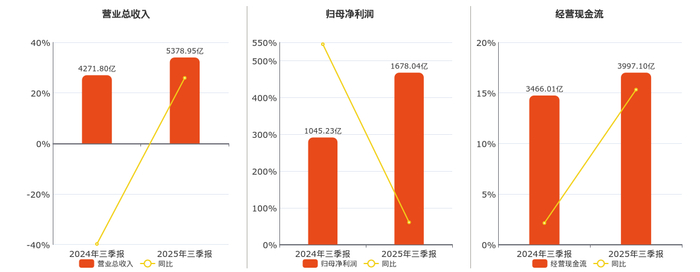
2025年10月31日,中国人寿(601628.SH)发布2025年三季报。 公司最新资产负债率为91.39%,较上季度资产负债率减少1.27个百分点。 公司最新ROE为26.81%,在已披露的同业公司中排名第2,较去年同期ROE增加8.37个百分点。 公司摊薄每股收益为5.94元,在已披露的同业公司中排名第2,较去年同报告期摊薄每股收益增加2.24 元,实现2年连续上涨,同比较去年同期上涨60.54%。 公司最新总资产周转率为0.08次,较去年同期总资产周转率增加0.01次,同比较去年同期上涨7.67%。 公司营业总收入为5378.95亿元,在已披露的同业公司中排名第2,较去年同报告期营业总收入增加 1107.15亿元,实现2年连续上涨,同比较去年同期上涨25.92%。归母净利润为1678.04亿元,在已披露 的同业公司中排名第1,较去年同报告期归母净利润增加632.81亿元,实现3年连续上涨,同比较去年同 期上涨60.54%。经营活动现金净流入为3997.10亿元,在已披露的同业公司中排名第1,较去年同报告期 经营活动现金净流入增加531.09亿元,实现5年连续上涨,同比较去年同期上涨15.32%。 公司 ...