China Life(601628)

Search documents
方舟奖揭晓! 中国人寿斩获高质量发展与普惠金融实践两项大奖
Mei Ri Shang Bao· 2025-12-01 23:27
Core Insights - China Life Insurance Company has won two prestigious awards at the 2025 China Financial Institutions Annual Conference, recognizing its excellence in high-quality development and inclusive finance [1] Group 1: Financial Performance - In the first three quarters, China Life achieved total premiums of 669.645 billion yuan, a year-on-year increase of 10.1%, with new premiums reaching 218.034 billion yuan, up 10.4% [1] - The new business value saw a robust growth of 41.8% during the same period [2] - The net profit attributable to shareholders exceeded 167.8 billion yuan, marking a 60.5% increase compared to the same period last year [2] - Shareholder equity reached 625.828 billion yuan, reflecting a 22.8% growth from the end of the previous year [2] - The solvency ratios remained strong, with a core solvency adequacy ratio of 137.50% and a comprehensive solvency adequacy ratio of 183.94% [2] - The company has maintained an A rating in the comprehensive risk assessment for 29 consecutive quarters [2] Group 2: Social Responsibility and Inclusive Finance - China Life emphasizes social responsibility by diversifying its inclusive insurance and services [3] - As of mid-2025, 327 million effective long-term policies cover urban and rural areas, with customized commercial health insurance benefiting ordinary families in over 140 cities [3] - The company has significantly increased personal pension premiums, with nearly 4 trillion yuan in annuity reserves to strengthen retirement security [3] - Focused on key groups such as the elderly, small and micro enterprises, and rural areas, the company offers tailored products and solutions [3] - In the first half of 2025, risk protection for small and micro enterprises and individual businesses amounted to approximately 27 trillion yuan, demonstrating a commitment to inclusive finance [3]

2025年寿险公司净资产的运营变化
13个精算师· 2025-12-01 09:48
Core Viewpoint - The life insurance industry appears to be thriving with reported profits of 460 billion RMB in the first three quarters of the year, but a deeper analysis reveals a concerning decline in net assets under the CGAAP standards, indicating underlying financial pressures [1][2]. Summary by Sections 1. Changes in Net Assets under CGAAP - Despite a reported increase of 222 billion RMB in net assets for companies that disclosed third-quarter results, most life insurance companies experienced a decline in net assets under the old CGAAP standards, primarily due to rising long-term interest rates and poor performance in equity investments [2][3]. - The average return of high-dividend stocks, heavily weighted in the life insurance sector, fell significantly, with only a few companies outperforming the 18% return of the CSI 300 index in the third quarter [2][3]. 2. Implementation of New Accounting Standards (IFRS 17) - Several established life insurance companies have adopted the IFRS 17 accounting standards, leading to higher reported profits compared to the old CGAAP standards. This shift has resulted in changes in liability assessment curves that positively impact comprehensive income [3][4]. - The transition to IFRS 17 allows for the exclusion of certain losses from financial statements, enhancing the reported profitability of companies that have adopted the new standards [4][5]. 3. Net Asset Operational Changes - The operational change in net assets for the life insurance sector was negative 99 million RMB, with only 20 companies reporting positive growth. The "old seven" companies saw a 4% increase, while foreign and small domestic companies experienced declines of 16% and 11%, respectively [10][11]. - The banking-affiliated companies faced the most significant decline in net assets, with a drop of 24%, attributed to their high leverage ratios and the reclassification of HTM assets to AFS [11][12]. 4. Factors Influencing Net Asset Changes - The average yield curve for interest rates increased by 25 basis points, leading to a decline in the market value of existing AFS bonds, estimated to be a loss of 200 to 300 billion RMB for the industry [14][15]. - If the asset and liability assessment curves had remained unchanged, the net assets of the companies could have increased by 500 to 600 billion RMB, primarily driven by excess returns from equity investments [15][16]. 5. Future Implications of IFRS 17 - Starting in 2026, all insurance companies in China will implement IFRS 17, which is expected to provide better alignment between asset and liability assessment curves, potentially offering a protective effect on net assets, especially for traditional insurance products [19][21]. - The focus on duration matching will become increasingly important under the new standards, as it will significantly influence the net assets and solvency of companies in the future [18][19].




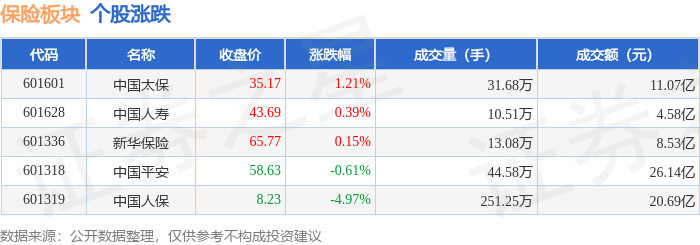
保险板块12月1日跌0.56%,中国人保领跌,主力资金净流出7194.41万元
Zheng Xing Xing Ye Ri Bao· 2025-12-01 09:09
Core Insights - The insurance sector experienced a decline of 0.56% on December 1, with China Life Insurance leading the losses [1] - The Shanghai Composite Index closed at 3914.01, up 0.65%, while the Shenzhen Component Index closed at 13146.72, up 1.25% [1] Insurance Sector Performance - China Pacific Insurance (601601) closed at 35.17, up 1.21% with a trading volume of 316,800 shares - China Life Insurance (601628) closed at 43.69, up 0.39% with a trading volume of 105,100 shares - New China Life Insurance (601336) closed at 65.77, up 0.15% with a trading volume of 130,800 shares - Ping An Insurance (601318) closed at 58.63, down 0.61% with a trading volume of 445,800 shares - China Reinsurance (601319) closed at 8.23, down 4.97% with a trading volume of 2,512,500 shares [1] Capital Flow Analysis - The insurance sector saw a net outflow of 71.94 million yuan from institutional investors, while retail investors contributed a net inflow of 25.40 million yuan [1] - The detailed capital flow for individual stocks shows: - New China Life Insurance had a net inflow of 4.39 million yuan from retail investors but a net outflow of 4.47 million yuan from institutional investors [2] - China Reinsurance experienced a net outflow of 2.03 million yuan from institutional investors and a net inflow of 131 million yuan from retail investors [2] - Ping An Insurance had a net outflow of 5.31 million yuan from institutional investors but a net inflow of 99.46 million yuan from retail investors [2]


中国人寿南宁分公司“振兴保”精准施策防返贫
Zhong Guo Jin Rong Xin Xi Wang· 2025-12-01 07:52
Core Viewpoint - China Life's Nanning branch launched a financial inclusion product "Zhenxing Bao" aimed at reducing poverty risks among key rural populations in Mashan County, Nanning, through innovative financial models and specialized insurance design [1] Group 1: Product Overview - "Zhenxing Bao" provides targeted protection against risks related to illness, education, and disasters, effectively preventing the risk of falling back into poverty [1] - During the promotion period, out of 65,000 migrant workers from the poverty alleviation population in Mashan County, 37,000 participated in the insurance, receiving over 4 billion yuan in insurance coverage [1] Group 2: Monitoring and Support - In 2024, approximately 65,000 individuals from the poverty alleviation population in Mashan County are expected to work outside the county, highlighting the need for financial support to prevent severe living difficulties due to unexpected expenses or income reductions [1] - The Nanning branch of China Life aims to enhance the effectiveness of poverty prevention monitoring and support through early detection, intervention, and assistance [1] Group 3: Subsidy Structure - The insurance premium for "Zhenxing Bao" is subsidized through a "three-point" approach: government funding contributes one point, the insured individuals contribute one point, and the insurance company waives one point, allowing participants to purchase based on personal willingness [1]
保险行业10月保费:产寿单月保费短期下滑,看好寿险开门红表现
Soochow Securities· 2025-12-01 06:04
Investment Rating - The report maintains an "Overweight" rating for the insurance industry [1] Core Insights - In October 2025, the premium income for life insurance companies decreased, but the pre-sale for the "opening red" period is progressing steadily, indicating a positive outlook for new policy premium growth [5] - The total original premium for life insurance from January to October 2025 reached 425.19 billion yuan, a year-on-year increase of 9.6%, while the scale premium was 480.10 billion yuan, up 8.8% year-on-year [5] - The report anticipates that market demand remains strong, with the attractiveness of insurance products still evident compared to bank deposits, supporting optimistic expectations for new policy premium growth [5] Summary by Sections Life Insurance - In October 2025, the original premium scale for life insurance companies was 149.1 billion yuan, down 4.6% year-on-year, with the decline attributed to companies focusing on preparations for the 2026 "opening red" period [5] - The new investment contributions from policyholders increased by 2% year-on-year, with unit-linked insurance seeing a 17% increase [5] Health Insurance - Health insurance premiums in October 2025 increased by 0.5% year-on-year, with a total year-to-date increase of 2.3% [5] - The report notes that the China Banking and Insurance Regulatory Commission's recent guidelines are expected to stimulate growth in the health insurance market [5] Property Insurance - Property insurance premiums in October 2025 decreased by 5.5% year-on-year, with both auto and non-auto insurance experiencing declines [5] - The report highlights that the growth in auto insurance premiums is expected to be supported by the increasing penetration of new energy vehicles [5] Financial Performance - The report indicates that both liabilities and assets are continuously improving, with significant upward potential in valuations [5] - The estimated valuation for the insurance sector as of November 28, 2025, is between 0.55-0.94 times PEV and 1.07-2.00 times PB, which is considered historically low [5]
六盘水金融监管分局同意撤销中国人寿盘州支公司盘关营销服务部
Jin Tou Wang· 2025-12-01 04:23
三、中国人寿保险股份有限公司六盘水分公司应做好各项善后工作,切实维护金融消费者合法权益,并 按规定进行公告。 二、接此批复文件后,中国人寿保险股份有限公司六盘水分公司应立即停止该公司一切经营活动,于15 个工作日内向六盘水金融监管分局缴回许可证,并按照有关法律法规要求办理相关手续。 2025年11月26日,六盘水金融监管分局发布批复称,《关于中国人寿(601628)保险股份有限公司六盘 水分公司申请撤销下辖营销服务部的请示》(国寿人险市发〔2025〕72号)收悉。经审核,现批复如 下: 一、同意撤销中国人寿保险股份有限公司盘州支公司盘关营销服务部。 ...
遵义金融监管分局同意撤销中国人寿绥阳支公司郑场镇营销服务部
Jin Tou Wang· 2025-12-01 04:23
一、同意撤销中国人寿保险股份有限公司绥阳支公司郑场镇营销服务部,其业务并入中国人寿保险股份 有限公司绥阳支公司。 2025年11月25日,遵义金融监管分局发布批复称,《中国人寿(601628)保险股份有限公司遵义分公司 关于撤销中国人寿保险股份有限公司绥阳支公司郑场镇营销服务部的请示》(国寿人险遵发〔2025〕 100号)收悉。经审核,现批复如下: 二、接此批复文件后,中国人寿保险股份有限公司绥阳支公司郑场镇营销服务部应立即停止一切经营活 动,于15个工作日内向遵义金融监管分局缴回许可证,并按照有关法律法规要求办理相关手续。 ...
遵义金融监管分局同意撤销中国人寿湄潭支公司永兴镇营销服务部
Jin Tou Wang· 2025-12-01 04:20
Core Viewpoint - The Zunyi Financial Regulatory Bureau has approved the dissolution of the Yongxing Town Marketing Service Department of China Life Insurance Co., Ltd. Meitan Branch, with its business being merged into the Meitan Branch [1] Group 1 - The approval document states that the Yongxing Town Marketing Service Department is to cease all business activities immediately upon receipt of the approval [1] - The Meitan Branch is required to return the operating license to the Zunyi Financial Regulatory Bureau within 15 working days and complete relevant procedures according to applicable laws and regulations [1]
中国人寿(02628) - 截至2025年11月30日止股份发行人的证券变动月报表
2025-12-01 03:00
致:香港交易及結算所有限公司 公司名稱: 中國人壽保險股份有限公司 呈交日期: 2025年12月1日 股份發行人及根據《上市規則》第十九B章上市的香港預託證券發行人的證券變動月報表 截至月份: 2025年11月30日 狀態: 新提交 I. 法定/註冊股本變動 | 1. 股份分類 | 普通股 | 股份類別 | H | | | 於香港聯交所上市 (註1) | | 是 | | | --- | --- | --- | --- | --- | --- | --- | --- | --- | --- | | 證券代號 (如上市) | 02628 | 說明 | | | | | | | | | | | 法定/註冊股份數目 | | | 面值 | | | 法定/註冊股本 | | | 上月底結存 | | | 7,441,175,000 | RMB | | | 1 RMB | | 7,441,175,000 | | 增加 / 減少 (-) | | | | | | | RMB | | | | 本月底結存 | | | 7,441,175,000 | RMB | | | 1 RMB | | 7,441,175,000 | | 2. 股份分 ...
中国人寿多家分支机构同时被罚 4家分公司财务数据不真实
Xi Niu Cai Jing· 2025-12-01 02:22
Summary of Key Points Core Viewpoint - China Life Insurance has faced multiple administrative penalties for various violations, including misleading policyholders and providing benefits outside of insurance contracts, resulting in significant fines across several branches [2][3][4][5]. Group 1: Administrative Penalties - China Life Insurance's Quanzhou branch was fined a total of 330,000 yuan for deceiving policyholders and making misleading comparisons between insurance terms and bank deposit rates [2][3]. - The head of the Quanzhou branch's marketing department, Chen Zhenyi, received a warning and was fined 97,000 yuan for his role in the violations [2][3]. - The Anxi branch was fined 100,000 yuan for inaccurate financial data, with the head, Zheng Zhirong, receiving a warning and a fine of 11,000 yuan [4]. - The Nan'an branch was penalized 180,000 yuan for similar financial inaccuracies, with manager Dai Peikun fined 30,000 yuan [4]. - The Yongchun branch faced an 110,000 yuan fine for untrue financial data, with the manager receiving a warning and a fine of 13,000 yuan [4]. - The Quanzhou district branch was fined 140,000 yuan for providing benefits outside of the contract, with deputy manager Pan Jinbian fined 45,000 yuan [4]. - The second marketing service department of the Nan'an branch was fined 120,000 yuan for inaccurate financial data, with manager Liu Jianfeng receiving a warning and a fine of 16,000 yuan [5].