PSBC(601658)

Search documents
工行、农行、中行、建行、交行、邮储银行,集体表态!
券商中国· 2025-10-26 04:51
Core Viewpoint - The six major state-owned banks in China are aligning their strategies with the spirit of the 20th National Congress, focusing on supporting economic stability and high-quality development while enhancing risk management and financial services [1][2][3][4][5][6][7][8]. Group 1: Industrial Bank Strategies - Industrial Bank emphasizes the importance of integrating domestic and international strategies, supporting high-quality development, and enhancing risk management while fulfilling its responsibilities as a major bank [2]. - Agricultural Bank focuses on serving the rural economy, increasing financial supply in rural areas, and supporting the modernization of agriculture while ensuring financial risk management [3]. - Bank of China aims to enhance its global competitiveness, optimize financial resource allocation, and support the development of a modern industrial system while promoting the internationalization of the RMB [4]. - Construction Bank is committed to supporting the development of advanced manufacturing and enhancing its financial service system to promote new quality productivity [6]. - Bank of Communications emphasizes the importance of public engagement in strategic planning and aims to contribute to economic recovery while ensuring a smooth transition between the 14th and 15th Five-Year Plans [7]. - Postal Savings Bank prioritizes high-quality development, focusing on effective financial supply to meet the evolving needs of the economy and society [8].



邮储银行广东龙川县支行用精准服务激活县域经济发展动能
Zheng Quan Ri Bao Zhi Sheng· 2025-10-25 17:10
Core Insights - Postal Savings Bank of China in Longchuan County is leveraging financial innovation to address the financing challenges in agriculture, thereby stimulating local economic development [1][3] Group 1: Agricultural Financing Innovations - The bank has developed a unique assessment model for oil tea plantations, allowing for a credit limit of 4 million yuan for a company based on the potential yield and market conditions [2] - The bank's support has enabled the expansion of oil tea plantations from 2,000 acres to 5,000 acres, resulting in a 50% annual increase in online sales of derived products [2][3] - By September 2025, the bank has provided over 120 million yuan in credit to 20 oil tea enterprises and 26 cooperatives, supporting an annual output value exceeding 1 billion yuan [2][3] Group 2: Support for Technological Innovation - The bank's "Science and Technology Credit Loan" has facilitated a company in the high-end equipment manufacturing sector to secure a 50 million yuan credit line, enabling significant advancements in production capacity and patent development [4][5] - The company’s production capacity increased from 8,000 tons to 12,000 tons, and product quality improved significantly after receiving the loan [5] Group 3: Assistance for Small and Micro Enterprises - The bank has implemented a rapid approval process for small and micro enterprises, reducing loan approval times from 15 days to 7 days, which has been crucial for companies needing to capitalize on market opportunities [6][7] - By September 2025, the bank has provided over 230 million yuan in credit to 26 small and micro enterprises, contributing to a 25% increase in their survival rates and creating over 3,000 jobs [7] Group 4: Overall Impact on Local Economy - The bank's approach emphasizes becoming a growth partner for enterprises and a supportive entity for farmers, thereby enhancing the overall quality of economic development in the region [7]

邮储银行“快服务”“暖支持”守护粮食安全
Zheng Quan Ri Bao Zhi Sheng· 2025-10-25 17:10
Core Insights - China Postal Savings Bank (Postal Bank) is actively extending financial services to support the autumn harvest, addressing urgent needs of farmers during critical weather conditions [1][2][3] - The bank has implemented an "autumn harvest financial emergency service mechanism" to expedite loan approvals and provide timely assistance to farmers [2][3] Group 1: Financial Support Initiatives - Postal Bank's Shandong branch has developed targeted service plans for the grain industry, conducting proactive outreach to identify urgent needs such as machinery leasing and funding [1] - The bank has established a "green channel" for loan processing, ensuring priority handling and expedited approvals for farmers facing challenges due to adverse weather [1][2] Group 2: Case Studies of Support - Lu Junxin, a cooperative leader in Henan, received a loan to purchase new harvesting equipment, enabling efficient grain collection during a critical weather window [2] - In Shandong, a company utilized Postal Bank's support to enhance its grain drying capacity, doubling its processing capability to meet increased demand from local farmers [2] - Yang, a large-scale grain grower in Hebei, secured a loan for harvesting and drying equipment, allowing him to assist neighboring farmers while maintaining his own harvest [3] Group 3: Future Commitment - Postal Bank plans to continue its commitment to providing high-quality financial services to support national food security, ensuring timely assistance to farmers [3]
邮储银行德兴市支行助力葛产业成富民兴村的“黄金产业”
Zheng Quan Ri Bao Zhi Sheng· 2025-10-25 16:39
Core Insights - The article highlights the success of Song's Cassava Industry Co., Ltd. in Deqing, which has transformed the cassava industry into a local agricultural specialty, supported by financial backing from Postal Savings Bank [1][5] Group 1: Company Overview - Song's Cassava Industry Co., Ltd. is recognized as a national high-tech enterprise and a specialized small and medium-sized enterprise in Jiangxi Province, focusing on the entire cassava industry chain from cultivation to deep processing [1][2] - The company has developed a range of products, including "Sugar No Worries" cassava tablets and "Wang Cassava" drinks, achieving annual sales exceeding 100 million yuan [1][2] Group 2: Financial Support and Growth - Postal Savings Bank provided 5 million yuan in credit support, enabling the expansion of the cassava seed breeding base and the upgrade of deep processing production lines [1][5] - The bank's "Science and Technology Innovation Loan" facilitated a 300,000 yuan credit loan within three working days, allowing the company to expand its breeding base to 1,800 acres, producing over 20 million high-quality cassava seedlings annually [2][3] Group 3: Industry Impact - The company’s growth has positively impacted local farmers, with an average income increase of over 3,000 yuan per acre, contributing to an annual output value of 51 million yuan [4][6] - The company has also addressed the challenge of cassava waste recycling, developing a product that significantly exceeds the polysaccharide content of ordinary wood-based products, enhancing the overall value chain [4][5] Group 4: Future Prospects - The Postal Savings Bank aims to continue supporting local industries with tailored financial products, enhancing the growth of agriculture and rural development [5][6] - The "company + base + farmer" model has successfully increased the income of thousands of farmers, establishing cassava as a vital industry for rural prosperity [6]
第十届融城杯金融科技创新十佳案例揭晓 农行邮储上榜
Xin Hua Cai Jing· 2025-10-25 11:35
Core Viewpoint - The "10th Rongcheng Cup Financial Technology Innovation Case Selection Award Ceremony" was held, recognizing ten institutions for their innovative contributions in various financial technology areas, showcasing significant advancements in inclusive finance, green finance, and intelligent risk control [1][3][5]. Group 1: Awarded Institutions and Innovations - The awarded institutions include Agricultural Bank of China, Postal Savings Bank of China, Industrial Bank, Shanghai Pudong Development Bank, Zhejiang Commercial Bank, Jiangsu Bank, Hangzhou Bank Wealth Management, Ant Group, Volcano Engine, and Sangfor Technologies [1][3]. - Agricultural Bank of China's AI + Smart Remote Sensing Financial Service Platform developed over ten AI remote sensing interpretation models, enhancing the quality of inclusive and green finance [3][4]. - Postal Savings Bank of China's enterprise-level model management practice established a governance framework covering the entire model lifecycle, creating a low-code intelligent platform for efficient decision-making [3][4]. - Industrial Bank's consumer rights protection intelligent review platform utilizes a compliance knowledge base to automatically identify potential violations, representing a significant application of intelligent technology in consumer protection [3][4]. - Shanghai Pudong Development Bank's digital financial supply chain project integrates blockchain, AI, and IoT technologies, establishing a comprehensive intelligent service system for supply chain finance [3][4]. Group 2: Additional Recognitions and Trends - The "Excellent Case" award was also given to nine other institutions, including Tianjin Bank and East Asia Bank, recognizing their contributions to financial technology exploration [5]. - The evaluation committee identified five new trends in digital finance development: technology integration, practical AI advancements, data value release, innovation in business models focusing on ecological collaboration, and lightweight digital transformation paths for small financial institutions [5].






重磅!工行、农行、中行、建行、交行、邮储等国有六大行,集体发声!
Zhong Guo Ji Jin Bao· 2025-10-25 01:59
Core Points - The six major state-owned banks in China, including ICBC, ABC, BOC, CCB, BC, and PSBC, collectively emphasized the importance of implementing the spirit of the 20th Central Committee's Fourth Plenary Session, which is crucial for advancing China's modernization and national rejuvenation [1][7][26]. Group 1: Meeting Highlights - The meetings held by the banks focused on the significance of the 20th Central Committee's Fourth Plenary Session, which aims to unify the strength of the party and the people for the construction of a modern socialist country [2][26]. - The banks recognized the importance of Xi Jinping's leadership and the guiding principles of Xi Jinping's Thought on Socialism with Chinese Characteristics for a New Era in achieving significant accomplishments during the 14th Five-Year Plan [3][14][27]. - The banks are tasked with deeply understanding and implementing the strategic goals and major tasks outlined for the 15th Five-Year Plan, which is seen as a critical period for achieving socialist modernization [4][15][24]. Group 2: Implementation Strategies - The banks are required to prioritize the study and dissemination of the Plenary Session's spirit, integrating it into their training programs and ensuring it reaches all levels of staff [5][9][28]. - There is a strong emphasis on maintaining the centralized leadership of the Party over financial work, ensuring that the Party's directives are effectively implemented across all operations [4][11][20]. - The banks are expected to align their development plans with the national economic and social development strategies, focusing on high-quality growth and supporting the real economy [10][19][29]. Group 3: Future Directions - The banks will focus on enhancing their financial services to support the modernization of agriculture and rural areas, as well as promoting common prosperity [10][18][29]. - They are encouraged to actively participate in international financial cooperation and contribute to the global economic landscape, including the Belt and Road Initiative [20][24]. - The banks are tasked with strengthening risk management frameworks to prevent systemic financial risks while ensuring compliance with regulatory requirements [15][21][25].



重磅!工行、农行、中行、建行、交行、邮储等国有六大行,集体发声!
中国基金报· 2025-10-25 01:25
Core Viewpoint - The article emphasizes the significance of the 20th Central Committee's Fourth Plenary Session in guiding the financial sector towards achieving the goals of the 15th Five-Year Plan and advancing China's modernization efforts [2][12][27]. Group 1: Importance of the 20th Central Committee's Fourth Plenary Session - The session is deemed crucial for uniting the party and the nation in the pursuit of modernization and national rejuvenation [2][26]. - It provides a strategic framework for the next five years, highlighting the importance of the 15th Five-Year Plan in ensuring decisive progress towards socialist modernization [2][12][22]. Group 2: Implementation of the Session's Spirit - Financial institutions are tasked with deeply understanding and implementing the session's spirit as a major political responsibility [3][9][23]. - There is a call for comprehensive learning and promotion of the session's principles across all levels of the financial sector [4][18][28]. Group 3: Strategic Focus Areas - Financial institutions must align their operations with the major tasks outlined in the 15th Five-Year Plan, focusing on high-quality development and risk management [5][10][19]. - Emphasis is placed on serving the real economy and supporting initiatives that promote common prosperity and sustainable development [5][10][29]. Group 4: Strengthening Party Leadership - The meetings stress the necessity of maintaining strong party leadership within financial institutions to ensure effective implementation of policies [11][20][24]. - Continuous efforts are required to enhance the political responsibility of party organizations within the financial sector [11][20][25].

中小银行密集下调存款利率 四季度降息预期升温
Zhong Guo Jing Ying Bao· 2025-10-24 18:53
Core Viewpoint - The recent adjustments in deposit rates by small and medium-sized banks reflect a response to ongoing pressure on net interest margins and the need for cost control in a competitive banking environment [1][2][3]. Group 1: Deposit Rate Adjustments - Since October, several small and medium-sized banks have announced reductions in deposit rates, particularly for long-term deposits, following similar moves by large banks [1][4]. - The adjustments include the cancellation of automatic renewal for notice deposits, aimed at optimizing the liability structure and reducing funding costs [2][3]. - Some banks have reduced three-year and five-year deposit rates by as much as 80 basis points, indicating a significant shift in the market [4]. Group 2: Reasons for Adjustments - The adjustments are driven by three main factors: cost control needs, liquidity management, and customer structure optimization [2][3]. - Regulatory pressures have also played a role, as authorities seek to curb excessive competition in deposit pricing and ensure a stable financial market [3][6]. Group 3: Future Outlook - Analysts predict that the ongoing adjustments may lead to a potential easing of net interest margin pressures, especially if further interest rate cuts occur [7][9]. - However, long-term challenges remain, including limited room for further reductions in deposit rates and continued downward pressure on asset yields [9][10]. - The banking sector may need to diversify its strategies, focusing on business transformation and non-interest income expansion to maintain profitability [9][10].
邮储银行新乡市分行开展反诈知识进校园活动
Huan Qiu Wang· 2025-10-24 08:46
来源:环球网 为切实提升青年学生群体防范网络诈骗的意识,普及金融安全知识,近日,邮储银行新乡市分行走进当 地高校,开展"反诈拒赌校园行"主题宣传活动,为在校师生送上一堂生动的"反诈安全课"。 活动采用"固定宣传+互动讲解"的模式,构建了全方位的宣传场景。活动现场设置反诈咨询台、悬挂宣 传条幅,邮储银行新乡市分行工作人员主动向过往师生发放宣传资料,结合生动案例,讲解相关法律法 规以及发类案件、防诈关键词、反诈利器等内容,用"面对面讲解、手把手教学"的方式,引导大家识别 和防范网络刷单诈骗、虚假网络投资理财类诈骗、贷款征信类诈骗等常见诈骗手段。 为强化"技防"能力,工作人员还引导师生下载"国家反诈中心"APP等"反诈利器",逐一演示APP内核心 功能的使用方法,提醒大家开启"来电预警"功能,实时拦截诈骗电话与短信,提高自我保护能力。 据介绍,此次反诈宣传活动得到了高校师生的广泛认可与积极参与。大家纷纷表示,通过此次宣传,不 仅认清了各类诈骗手段的"真面目",更掌握了实用的防骗方法,未来会主动向身边同学、家人、朋友传 播反诈知识,共同打造"全民反诈、校园无诈"的安全环境。(畅珊珊 张琳) ...
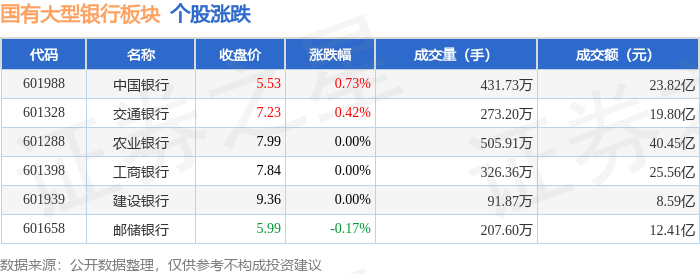
国有大型银行板块10月24日涨0.13%,中国银行领涨,主力资金净流出8504.6万元
Zheng Xing Xing Ye Ri Bao· 2025-10-24 08:27
Market Performance - On October 24, the state-owned large bank sector increased by 0.13% compared to the previous trading day, with Bank of China leading the gains [1] - The Shanghai Composite Index closed at 3950.31, up 0.71%, while the Shenzhen Component Index closed at 13289.18, up 2.02% [1] Individual Bank Performance - Bank of China (601988) closed at 5.53 with a gain of 0.73%, trading volume of 4.3173 million shares, and a transaction value of 2.382 billion [1] - Agricultural Bank of China (601288) remained unchanged at 7.99, with a trading volume of 5.0591 million shares [1] - Industrial and Commercial Bank of China (601398) also remained unchanged at 7.84, with a trading volume of 3.2636 million shares [1] - Postal Savings Bank of China (601658) saw a slight decline of 0.17% to close at 5.99, with a trading volume of 2.0760 million shares [1] Fund Flow Analysis - The state-owned large bank sector experienced a net outflow of 85.046 million from institutional investors and 51.2904 million from retail investors, while retail investors saw a net inflow of 136 million [1] - Bank of China had a net inflow of 13 million from institutional investors but a net outflow of 132 million from speculative funds [2] - Agricultural Bank of China had a net inflow of approximately 19.87 million from institutional investors, while it faced a net outflow of 37 million from retail investors [2] - Postal Savings Bank of China experienced a significant net outflow of 137 million from institutional investors, despite a net inflow of 77.09 million from retail investors [2]