
Tuopu Group(601689)

Search documents
资金风向标 | 两融余额较上一日减少83.62亿元 汽车行业获融资净买入额居首
Sou Hu Cai Jing· 2026-01-20 01:52
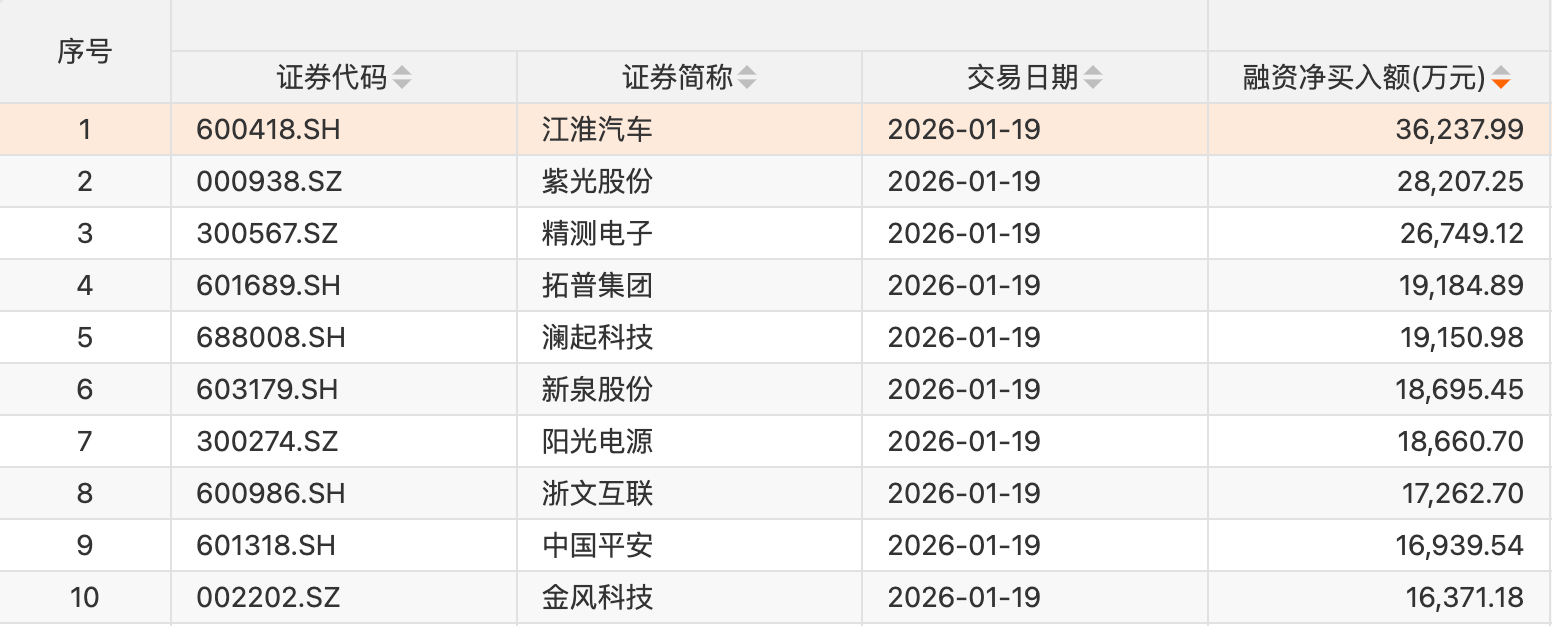
Group 1 - As of January 19, the margin trading balance of A-shares is 27,231.75 billion yuan, a decrease of 83.62 billion yuan from the previous trading day, accounting for 2.63% of the A-share circulating market value [1] - The margin trading turnover on the same day is 2,683.76 billion yuan, down by 681.14 billion yuan from the previous trading day, representing 9.82% of the A-share transaction volume [1] - Among the 31 primary industries, 10 industries received net financing inflows, with the automotive industry leading at a net inflow of 758 million yuan [1] Group 2 - A total of 33 stocks received net financing inflows exceeding 100 million yuan, with Jianghuai Automobile leading at a net inflow of 362 million yuan [1] - Other notable stocks with significant net financing inflows include Unisplendour, Jingce Electronics, Top Group, Lanke Technology, New Spring Shares, Sungrow Power Supply, Zhejiang Wenhu Interconnect, China Ping An, and Goldwind Technology [1] - According to a report from Industrial Securities, in 2026, the automotive sector is expected to undergo a value reassessment due to advancements in high-level assisted driving and breakthroughs in robotics technology [2] - The robotics sector is gradually entering a large-scale production phase, with investment opportunities shifting from divergence to convergence [2] - The report suggests focusing on two main lines: technological changes in autonomous driving and robotics, and the industrial chain opportunities arising from large-scale implementation [2]





2026 中国新能源汽车与动力电池手册_从自动驾驶到人工智能-2026 China EV & EV Battery Handbook_ From Autonomous Driving to AI
2026-01-20 01:50
Summary of Key Points from the Conference Call Industry Overview: Greater China Auto, EV, and EV Battery Industry Forecasts - **China's Auto Industry**: Expected to face challenges in 2026 with a forecasted decline in auto wholesales by **1.6% YoY** compared to a **10% YoY** increase in 2025. This decline is attributed to front-loaded demand in 2025 [1] - **Domestic EV Sales**: Anticipated to grow only **7% YoY** in 2026 due to a **5% increase in purchase tax** and reduced trade-in subsidies [1] - **Export Sales**: Projected to increase by **12% YoY**, reaching **7.9 million units** in 2026, with EV exports expected to surge by **40% YoY** [1] - **Competition Dynamics**: Shift from price competition to configuration-based competition, necessitating more investment in autonomous driving (AD) and smart cabin technologies [1] Key Automotive/EV Themes for 2026 Theme 1: Export Growth - **Export Growth**: Companies like Chery and BYD are expected to benefit significantly from exports, especially with the EU's minimum EV price replacing tariffs [2] Theme 2: Autonomous Driving Development - **ADAS to AD Transition**: L3 permits issued to Changan and BAIC, with highway/city NOA penetration expected to exceed **40%** in 2026 and **85%** by 2030. L4/L5 penetration is projected to reach **8%** by 2030 [3] Theme 3: Cost Concerns - **Battery and Memory Costs**: Rising costs and supply stability of memory are key concerns for auto OEMs [3] Key Battery Themes for 2026 Theme 1: Energy Storage Systems (ESS) - **ESS Demand**: Global battery ESS installations expected to grow by **33% YoY** in 2026, with shipments increasing by **41% YoY** [4] Theme 2: Global Expansion - **Overseas Capacity Expansion**: Chinese battery manufacturers are accelerating their overseas capacity expansion, particularly in Europe and Southeast Asia, in response to rising tariffs and trade tensions [4] Theme 3: VAT Rebate Changes - **Export VAT Rebate Cut**: Anticipated to lead to a rush in battery production and shipment in Q1 2026, potentially increasing raw material prices and exerting cost pressure on battery makers and auto OEMs [5] Theme 4: Technological Innovation - **Sodium-Ion Battery**: Launch of Gen-2 sodium-ion battery expected, with ASSB (all-solid-state battery) small-batch production anticipated to start in 2027 and scale up significantly post-2029 [5] Investment Recommendations - **Top Picks**: - **XPeng**: Launch of Mona SUV and HR in 2H26, with a focus on AI-related businesses [6] - **CATL**: Growth driven by CEV, ESS, and overseas capacity despite short-term cost pressures [6] - **Tuopu**: Major supplier for humanoid robots with overseas expansion [6] - **Minth**: Resilient earnings growth supported by high overseas market exposure [6] - **Hesai**: Increased LiDAR adoption in China alongside L3 ADAS development [6] Additional Insights - **Market Dynamics**: The shift in competition and the focus on technological advancements highlight the evolving landscape of the automotive and EV sectors in China, emphasizing the need for companies to adapt to changing consumer preferences and regulatory environments [1][3][4][5]






11.86亿元主力资金今日抢筹汽车板块
Zheng Quan Shi Bao Wang· 2026-01-19 10:36
Market Overview - The Shanghai Composite Index rose by 0.29% on January 19, with 23 out of the 28 sectors experiencing gains, led by basic chemicals and petroleum & petrochemicals, which increased by 2.70% and 2.08% respectively [1] - The automotive sector saw an increase of 1.70% [1] - The sectors that faced declines included computers and communications, with decreases of 1.55% and 0.96% respectively [1] Capital Flow Analysis - The main capital flow showed a net outflow of 35.714 billion yuan across the two markets, with 13 sectors experiencing net inflows [1] - The power equipment sector had the highest net inflow, totaling 7.597 billion yuan, while the basic chemicals sector followed with a net inflow of 1.331 billion yuan [1] - Eighteen sectors experienced net outflows, with the electronics sector leading at a net outflow of 14.653 billion yuan, followed by the computer sector with a net outflow of 10.750 billion yuan [1] Automotive Sector Performance - The automotive sector had a net inflow of 1.186 billion yuan, with 211 out of 284 stocks rising, including 6 hitting the daily limit [2] - The top three stocks with the highest net inflow were Top Group (5.12 billion yuan), Chaojie Co. (2.72 billion yuan), and Xinquan Co. (2.11 billion yuan) [2] - The sector also saw 69 stocks decline, with 17 stocks experiencing net outflows exceeding 50 million yuan, led by Wanxiang Qianchao (3.78 billion yuan), Shanzikao (2.36 billion yuan), and Aerospace Science and Technology (1.57 billion yuan) [2] Automotive Sector Capital Inflow - The top stocks in terms of capital inflow included: - Top Group: +5.19%, turnover rate 3.61%, net inflow 51.179 million yuan - Chaojie Co.: +16.15%, turnover rate 15.82%, net inflow 27.189 million yuan - Xinquan Co.: +3.95%, turnover rate 6.00%, net inflow 21.141 million yuan [2] Automotive Sector Capital Outflow - The top stocks in terms of capital outflow included: - Wanxiang Qianchao: +0.83%, turnover rate 8.91%, net outflow -37.801 million yuan - Shanzikao: +0.59%, turnover rate 10.27%, net outflow -23.551 million yuan - Aerospace Science and Technology: 0.00%, turnover rate 9.12%, net outflow -15.696 million yuan [3]



拓普集团(601689):汽车平台型龙头跨域进化,机器人有望构建新增长曲线
NORTHEAST SECURITIES· 2026-01-19 08:13
Investment Rating - The report maintains a "Buy" rating for the company [4]. Core Insights - The company has evolved from a single component supplier to a comprehensive solution provider in the automotive parts sector, with a strong focus on R&D and strategic positioning in emerging markets [1][2]. - The company is well-positioned to benefit from the growing humanoid robot market, leveraging its core competencies in actuator technology [3]. - The financial forecast indicates a steady increase in net profit from 28.95 billion CNY in 2025 to 42.70 billion CNY in 2027, with corresponding PE ratios decreasing from 44.84 to 30.40 [3]. Summary by Sections Company Overview - The company is a leading automotive parts manufacturer with a diversified product range, including shock absorption systems, interior and exterior trim systems, lightweight chassis components, and intelligent driving systems [1][2]. - It has established a global presence with 26 production bases and 7 R&D centers, maintaining strong partnerships with major clients like Tesla and BYD [1]. Business Structure - The company's business model is supported by two main pillars: traditional advantages in interior components and chassis systems, and emerging sectors such as thermal management and automotive electronics [2]. - The thermal management segment has rapidly expanded since its inception in 2020, with innovative products like the integrated heat pump module [2]. Robotics and Future Growth - The humanoid robot market is projected to reach a trillion-dollar scale, with the company positioned as a key supplier of actuators, benefiting from its technological synergies and global manufacturing capabilities [3]. - The company aims to leverage its existing automotive client relationships to penetrate the robotics market effectively [3]. Financial Performance - The company has shown robust revenue growth, with a projected increase in operating income from 19.70 billion CNY in 2023 to 43.01 billion CNY in 2027, reflecting a compound annual growth rate of approximately 19.41% [7]. - Despite short-term profit pressures due to increased R&D investments, long-term profitability is expected to improve as new capacities come online and market share in thermal management grows [20][25].
机器人概念震荡拉升 昊志机电涨超10%
Xin Lang Cai Jing· 2026-01-19 03:12
Group 1 - The core viewpoint of the article highlights a significant surge in the robotics sector, with companies like Haozhi Electromechanical experiencing over a 10% increase in stock price [1] - The report from Counterpoint Research indicates that approximately 16,000 humanoid robots were newly installed globally in the current year [1] - By 2025, the top five manufacturers of humanoid robots are projected to hold 73% of the market share [1] Group 2 - The stock performance of related companies includes Fenglong Co. achieving a 14-day consecutive rise, while Okoyi and Riying Electronics hit the daily limit [1] - Other companies such as Yifan Transmission, Top Group, Tianqi Co., Fule New Materials, and Founder Electric also saw stock price increases [1]





拓普集团股价涨6.31%,中银证券旗下1只基金重仓,持有22万股浮盈赚取103.62万元
Xin Lang Cai Jing· 2026-01-19 02:50
中银证券精选行业股票A(010892)成立日期2021年1月20日,最新规模6.07亿。今年以来收益3.42%, 同类排名3679/5579;近一年收益69.39%,同类排名538/4225;成立以来亏损36.24%。 中银证券精选行业股票A(010892)基金经理为林博程、陆莎莎。 截至发稿,林博程累计任职时间7年314天,现任基金资产总规模11.86亿元,任职期间最佳基金回报 110.75%, 任职期间最差基金回报-48.35%。 1月19日,拓普集团涨6.31%,截至发稿,报79.40元/股,成交20.74亿元,换手率1.56%,总市值1379.84 亿元。 资料显示,宁波拓普集团股份有限公司位于浙江省宁波市北仑区大碶街道育王山路268号,成立日期 2004年4月22日,上市日期2015年3月19日,公司主营业务涉及汽车零部件及配件的研发、生产和销售。 主营业务收入构成为:内饰功能件33.76%,底盘系统28.66%,减震器15.77%,汽车电子8.31%,热管理 系统7.58%,其他(补充)5.86%,电驱系统0.06%。 从基金十大重仓股角度 数据显示,中银证券旗下1只基金重仓拓普集团。中银证券精选 ...
拓普集团股价涨6.31%,光大保德信基金旗下1只基金重仓,持有62.59万股浮盈赚取294.79万元
Xin Lang Cai Jing· 2026-01-19 02:47
光大保德信智能汽车主题股票A(011104)成立日期2021年2月9日,最新规模7.71亿。今年以来收益 1.32%,同类排名4759/5579;近一年收益29.09%,同类排名2737/4225;成立以来亏损2.68%。 光大保德信智能汽车主题股票A(011104)基金经理为王明旭。 截至发稿,王明旭累计任职时间4年167天,现任基金资产总规模13.89亿元,任职期间最佳基金回报 40.16%, 任职期间最差基金回报-17.39%。 1月19日,拓普集团涨6.31%,截至发稿,报79.40元/股,成交20.48亿元,换手率1.54%,总市值1379.84 亿元。 资料显示,宁波拓普集团股份有限公司位于浙江省宁波市北仑区大碶街道育王山路268号,成立日期 2004年4月22日,上市日期2015年3月19日,公司主营业务涉及汽车零部件及配件的研发、生产和销售。 主营业务收入构成为:内饰功能件33.76%,底盘系统28.66%,减震器15.77%,汽车电子8.31%,热管理 系统7.58%,其他(补充)5.86%,电驱系统0.06%。 从基金十大重仓股角度 数据显示,光大保德信基金旗下1只基金重仓拓普集团。光大保 ...
一季度整车有望反弹,零部件聚焦新产业投资:汽车行业周报(20260112-20260118)-20260118
Huachuang Securities· 2026-01-18 12:26
Investment Rating - The report maintains a positive outlook for the automotive industry, expecting a rebound in vehicle sales in Q1 and focusing on investments in intelligent driving, robotics, and liquid cooling technologies [3]. Core Insights - The automotive sector is experiencing significant dynamics, including sales, pricing, exports, and robotics developments [2]. - The report highlights that January's early sales data shows a substantial year-on-year decline, primarily due to subsidy reductions and rising vehicle prices, leading to consumer hesitation [5]. - The report anticipates that the pressure on vehicle prices will be managed through strict enforcement of anti-competitive practices, aiming to stabilize prices and profit margins [5]. - The export market is expected to grow rapidly, supported by agreements that lower trade barriers for electric vehicles, enhancing profitability for manufacturers and dealers [5]. - The robotics sector is gaining traction, with the Optimus V3 generating market excitement and expectations for product launches [5]. Data Tracking - In early January, the average discount rate remained stable, with a 9.6% increase year-on-year, and the average discount amount reached 22,259 yuan, up by 2,192 yuan year-on-year [4]. - December's wholesale vehicle sales were reported at 2.85 million units, reflecting a year-on-year decline of 8.7% and a month-on-month decline of 6.3% [4]. - Notable sales performance in December included significant year-on-year growth for new energy vehicle manufacturers like NIO and Li Auto, while traditional automakers like SAIC and Changan showed mixed results [6]. Industry News - The report discusses various industry developments, including the price commitments for electric vehicles between China and Europe, which aim to facilitate trade [27]. - The Ministry of Industry and Information Technology is focusing on enhancing the competitiveness of the new energy vehicle sector and regulating market practices to prevent price wars [27]. - Recent data indicates a significant drop in retail sales of passenger vehicles in early January, with a 32% year-on-year decline [27]. Market Performance - The automotive sector saw a weekly increase of 0.71%, ranking 8th out of 29 sectors, while the overall market indices showed mixed results [10].



科技制造产业月报(2025年12月):奔跑的机器人,与变局的制造业-20260117
Huachuang Securities· 2026-01-17 14:01
Investment Rating - The report does not explicitly provide an investment rating for the industry Core Insights - The human-shaped robot's ability to run smoothly represents a significant technological leap from mere functionality to human-like capabilities, indicating a potential shift towards practical applications in complex environments [9][20] - The competition in the humanoid robot industry has evolved into a multi-dimensional strategic game, with different focuses across the supply chain, emphasizing the need for companies to integrate technology, establish standards, and meet real industry demands [22][30] - The future of humanoid robots hinges on overcoming five critical conditions: technological maturity, cost control, clear market positioning, infrastructure development, and societal acceptance [30][31] Summary by Sections Section 1: The Impact of Robot Running Demonstrations - The recent running demonstrations by Tesla's Optimus and Figure AI have generated significant global interest, suggesting a potential breakthrough in the commercialization of humanoid robots [5][6] - These demonstrations challenge the notion that advanced robotics can only exist in controlled environments, indicating a shift towards practical, scalable applications [31] Section 2: Technical Breakdown of Running Capabilities - Achieving running capabilities involves overcoming substantial technical challenges, including dynamic balance, rapid response times, and energy efficiency [10][19] - The transition from walking to running signifies a fundamental change in robotic capabilities, moving from static to dynamic balance, which is essential for operating in unpredictable environments [12][20] Section 3: Business Logic Behind the Demonstrations - The timing of these demonstrations reflects a strategic move by industry leaders to signal their technological advancements and readiness for market integration [32] - Both Tesla and Figure AI are pursuing different paths: Tesla aims for a universal platform while Figure AI focuses on specific industrial applications, highlighting the diverse strategies within the industry [26][30] Section 4: Industry Chain Dynamics - The competition among suppliers, manufacturers, and application developers is intensifying, with each segment vying for control over standards and market share [22][30] - The report emphasizes the importance of establishing a robust ecosystem that supports the development and deployment of humanoid robots in real-world applications [30] Section 5: Future Outlook - The next few years are critical for validating the feasibility of humanoid robots, with key indicators including commercial orders, supply chain formation, and cost reduction trends [31] - The industry is at a pivotal moment, transitioning from experimental demonstrations to practical implementations that can deliver economic value [31]



智能化迎来全球共振与产业加速,智能车ETF泰康(159720)红盘上涨1.25%,三花智控涨超6%
Xin Lang Cai Jing· 2026-01-16 06:01
Group 1 - The core viewpoint is that the smart electric vehicle (EV) sector is undergoing significant transformation, with a strong emphasis on the globalization of components and the rise of autonomous driving technologies, which are expected to enhance market penetration by 2026 [1][2] - The smart electric vehicle ETF, TaiKang (159720), has shown a 1.25% increase, tracking the CSI Smart Electric Vehicle Index, which rose by 1.17%, indicating strong performance among key component stocks [1] - The report highlights that the automotive chip sector is becoming a critical technological barrier, with ongoing domestic replacement strategies and rapid growth in the new energy vehicle market supporting the automotive parts industry [2] Group 2 - The ETF covers key aspects of smart driving, with the top ten weighted stocks accounting for over 58%, allowing investors to mitigate individual stock volatility while benefiting from overall industry growth [3] - The industry is expected to experience a positive cycle driven by technological breakthroughs, policy support, and scale expansion, positioning the smart car ETF as a long-term beneficiary [3] - The report anticipates that by 2025, the trend of intelligent driving will solidify, with significant advancements in high-level autonomous driving technologies and increased market penetration expected by 2026 [1][2]


