Tuopu Group(601689)

Search documents
智能化迎来全球共振与产业加速,智能车ETF泰康(159720)红盘上涨1.25%,三花智控涨超6%
Xin Lang Cai Jing· 2026-01-16 06:01
Group 1 - The core viewpoint is that the smart electric vehicle (EV) sector is undergoing significant transformation, with a strong emphasis on the globalization of components and the rise of autonomous driving technologies, which are expected to enhance market penetration by 2026 [1][2] - The smart electric vehicle ETF, TaiKang (159720), has shown a 1.25% increase, tracking the CSI Smart Electric Vehicle Index, which rose by 1.17%, indicating strong performance among key component stocks [1] - The report highlights that the automotive chip sector is becoming a critical technological barrier, with ongoing domestic replacement strategies and rapid growth in the new energy vehicle market supporting the automotive parts industry [2] Group 2 - The ETF covers key aspects of smart driving, with the top ten weighted stocks accounting for over 58%, allowing investors to mitigate individual stock volatility while benefiting from overall industry growth [3] - The industry is expected to experience a positive cycle driven by technological breakthroughs, policy support, and scale expansion, positioning the smart car ETF as a long-term beneficiary [3] - The report anticipates that by 2025, the trend of intelligent driving will solidify, with significant advancements in high-level autonomous driving technologies and increased market penetration expected by 2026 [1][2]


拓普集团跌2.03%,成交额17.24亿元,主力资金净流出1.45亿元
Xin Lang Cai Jing· 2026-01-14 05:23
Group 1 - The core viewpoint of the news is that Top Group's stock has experienced fluctuations, with a recent decline of 2.03% and a year-to-date drop of 6.59% as of January 14 [1] - As of January 14, Top Group's stock price is 72.09 yuan per share, with a total market capitalization of 125.28 billion yuan [1] - The company reported a revenue of 20.93 billion yuan for the first nine months of 2025, reflecting a year-on-year growth of 8.14%, while the net profit attributable to shareholders decreased by 11.97% to 1.97 billion yuan [2] Group 2 - The main business segments of Top Group include interior functional parts (33.76%), chassis systems (28.66%), shock absorbers (15.77%), automotive electronics (8.31%), thermal management systems (7.58%), and others (5.86%) [1] - The company has distributed a total of 3.58 billion yuan in dividends since its A-share listing, with 2.06 billion yuan distributed in the last three years [3] - As of September 30, 2025, the number of shareholders increased by 30.02% to 143,700, while the average circulating shares per person decreased by 23.09% to 12,092 shares [2]
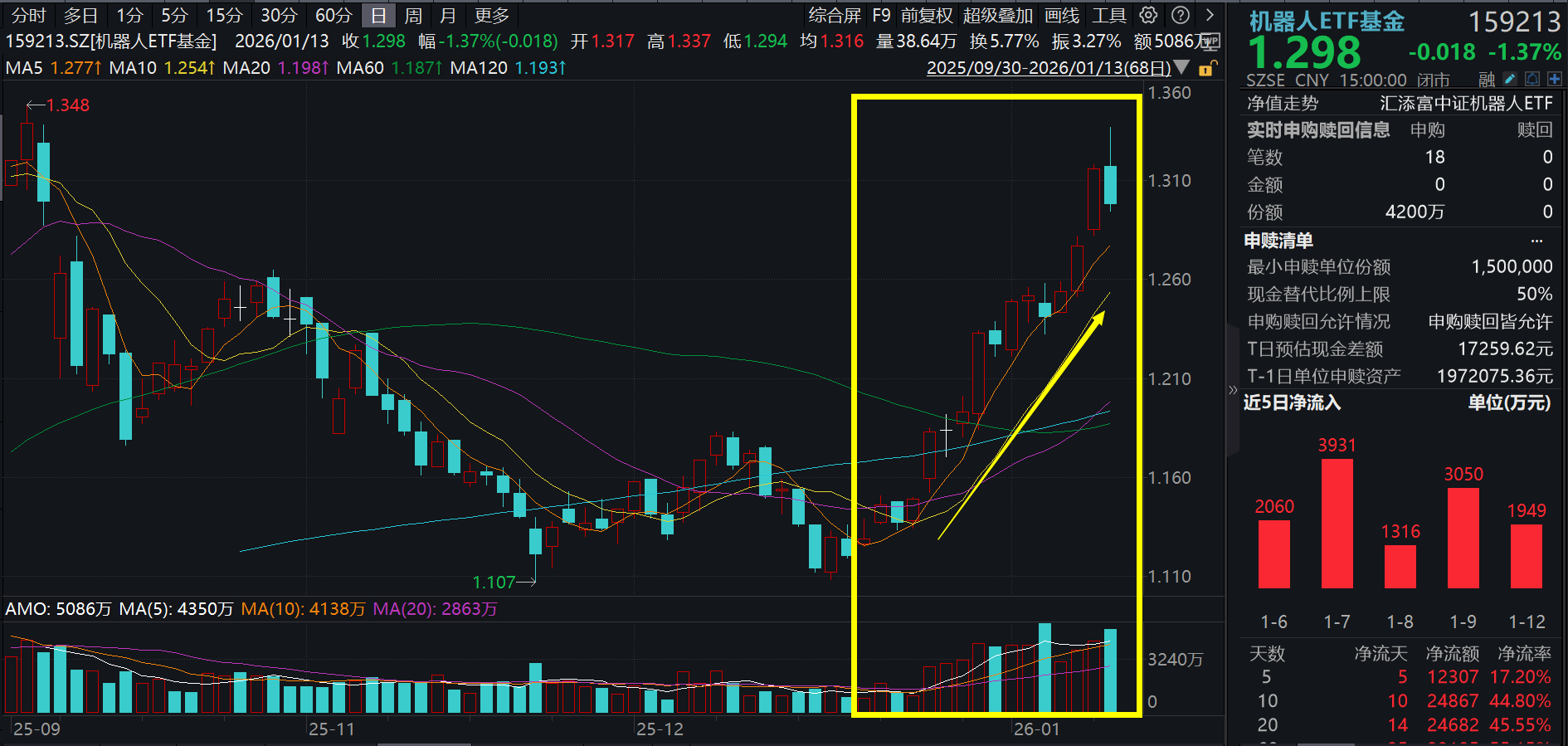
人形机器人再迎政策催化!中控技术涨近10%,资金连续11日涌入机器人ETF基金(159213),合计净流入超3亿元!机器人4年后将完胜人类医生?
Sou Hu Cai Jing· 2026-01-13 09:43
Market Overview - On January 13, the A-share market experienced a volatile pullback, with the Shanghai Composite Index halting its 17-day winning streak. The Robot ETF Fund (159213) fell by 1.37%, while it attracted over 55 million yuan in capital on that day, marking a total of over 300 million yuan in inflows over the past 11 days [1] ETF Fund Composition - The top ten constituent stocks of the Robot ETF Fund (159213) showed mixed performance, with notable gainers including Zhongkong Technology (+9.9%), Lide Harmony (+3.54%), and Keda Xunfei (+2.16%). Conversely, major declines were seen in Dazhu Laser (-5.52%) and Huichuan Technology (-3.12%) [2][4] Policy and Industry Dynamics - The Ministry of Industry and Information Technology announced initiatives for the 14th Five-Year Plan, focusing on revitalizing traditional industries and promoting emerging sectors, including quantum technology, humanoid robots, and AI [3] - The recent CES exhibition highlighted the dominance of Chinese humanoid robot manufacturers, with Chinese companies occupying 21 out of 38 humanoid robot booths, exceeding 50% of the total [5] Technological Developments - Elon Musk projected that general artificial intelligence (AGI) will arrive by 2026, with robots expected to surpass human surgical skills within three years and achieve superior performance compared to human doctors in four years [6] - Eastern Securities noted that the narrative around humanoid robots is shifting from simple mass production to AGI capabilities, suggesting that the latter will have a stronger impact on investment opportunities [7] Challenges in Production - The production of humanoid robots faces three main challenges: developing a highly dexterous hand, an AI brain capable of understanding the real world, and achieving large-scale production. The AI brain is identified as the most critical challenge for the industry's advancement [8] - Tesla is actively working on enhancing its AI brain for humanoid robots, with expectations for prototype production readiness by early 2026, indicating potential investment opportunities in the first half of 2026 [9] Investment Opportunities - The market is witnessing a significant interest in humanoid robots, with major global tech companies investing in this sector. The Robot ETF Fund (159213) is positioned to provide investors with access to the growth potential of the humanoid robot industry [10]





人形机器人:参与者布局梳理-Humanoid Robotics Who plays where
2026-01-13 02:11
Summary of Humanoid Robotics Industry Analysis Industry Overview - The analysis covers the humanoid robotics sector, focusing on approximately 150 global players, including OEMs and parts suppliers [1][2][3]. Key Characteristics of the Humanoid Robotics Ecosystem 1. **Supply Chain Structure** - Humanoid robotics companies are categorized into OEMs and parts suppliers, with a supply chain structure similar to the automotive industry, featuring multiple actuator suppliers [1]. 2. **Key Know-Hows** - Hardware expertise centers on robotic design, while software involves distinct layers: "robotic models" (brain and locomotion algorithms) and "world models" (simulation environments) [1]. 3. **Vertical Integration** - Most OEMs design critical components in-house, with varying degrees of outsourcing for production. Unitree is noted for its unique approach, focusing on hardware with integrated locomotion algorithms [1]. 4. **Competition and Differentiation** - The industry has a high number of participants, indicating low entry barriers. However, differentiation is possible through quality, agility, and cost, particularly in robotic models and actuators [1]. 5. **China vs. the West** - China is emerging as a significant player in humanoid robotics, with more participants than the rest of the world combined. China leads in most areas of the value chain, except for AI chips and simulation environments [1]. Competitive Landscape - **Non-Chinese Humanoid Robot OEMs** - Key players include Tesla, Boston Dynamics, and Agility Robotics, with varying capabilities in hardware and software [2]. - **Non-Chinese Humanoid Parts Suppliers** - Major suppliers include NVIDIA, Google, and Intel, providing essential components like AI chips and actuators [3]. - **Chinese Humanoid Robot OEMs** - Notable companies include Unitree Robotics, UBTech, and XPeng, with a focus on various hardware and software capabilities [4]. - **Chinese Humanoid Parts Suppliers** - Key suppliers include Hesai and RoboSense, contributing to the hardware and software needs of the industry [6][9]. Investment Implications - Recommendations include: - **Outperform**: Shuanghuan, Hesai, Tuopu, Inovance, Harmonic Drive - **Market-Perform**: Sanhua - **Underperform**: Leader Drive [10]. Financial Metrics - Specific financial metrics and projections for key companies are provided, including EPS and P/E ratios for 2024-2026 [11]. Conclusion - The humanoid robotics industry is characterized by rapid growth, significant competition, and a clear divide between Chinese and Western players. Investment opportunities exist, particularly in companies that demonstrate strong differentiation and technological capabilities.



汽车行业周报:如何展望2025Q4业绩?-20260112
Changjiang Securities· 2026-01-12 11:22
Investment Rating - The investment rating for the automotive industry is "Positive" and maintained [9] Core Insights - The wholesale sales of passenger vehicles in Q4 2025 are expected to be approximately 8.76 million units, a year-on-year decrease of 1% but a quarter-on-quarter increase of 14%. The profitability in Q4 may show differentiation compared to the same period last year, with expectations for a quarter-on-quarter improvement [2][5] - The revenue from automotive parts is anticipated to grow steadily quarter-on-quarter, but profitability may face pressure due to factors such as raw material costs and exchange rates [2][5] - The wholesale sales of heavy trucks are projected to be 314,000 units in Q4 2025, representing a year-on-year increase of 43.6% and a quarter-on-quarter increase of 11.5% [2][5] - The overall sales of buses are expected to see a significant quarter-on-quarter increase during the peak season, with sales of large and medium buses reaching 44,000 units, a year-on-year increase of 8.8% and a quarter-on-quarter increase of 42.2% [2][5] - The total sales of motorcycles are estimated to be around 4.73 million units in Q4 2025, reflecting a year-on-year increase of 11.0% but a quarter-on-quarter decrease of 6.2% [2][6] Summary by Sections Passenger Vehicles - Q4 2025 wholesale sales are expected to be about 8.76 million units, down 1% year-on-year but up 14% quarter-on-quarter. New energy vehicle sales are projected at 4.84 million units, up 13% year-on-year and 21% quarter-on-quarter [5] Automotive Parts - Revenue is expected to grow steadily quarter-on-quarter, but profitability may be pressured by raw material and exchange rate factors [5] Heavy Trucks - Q4 2025 wholesale sales are projected at 314,000 units, with a year-on-year increase of 43.6% and a quarter-on-quarter increase of 11.5% [5] Buses - Large and medium bus sales are expected to reach 44,000 units in Q4 2025, with a year-on-year increase of 8.8% and a quarter-on-quarter increase of 42.2% [5] Motorcycles - Total motorcycle sales are estimated at 4.73 million units in Q4 2025, reflecting an 11.0% year-on-year increase but a 6.2% quarter-on-quarter decrease [6]




汽车及汽车零部件行业周报:2026年“两新”政策落地,有望带动需求稳步向上-20260111
SINOLINK SECURITIES· 2026-01-11 15:10
Group 1 - The investment rating for the automotive industry is positive, with expectations for steady demand growth driven by the implementation of the "Two New" policy in 2026 [1][12][14] - The core viewpoint emphasizes that the subsidy policy has shifted from fixed amounts to a percentage of the vehicle price, which is expected to benefit high-end vehicles while putting pressure on low-priced cars [1][14] - The report anticipates a marginal recovery in sales growth in Q1 2026, with an upward revision of the annual domestic sales growth forecast to -2% [1][14][16] Group 2 - The report highlights opportunities in themes such as smart technology and overseas expansion, with passenger car exports maintaining a growth rate of over 20% year-on-year [2][17] - Key companies to watch include BYD, Geely, and Li Auto in the automotive sector, and Horizon Robotics and Top Group in the smart technology and robotics sectors [2][22] - The report notes that the export volume of passenger cars is expected to maintain double-digit growth in 2026, driven by recovering demand in markets like Russia and the increasing penetration of fuel and new energy vehicles [2][17] Group 3 - The automotive market saw a wholesale sales volume of 1.457 million units in the last week of December 2025, with a year-on-year increase of 5%, while new energy vehicles accounted for 772,000 units, up 22% year-on-year [4][31] - In December 2025, the total wholesale sales volume was 2.759 million units, down 10% year-on-year, with new energy vehicles at 1.554 million units, showing a 3% increase [4][31] - The retail sales data for December 2025 indicated a total of 2.296 million units sold, down 13% year-on-year, while new energy vehicles saw a 7% increase in retail sales [4][31][46]

汽车零部件、机器人主线周报:本周板块持续向上,新剑完成IPO辅导登记-20260111
Soochow Securities· 2026-01-11 14:06
Investment Rating - The industry investment rating is "Overweight," indicating an expected outperformance of the industry index relative to the benchmark by more than 5% in the next six months [53]. Core Insights - The automotive parts sector saw a weekly increase of 3.37%, ranking second among the SW automotive sector, with a year-to-date increase of 47.4% since the beginning of 2025 [2][19]. - The robotics sector experienced a weekly rise of 3.74%, with a year-to-date increase of 68.14% since the beginning of 2025, outperforming the automotive parts sector by 0.37% [2][27]. - Key developments include the announcement of a 7.8 billion yuan contract for Xusheng Group with a North American new energy manufacturer, expected to start production by the end of 2026 [2][42]. - Notable stock performances this week include Xusheng Group (+18.05%), Xinquan Co. (+16.17%), and Hengshuai Co. (+13.24%) [2][42]. Summary by Sections Automotive Parts Sector Weekly Review - The automotive parts sector ranked second in the SW automotive index this week, with a performance of +3.37% [19]. - The sector's PE (TTM) is at 1.3 times that of the entire A-share market, and its PB (LF) is at 1.5 times, indicating a strong valuation relative to the market [25]. - The sector's PE has increased by 8.75 times and PB by 0.74 times since the beginning of 2025 [25]. Robotics Sector Weekly Review - The robotics index increased by 3.74% this week, with a year-to-date performance of +68.14% since the beginning of 2025 [27]. - The latest PE (TTM) for the robotics sector is at 1.39 times that of the entire A-share market, with a PB (LF) at 1.90 times [37]. - The sector's PE has risen by 5.53 times and PB by 0.64 times since the beginning of 2025 [37]. Key Stock Tracking - Core stocks in the automotive parts sector include Fuyao Glass, Top Group, and Junsheng Electronics, with recommendations based on EPS and PE dimensions [48]. - The report highlights the importance of focusing on structural opportunities in the automotive parts sector and certainty in the robotics sector, particularly with upcoming product launches and market applications [2][48].



汽车零部件板块1月9日涨1.4%,旭升集团领涨,主力资金净流出24.4亿元
Zheng Xing Xing Ye Ri Bao· 2026-01-09 08:54
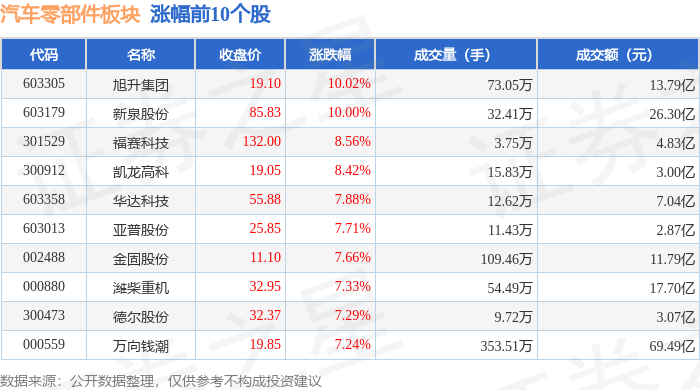
Market Performance - The automotive parts sector increased by 1.4% on January 9, with Xusheng Group leading the gains [1] - The Shanghai Composite Index closed at 4120.43, up 0.92%, while the Shenzhen Component Index closed at 14120.15, up 1.15% [1] Top Gainers in Automotive Parts Sector - Xusheng Group (603305) closed at 19.10, up 10.02% with a trading volume of 730,500 shares and a transaction value of 1.379 billion [1] - New Spring Co., Ltd. (603179) closed at 85.83, up 10.00% with a trading volume of 324,100 shares and a transaction value of 2.630 billion [1] - Fosa Technology (301529) closed at 132.00, up 8.56% with a trading volume of 37,500 shares and a transaction value of 483 million [1] Decliners in Automotive Parts Sector - Suoling Co., Ltd. (002766) closed at 6.74, down 6.39% with a trading volume of 1,453,700 shares and a transaction value of 1.003 billion [2] - Zhejiang Shibao (002703) closed at 25.31, down 5.10% with a trading volume of 1,326,000 shares and a transaction value of 3.428 billion [2] - Moulding Technology (000700) closed at 14.20, down 4.18% with a trading volume of 1,243,600 shares and a transaction value of 1.782 billion [2] Capital Flow Analysis - The automotive parts sector experienced a net outflow of 2.44 billion from main funds, while retail investors saw a net inflow of 3.335 billion [2] - The main funds showed a significant outflow from Xusheng Group and Wanhua Qianchao, with net outflows of 2.12 billion and 2.81 billion respectively [3] - Retail investors had a net inflow into Xusheng Group of 1.64 billion, indicating strong retail interest despite the overall outflow [3]


智元机器人出货登顶,机器人ETF嘉实(159526)聚焦机器人全产业链机遇
Xin Lang Cai Jing· 2026-01-09 03:35
Group 1 - The core viewpoint of the articles highlights the strong growth and potential of the humanoid robot market, with significant contributions from Chinese manufacturers [1][2] - According to Omdia's report, global humanoid robot shipments are expected to reach 13,000 units by 2025, with Chinese companies leading the market [1] - AGIBOT has achieved the highest global shipment volume of over 5,100 units, capturing a 39% market share, making it the leader in both shipment volume and market share [1] - The humanoid robot industry is accelerating, with multiple manufacturers launching mass production versions and some products already being utilized in factories [1] - The report predicts exponential growth in the humanoid robot sector, with shipments potentially reaching 2.6 million units by 2035 [1] - The top ten weighted stocks in the CSI Robot Index account for 52.83% of the index, indicating a concentrated investment opportunity in leading companies [1] Group 2 - The Jia Shi Robot ETF (159526) closely tracks the CSI Robot Index, focusing on companies involved in the entire robot industry chain, including system solution providers and automation equipment manufacturers [2] - Investors without stock accounts can access the robot industry development opportunities through the Jia Shi Robot ETF linked fund (024620) [2]


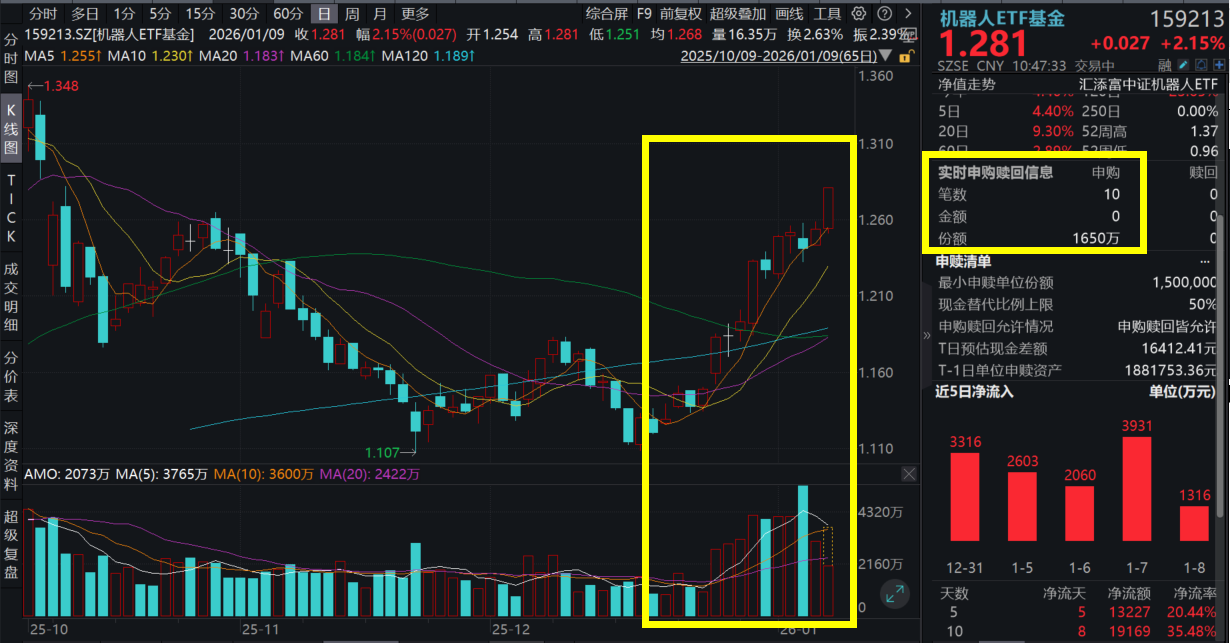
“人工智能+制造”政策重磅发布!机器人再度冲高,大族激光涨超9%,机器人ETF基金(159213)大涨超2%,连续9日强势吸金超2亿元!
Xin Lang Cai Jing· 2026-01-09 03:09
Group 1 - The A-share market experienced a rebound, with the Shanghai Composite Index rising nearly 1% and returning to 4100 points for the first time in 10 years [1] - The Robot ETF Fund (159213) saw a significant inflow of funds, attracting over 210 million yuan in a single day and accumulating over 2 billion yuan in inflows over the past nine days [1] - The top ten constituent stocks of the Robot ETF Fund showed strong performance, with notable gains from companies like Keda Xunfei (10.31%) and Dazhong Laser (4.12%) [1] Group 2 - The Ministry of Industry and Information Technology and eight other departments issued an implementation opinion on the "Artificial Intelligence + Manufacturing" initiative, emphasizing the acceleration of industrial robot applications and the establishment of humanoid robot production bases [2] - The humanoid robot industry is in its early production stage, with significant breakthroughs in order sizes and a shift towards mass production, indicating a growing market presence [3][4] - By 2025, the cumulative order volume for domestic humanoid robots is expected to exceed 20,000 units, with an estimated delivery volume of over 10,000 units for the year, reflecting rapid maturation of production capacity and supply chain collaboration [3] Group 3 - The humanoid robot market is projected to grow significantly, with estimates suggesting a market size of 2.383 trillion yuan by 2030, representing over 40 times growth from 2025 [6] - The industry is expected to evolve from structured industrial applications to semi-structured commercial services and eventually to open household scenarios, indicating a broadening of application areas [4] - Elon Musk's insights on humanoid robots suggest a future demand ratio of 3:1 to 5:1 between humanoid robots and humans, potentially leading to a global stock of 20 to 30 billion humanoid robots [7] Group 4 - The development of humanoid robots faces three main challenges: creating a highly dexterous hand, developing an AI brain that understands the real world, and achieving large-scale production capabilities [10] - The current focus is on advancing the AI brain, which is crucial for the practical application of humanoid robots, as hardware advancements are already converging [10][11] - Major tech companies are actively investing in humanoid robots, indicating a significant growth opportunity in this sector, with the Robot ETF Fund providing a means for investors to engage with this emerging market [11]