CHINA TELECOM(601728)

Search documents
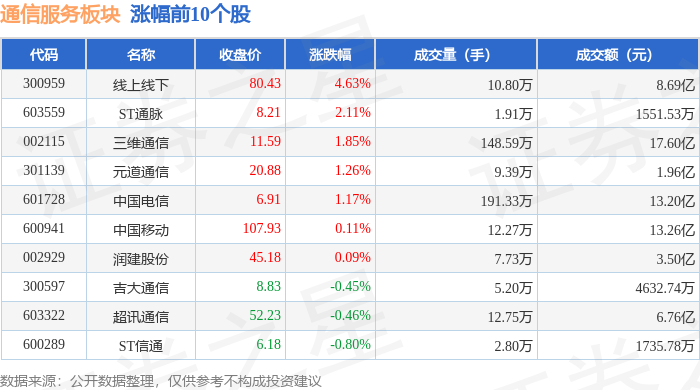
通信服务板块10月17日跌0.35%,蜂助手领跌,主力资金净流出1.65亿元
Zheng Xing Xing Ye Ri Bao· 2025-10-17 08:37
证券之星消息,10月17日通信服务板块较上一交易日下跌0.35%,蜂助手领跌。当日上证指数报收于 3839.76,下跌1.95%。深证成指报收于12688.94,下跌3.04%。通信服务板块个股涨跌见下表: | 代码 | 名称 | 收盘价 | 涨跌幅 | 成交量(手) | 成交额(元) | | | --- | --- | --- | --- | --- | --- | --- | | 300959 | 线上线下 | 80.43 | 4.63% | 10.80万 | | 8.69Z | | 603550 | ST通脉 | 8.21 | 2.11% | 1.91万 | | 1551.53万 | | 002115 | 三维通信 | 11.59 | 1.85% | 148.59万 | | 17.60亿 | | 301139 | 元道通信 | 20.88 | 1.26% | 9.39万 | | 1.96/Z | | 601728 | 中国电信 | 6.91 | 1.17% | 191.33万 | | 13.20亿 | | 600941 | 中国移动 | 107.93 | 0.11% | 12.27万 | | 13.26 ...



上海电信为松江注入“数智能量”,助力打赢转型发展攻坚战突围战
Zhong Guo Fa Zhan Wang· 2025-10-17 07:48
Core Viewpoint - The strategic cooperation agreement between Shanghai Telecom and Songjiang District, titled "Smart Cloud Shanghai, Smart Benefit Songjiang," marks a significant step towards the digital transformation and high-quality development of the region [3][7]. Group 1: Strategic Cooperation - The signing of the "Smart Cloud Shanghai, Smart Benefit Songjiang" agreement signifies the transition from a broad layout phase to a focused implementation phase in Songjiang [3][7]. - Key officials from both Shanghai Telecom and Songjiang District attended the signing ceremony, highlighting the collaborative effort [3][7]. Group 2: Digital Infrastructure Development - Songjiang is accelerating the creation of a modern industrial system, focusing on advanced manufacturing and digital infrastructure as part of its development strategy [4][8]. - The "Smart Cloud Shanghai" initiative aims to build a comprehensive digital infrastructure, integrating cloud, network, and edge computing capabilities [7][9]. Group 3: Economic and Social Impact - The collaboration is expected to enhance the economic and social development of Songjiang, aligning with the goals of the "Smart Cloud Shanghai" brand [5][9]. - The initiative will provide robust computational capabilities and intelligent services to various industries, facilitating a more efficient business environment [9][10]. Group 4: Future Applications and Innovations - The partnership will explore innovative applications in smart communities, healthcare, education, and urban governance, leveraging artificial intelligence [9][10]. - The establishment of the "Smart Cloud Shanghai Songjiang Ten-Gigabit Park" aims to enhance the digital ecosystem for local businesses, making advanced technologies more accessible [9][10].

央企巨头布局AI玩具 故宫文化联合中国电信发布首款故宫猫福墩AI玩偶
Zheng Quan Ri Bao Wang· 2025-10-17 07:06
Core Insights - The global AI toy market is experiencing rapid growth, with major state-owned enterprises entering the sector [1] - The Palace Museum's AI toy, "Fudun," developed in collaboration with China Telecom's Tianyi IoT, represents a new paradigm of "AI + cultural creativity" [1] - The AI toy can interact intelligently, understand emotions, and provide cultural storytelling, enhancing the digital transformation of the cultural industry [1] Company Developments - Tianyi IoT, a subsidiary of China Telecom, is actively promoting the integration of AI and IoT technologies in various industries, particularly in cultural creativity [2] - The AI toy is equipped with a domestically developed RISC-V architecture cloud AI module, ensuring secure and reliable data processing [2] - The Tianyi IoT platform supports over a billion devices for online perception and intelligent control, enhancing the interactive capabilities of the AI toy [2]
eSIM来了!手机“无卡时代”已近
Qi Lu Wan Bao· 2025-10-16 23:04
Core Viewpoint - The introduction of eSIM technology marks a significant shift in mobile telecommunications, allowing consumers to forgo traditional SIM cards in favor of integrated solutions [1] Group 1: Industry Overview - Major Chinese telecom operators, including China Telecom, China Mobile, and China Unicom, have received approval from the Ministry of Industry and Information Technology to launch eSIM mobile services nationwide [1] - eSIM technology integrates the functionality of a physical SIM card into a built-in chip within the phone, enabling users to download their phone numbers over the air without the need for a physical card [1] Group 2: Consumer Impact - Consumers purchasing eSIM-enabled devices will experience the same functionalities as traditional mobile services, but with enhanced convenience and flexibility [1]

【时代风口】 eSIM卡商用启航 国产通信大胆拥抱新技术
Zheng Quan Shi Bao· 2025-10-16 22:27
Core Insights - The launch of eSIM services by China's three major telecom operators marks a significant breakthrough in domestic communication technology, positioning China among the leaders globally in this field [1] - The adoption of eSIM technology is expected to reshape user habits and the competitive landscape of the telecom market, simplifying processes like number portability and enhancing device security [3][4] Group 1: eSIM Technology Overview - eSIM technology allows for the embedding of SIM functionality directly into device chips, eliminating the need for physical SIM cards, which enhances device design and user experience [1][2] - The global market for eSIM-enabled smartphones is projected to reach approximately 1 billion by the end of this year, with an expected growth to 6.9 billion by 2030, indicating a significant market opportunity for telecom operators [2] Group 2: Competitive Landscape - The strategic decision by Apple to exclusively offer eSIM versions of its iPhone Air globally, without a physical SIM card option for the Chinese market, has pressured Chinese telecom operators to accelerate their eSIM rollout [2] - The introduction of eSIM is anticipated to simplify the process of switching carriers, potentially transforming the market competition that has traditionally focused on package pricing [3] Group 3: User Experience and Market Implications - While many users currently prefer physical SIM cards for perceived security, the convenience of eSIM is expected to shift user preferences over time, similar to the transition from traditional banking to mobile banking [3] - eSIM technology integrates most functionalities into the device chip, enhancing security features such as anti-theft tracking and enabling users to manage multiple accounts easily [3][4]
eSIM卡商用启航 国产通信大胆拥抱新技术
Zheng Quan Shi Bao· 2025-10-16 18:47
Core Viewpoint - The launch of eSIM services by China's three major telecom operators marks a significant breakthrough in domestic communication technology, positioning China among the leaders globally in this field [1][2]. Group 1: eSIM Technology Overview - eSIM technology allows for the embedding of SIM cards directly into device chips, eliminating the need for physical SIM cards, which enhances convenience and security [1][2]. - The advantages of eSIM include space-saving, improved security, increased freedom in switching operators, and support for IoT infrastructure, driving mobile devices towards being lighter, smarter, and offering better user experiences [2][3]. - According to GSMA, approximately 1 billion eSIM smartphones are expected to be connected globally by the end of this year, with projections of growth to 6.9 billion by 2030 [2]. Group 2: Market Dynamics and Competition - The strategic decision by Apple to exclusively offer eSIM versions of the iPhone Air globally, without a physical SIM card option for the Chinese market, has pressured Chinese telecom operators to accelerate their eSIM commercialization efforts [2]. - The shift towards eSIM is expected to reshape user habits and the competitive landscape, simplifying the process of switching operators and potentially altering the focus from package pricing to service quality [3][4]. Group 3: Challenges and Considerations - While eSIM offers numerous benefits, concerns remain regarding potential high fees for switching numbers and the implications of losing the exclusivity of relationships with operators, which could affect service quality [4]. - The transition to eSIM is anticipated to face challenges, but ongoing market competition and technological advancements are expected to address these issues over time [4].

通信行业10月16日资金流向日报
Zheng Quan Shi Bao Wang· 2025-10-16 09:23
Market Overview - The Shanghai Composite Index rose by 0.10% on October 16, with seven industries experiencing gains, led by coal and banking sectors, which increased by 2.35% and 1.35% respectively [1] - The communication industry also saw a rise of 0.74% [1] - Conversely, the steel and non-ferrous metals industries faced declines, with decreases of 2.14% and 2.06% respectively [1] Capital Flow Analysis - The main capital flow showed a net outflow of 54.29 billion yuan across both markets, with five industries recording net inflows [1] - The banking sector led the net inflow with 939 million yuan, followed by the communication industry with a net inflow of 895 million yuan [1] - A total of 26 industries experienced net outflows, with the non-ferrous metals sector seeing the largest outflow of 9.242 billion yuan, followed by the electronics sector with 7.403 billion yuan [1] Communication Industry Performance - The communication industry had a net inflow of 895 million yuan, with 125 stocks in the sector, of which 23 rose and 100 fell [2] - Notable stocks with significant net inflows included ZTE Corporation, which saw an inflow of 1.327 billion yuan, followed by Zhongji Xuchuang and Xinyi Sheng with inflows of 672 million yuan and 276 million yuan respectively [2] - The sector also had six stocks with net outflows exceeding 100 million yuan, with Zhongtian Technology, Guanghetong, and Yongding shares leading the outflows at 228 million yuan, 136 million yuan, and 129 million yuan respectively [3] Top Gainers in Communication Sector - The top gainers in the communication sector included: - ZTE Corporation: +7.20% with a turnover rate of 8.37% and a capital flow of 1.327 billion yuan [2] - Zhongji Xuchuang: +3.63% with a turnover rate of 3.10% and a capital flow of 671 million yuan [2] - Xinyi Sheng: +0.67% with a turnover rate of 3.52% and a capital flow of 276 million yuan [2] Top Losers in Communication Sector - The top losers in the communication sector included: - Zhongtian Technology: -2.73% with a capital outflow of 227 million yuan [3] - Guanghetong: -5.18% with a capital outflow of 136 million yuan [3] - Yongding Shares: -3.37% with a capital outflow of 128 million yuan [3]



当手机用上eSIM,会带来哪些连锁反应?
Xin Jing Bao· 2025-10-16 08:42
Core Insights - The three major telecom operators in China, China Telecom, China Mobile, and China Unicom, have received approval from the Ministry of Industry and Information Technology for the commercial trial of eSIM mobile services, marking the official launch of eSIM services across 31 provinces and regions in China [1][3] - The introduction of eSIM technology signifies a shift towards a "cardless era," where the functionality of physical SIM cards is integrated into the phone's internal chip, enhancing user convenience and potentially transforming the mobile industry [1][2] Impact on Mobile Industry - The removal of physical SIM card slots allows for more streamlined and compact phone designs, aligning with trends pursued by manufacturers like Apple and Huawei towards fully sealed devices [2] - eSIM technology will simplify the manufacturing process by eliminating the need for SIM card slots and related components, potentially affecting hundreds of small suppliers in the industry [2] - The integration of eSIM will lead to a redesign of mobile phone motherboards, enhancing the dominance of chip manufacturers like Qualcomm and MediaTek in communication control [2] Changes in Operator Dynamics - The activation and management of eSIMs through cloud services may diminish the traditional advantages held by telecom operators, as consumers will no longer need to visit physical stores [3] - Mobile manufacturers could gain more influence over the customer experience, potentially sharing user data with operators and altering the competitive landscape [3] - The transition to eSIM technology may facilitate easier number portability for users, prompting operators to focus more on service quality and transparency rather than customer retention through binding contracts [3] Regulatory Considerations - The cautious rollout of eSIM services in China highlights the need for a new regulatory framework to address data security and identity management, given the unique context of mobile numbers in China [4] - The transition from physical SIM cards to eSIMs poses significant challenges in terms of data security, necessitating robust mechanisms to prevent identity theft and data breaches [4] - The eSIM initiative is not just a technological advancement but also a critical step in the evolution of China's digital identity system, requiring a balance between convenience and security [4]
通信服务板块10月16日跌0.25%,三维通信领跌,主力资金净流出6.29亿元
Zheng Xing Xing Ye Ri Bao· 2025-10-16 08:27
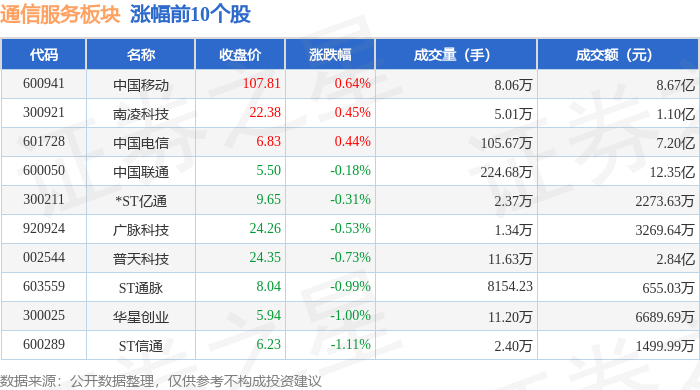
Market Overview - On October 16, the communication services sector declined by 0.25%, with Sanwei Communication leading the drop [1] - The Shanghai Composite Index closed at 3916.23, up 0.1%, while the Shenzhen Component Index closed at 13086.41, down 0.25% [1] Stock Performance - Key stocks in the communication services sector showed varied performance: - China Mobile (600941) closed at 107.81, up 0.64% with a trading volume of 80,600 shares and a turnover of 867 million yuan [1] - Sanwei Communication (002115) closed at 11.38, down 4.53% with a trading volume of 1,035,100 shares and a turnover of 1.192 billion yuan [2] - China Telecom (601728) closed at 6.83, up 0.44% with a trading volume of 1,056,700 shares and a turnover of 720 million yuan [1] - China Unicom (600050) closed at 5.50, down 0.18% with a trading volume of 2,246,800 shares and a turnover of 1.235 billion yuan [1] Capital Flow - The communication services sector experienced a net outflow of 629 million yuan from institutional investors, while retail investors saw a net inflow of 537 million yuan [2][3] - Notable capital flows included: - China Mobile saw a net inflow of 22.97 million yuan from institutional investors [3] - Puhua Technology (002544) had a net inflow of 20.09 million yuan from institutional investors [3] - Sanwei Communication experienced a significant net outflow of 11.92 billion yuan [2]

小摩:推荐买内地三大电讯股 首选中国电信(00728) 目标价7.5港元
智通财经网· 2025-10-16 08:20
Core Viewpoint - Morgan Stanley expresses optimism about three major telecom operators due to attractive shareholder returns, healthy profit growth, and potential cloud service revenue growth driven by AI [1] Group 1: Company Recommendations - The top pick is China Telecom (00728) due to its largest exposure to cloud business and resilient traditional mobile and broadband services, with a target price of HKD 7.5 [1] - China Mobile (00941) and China Unicom (00762) have target prices of HKD 110 and HKD 12 respectively, both rated as "Overweight" [1] Group 2: Market Performance - Over the past three months, the stock prices of the three major telecom operators, including China Mobile, China Telecom, and China Unicom, have underperformed the Hang Seng Index [1] - The current dividend yields for China Mobile, China Telecom, and China Unicom are projected to be 6.3%, 5.4%, and 5.6% respectively, making them attractive [1] Group 3: Revenue Trends - The growth of traditional telecom service revenue in the third quarter has slowed compared to the second quarter, which is reflected in the recent weakness of stock prices [1] - Investors are advised to take advantage of the lagging stock prices for potential buying opportunities [1]