
CEB BANK(601818)

Search documents
股份行前三季度盈利承压,4家营收净利双降
Di Yi Cai Jing Zi Xun· 2025-11-04 11:40
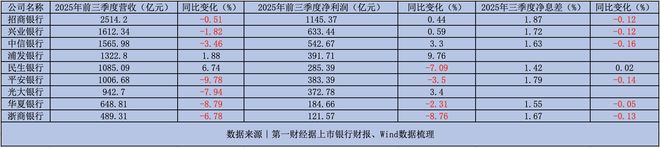
Core Insights - The overall profitability of A-share listed joint-stock banks faces significant pressure, with both revenue and net profit showing a year-on-year decline [1][2] - Among the nine listed banks, total revenue reached approximately 1.12 trillion yuan, down 2.56% year-on-year, while net profit was 406.1 billion yuan, with a nearly 1% decrease [2][3] - Leading banks like China Merchants Bank and Shanghai Pudong Development Bank performed relatively well, with the latter being the only bank to achieve "double growth" in both revenue and net profit [4] Revenue and Profit Performance - China Merchants Bank led with a revenue of 251.42 billion yuan, a slight decline of 0.51%, and a net profit of 114.54 billion yuan, an increase of 0.44% [3][4] - Shanghai Pudong Development Bank reported a revenue increase of 1.88% to 132.28 billion yuan and a net profit growth of 9.76% to 39.17 billion yuan [4] - Other banks like Ping An Bank, Everbright Bank, Huaxia Bank, and Zheshang Bank experienced declines in both revenue and net profit [4] Net Interest Margin and Asset Quality - The net interest margin (NIM) remains low but shows signs of stabilization, with five banks reporting a decrease in non-performing loan (NPL) ratios compared to the end of the previous year [1][6] - The average NPL ratio for the nine banks was 1.24%, with China Merchants Bank having the lowest at 0.94% and Huaxia Bank the highest at 1.58% [9][10] - The NIM for major banks like China Merchants Bank, Ping An Bank, and Industrial Bank showed a year-on-year decline, while Minsheng Bank saw a slight increase [6][7] Non-Interest Income and Market Trends - Non-interest income growth varied, with China Merchants Bank leading in wealth management, achieving a nearly 20% increase in fee and commission income [8] - The capital market's increased activity has positively impacted some banks' agency and custody businesses, although overall non-interest income growth remains weaker than that of state-owned banks [8] - Analysts suggest that wealth management, investment banking, and custody services are becoming new differentiators among joint-stock banks [8] Asset Quality and Risk Management - The overall asset quality of joint-stock banks remains stable, with a slight decline in NPL ratios and sufficient risk coverage [9][11] - Seven out of nine banks experienced a decline in their provision coverage ratios, with Ping An Bank showing the largest drop [11] - The risk management focus includes monitoring the asset quality of small and micro enterprises and unsecured retail loans, with expectations for stable asset quality in the coming year [12]






光大银行(601818) - 中国光大银行股份有限公司H股公告
2025-11-04 10:00
| 1. 股份分類 | 普通股 | 股份類別 H | | | 於香港聯交所上市 (註1) | | 是 | | | --- | --- | --- | --- | --- | --- | --- | --- | --- | | 證券代號 (如上市) | 06818 | 說明 | | | | | | | | | | 法定/註冊股份數目 | | | 面值 | | 法定/註冊股本 | | | 上月底結存 | | | 12,678,735,500 | RMB | | 1 RMB | | 12,678,735,500 | | 增加 / 減少 (-) | | | 0 | | | RMB | | 0 | | 本月底結存 | | | 12,678,735,500 | RMB | | 1 RMB | | 12,678,735,500 | | 2. 股份分類 | 普通股 | 股份類別 | A | | 於香港聯交所上市 (註1) | | 否 | | | --- | --- | --- | --- | --- | --- | --- | --- | --- | | 證券代號 (如上市) | 601818 | 說明 | 上海證券交易所 ...
光大银行(601818) - 中国光大银行股份有限公司H股公告
2025-11-04 10:00
香港交易及結算所有限公司及香港聯合交易所有限公司對本公告的內容概不負責,對其 準確性或完整性亦不發表任何聲明,並明確表示,概不對因本公告全部或任何部份內容 而產生或因倚賴該等內容而引致之任何損失承擔任何責任。 6818 關於召開董事會會議的通知 中國光大銀行股份有限公司(「本公司」)謹此公佈,本公司擬於2025年11月14日(星期五) 召開董事會會議,藉以審議並(如認為適當)批准建議派發2025年度中期股息(如有)等事 宜。 中國光大銀行股份有限公司 董事會 於本公告日期,本公司執行董事為郝成先生、齊曄女士及楊兵兵先生;非執行董事為吳 利軍先生、崔勇先生、曲亮先生、朱文輝先生、姚威先生、張銘文先生及李巍先生;以 及獨立非執行董事為邵瑞慶先生、洪永淼先生、李引泉先生、劉世平先生、黃志凌先生 及黃振中先生。 China Everbright Bank Company Limited 中國‧北京 2025年11月4日 ...
9家股份行三季报透视:5家不良率降,零售AUM增长成亮点
Nan Fang Du Shi Bao· 2025-11-04 09:59
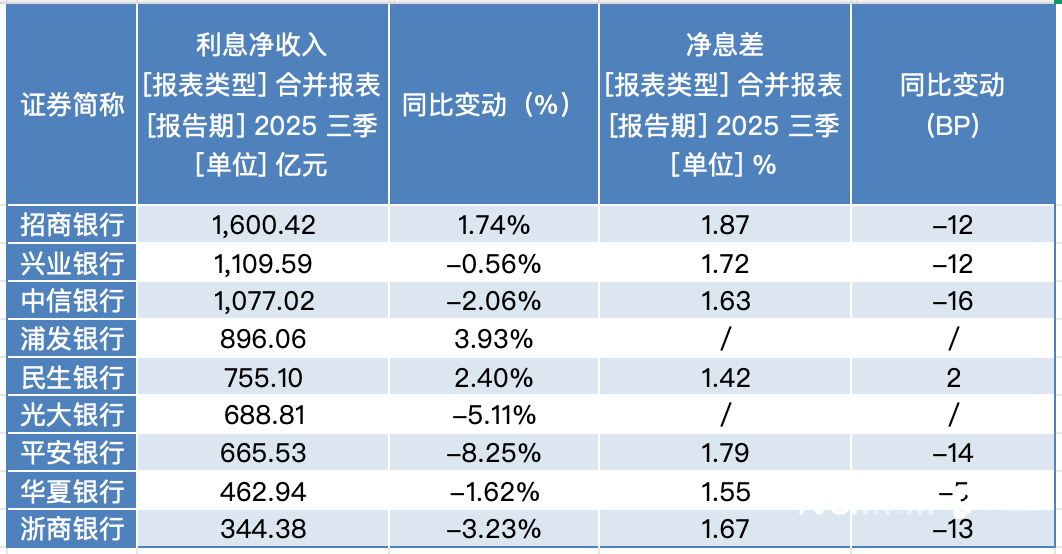
Core Viewpoint - The performance of nine A-share listed joint-stock banks in the third quarter of 2025 shows a mixed picture, with seven banks experiencing a year-on-year decline in operating income and five banks seeing a drop in net profit. Only Shanghai Pudong Development Bank achieved growth in both metrics [1][2]. Financial Performance - Among the nine banks, only Shanghai Pudong Development Bank and Minsheng Bank reported year-on-year growth in operating income, while four banks, including China Merchants Bank and Industrial Bank, saw an increase in net profit [2][3]. - China Merchants Bank led in operating income with CNY 251.42 billion, followed by Industrial Bank and CITIC Bank with CNY 161.23 billion and CNY 156.60 billion, respectively. Zhejiang Commercial Bank ranked last with CNY 48.93 billion [2]. - Minsheng Bank recorded the highest operating income growth rate at 6.74%, while Ping An Bank experienced the most significant decline at -9.78% [2]. Net Profit Analysis - China Merchants Bank maintained the highest net profit at CNY 113.77 billion, with a slight increase of 0.52%. Shanghai Pudong Development Bank saw a notable increase of 10.21% in net profit [3]. - The only bank to achieve growth in both operating income and net profit was Shanghai Pudong Development Bank, which reported a 1.88% increase in operating income [3]. Interest Income and Net Interest Margin - Six banks reported a year-on-year decline in net interest income, with the overall industry facing pressure on net interest margins, although the rate of decline has narrowed [4][6]. - China Merchants Bank led in net interest income with CNY 160.04 billion, showing a 1.74% increase, while Ping An Bank faced the largest decline at -8.25% [5][6]. Asset Quality - The asset quality of the banks showed mixed results, with five banks reporting a decline in non-performing loan (NPL) ratios, while three banks saw an increase [7][9]. - China Merchants Bank maintained the best asset quality with an NPL ratio of 0.94%, while Ping An Bank's NPL ratio was 1.05% [8][9]. Retail and Corporate Loan Trends - The third quarter of 2025 revealed a shift in loan structure, with corporate loans expanding while retail loans showed weakness. Three banks reported negative growth in retail loans [10][12]. - Among the banks, only Shanghai Pudong Development Bank, China Merchants Bank, and CITIC Bank saw growth in personal loans, while others experienced declines [11][12]. Retail Asset Under Management (AUM) - Several banks reported strong growth in retail AUM, with China Merchants Bank managing CNY 16.60 trillion in retail customer assets, an increase of 11.19% [12][14]. - Shanghai Pudong Development Bank's retail AUM reached CNY 4.62 trillion, reflecting a growth of 19.07% [13].


中国光大银行拟于11月14日召开董事会会议以审批建议派发2025年度中期股息
Ge Long Hui· 2025-11-04 09:52
Core Viewpoint - China Everbright Bank (06818.HK) plans to hold a board meeting on November 14, 2025, to review and potentially approve the proposal for the distribution of the interim dividend for the fiscal year 2025, if deemed appropriate [1] Group 1 - The board meeting is scheduled for November 14, 2025 [1] - The purpose of the meeting includes the review and approval of the proposed interim dividend for 2025 [1]
中国光大银行(06818.HK)拟于11月14日召开董事会会议以审批建议派发2025年度中期股息
Ge Long Hui· 2025-11-04 09:42
Core Viewpoint - China Everbright Bank (06818.HK) plans to hold a board meeting on November 14, 2025, to review and potentially approve the proposal for the distribution of the interim dividend for the fiscal year 2025, if deemed appropriate [1] Summary by Category - **Company Announcement** - The company will convene a board meeting on November 14, 2025, to discuss the interim dividend for 2025 [1]
中国光大银行(06818) - 关於召开董事会会议的通知
2025-11-04 09:39
6818 關於召開董事會會議的通知 中國光大銀行股份有限公司(「本公司」)謹此公佈,本公司擬於2025年11月14日(星期五) 召開董事會會議,藉以審議並(如認為適當)批准建議派發2025年度中期股息(如有)等事 宜。 香港交易及結算所有限公司及香港聯合交易所有限公司對本公告的內容概不負責,對其 準確性或完整性亦不發表任何聲明,並明確表示,概不對因本公告全部或任何部份內容 而產生或因倚賴該等內容而引致之任何損失承擔任何責任。 China Everbright Bank Company Limited 中國光大銀行股份有限公司 董事會 中國‧北京 2025年11月4日 於本公告日期,本公司執行董事為郝成先生、齊曄女士及楊兵兵先生;非執行董事為吳 利軍先生、崔勇先生、曲亮先生、朱文輝先生、姚威先生、張銘文先生及李巍先生;以 及獨立非執行董事為邵瑞慶先生、洪永淼先生、李引泉先生、劉世平先生、黃志凌先生 及黃振中先生。 ...
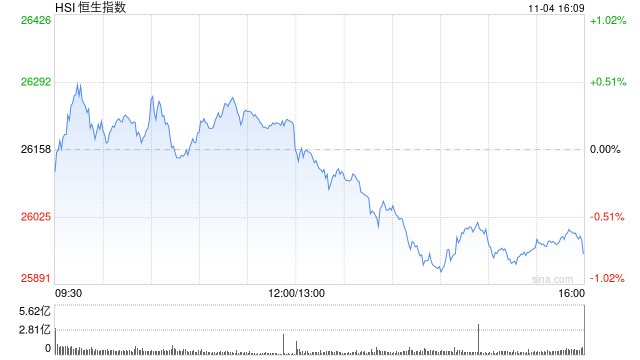
港股收评:午后跳水!恒指跌0.79%,黄金股、半导体股走低,内银股活跃,小米、京东跌近3%,阿里巴巴跌2.57%,光大银行涨3%
Ge Long Hui· 2025-11-04 08:50
Group 1 - Major technology stocks, including Xiaomi, JD.com, Alibaba, Meituan, and NetEase, experienced declines, negatively impacting market sentiment [2] - Baidu's stock rose nearly 3% after securing 260,000 autonomous taxi orders in a week [2] - The gold sector faced pressure due to adjustments in value-added tax, leading to declines in gold stocks such as Zijin Mining and Chifeng Jilong Gold [2] Group 2 - The cryptocurrency market saw a significant downturn, with over $1.2 billion in positions liquidated within 24 hours, causing a collective drop in cryptocurrency-related stocks [2] - The film industry reported a total box office exceeding 40 billion yuan in the first three quarters, leading to increased activity in entertainment stocks [2] - Bank investment returns showed a stark contrast, with China Construction Bank reporting a 150% increase, contributing to a rising trend in domestic bank stocks, particularly Everbright Bank which rose by 3% [2] Group 3 - The Hong Kong stock market indices, including the Hang Seng Tech Index, experienced notable declines, with the tech index dropping as much as 3% before closing down 1.76% [3] - Overall market sentiment in Hong Kong was described as very low, with the Hang Seng Index and the National Enterprises Index also showing declines of 0.79% and 0.92% respectively [3]
股份制银行板块11月4日涨2.44%,中信银行领涨,主力资金净流入17.63亿元
Zheng Xing Xing Ye Ri Bao· 2025-11-04 08:48
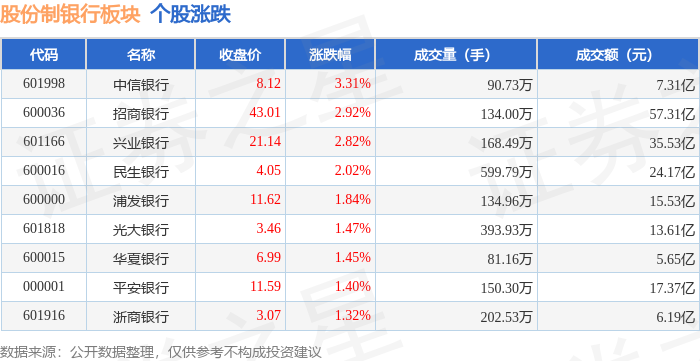
Core Viewpoint - The banking sector, particularly the joint-stock banks, experienced a notable increase of 2.44% on November 4, with CITIC Bank leading the gains, despite the overall decline in major stock indices [1] Group 1: Market Performance - The Shanghai Composite Index closed at 3960.19, down 0.41%, while the Shenzhen Component Index closed at 13175.22, down 1.71% [1] - CITIC Bank's stock price rose by 3.31% to 8.12, with a trading volume of 907,300 shares and a transaction value of 731 million [1] - Other notable performers included China Merchants Bank, which increased by 2.92% to 43.01, and Industrial Bank, which rose by 2.82% to 21.14 [1] Group 2: Capital Flow - The joint-stock banking sector saw a net inflow of 1.763 billion in main funds, while retail investors experienced a net outflow of 664 million [1] - Specific banks like Shanghai Pudong Development Bank had a main fund net inflow of 413 million, while retail investors saw a net outflow of 251 million [2] - Ping An Bank recorded a main fund net inflow of 294 million, with retail investors also experiencing a net outflow of 165 million [2]

中国光大银行(06818) - 截至二零二五年十月三十一日止月份之股份发行人的证券变动月报表
2025-11-04 08:31
股份發行人及根據《上市規則》第十九B章上市的香港預託證券發行人的證券變動月報表 截至月份: 2025年10月31日 狀態: 新提交 致:香港交易及結算所有限公司 公司名稱: 中國光大銀行股份有限公司(於中華人民共和國註冊成立的股份有限公司) 呈交日期: 2025年11月4日 I. 法定/註冊股本變動 | 1. 股份分類 | 普通股 | 股份類別 H | | | 於香港聯交所上市 (註1) | | 是 | | | --- | --- | --- | --- | --- | --- | --- | --- | --- | | 證券代號 (如上市) | 06818 | 說明 | | | | | | | | | | 法定/註冊股份數目 | | | 面值 | | 法定/註冊股本 | | | 上月底結存 | | | 12,678,735,500 | RMB | | 1 RMB | | 12,678,735,500 | | 增加 / 減少 (-) | | | 0 | | | RMB | | 0 | | 本月底結存 | | | 12,678,735,500 | RMB | | 1 RMB | | 12,678,735,500 ...