
Bank of Chengdu(601838)

Search documents
谈谈过去一年的教训和经验
雪球· 2026-01-04 08:04
Core Viewpoint - The article reflects on past investment experiences, emphasizing the importance of market trends alongside fundamental analysis and valuation in making investment decisions [4][11]. Group 1: Lessons from Profitable Stocks - The success with China Hongqiao was attributed to its favorable fundamentals, low valuation, and positive market trends, which were initially overlooked, leading to insufficient position size [5][6]. - The analysis of market trends, fundamental changes, and valuation is crucial; when two out of three factors indicate a better choice, decisive action should be taken [5][6]. Group 2: Lessons from Unprofitable Stocks - Chengdu Bank's disappointing third-quarter report highlighted the risk of ignoring market signals, leading to a misguided decision to buy against market trends [7]. - The experiences with Gree Electric and thermal power stocks underscored the necessity of having strong confidence in fundamentals before investing, as lack of confidence can lead to panic selling during market corrections [8]. Group 3: Key Investment Strategies - Identifying opportunities where fundamentals, low valuation, and positive market trends align is rare; when such opportunities arise, significant investment should be made [11]. - When market trends confirm investment logic, it is essential to increase position size decisively, as demonstrated by the successful investment in Shenhuo [10][11]. - A lack of confidence in fundamentals can lead to poor investment decisions, especially during market adjustments, resulting in losses [11]. Group 4: Future Focus - The company plans to concentrate on analyzing firms with strong cash flow, low valuations, and a commitment to sharing value with minority shareholders, while continuing to explore the thermal power sector [12].





优先股隐退永续债上位!银行业资本补充进入密集冲刺期,年利息至少省3%
Xin Lang Cai Jing· 2026-01-04 05:31
Core Viewpoint - The Chinese banking industry is undergoing a significant transformation, with banks redeeming high-cost preferred shares and issuing perpetual bonds as a more cost-effective financing alternative, driven by declining social financing costs and regulatory changes [2][4][11]. Group 1: Redemption of Preferred Shares - By the end of 2025, a total of 9 banks announced the redemption of preferred shares, amounting to 111.8 billion RMB in domestic preferred shares and 5.72 billion USD in foreign preferred shares [4]. - In December 2025 alone, five banks, including Changsha Bank and Beijing Bank, redeemed a total of 45.8 billion RMB in preferred shares [3]. - The redemption of preferred shares is facilitated by their lack of maturity dates but includes redemption clauses, allowing banks to manage capital flexibly [4]. Group 2: Issuance of Perpetual Bonds - As of December 31, 2025, Chinese commercial banks issued 69 perpetual bonds, raising a total of 821.8 billion RMB, marking a historical high in both issuance quantity and scale [5]. - The interest rates for newly issued perpetual bonds generally ranged from 2.0% to 2.9%, the lowest in nearly three years, with a significant issuance peak occurring in the second half of 2025 [5][6]. - The issuance of perpetual bonds is seen as a response to the urgent need for capital replenishment, especially among small and medium-sized banks facing declining capital adequacy ratios [2][6]. Group 3: Cost Savings and Financial Efficiency - By replacing preferred shares with perpetual bonds, banks can save at least 3% annually on interest expenses, significantly reducing their financing costs [8][10]. - For instance, the interest rate on newly issued perpetual bonds is substantially lower than that of previously issued preferred shares, with examples showing potential annual savings of 12.8 million RMB for banks like Industrial Bank [10]. - The transition from preferred shares to perpetual bonds is viewed as a strategic move to optimize capital structure and reduce interest payment burdens, aligning with regulatory requirements [8][10]. Group 4: Regulatory Environment and Market Dynamics - The shift towards perpetual bonds is influenced by regulatory changes that favor capital instruments with loss absorption capabilities, making traditional preferred shares less attractive [11]. - The approval process for issuing perpetual bonds is simpler and faster compared to preferred shares, which require dual regulatory approvals, thus enhancing their appeal to banks [11]. - The current low-interest-rate environment is expected to persist, allowing banks to lock in low financing costs for the next 5 to 10 years, effectively mitigating the pressure from narrowing net interest margins [10].






银行:银行2026年展望:稳中求进
2025-12-31 16:02
Summary of the Conference Call Transcript Industry Overview - The banking sector is entering a phase of high-quality development, with a focus on absolute and relative returns from bank stocks, driven by high dividend yields and asset quality [3][4][20]. Key Points Financial Performance Projections - Expected revenue growth for listed banks in 2026 and 2027 is +2.5% and +3.6% respectively, with net profit growth of +1.9% and +2.6% [4][20]. - Revenue and profit growth are anticipated to improve due to: 1. Narrowing net interest margin pressure 2. Quality-focused credit issuance amid weak demand [4][20]. 3. Stabilization of fee income growth after several years of fee reductions [4][20]. 4. Stable or improving net non-performing loan generation rates [4][11]. 5. Accelerated supply-side reforms leading to a reduction in the number of bank licenses, improving competition and operational landscape [4][11]. Customer Demand and Market Dynamics - The low-interest-rate environment has shifted customer demand, with government and state-owned enterprises becoming significant contributors to leverage, affecting the structure of new social financing [5][10]. - Regulatory policies are influencing the development of inclusive finance, focusing on risk compensation rather than merely increasing customer numbers [5][10]. Risk Factors - Risks associated with real estate developers and retail sectors are highlighted, with potential for greater-than-expected exposure [6][11]. Profitability and Valuation Adjustments - Adjustments to profitability forecasts for 2025 and 2026 have been made, with a focus on net interest income recovery and fee income growth [20][21]. - The expected net interest margin for 2026 is projected to be approximately 1.34%, a decrease of 6 basis points from 2025 [21][22]. - Fee income is expected to grow by 3.6% and 4.9% in 2026 and 2027 respectively, indicating a positive trend in non-interest income [21][22]. Asset Quality and Credit Costs - The net non-performing loan generation rate is expected to stabilize or slightly decline, with structural characteristics of retail and corporate lending continuing [11][21]. - Credit costs are projected to remain stable at around 0.58% for 2026 and 2027, reflecting the balance between corporate and household debt servicing capabilities [21][22]. Investment Recommendations - The report suggests a continued positive outlook for bank stocks, emphasizing the importance of dividend yield and asset quality in investment decisions [3][4][20]. Additional Insights - The banking sector is undergoing a transformation towards high-quality development, with a shift in focus from scale to quality, driven by macroeconomic pressures and regulatory changes [12][20]. - The reduction in the number of banking licenses over the past five years indicates successful risk management efforts within the sector [11][12]. - The report emphasizes the need for banks to adapt their strategies to maintain competitiveness in a changing regulatory and economic environment [12][20].


成都银行监事长孙波因工作调动辞职
Xin Lang Cai Jing· 2025-12-31 16:01
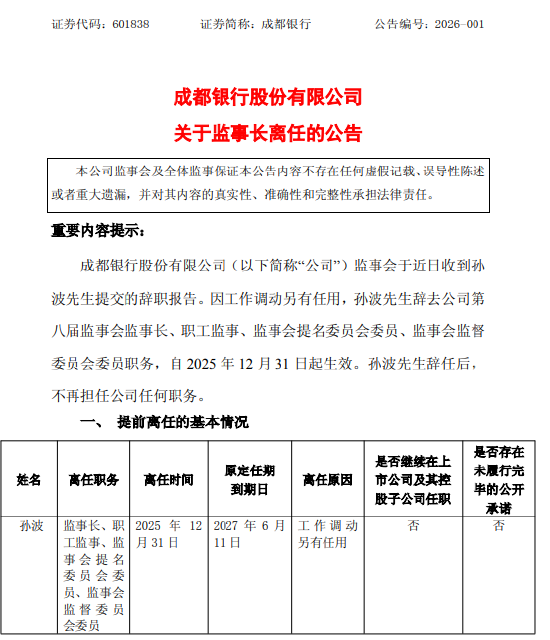
成都银行(601838)发布公告,因工作调动另有任用,孙波辞去公司监事长、职工监事、监事会提名委 员会委员、监事会监督委员会委员职务,自2025年12月31日起生效。孙波辞任后,不再担任公司任何职 务。 成都银行(601838)发布公告,因工作调动另有任用,孙波辞去公司监事长、职工监事、监事会提名委 员会委员、监事会监督委员会委员职务,自2025年12月31日起生效。孙波辞任后,不再担任公司任何职 务。 ...
因工作调动另有任用,成都银行监事长孙波辞任
Bei Jing Shang Bao· 2025-12-31 11:29
北京商报讯(记者 孟凡霞 周义力)12月31日,成都银行公告,该行监事会于近日收到孙波提交的辞职 报告。因工作调动另有任用,孙波辞去成都银行第八届监事会监事长、职工监事、监事会提名委员会委 员、监事会监督委员会委员职务,自2025年12月31日起生效。孙波辞任后,不再担任成都银行任何职 务。 ...
成都银行:监事长孙波因工作调动提前离任
Xin Lang Cai Jing· 2025-12-31 11:11
12月31日金融一线消息,成都银行今日发布公告称,公司监事会于近日收到孙波提交的辞职报告。因工 作调动另有任用,孙波辞去公司第八届监事会监事长、职工监事、监事会提名委员会委员、监事会监督 委员会委员职务,自2025年12月31日起生效。孙波辞任后,不再担任公司任何职务。 | 姓名 | 高任职务 | 高任时间 | 原定任期 到期日 | 高任原因 | 是否继续在上 市公司及其控 | 是否存在 未展行元 辛的公开 | | --- | --- | --- | --- | --- | --- | --- | | | | | | | 股子公司任职 | | | | | | | | | 承诺 | | 孙波 | 监事长、职 | 2025 年 12 | 2027 年 6 月 | 工作调动 | 合 | 合 | | | 工监事、监 | 月 31 日 | 11日 | 另有任用 | | | | | 事会提名 | | | | | | | | 委员会委 | | | | | | | | 员、监事会 | | | | | | | | 监督委员 | | | | | | | | 会委员 | | | | | | 责任编辑:王馨茹 12月31日金融一线消 ...
成都银行(601838) - 成都银行股份有限公司关于监事长离任的公告
2025-12-31 09:45
证券代码:601838 证券简称:成都银行 公告编号:2026-001 成都银行股份有限公司 关于监事长离任的公告 | 姓名 | 离任职务 | | 离任时间 | | | 原定任期 到期日 | | 离任原因 | | | 是否继续在上 市公司及其控 | 是否存在 未履行完 毕的公开 | | --- | --- | --- | --- | --- | --- | --- | --- | --- | --- | --- | --- | --- | | | | | | | | | | | | | 股子公司任职 | 承诺 | | 孙波 | 监事长、职 | 2025 | 年 | 12 | 2027 | 年 6 | 月 | 工 作 | 调 | 动 | 否 | 否 | | | 工监事、监 | 月 31 | 日 | | 11 | 日 | | 另有任用 | | | | | | | 事 会 提 名 | | | | | | | | | | | | | | 委 员 会 委 | | | | | | | | | | | | | | 员、监事会 | | | | | | | | | | | | | | 监 督 委 员 | | | | | | | ...
成都银行(601838.SH):第八届监事会监事长孙波辞职
Ge Long Hui A P P· 2025-12-31 09:40
格隆汇12月31日丨成都银行(601838.SH)公布,公司监事会于近日收到孙波先生提交的辞职报告。因工 作调动另有任用,孙波先生辞去公司第八届监事会监事长、职工监事、监事会提名委员会委员、监事会 监督委员会委员职务,自2025年12月31日起生效。孙波先生辞任后,不再担任公司任何职务。 ...
城商行板块12月31日跌0.33%,厦门银行领跌,主力资金净流入2.01亿元
Zheng Xing Xing Ye Ri Bao· 2025-12-31 09:07
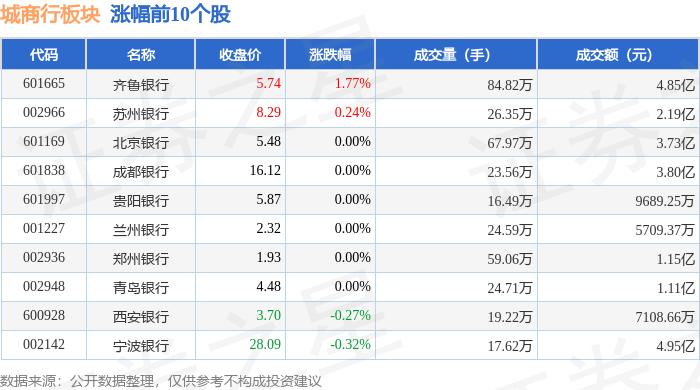
Market Overview - The city commercial bank sector experienced a decline of 0.33% on December 31, with Xiamen Bank leading the drop [1] - The Shanghai Composite Index closed at 3968.84, up 0.09%, while the Shenzhen Component Index closed at 13525.02, down 0.58% [1] Individual Bank Performance - Qilu Bank closed at 5.74, up 1.77% with a trading volume of 848,200 shares and a transaction value of 485 million [1] - Suzhou Bank closed at 8.29, up 0.24% with a trading volume of 263,500 shares and a transaction value of 219 million [1] - Xiamen Bank closed at 7.34, down 1.08% with a trading volume of 133,200 shares and a transaction value of 97.8 million [2] - Nanjing Bank closed at 11.43, down 0.78% with a trading volume of 235,600 shares and a transaction value of 270 million [2] Capital Flow Analysis - The city commercial bank sector saw a net inflow of 201 million from institutional investors, while retail investors experienced a net outflow of 9.56 million [2] - The capital flow for individual banks shows that Shanghai Bank had a net inflow of 48.9 million from institutional investors, while Hangzhou Bank had a net outflow of 50.55 million [3] - Suzhou Bank recorded a net inflow of 30.66 million from institutional investors, while retail investors had a net outflow of 27.1 million [3]



地方消费贷“红包”来了 成都银行已落地新政
Zheng Quan Ri Bao· 2025-12-30 07:08
Core Viewpoint - The rapid implementation of local consumer loan interest subsidy policies by Chengdu Bank, following the national "Guo Bu" consumer loan initiative, aims to stimulate consumer spending and economic recovery in Sichuan Province [1][2]. Group 1: Policy Implementation - Chengdu Bank released specific implementation details for the consumer loan interest subsidy policy, which is effective from October 1, 2025, to March 31, 2026, covering key consumption periods such as New Year's Day and Spring Festival [1]. - The policy is designed to balance fairness and efficiency, addressing both large consumer needs and smaller purchases like home appliance upgrades [1]. Group 2: Financial Performance - Since 2025, Chengdu Bank has issued a total of 27 billion yuan in consumer loans, reflecting a year-on-year growth of 10.9%, thereby injecting financial resources into the consumer market [1]. - The bank has invested over 11 million yuan in subsidies since 2025, benefiting 1.5 million citizens and directly driving consumption exceeding 1.5 billion yuan [2]. Group 3: Digital Services and Consumer Engagement - Chengdu Bank has developed a cloud-based automotive finance rights platform, creating a fully digital service system for auto financing, and has conducted 24 promotional events since 2023, distributing 660 million yuan in consumer rewards [2]. - The bank collaborates with major platforms like Meituan and JD.com, as well as over 200 local merchants, to create a comprehensive discount matrix that enhances consumer engagement [2]. Group 4: Future Outlook - Chengdu Bank plans to continue focusing on local service and enhancing consumer financial products to contribute to urban economic vitality and promote quality consumption expansion [2].