Bank of Chengdu(601838)

Search documents
A股银行ESG强信披名单扩容,北京银行、南京银行成碳排大户
2 1 Shi Ji Jing Ji Bao Dao· 2025-12-24 12:15
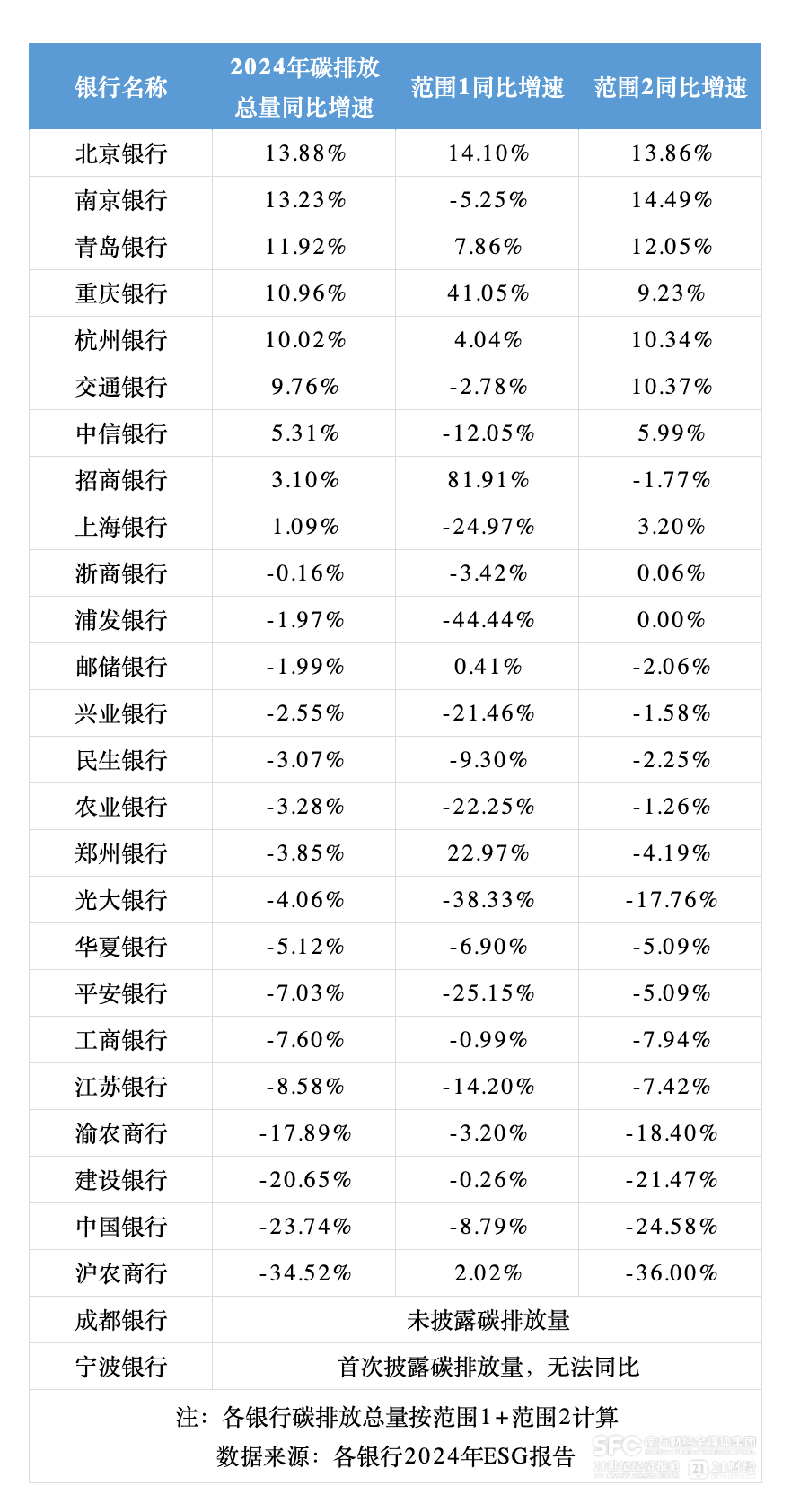
2026年即将到来,在监管要求下ESG 强制信息披露元年大幕正在拉开,而A股银行ESG强信披名单也迎来了扩容。 依据证监会指导沪深北交易所《上市公司自律监管指引——可持续发展报告》,ESG强信披阵营锁定上证180、深证100、科创50、创业板指成分股及境内 外同步上市企业。伴随上证180等指数调整,成都银行、沪农商行两家上市银行新晋入列。 | 银行名称 | 2024年碳排放 总量同比增速 | 范围1同比增速 | 范围2同比增速 | | --- | --- | --- | --- | | 北京银行 | 13.88% | 14.10% | 13.86% | | 南京银行 | 13.23% | -5.25% | 14.49% | | 青岛银行 | 11.92% | 7.86% | 12.05% | | 重庆银行 | 10.96% | 41.05% | 9.23% | | 杭州银行 | 10.02% | 4.04% | 10.34% | | 交通银行 | 9.76% | -2.78% | 10.37% | | 中信银行 | 5.31% | -12.05% | 5.99% | | 招商银行 | 3.10% | 81.9 ...




成都银行大宗交易成交17.88万股 成交额268.74万元
Zheng Quan Shi Bao Wang· 2025-12-22 13:53
两融数据显示,该股最新融资余额为14.56亿元,近5日减少6992.49万元,降幅为4.58%。(数据宝) (原标题:成都银行大宗交易成交17.88万股 成交额268.74万元) 成都银行12月22日大宗交易平台出现一笔成交,成交量17.88万股,成交金额268.74万元,大宗交易成交 价为15.03元,相对今日收盘价折价9.07%。该笔交易的买方营业部为方正证券股份有限公司瑞安罗阳大 道证券营业部,卖方营业部为方正证券股份有限公司瑞安罗阳大道证券营业部。 进一步统计,近3个月内该股累计发生2笔大宗交易,合计成交金额为2736.75万元。 证券时报•数据宝统计显示,成都银行今日收盘价为16.53元,下跌0.66%,日换手率为0.47%,成交额为 3.31亿元,全天主力资金净流出1602.18万元,近5日该股累计下跌0.06%,近5日资金合计净流出4614.86 万元。 12月22日成都银行大宗交易一览 | 成交 | 成交 | | 相对当 日 | | | | --- | --- | --- | --- | --- | --- | | | | 成交价 | | | | | 量 | 金额 | 格 | 收盘折 | 买方 ...
三地同步发力!消费贷新政落地,中小银行助力政策触达“最后一公里”
Xin Lang Cai Jing· 2025-12-19 02:50
Core Viewpoint - The consumer loan interest subsidy policy is being implemented at the local level, with provinces like Sichuan, Chongqing, and Guizhou initiating provincial subsidy programs, marking a further refinement of the national policy [2][10]. Group 1: Policy Implementation - Sichuan, Chongqing, and Guizhou have launched provincial subsidy programs for consumer loans, including local small and medium-sized banks as processing institutions [3][11]. - The subsidy period for Sichuan is from October 1, 2025, to March 31, 2026, while Chongqing's period is from September 1, 2025, to August 31, 2026, and Guizhou's is from September 1, 2025, to December 31, 2025 [3][11]. - The core standard for the subsidy is a 1% annual interest subsidy rate, not exceeding 50% of the loan contract interest rate, consistent with national standards [5][13]. Group 2: Market Impact - The inclusion of local policies is expected to create a structural impact, leading to a policy overlay effect that lowers consumer credit interest rates and stimulates demand [4][12]. - This policy shift breaks the initial trend where national subsidies primarily benefited large national banks, providing local banks with competitive tools and preventing excessive market concentration [5][13]. - The initiative encourages financial institutions to innovate products based on regional consumption characteristics, leading to a more diverse and balanced financial support network for consumption [5][13]. Group 3: Future Outlook - The Ministry of Commerce and other regulatory bodies have emphasized the need for collaboration among financial policies to guide credit funds towards key consumption areas [6][14]. - Experts predict that more provinces, especially economically significant ones, will adopt similar policies, with a focus on green and digital consumption [6][14]. - There is a strong motivation for regions with weak consumption recovery or those looking to enhance local commercial vitality to implement similar measures, creating a synergistic effect between national and local subsidies [6][14]. Group 4: Challenges for Local Banks - Local banks face both opportunities and challenges from this policy, as it provides a short-term growth window but also highlights their limitations in customer base, risk control technology, and product capabilities compared to larger banks [7][15]. - The policy's benefits may be temporary, and local banks must enhance their digital operations and service capabilities to retain customers after the policy period ends [7][15]. - Recommendations for local banks include leveraging policy benefits for rapid digital upgrades, building a "credit + scenario" ecosystem, and strengthening risk control and unique capabilities to avoid dependency on subsidies [7][15].


金融力量与城市温度共融共生 成都银行获评“最具社会责任上市公司”
Mei Ri Jing Ji Xin Wen· 2025-12-16 12:20
Core Viewpoint - Chengdu Bank has been recognized as the "Most Socially Responsible Listed Company" at the 2025 14th Annual Development Conference for Listed Companies, highlighting its commitment to social responsibility and sustainable development [1] Group 1: Business Performance - For the first nine months of 2025, Chengdu Bank achieved an operating income of 17.761 billion yuan, a year-on-year increase of 3.01%, and a net profit attributable to shareholders of 9.493 billion yuan, up 5.03% year-on-year [3] - As of September 2025, total deposits reached 986.432 billion yuan, an increase of 100.573 billion yuan or 11.35% since the beginning of the year, while total loans exceeded 847.481 billion yuan, growing by 104.9 billion yuan or 14.13% [3] - The bank's total assets surpassed 1.38 trillion yuan, reflecting a steady growth of 10.81% since the start of the year, with a non-performing loan ratio of 0.68%, indicating strong asset quality [3] Group 2: Strategic Development - Chengdu Bank has established three major business pillars: government-finance cooperation, entity business, and individual financial liabilities, successfully becoming the first city commercial bank in the West to exceed 1 trillion yuan in asset scale in 2023 [2] - The bank is focusing on new strategic planning to explore growth drivers in areas such as entity business, retail asset management, wealth management, and international business [2] - The bank's commitment to social responsibility is integrated into its development strategy, emphasizing service to the real economy and enhancing public welfare [1][6] Group 3: Innovation and Technology - Chengdu Bank has been recognized for its financial technology capabilities, maintaining a leading position among city commercial banks in China, with over 5 million mobile banking users and 1.43 million monthly active users as of mid-2025 [10] - The bank has launched a "Ruin Garden Benefit Enterprise" financial initiative to support industrial parks, aiming to provide over 50 billion yuan in credit support by the end of 2025 [7] - The bank has also issued 3 billion yuan in green financial bonds, leading the market in green credit with a compound growth rate exceeding 90% [8] Group 4: Community Engagement and Social Responsibility - Chengdu Bank has actively engaged in community service, conducting over 800 volunteer activities in the previous year, benefiting more than 24,000 people [11] - The bank has implemented a comprehensive service model to support major projects and industrial upgrades, with significant credit investments in the Chengdu-Chongqing economic circle [6][12] - The bank's commitment to social responsibility includes promoting agricultural finance services and supporting rural revitalization projects [12]
小红日报 | 孚日股份涨停,标普红利ETF(562060)标的指数收涨0.17%
Xin Lang Cai Jing· 2025-12-16 01:04
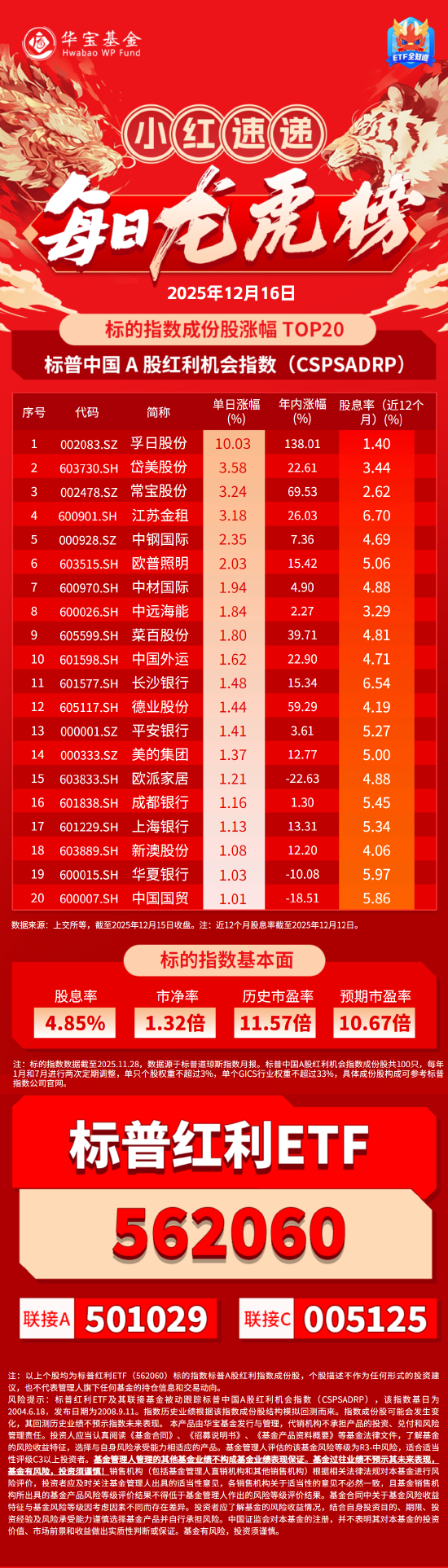
Core Insights - The article highlights the top 20 stocks in the S&P China A-Share Dividend Opportunity Index (CSPSADRP) based on their performance and dividend yield as of December 15, 2025 [1][4] Group 1: Stock Performance - The top-performing stock is LuRi Co., Ltd. (002083.SZ) with a daily increase of 10.03% and a year-to-date increase of 138.01% [1][4] - Dai Mei Co., Ltd. (603730.SH) ranks second with a daily increase of 3.58% and a year-to-date increase of 22.61% [1][4] - Changbao Co., Ltd. (002478.SZ) follows with a daily increase of 3.24% and a year-to-date increase of 69.53% [1][4] Group 2: Dividend Yields - Jiangsu Jinzhong (600901.SH) offers the highest dividend yield among the top 20 stocks at 6.70% [1][4] - Other notable dividend yields include Changsha Bank (601577.SH) at 6.54% and Huaxia Bank (600015.SH) at 5.97% [1][4] - The average dividend yield for the top 20 stocks varies, with several companies offering yields above 5% [1][4] Group 3: Additional Stock Insights - The performance of stocks like Midea Group (000333.SZ) shows a year-to-date increase of 12.77% despite a daily increase of only 1.37% [1][4] - Some stocks, such as Oppein Home Group (603833.SH), have experienced a year-to-date decline of 22.63% [1][4] - The data reflects a diverse range of performance and dividend strategies among the top stocks in the index [1][4]





融资再创新高,把握优质金融股
HTSC· 2025-12-14 12:00
Investment Rating - The report maintains an "Overweight" rating for the securities and banking sectors, while suggesting a cautious approach towards the insurance sector [9]. Core Insights - The report highlights a recovery in trading activity, with stock trading volume exceeding 2 trillion yuan over two trading days, and financing balances reaching a new high of 2.49 trillion yuan [1][12]. - The Central Economic Work Conference reiterated a proactive fiscal policy and moderately loose monetary policy stance, emphasizing the need for continued deepening of capital market reforms [1][23]. - The report expresses optimism regarding the performance of insurance products during the "opening red" period, although it notes that this is not the primary driver of valuation [1][46]. Summary by Sections Investment Opportunities - The report identifies investment opportunities in the following order: securities > banking > insurance [1][12]. - The trading activity has rebounded, with significant increases in stock transaction volumes and financing balances [1][12]. Sub-industry Perspectives 1. **Securities**: The report notes a high level of trading activity and a recovery in financing balances, suggesting a favorable environment for brokerage firms [2][13]. 2. **Banking**: The report indicates that the banking sector is seeing improved cost-effectiveness and suggests focusing on high-quality banks for structural opportunities [2][23]. 3. **Insurance**: The report advises caution due to uncertainties in market liquidity and sector rotation, recommending a focus on stable combinations [2][46]. Key Companies and Dynamics - **Securities**: Recommended companies include CITIC Securities, Guotai Junan, and GF Securities [3][47]. - **Banking**: Suggested quality stocks include Nanjing Bank, Chengdu Bank, and Shanghai Bank [3][47]. - **Insurance**: The report recommends focusing on stable companies such as AIA, Ping An, and China Pacific Insurance [46].




川黔渝地方银行加入消费贷贴息阵营 部分银行要求更为严格
Jing Ji Guan Cha Wang· 2025-12-12 09:35
Core Viewpoint - The announcement by Chongqing Rural Commercial Bank regarding the implementation of a personal consumption loan interest subsidy policy aims to boost local consumption by allowing residents to benefit from interest subsidies on loans used for consumption from September 1, 2025, to August 31, 2026 [1][2]. Group 1: Policy Implementation - The personal consumption loan interest subsidy policy will be applicable to loans issued by regional banks in addition to the six major state-owned commercial banks and twelve national joint-stock commercial banks [1][2]. - The subsidy will cover loans for various consumption categories, including household vehicles, education, and healthcare, with a maximum annual subsidy rate of 1% and a cap of 50% of the loan contract interest rate [2][3]. Group 2: Regional Bank Participation - Several regional banks, including Chongqing Bank and Guizhou Bank, have announced their participation in the subsidy program, indicating a broader implementation of the policy across different financial institutions [1][8]. - The execution periods for the subsidy may vary among regional banks, with some banks setting specific time frames for eligibility [3][4]. Group 3: Eligibility and Restrictions - Regional banks have established strict eligibility criteria for the subsidy, requiring that the consumption must occur within the respective provinces and that certain documentation must be provided [5][6]. - There are specific restrictions on the types of transactions that qualify for the subsidy, such as requiring that the loan be used for consumption within 30 days of disbursement [6][7]. Group 4: Local Government Support - Local governments are encouraged to support the implementation of the subsidy policy, with funding responsibilities shared between provincial and municipal levels [8]. - The policy aims to enhance the competitiveness of regional banks and stimulate local consumption while keeping the fiscal burden manageable for local governments [9].

城商行板块12月12日跌0.23%,杭州银行领跌,主力资金净流出908.98万元
Zheng Xing Xing Ye Ri Bao· 2025-12-12 09:12
Core Points - The city commercial bank sector experienced a decline of 0.23% on December 12, with Hangzhou Bank leading the drop [1] - The Shanghai Composite Index closed at 3889.35, up 0.41%, while the Shenzhen Component Index closed at 13258.33, up 0.84% [1] Summary by Category Stock Performance - Hangzhou Bank closed at 15.12, down 0.92% with a trading volume of 543,600 shares and a transaction value of 824 million yuan [2] - Qilu Bank closed at 5.63, down 0.71% with a trading volume of 1,165,000 shares and a transaction value of 657 million yuan [2] - Qingdao Bank closed at 4.58, down 0.65% with a trading volume of 370,100 shares and a transaction value of 169 million yuan [2] - Chongqing Bank closed at 10.84, down 0.64% with a trading volume of 118,200 shares and a transaction value of 129 million yuan [2] - Chengdu Bank closed at 16.35, down 0.49% with a trading volume of 390,900 shares and a transaction value of 642 million yuan [2] - Lanzhou Bank closed at 2.32, down 0.43% with a trading volume of 529,700 shares and a transaction value of 123 million yuan [2] - Xiamen Bank closed at 7.56, down 0.26% with a trading volume of 358,000 shares and a transaction value of 270 million yuan [2] - Ningbo Bank closed at 27.72, down 0.25% with a trading volume of 215,400 shares and a transaction value of 596 million yuan [2] - Changsha Bank closed at 9.48, down 0.21% with a trading volume of 321,800 shares and a transaction value of 306 million yuan [2] - Jiangsu Bank closed at 10.39, down 0.19% with a trading volume of 1,989,400 shares and a transaction value of 2.066 billion yuan [2] Capital Flow - The city commercial bank sector saw a net outflow of 9.0898 million yuan from institutional investors, while retail investors contributed a net inflow of 230 million yuan [4] - Speculative funds experienced a net outflow of 2.21 billion yuan [4]


两大股东6亿增持+榜单领跑,解码成都银行稳健经营底色
Tai Mei Ti A P P· 2025-12-12 08:08
Core Viewpoint - The recent surge in the A-share banking sector, particularly the significant share buybacks by major shareholders of Chengdu Bank, reflects strong confidence in the bank's robust operational performance and competitive positioning in the regional market [2][3]. Group 1: Shareholder Actions - Chengdu Bank's major shareholders, Chengdu Industrial Capital Group and Chengdu Xintianyi Investment, have collectively invested 611 million yuan to buy back 34.247 million shares, indicating their commitment to the bank's future growth [2]. - The initial buyback plan announced in April 2023 was adjusted in August 2023 due to rising stock prices, with the new plan allowing for a total investment of between 699.98 million yuan and 1.39996 billion yuan [3]. - As of November 21, 2023, the shareholders have increased their holdings to 6.0618% and 4.2737%, respectively, with plans for further investments [3]. Group 2: Financial Performance - For the first nine months of 2023, Chengdu Bank reported a revenue of 17.761 billion yuan, a year-on-year increase of 3.01%, and a net profit of 9.493 billion yuan, up 5.03% [4]. - The bank's total assets reached 1.39 trillion yuan, growing by 10.81% since the beginning of the year, with total loans increasing by 14.13% to 847.481 billion yuan [4]. - The bank maintains a low non-performing loan ratio of 0.68% and a high provision coverage ratio of 433.08%, indicating strong asset quality and risk management capabilities [5]. Group 3: Awards and Recognition - Chengdu Bank has received multiple prestigious awards, reinforcing its competitive edge among regional banks, including recognition as a leading bank in the 2025 China Banking Competitiveness Research Report [7]. - The bank's commitment to supporting the Chengdu-Chongqing economic circle has led to over 1 trillion yuan in credit support over the past five years, with significant investments in infrastructure and public services [8]. Group 4: Innovation and Service - The bank has implemented various innovative financial services, including targeted support for local industries and a focus on elderly financial services, enhancing its community engagement and customer base [10]. - Chengdu Bank has actively participated in major infrastructure projects, providing substantial funding for initiatives such as the Tianfu Airport Phase II and urban transportation systems [9].
“红包”来了!多地区域性银行入局!
券商中国· 2025-12-11 13:00
Core Viewpoint - The expansion of personal consumption loan interest subsidy policies by regional banks in Guizhou, Sichuan, and Chongqing aims to stimulate local consumption and enhance the competitiveness of regional financial institutions [1][6]. Group 1: Implementation of Subsidy Policies - Regional banks such as Guiyang Bank, Guizhou Bank, and Chengdu Bank have announced the implementation of personal consumption loan interest subsidies, expanding the original 23 financial institutions to include more local banks [1][2]. - The subsidy policies are in response to national calls to boost local consumption, with other provinces expected to follow suit [1][6]. Group 2: Specifics of Subsidy Programs - In Guizhou, the subsidy period is from December 1, 2025, to December 31, 2025, with a maximum subsidy of 3,000 yuan for eligible borrowers [2][4]. - In Chongqing, the subsidy applies to personal consumption loans issued from September 1, 2025, to August 31, 2026, with three local banks included as loan issuers [3][4]. - Chengdu Bank and Chengdu Rural Commercial Bank have set a subsidy cap of 1,500 yuan for borrowers during their policy period [5]. Group 3: Variations in Subsidy Standards - The annual subsidy rate for personal consumption loans in Guizhou and Chongqing is set at 1%, but the maximum subsidy amounts differ, with Guizhou and Chongqing allowing up to 3,000 yuan per borrower [4]. - Chengdu's subsidy cap is lower, at 1,500 yuan, indicating regional differences in subsidy implementation [5]. Group 4: Future Prospects and Market Impact - The introduction of these subsidy policies is expected to create a "national subsidy + local subsidy" synergy, enhancing regional banks' market competitiveness and stimulating local consumption [6][7]. - The policies are seen as a short-term growth opportunity for banks, but long-term sustainability may be challenged due to differences in customer base and risk management capabilities compared to larger banks [7].