
ZJB(601860)

Search documents
紫金农商银行江都支行获评“江都区消费者满意标杆网点”
Jiang Nan Shi Bao· 2025-12-01 02:45
Core Insights - The Jiangdu District of Yangzhou has recognized the Zijin Rural Commercial Bank Jiangdu Branch as a "2024 Consumer Satisfaction Benchmark Outlet," highlighting its commitment to customer service and quality [1][2] Group 1: Consumer Satisfaction Initiatives - Since its establishment in 2018, the Jiangdu Branch has prioritized consumer satisfaction as a core service upgrade metric, utilizing regular surveys and feedback mechanisms to capture customer needs [2] - The branch has implemented various initiatives, including an "Elderly Financial Service Zone" and a "Volunteer Home" feature, to enhance service offerings while protecting consumer rights [2] Group 2: Community Engagement and Social Responsibility - The Jiangdu Branch has actively engaged in over 50 community service activities, such as financial literacy programs and fraud prevention campaigns, benefiting more than 10,000 residents [2] - The recognition as a benchmark outlet for consumer satisfaction marks the third consecutive year the branch has received this honor, reflecting its ongoing commitment to customer satisfaction and community service [2]

紫金农商银行荣获市级“民营企业最满意银行”称号
Jiang Nan Shi Bao· 2025-12-01 02:45
Core Viewpoint - The People's Bank of China Jiangsu Branch and Jiangsu Federation of Industry and Commerce announced that Zijin Rural Commercial Bank was awarded the title of "Most Satisfied Bank for Private Enterprises" in Nanjing, highlighting its exceptional performance in financial services for private enterprises [1] Group 1: Service Mechanisms - The bank has integrated private enterprise loan issuance into its overall performance assessment system, increasing the weight of private loans in evaluations to ensure precise implementation at the branch and customer manager levels [2] - A "small and scattered" empowerment mechanism has been introduced, managing non-large loans through a list system to stimulate service vitality [2] - The bank has simplified the approval process for loans under 10 million yuan and expanded the whitelist, exploring online renewal of credit [2] Group 2: Product Innovation - The bank has upgraded traditional and specialized products, focusing on technology-oriented private enterprises and extending the credit period for mortgage loans [3] - New products like "Sutong Carbon Loan" and "Specialized and Innovative Insurance" have been introduced, exploring pledges based on intellectual property and carbon emission quotas [3] - The bank has launched credit products like "Zixin Loan" and "Suxin Loan" to support private enterprises, enhancing financing efficiency across the supply chain [3] Group 3: Technological Empowerment - The bank has developed a mobile version of "Tongshang e-loan," facilitating loan applications through various digital platforms, achieving 1.22 billion yuan in loans to 465 clients by the end of Q1 [4] - The "Inclusive Exhibition Platform" has granted credit to over 7,800 clients, totaling more than 4.8 billion yuan [4] - A systematic approach to client visits has been established, with 11,000 clients visited in Q1 to enhance service delivery to private enterprises [4]
农商行板块11月28日涨0.53%,沪农商行领涨,主力资金净流入2952.17万元
Zheng Xing Xing Ye Ri Bao· 2025-11-28 09:05
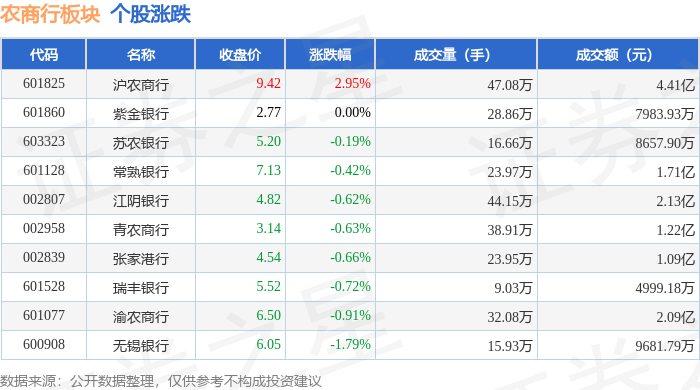
Market Performance - The agricultural commercial bank sector increased by 0.53% compared to the previous trading day, with Hu Nong Bank leading the gains [1] - The Shanghai Composite Index closed at 3888.6, up 0.34%, while the Shenzhen Component Index closed at 12984.08, up 0.85% [1] Individual Stock Performance - Hu Nong Bank (601825) closed at 9.42, with a rise of 2.95% and a trading volume of 470,800 shares, totaling a transaction value of 441 million yuan [1] - Other banks such as Zijin Bank (601860) remained unchanged at 2.77, while Su Nong Bank (603323) decreased by 0.19% to 5.20 [1] - Jiangyin Bank (002807) and Qingnong Bank (002958) saw declines of 0.62% and 0.63%, respectively, with closing prices of 4.82 and 3.14 [1] Capital Flow Analysis - The agricultural commercial bank sector experienced a net inflow of 29.52 million yuan from main funds, while retail investors saw a net outflow of 76.19 million yuan [1] - Notable net inflows from speculative funds were recorded at 46.67 million yuan [1] Detailed Capital Flow for Individual Stocks - Jiangyin Bank (002807) had a main fund net inflow of 27.00 million yuan, but a net outflow of 17.94 million yuan from retail investors [2] - Su Nong Bank (603323) reported a main fund net inflow of 12.32 million yuan, with retail investors experiencing a net outflow of 6.88 million yuan [2] - Wuxi Bank (600908) had a main fund net inflow of 10.91 million yuan, while retail investors faced a net outflow of 12.60 million yuan [2]




农商行板块11月26日涨0.17%,江阴银行领涨,主力资金净流出1257.83万元
Zheng Xing Xing Ye Ri Bao· 2025-11-26 09:05
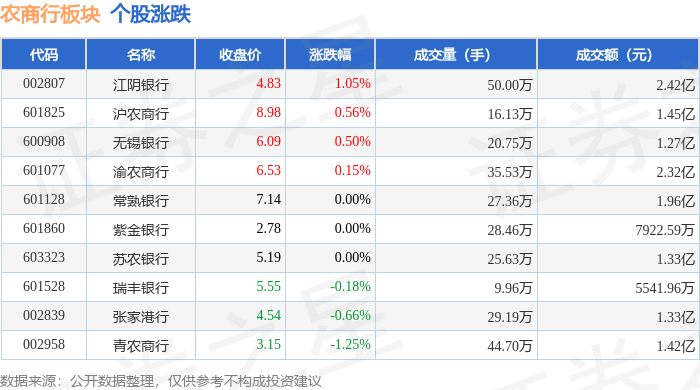
Core Insights - The rural commercial bank sector experienced a slight increase of 0.17% on November 26, with Jiangyin Bank leading the gains [1] - The Shanghai Composite Index closed at 3864.18, down 0.15%, while the Shenzhen Component Index rose by 1.02% to 12907.83 [1] Stock Performance - Jiangyin Bank (002807) closed at 4.83, up 1.05% with a trading volume of 500,000 shares and a transaction value of 2.42 billion [1] - Other notable performances include: - Hu Nong Commercial Bank (601825) at 86.8, up 0.56% with a transaction value of 145 million - Wuxi Bank (600908) at 6.09, up 0.50% with a transaction value of 127 million - Yunnan Agricultural Commercial Bank (601077) at 6.53, up 0.15% with a transaction value of 232 million [1] Capital Flow - The rural commercial bank sector saw a net outflow of 12.58 million from institutional investors, while retail investors experienced a net outflow of 46.30 million [1] - Notably, speculative funds had a net inflow of 58.87 million [1] Individual Stock Capital Flow - Jiangyin Bank had a net inflow of 34.67 million from institutional investors, but a net outflow of 22.04 million from retail investors [2] - Qingnong Commercial Bank (002958) saw a net inflow of 4.52 million from institutional investors, while retail investors had a net outflow of 5.52 million [2] - Zhangjiagang Bank (002839) experienced a net inflow of 4.19 million from institutional investors and a net outflow of 15.75 million from retail investors [2]


农商行板块11月25日涨0.72%,XD无锡银领涨,主力资金净流入1421.15万元
Zheng Xing Xing Ye Ri Bao· 2025-11-25 09:09
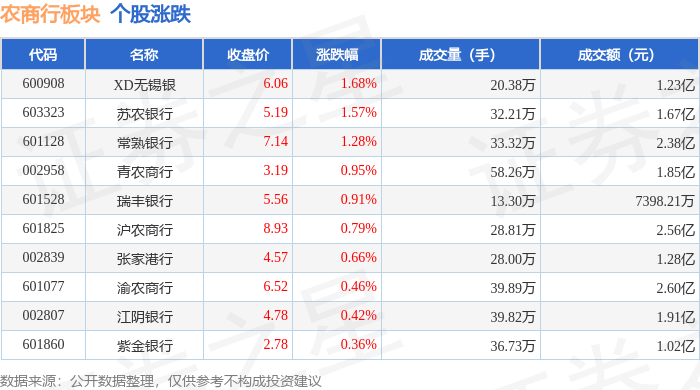
Core Points - The rural commercial bank sector saw an increase of 0.72% on November 25, with XD Wuxi leading the gains [1] - The Shanghai Composite Index closed at 3870.02, up 0.87%, while the Shenzhen Component Index closed at 12777.31, up 1.53% [1] Summary by Category Stock Performance - XD Wuxi Bank (600908) closed at 6.06, up 1.68% with a trading volume of 203,800 shares and a turnover of 123 million yuan [1] - Su Nong Bank (603323) closed at 5.19, up 1.57% with a trading volume of 322,100 shares and a turnover of 167 million yuan [1] - Changshu Bank (601128) closed at 7.14, up 1.28% with a trading volume of 333,200 shares and a turnover of 238 million yuan [1] - Other notable performances include Qingnong Commercial Bank (002958) at 3.19, up 0.95%, and Ruifeng Bank (601528) at 5.56, up 0.91% [1] Capital Flow - The rural commercial bank sector experienced a net inflow of 14.21 million yuan from institutional investors, while retail investors saw a net outflow of 56.75 million yuan [2] - Speculative funds had a net inflow of 42.54 million yuan into the sector [2]
紫金农商银行:为银发客群添“金”彩
Jiang Nan Shi Bao· 2025-11-24 14:27
Core Viewpoint - Zijin Rural Commercial Bank is actively implementing a comprehensive strategy to address the financial service needs of the aging population, focusing on the renovation of service points, product adaptation, and service extension for elderly clients [1] Group 1: Service Point Renovation - The bank has completed the hardware renovation of all 135 service points to meet elderly-friendly standards, ensuring that senior clients can handle financial and administrative tasks conveniently [3] - Features such as barrier-free access, elderly care zones, and dedicated service windows have been established to enhance the comfort and ease of service for older customers [2][3] - The bank has created 384 rural inclusive financial service points to provide comprehensive financial services to elderly clients without them needing to leave their villages [3] Group 2: Resource Allocation for Elderly Services - Zijin Rural Commercial Bank is directing financial resources towards pension finance, developing savings, investment, and credit products tailored to the needs of elderly clients [4] - The bank offers customized pension financial planning based on clients' age, risk preferences, and retirement goals, with over 300,000 clients aged 60 and above receiving wealth management services [4] - Loan conditions for elderly clients have been relaxed, with 1,909 clients receiving a total credit amount of 716 million yuan for consumption and mortgage loans [4] Group 3: Extension of Services for the Elderly - The bank is enhancing its pension financial service quality through professional training, volunteer services, and various community activities [5][6] - Volunteer teams have been established to provide on-site services such as haircuts, appliance repairs, and medical consultations, with over 1,000 community service events conducted [6] - The bank organizes financial literacy programs and community activities to improve elderly residents' awareness of fraud and enhance their cultural life, with nearly 500 events held [6] Future Plans - The bank aims to continue researching the financial needs of the elderly population and explore further enhancements in service quality, product development, and support for pension-related public welfare initiatives [6]
农商行板块11月24日跌0.65%,沪农商行领跌,主力资金净流入6415.83万元
Zheng Xing Xing Ye Ri Bao· 2025-11-24 09:12
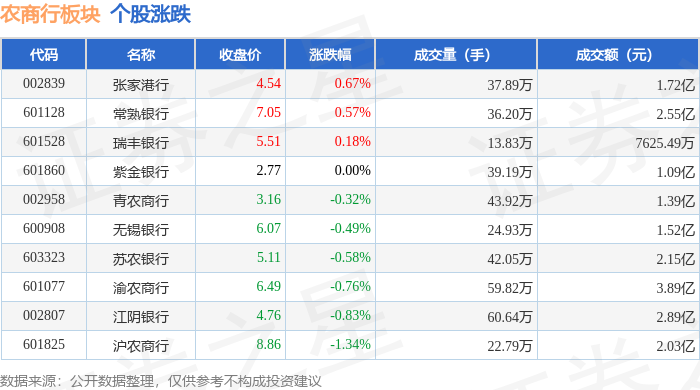
Core Insights - The rural commercial bank sector experienced a decline of 0.65% on November 24, with Hu Nong Commercial Bank leading the drop [1] - The Shanghai Composite Index closed at 3836.77, up 0.05%, while the Shenzhen Component Index closed at 12585.08, up 0.37% [1] Stock Performance - Zhangjiagang Bank (002839) closed at 4.54, up 0.67% with a trading volume of 378,900 shares and a transaction value of 172 million [1] - Changshu Bank (601128) closed at 7.05, up 0.57% with a trading volume of 362,000 shares and a transaction value of 255 million [1] - Ruifeng Bank (601528) closed at 5.51, up 0.18% with a trading volume of 138,300 shares and a transaction value of 76.25 million [1] - Zijin Bank (601860) closed at 2.77, unchanged with a trading volume of 391,900 shares and a transaction value of 109 million [1] - Qingnong Commercial Bank (002958) closed at 3.16, down 0.32% with a trading volume of 439,200 shares and a transaction value of 139 million [1] - Wuxi Bank (600908) closed at 6.07, down 0.49% with a trading volume of 249,300 shares and a transaction value of 152 million [1] - Sunong Bank (603323) closed at 5.11, down 0.58% with a trading volume of 420,500 shares and a transaction value of 215 million [1] - Yunnan Rural Commercial Bank (601077) closed at 6.49, down 0.76% with a trading volume of 598,200 shares and a transaction value of 389 million [1] - Jiangyin Bank (002807) closed at 4.76, down 0.83% with a trading volume of 606,400 shares and a transaction value of 289 million [1] - Hu Nong Commercial Bank (601825) closed at 8.86, down 1.34% with a trading volume of 227,900 shares and a transaction value of 203 million [1] Capital Flow - The rural commercial bank sector saw a net inflow of 64.16 million from institutional investors, while retail investors experienced a net outflow of 32.24 million [1] - The capital flow for individual stocks shows that Changshu Bank had a net outflow of 43.91 million from institutional investors [2] - Su Nong Bank had a net inflow of 26.33 million from institutional investors, indicating a positive sentiment [2] - Wuxi Bank recorded a net inflow of 12.99 million from institutional investors, while retail investors had a significant outflow of 22.25 million [2] - Hu Nong Commercial Bank experienced a net outflow of 13.33 million from institutional investors, but a net inflow of 19.17 million from retail investors [2]
昆山农商银行:数字赋能,重塑远程信贷模式
Jiang Nan Shi Bao· 2025-11-23 13:23
Core Viewpoint - Kunshan Rural Commercial Bank is initiating a strategic innovation in remote credit business starting January 2024, aiming to integrate traditional credit risk control with the convenience of internet services, marking a significant systemic transformation in its operations [1][3]. Group 1: Mechanism and Efficiency - The remote credit model innovatively employs a "one on-site, one in-house" collaborative approach, enhancing resource optimization and significantly improving work efficiency [1]. - The complete imaging and video documentation generated during the process can be directly stored in the credit system, providing comprehensive and real-time evidence for approval decisions, thereby reducing operational risks and ensuring compliance [1]. - A fault-tolerant and due diligence exemption mechanism has been established to encourage credit managers to take calculated risks within a compliant framework, supporting business innovation [1]. Group 2: Technology and Innovation - The boundaries of remote banking services are continuously expanding, with ongoing optimization of the technology platform to achieve a closed-loop risk control process [2]. - An efficient decision-making mechanism is formed through immediate feedback from the approval end in case of anomalies, enhancing collaborative efficiency [2]. - The appointment system has been optimized to adjust the appointment slots dynamically based on seat availability, significantly improving customer service experience [2]. Group 3: Strategic Positioning - The remote credit business represents a transition from online channels to a new digital financial model, focusing on data as a key production factor and technology as the core driving force [2]. - The bank aims to build core competitiveness for the future by establishing a platform ecosystem [2]. - The remote model effectively addresses the challenges of "difficult and expensive financing" for small and micro enterprises, individual businesses, and farmers, thereby facilitating smoother financial support for the real economy [2]. Group 4: Systemic Transformation - The innovation in remote credit business is a profound systemic reshaping rather than a mere technological upgrade, enhancing the bank's core competitiveness and innovative vitality in the digital economy era [3].
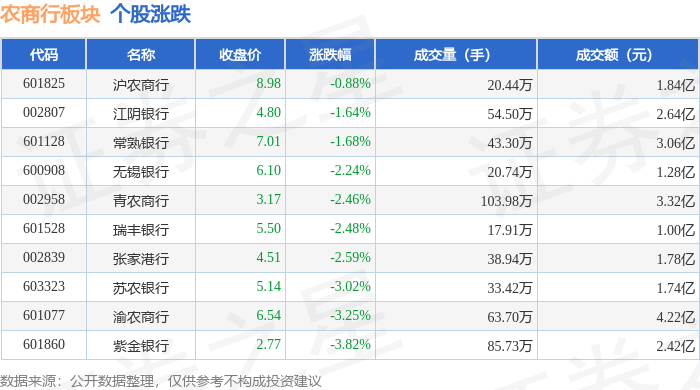
农商行板块11月21日跌2.08%,紫金银行领跌,主力资金净流出1.52亿元
Zheng Xing Xing Ye Ri Bao· 2025-11-21 09:33
Market Overview - The rural commercial bank sector experienced a decline of 2.08% on November 21, with Zijin Bank leading the drop [1] - The Shanghai Composite Index closed at 3834.89, down 2.45%, while the Shenzhen Component Index closed at 12538.07, down 3.41% [1] Individual Stock Performance - Key stocks in the rural commercial bank sector showed varied performance, with the following notable declines: - Zijin Bank: -3.82% closing at 2.77 [1] - Yunnan Rural Commercial Bank: -3.25% closing at 6.54 [1] - Su Nong Bank: -3.02% closing at 5.14 [1] - Jiangyin Bank: -1.64% closing at 4.80 [1] - The trading volume and turnover for these stocks were significant, with Jiangyin Bank recording a turnover of 2.64 billion [1] Capital Flow Analysis - The rural commercial bank sector saw a net outflow of 1.52 billion from main funds, while retail investors contributed a net inflow of 1.41 billion [1] - Specific stock capital flows indicated: - Qingnong Bank: Main funds net inflow of 26.47 million, retail net outflow of 16.33 million [2] - Zijin Bank: Main funds net outflow of 24.65 million, retail net inflow of 14.04 million [2] - Yunnan Rural Commercial Bank: Main funds net outflow of 59.37 million, retail net inflow of 57.10 million [2]
紫金银行跌2.08%,成交额9254.27万元,主力资金净流出928.86万元
Xin Lang Zheng Quan· 2025-11-21 02:48
Core Viewpoint - Zijin Bank's stock price has experienced a decline, with a current trading price of 2.82 CNY per share, reflecting a 2.08% drop on November 21. The bank's market capitalization stands at 10.32 billion CNY [1]. Group 1: Stock Performance - As of November 21, Zijin Bank's stock has increased by 2.55% year-to-date, but has seen declines of 2.76% over the past five trading days, 3.75% over the past twenty days, and 6.00% over the past sixty days [1]. - The trading volume on November 21 reached 92.54 million CNY, with a turnover rate of 0.91% [1]. Group 2: Financial Performance - For the period from January to September 2025, Zijin Bank reported zero operating income and a net profit attributable to shareholders of 1.204 billion CNY, representing a year-on-year decrease of 10.90% [2]. - Since its A-share listing, Zijin Bank has distributed a total of 2.563 billion CNY in dividends, with 1.098 billion CNY distributed over the past three years [2]. Group 3: Shareholder Information - As of September 30, 2025, Zijin Bank had 63,000 shareholders, an increase of 1.08% from the previous period, with an average of 56,351 circulating shares per shareholder, a decrease of 1.07% [2]. - The seventh largest circulating shareholder is Hong Kong Central Clearing Limited, holding 43.3154 million shares, which is a decrease of 4.93781 million shares from the previous period [2]. Group 4: Business Overview - Zijin Bank, established on March 25, 2011, and listed on January 3, 2019, is headquartered in Nanjing, Jiangsu Province. Its main business segments include corporate finance (40.19%), personal finance (44.86%), funding business (14.51%), and others (0.45%) [1]. - The bank is categorized under the banking sector, specifically as a rural commercial bank [1].