ZJB(601860)

Search documents
紫金银行:坚持服务实体经济、坚持做小做散
Zheng Quan Ri Bao· 2026-01-15 13:40
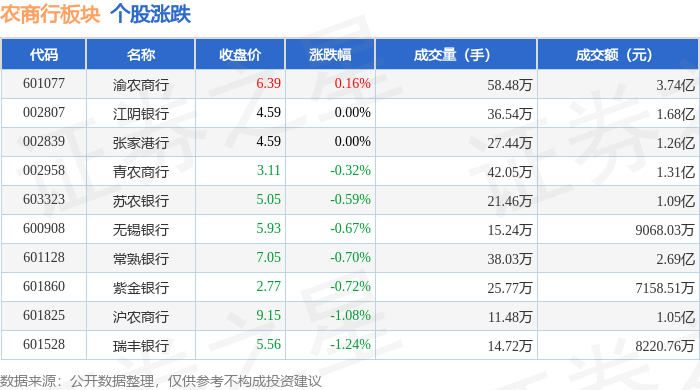
证券日报网1月15日讯 ,紫金银行在接受调研者提问时表示,我行坚持服务实体经济、坚持做小做散, 围绕金融"五篇大文章",积极稳妥加大信贷投放力度,持续优化普惠金融产品与服务,为地方经济和社 会发展提供优质的金融服务。 (文章来源:证券日报) ...


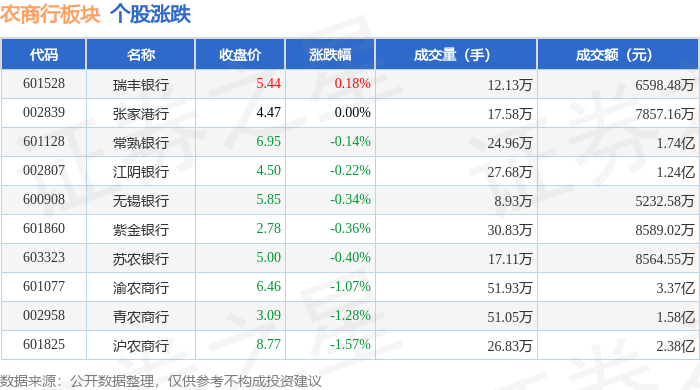
农商行板块1月15日跌0.94%,沪农商行领跌,主力资金净流出4296.1万元
Zheng Xing Xing Ye Ri Bao· 2026-01-15 08:59
Group 1 - The agricultural commercial bank sector experienced a decline of 0.94% on January 15, with Hu Nong Commercial Bank leading the drop [1] - The Shanghai Composite Index closed at 4112.6, down 0.33%, while the Shenzhen Component Index closed at 14306.73, up 0.41% [1] - The trading volume and turnover for various agricultural commercial banks are detailed in a table, showing mixed performance among individual stocks [1] Group 2 - The net outflow of main funds from the agricultural commercial bank sector was 42.961 million yuan, while retail funds saw a net outflow of 56.997 million yuan [1] - The table of fund flows indicates that some banks, like Changshu Bank and Zhangjiagang Bank, had positive net inflows from retail and speculative funds, while others like Yunnan Agricultural Bank and Jiangyin Bank faced significant outflows [2] - Specific data shows that Changshu Bank had a main fund net inflow of 8.1314 million yuan, while Yunnan Agricultural Bank had a net outflow of 25.5857 million yuan [2]


昆山农商银行:以金融力量赋能低空经济产业发展
Jiang Nan Shi Bao· 2026-01-15 01:00
此次沙龙的成功举办,是昆山农商银行深化"金融+产业"融合、赋能新兴产业发展的重要举措,既彰显 了昆山市布局低空经济产业的前瞻视野,也体现了昆山农商银行立足本土、服务实体的金融担当。未 来,昆山农商银行将持续深化与政府部门、产业链企业及专业服务机构的合作,不断优化金融服务模 式,升级定制化金融产品,为低空经济产业升级发展提供更具针对性、专业性的金融解决方案,与各方 携手共绘昆山低空经济产业高质量发展新蓝图。张芸芳 日前,昆山农商银行联合海联海律师事务所、昆山市交通运输局举办"聚势低空,共创未来"低空经济产 业沙龙活动。活动汇聚昆山市低空经济领域企业代表,以及券商、律所、会所、投行、保险等专业服务 机构人士,搭建起跨领域、多层次的交流合作平台,为昆山市低空经济产业发展注入强劲动力。 沙龙期间,行业专家与专业人士带来了一场内容丰富、干货满满的分享盛宴。苏州镭创光电技术有限公 司技术专家深入解读我国低空经济领域技术发展现状及国际竞争力,展现了行业前沿动态;开源证券专 家从资本视角出发,分析低空经济产业政策导向、产业链投资逻辑、市场前景及企业资本运作路径,为 企业对接资本市场提供思路;上海锦天城律师事务所资深律师聚焦企 ...
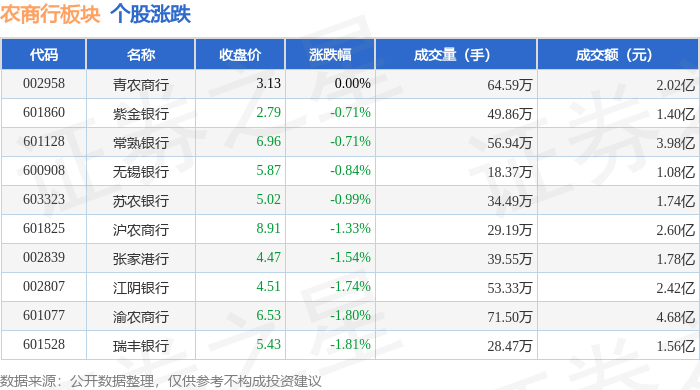
农商行板块1月14日跌1.28%,瑞丰银行领跌,主力资金净流入1.14亿元
Zheng Xing Xing Ye Ri Bao· 2026-01-14 08:58
Core Viewpoint - The rural commercial bank sector experienced a decline of 1.28% on January 14, with Ruifeng Bank leading the drop, while the Shanghai Composite Index fell by 0.31% and the Shenzhen Component Index rose by 0.56% [1] Group 1: Market Performance - The closing price of Qingnong Commercial Bank was 3.13, unchanged from the previous day, with a trading volume of 645,900 shares and a transaction value of 202 million yuan [1] - Zijin Bank closed at 2.79, down 0.71%, with a trading volume of 498,600 shares and a transaction value of 140 million yuan [1] - Changshu Bank's closing price was 6.96, also down 0.71%, with a trading volume of 569,400 shares and a transaction value of 398 million yuan [1] - Wuxi Bank closed at 5.87, down 0.84%, with a trading volume of 183,700 shares and a transaction value of 108 million yuan [1] - The overall rural commercial bank sector saw a net inflow of 114 million yuan from main funds, while retail investors experienced a net outflow of 1.41 billion yuan [1] Group 2: Fund Flow Analysis - Changshu Bank had a main fund net inflow of 22.95 million yuan, accounting for 5.77% of its total, while retail investors had a net outflow of 5.30 million yuan [2] - Yunnan Agricultural Commercial Bank saw a main fund net inflow of 20.12 million yuan, representing 4.30%, but a retail net outflow of 34.64 million yuan [2] - Zhangjiagang Bank recorded a main fund net inflow of 15.78 million yuan, with a retail net outflow of 29.95 million yuan [2] - Wuxi Bank had a main fund net inflow of 12.01 million yuan, which is 11.10% of its total, while retail investors faced a net outflow of 9.00 million yuan [2] - Ruifeng Bank experienced a main fund net inflow of 3.60 million yuan, with a retail net outflow of 9.82 million yuan [2]

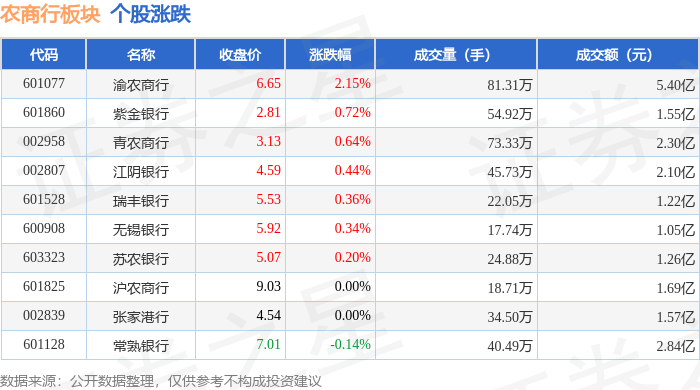
农商行板块1月13日涨0.62%,渝农商行领涨,主力资金净流入5648.9万元
Zheng Xing Xing Ye Ri Bao· 2026-01-13 09:06
Core Viewpoint - The agricultural commercial bank sector experienced a rise of 0.62% on January 13, with Chongqing Rural Commercial Bank leading the gains, while the Shanghai Composite Index fell by 0.64% and the Shenzhen Component Index dropped by 1.37% [1] Group 1: Market Performance - Chongqing Rural Commercial Bank (601077) closed at 6.65, up by 2.15% with a trading volume of 813,100 shares and a transaction value of 540 million yuan [1] - Other notable banks included Zijin Bank (601860) with a closing price of 2.81, up by 0.72%, and Qingnong Bank (002958) at 3.13, up by 0.64% [1] - The overall trading volume for the agricultural commercial bank sector was significant, with total net inflow of main funds amounting to 56.49 million yuan [1] Group 2: Fund Flow Analysis - Main funds saw a net inflow of 17.50 million yuan into Chongqing Rural Commercial Bank, while retail investors experienced a net outflow of 47.08 million yuan [2] - Jiangyin Bank (002807) had a net inflow of 13.55 million yuan from main funds, but retail investors withdrew 8.41 million yuan [2] - The fund flow data indicates a mixed sentiment among retail and institutional investors, with main funds generally showing positive interest in several banks while retail investors were more cautious [2]

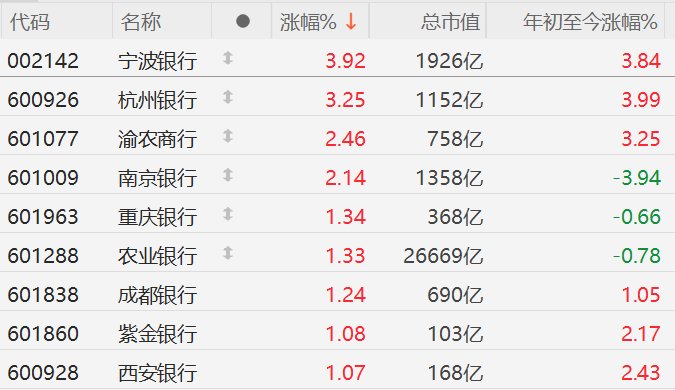
A股银行股普涨,宁波银行、杭州银行涨超3%
Ge Long Hui A P P· 2026-01-13 03:43
Group 1 - The A-share market saw a general rise in bank stocks, with notable increases in Ningbo Bank and Hangzhou Bank, both rising over 3% [1] - Other banks such as Chongqing Bank, Agricultural Bank, and Xian Bank also experienced gains of over 1% [1] Group 2 - Ningbo Bank's stock increased by 3.92%, with a total market capitalization of 192.6 billion [2] - Hangzhou Bank's stock rose by 3.25%, with a market cap of 115.2 billion [2] - Chongqing Bank and Agricultural Bank saw increases of 1.34% and 1.33% respectively, with market caps of 36.8 billion and 26,669 billion [2] - The year-to-date performance shows that Ningbo Bank and Hangzhou Bank have increased by 3.84% and 3.99% respectively, while Nanjing Bank has decreased by 3.94% [2]





银行股普涨,宁波银行、杭州银行涨超3%
Ge Long Hui· 2026-01-13 03:41
Core Viewpoint - The A-share market saw a significant increase in bank stocks on January 13, with notable gains from several banks, indicating a positive trend in the banking sector [1]. Group 1: Stock Performance - Ningbo Bank (002142) experienced a rise of 3.92%, with a total market capitalization of 192.6 billion [2]. - Hangzhou Bank (600926) increased by 3.25%, with a market cap of 115.2 billion [2]. - Chongqing Rural Commercial Bank (601077) saw a gain of 2.46%, with a market value of 75.8 billion [2]. - Nanjing Bank (601009) rose by 2.14%, but has a year-to-date decline of 3.94%, with a market cap of 135.8 billion [2]. - Agricultural Bank of China (601288) increased by 1.33%, with a substantial market capitalization of 2,666.9 billion [2]. - Other banks such as Chengdu Bank (601838), Zijin Bank (601860), and Xi'an Bank (600928) also reported gains of 1.24%, 1.08%, and 1.07% respectively [2].
农商行板块1月12日跌0.14%,渝农商行领跌,主力资金净流出5928.29万元
Zheng Xing Xing Ye Ri Bao· 2026-01-12 09:04
Market Overview - The agricultural commercial bank sector experienced a decline of 0.14% on January 12, with Yunnan Agricultural Commercial Bank leading the drop [1] - The Shanghai Composite Index closed at 4165.29, up 1.09%, while the Shenzhen Component Index closed at 14366.91, up 1.75% [1] Individual Bank Performance - Zijin Bank closed at 2.79, with an increase of 0.72% and a trading volume of 386,600 shares, totaling a transaction value of 107 million yuan [1] - Su Nong Bank closed at 5.06, up 0.40%, with a trading volume of 204,900 shares, totaling 104 million yuan [1] - Ruifeng Bank closed at 5.51, up 0.36%, with a trading volume of 181,100 shares, totaling approximately 99.28 million yuan [1] - Qing Nong Bank closed at 3.11, up 0.32%, with a trading volume of 422,100 shares, totaling 131 million yuan [1] - Yunnan Agricultural Commercial Bank closed at 6.51, down 0.91%, with a trading volume of 690,100 shares [1] Capital Flow Analysis - The agricultural commercial bank sector saw a net outflow of 59.28 million yuan from institutional investors, while retail investors contributed a net inflow of 49.11 million yuan [1] - The table of capital flow indicates that Changshu Bank had a net inflow of 7.30 million yuan from institutional investors, while it faced a net outflow of 22.43 million yuan from speculative funds [2] - Yunnan Agricultural Commercial Bank experienced a net outflow of 21.20 million yuan from institutional investors, but a net inflow of 42.56 million yuan from speculative funds [2]

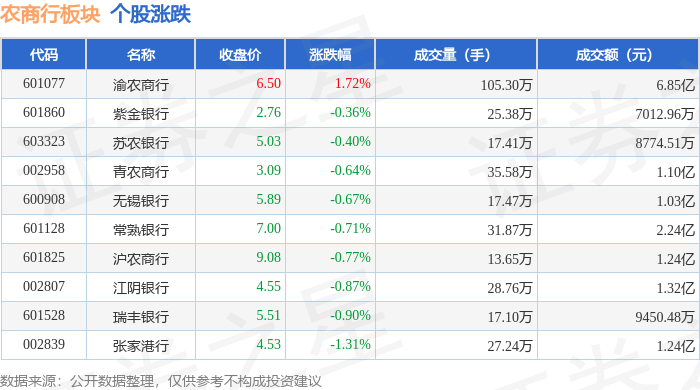
农商行板块1月8日跌0.18%,张家港行领跌,主力资金净流出3731.72万元
Zheng Xing Xing Ye Ri Bao· 2026-01-08 08:56
Core Viewpoint - The agricultural commercial bank sector experienced a slight decline of 0.18% on January 8, with Zhangjiagang Bank leading the drop [1] Group 1: Market Performance - The Shanghai Composite Index closed at 4082.98, down 0.07%, while the Shenzhen Component Index closed at 13959.48, down 0.51% [1] - The agricultural commercial bank sector's individual stock performance showed varied results, with Yunnan Agricultural Commercial Bank rising by 1.72% to a closing price of 6.50 [1] Group 2: Trading Volume and Turnover - The trading volume and turnover for various banks were reported, with Jiangyin Bank having a turnover of 1.32 billion and a trading volume of 287,600 shares [1] - The overall net outflow of main funds from the agricultural commercial bank sector was 37.32 million, while retail funds saw a net outflow of 18.16 million [1] Group 3: Fund Flow Analysis - The main fund inflow for Ruifeng Bank was 4.77 million, accounting for 5.04% of its total, while it faced a retail net outflow of 8.39 million [2] - Zhangjiagang Bank experienced a significant main fund outflow of 6.71 million, with retail investors also withdrawing 7.63 million [2]
农商行板块1月7日跌0.57%,瑞丰银行领跌,主力资金净流入5042.72万元
Zheng Xing Xing Ye Ri Bao· 2026-01-07 08:58
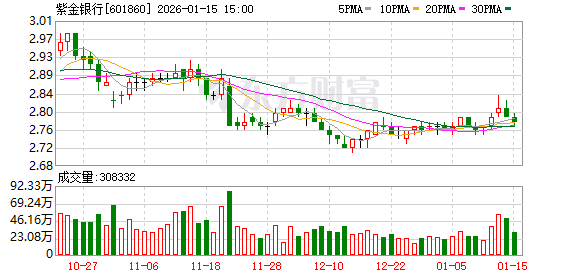
Core Viewpoint - The rural commercial bank sector experienced a decline of 0.57% on January 7, with Ruifeng Bank leading the drop, while the Shanghai Composite Index rose by 0.05% and the Shenzhen Component Index increased by 0.06% [1] Group 1: Market Performance - The closing prices and performance of key rural commercial banks on January 7 are as follows: - Yunnan Rural Commercial Bank (601077) closed at 6.39, up by 0.16% - Jiangyin Bank (002807) closed at 4.59, unchanged - Zhangjiagang Bank (002839) closed at 4.59, unchanged - Qingnong Bank (002958) closed at 3.11, down by 0.32% - Sunan Bank (603323) closed at 5.05, down by 0.59% - Wuxi Bank (600908) closed at 5.93, down by 0.67% - Changshu Bank (601128) closed at 7.05, down by 0.70% - Zijin Bank (601860) closed at 2.77, down by 0.72% - Hunan Rural Commercial Bank (601825) closed at 9.15, down by 1.08% - Ruifeng Bank (601528) closed at 5.56, down by 1.24% [1] Group 2: Capital Flow - On January 7, the rural commercial bank sector saw a net inflow of 50.43 million yuan from main funds, while retail investors experienced a net outflow of 84.63 million yuan [1] - The capital flow for individual banks is as follows: - Zhangjiagang Bank (002839) had a main fund net inflow of 13.66 million yuan, but a retail net outflow of 13.84 million yuan - Changshu Bank (601128) had a main fund net inflow of 13.25 million yuan, with a retail net outflow of 22.78 million yuan - Qingnong Bank (002958) had a main fund net inflow of 12.24 million yuan, but a retail net outflow of 8.34 million yuan - Wuxi Bank (600908) had a main fund net inflow of 9.53 million yuan, with a retail net outflow of 6.99 million yuan [2]