Workflow
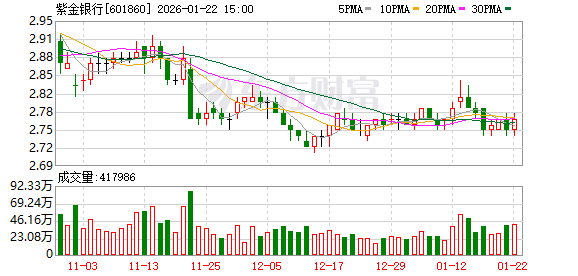
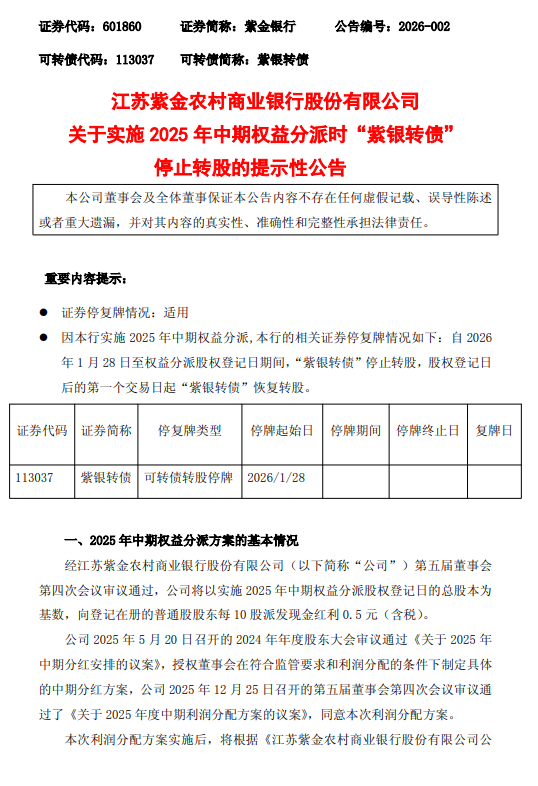
ZJB(601860)
icon
Search documents
紫金农商银行:深耕养老金融 为银发客群添“金”彩
Jiang Nan Shi Bao· 2025-11-12 08:05
Core Viewpoint - The company is actively implementing a comprehensive strategy to address the financial service needs of the aging population, focusing on the renovation of service points, product adaptation, and service extension to enhance elderly financial services [1] Group 1: Service Point Renovation - The company has completed the renovation of all 135 service points to meet elderly-friendly standards, ensuring that elderly clients can conveniently access financial and governmental services nearby [3] - The renovated service points include features such as barrier-free access, elderly care zones equipped with necessary facilities, and dedicated service windows for elderly clients, enhancing their comfort and ease of use [2][3] Group 2: Resource Allocation for Elderly Financial Services - The company is directing financial resources towards the development of tailored savings, investment, and credit products that align with the consumption habits of elderly clients [4] - A comprehensive assessment of clients' needs based on age, risk preference, and retirement goals is conducted to provide customized financial planning and support for wealth accumulation [4] - As of the end of September, the company has provided wealth management services to over 300,000 clients aged 60 and above, with a significant number of credit clients receiving loans totaling 716 million [4] Group 3: Extension of Elderly Services - The company is enhancing its elderly financial services through professional training for staff, community volunteer services, and various special activities to meet the diverse needs of elderly clients [5][6] - Volunteer teams have been established to provide on-site services such as haircuts, appliance repairs, and health check-ups, with over 1,000 community service events conducted [6] - The company organizes financial education and community safety activities to improve elderly residents' awareness of fraud and scams, alongside cultural events to enrich their lives [6]
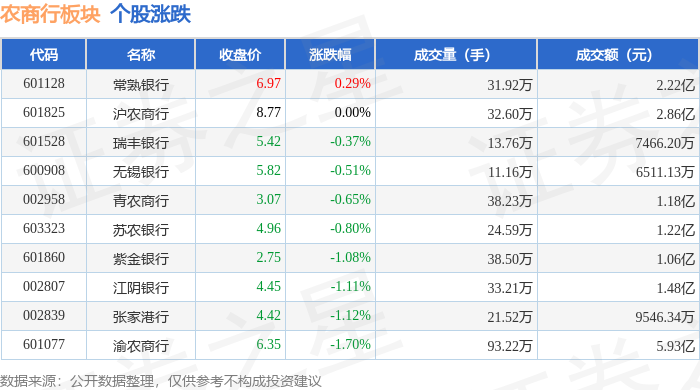
农商行板块11月11日涨0.01%,张家港行领涨,主力资金净流出1.4亿元
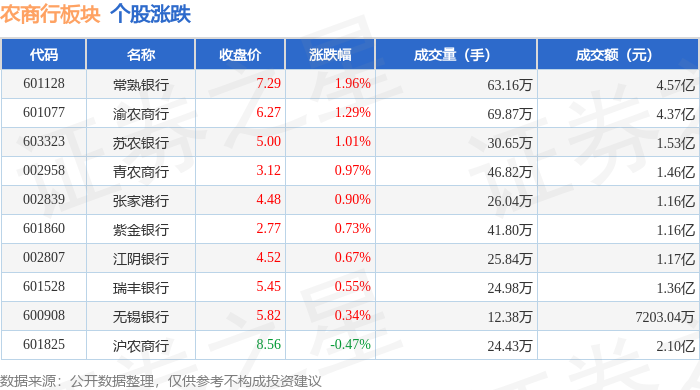
Core Insights - The rural commercial bank sector experienced a slight increase of 0.01% on November 11, with Zhangjiagang Bank leading the gains [1] - The Shanghai Composite Index closed at 4002.76, down 0.39%, while the Shenzhen Component Index closed at 13289.0, down 1.03% [1] Stock Performance - Zhangjiagang Bank (002839) closed at 4.66, up 1.08% with a trading volume of 305,100 shares and a transaction value of 1.42 billion [1] - Su Nong Bank (603323) closed at 5.36, up 0.94% with a trading volume of 200,500 shares and a transaction value of 107 million [1] - Jiangyin Bank (002807) closed at 5.05, up 0.80% with a trading volume of 394,000 shares and a transaction value of 1.98 billion [1] - Wuxi Bank (600908) closed at 6.25, up 0.64% with a trading volume of 137,500 shares and a transaction value of 85.68 million [1] - Qingnong Commercial Bank (002958) and Changshu Bank (601128) remained unchanged at 3.27 and 7.25 respectively [1] Fund Flow Analysis - The rural commercial bank sector saw a net outflow of 140 million from institutional investors, while retail investors contributed a net inflow of 79.48 million [1] - Zhangjiagang Bank had a net inflow of 6.31 million from institutional investors, but a net outflow of 4.63 million from retail investors [2] - Wuxi Bank experienced a net inflow of 2.46 million from institutional investors, with retail investors contributing a net inflow of 3.07 million [2] - Qingnong Commercial Bank faced a significant net outflow of 23.40 million from institutional investors, while retail investors contributed a net inflow of 20.09 million [2] - Yunnan Agricultural Bank (601077) had the highest net outflow of 87.93 million from institutional investors, with retail investors contributing a net inflow of 47.76 million [2]
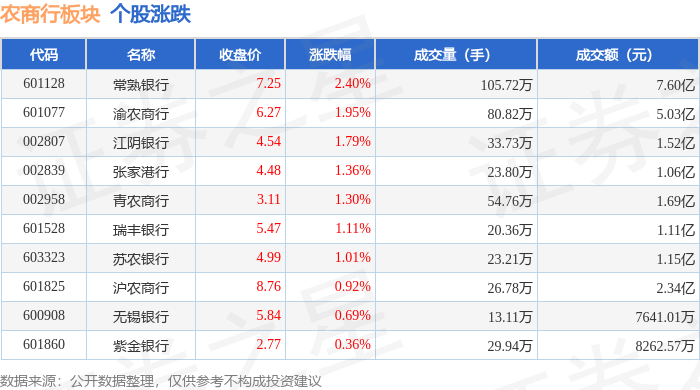
农商行板块11月10日涨0.92%,沪农商行领涨,主力资金净流出2.1亿元
Core Insights - The agricultural commercial bank sector experienced a rise of 0.92% on November 10, with Shanghai Agricultural Commercial Bank leading the gains [1] - The Shanghai Composite Index closed at 4018.6, up 0.53%, while the Shenzhen Component Index closed at 13427.61, up 0.18% [1] Sector Performance - Shanghai Agricultural Commercial Bank (601825) closed at 60.6, with a gain of 2.48% and a trading volume of 291,000 shares, amounting to a transaction value of 263 million yuan [1] - Changshu Bank (601128) closed at 7.25, up 0.97%, with a trading volume of 290,900 shares and a transaction value of 210 million yuan [1] - Ruifeng Bank (601528) closed at 5.67, up 0.53%, with a trading volume of 144,300 shares and a transaction value of 81.76 million yuan [1] - Zhangjiagang Bank (002839) closed at 4.61, up 0.44%, with a trading volume of 129,300 shares and a transaction value of 135 million yuan [1] - Yuanxi Bank (600908) closed at 6.21, up 0.32%, with a trading volume of 117,800 shares and a transaction value of 72.99 million yuan [1] - Shinan Bank (603323) closed at 5.31, up 0.19%, with a trading volume of 165,600 shares and a transaction value of 87.91 million yuan [1] - Zijin Bank (601860) closed at 2.88, unchanged, with a trading volume of 366,300 shares and a transaction value of 105 million yuan [1] - Qingnong Commercial Bank (002958) closed at 3.27, unchanged, with a trading volume of 557,400 shares and a transaction value of 182 million yuan [1] - Yunnan Agricultural Commercial Bank (601077) closed at 7.00, down 0.14%, with a trading volume of 633,700 shares and a transaction value of 444 million yuan [1] - Jiangyin Bank (002807) closed at 5.01, down 0.20%, with a trading volume of 391,700 shares and a transaction value of 196 million yuan [1] Fund Flow Analysis - The agricultural commercial bank sector saw a net outflow of 210 million yuan from main funds, while retail funds experienced a net inflow of 118 million yuan [1] - The main fund flow for Shanghai Agricultural Commercial Bank was a net inflow of 9.12 million yuan, while retail funds saw a net outflow of 197,440 yuan [2] - Ruifeng Bank had a main fund net inflow of 4.43 million yuan, but retail funds experienced a net outflow of 763.71 million yuan [2] - Zhangjiagang Bank had a significant main fund net outflow of 16.33 million yuan, while retail funds saw a net inflow of 1.77 million yuan [2] - Changshu Bank experienced a main fund net outflow of 21.87 million yuan, with retail funds seeing a net inflow of 26.42 million yuan [2] - Qingnong Commercial Bank had a main fund net outflow of 32.17 million yuan, while retail funds had a net inflow of 20.39 million yuan [2] - Yunnan Agricultural Commercial Bank faced a substantial main fund net outflow of 143 million yuan, but retail funds had a net inflow of 59.38 million yuan [2]
从增量扩面到提质控险 银行业普惠金融迈向差异化精准服务
Core Insights - The report highlights the significant growth and development of inclusive finance in China, particularly focusing on small and micro enterprises and rural areas, with a notable annual growth rate of over 20% in inclusive micro loans during the 14th Five-Year Plan period [1][2] - As of June 2025, the balance of inclusive micro loans reached 36 trillion yuan, which is 2.3 times that of the end of the 13th Five-Year Plan, with a decrease in interest rates by 2 percentage points [1][2] - The average interest rate for newly issued inclusive micro loans was 3.48% as of June 2025, reflecting a decrease of 66 basis points year-on-year [1][2] Group 1: Digital Empowerment - Digital technology has been a key driver for the development of inclusive finance, with banks utilizing big data and AI to enhance loan approval efficiency and reduce financing costs [2][7] - The market structure among banks is changing, with large commercial banks holding a 45.11% share of inclusive micro loans, while rural financial institutions have seen a decline in their market share [2][3] - The average growth rate of inclusive micro loans has been slowing down, with a decrease from 30.9% in 2020 to 12.3% by mid-2025 [2][3] Group 2: Performance of Listed Banks - Among listed banks, Agricultural Bank of China, Industrial and Commercial Bank of China, and Beijing Bank reported the highest growth rates in inclusive micro loans at 18.50%, 17.30%, and 17.27% respectively [3][4] - In contrast, some banks, including Shanghai Bank and Zhengzhou Bank, experienced negative growth rates of -3.97% and -2.06% [3][4] - The performance of different banks varies significantly, with state-owned banks generally showing stronger growth in inclusive micro loans compared to smaller banks [3][4] Group 3: Interest Rates and Risk Management - The interest rates for newly issued inclusive micro loans have decreased across various banks, with the highest rate at 4.20% and the lowest at 2.94% [7][8] - The gap in interest rates between large and small banks is narrowing, with some large banks' rates aligning closely with those of smaller banks [8][9] - The report emphasizes the importance of risk management in the inclusive finance sector, with several banks focusing on improving asset quality and managing non-performing loans [9][10]
紫金农商银行:深耕三农沃土 助力乡村振兴
Jiang Nan Shi Bao· 2025-11-07 09:08
Core Viewpoint - Zijin Rural Commercial Bank emphasizes its commitment to serving the "three rural issues" (agriculture, rural areas, and farmers) as the foundation of its operations and development, achieving a significant increase in inclusive agricultural loans to support rural revitalization [1] Group 1: Financial Performance - As of September 2025, the bank's inclusive agricultural loan balance reached 3.659 billion yuan, an increase of 211 million yuan from the beginning of the year, representing a growth rate of 6.12%, which is higher than the average growth rate of the bank's loans [1] Group 2: Service System Development - The bank has established a specialized "Three Rural Center" to coordinate agricultural financial services and tailor financial solutions for agricultural stakeholders [2] - A comprehensive product matrix centered around the "Jinling Huinong Series" has been developed, covering various loan products, with a cumulative balance of 4.77 billion yuan as of September 2025 [2] - The approval process for agricultural loans has been significantly streamlined, with loans under 10 million yuan approved within one day and online processing for loans under 300,000 yuan [2] Group 3: Support for Agricultural Development - The bank has conducted extensive outreach to 32,89 new agricultural operating entities and 266,000 farmers to accurately assess their needs [3] - It has provided credit to 260 industrial chain enterprises, amounting to 680 million yuan, and supported major agricultural projects in Nanjing with loans totaling 420 million yuan [3] - Loans of 220 million yuan have been issued to support the construction of basic and high-standard farmland, reinforcing the foundation for food production [3] Group 4: Enhancing Rural Quality of Life - The bank has completed whole-village credit assessments for 463 villages, covering 5.2552 million households, with total loans amounting to 2.067 billion yuan [4] - It has established 384 inclusive financial service points, achieving full coverage of rural communities, and processed 413,000 transactions since 2025 [4] - The bank has launched an online live-streaming platform, "Zijin Youxuan," conducting 22 live-streaming events with 2.47 million views and sales exceeding 3.74 million yuan [4]
农商行板块11月7日跌0.26%,渝农商行领跌,主力资金净流出5990.34万元
Market Overview - On November 7, the rural commercial bank sector declined by 0.26% compared to the previous trading day, with Yunnan Rural Commercial Bank leading the decline [1] - The Shanghai Composite Index closed at 3997.56, down 0.25%, while the Shenzhen Component Index closed at 13404.06, down 0.36% [1] Individual Stock Performance - Key stock performances in the rural commercial bank sector included: - Zijin Bank: Closed at 2.88, up 0.35% with a trading volume of 311,000 shares and a turnover of 89.53 million yuan - Hu'nong Commercial Bank: Closed at 8.87, up 0.34% with a trading volume of 203,200 shares and a turnover of 181 million yuan - Jiangyin Bank: Closed at 5.02, up 0.20% with a trading volume of 414,100 shares and a turnover of 208 million yuan - Yunnan Rural Commercial Bank: Closed at 7.01, down 1.13% with a trading volume of 566,000 shares and a turnover of 397 million yuan [1] Fund Flow Analysis - The rural commercial bank sector experienced a net outflow of 59.90 million yuan from institutional investors and 50.91 million yuan from retail investors, while there was a net inflow of 111 million yuan from individual investors [1] - Detailed fund flow for individual stocks showed: - Yunnan Rural Commercial Bank: Net outflow of 10.11 million yuan from retail investors, with a net inflow of 777.16 thousand yuan from institutional investors [2] - Jiangyin Bank: Net outflow of 560.48 thousand yuan from institutional investors, with a net inflow of 1.24 million yuan from retail investors [2] - Common trends included significant net outflows from institutional and speculative investors across various banks, while retail investors showed some net inflows in several cases [2]
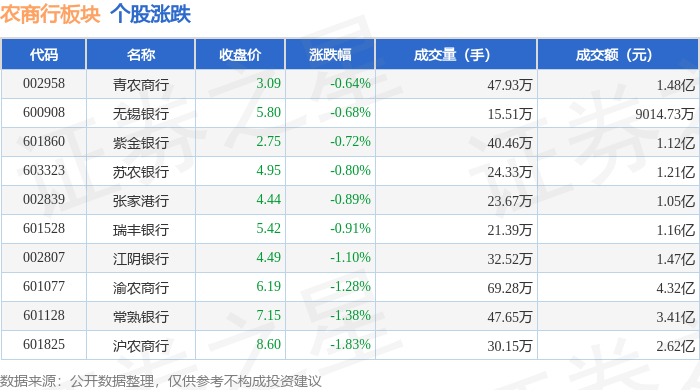
农商行板块11月6日跌0.04%,江阴银行领跌,主力资金净流出1.74亿元
Core Viewpoint - The rural commercial bank sector experienced a slight decline of 0.04% on November 6, with Jiangyin Bank leading the drop, while the overall market indices showed positive performance with the Shanghai Composite Index rising by 0.97% and the Shenzhen Component Index increasing by 1.73% [1] Market Performance - The closing prices and performance of key rural commercial banks are as follows: - Changshu Bank: Closed at 7.24, up 0.70% with a trading volume of 384,200 shares and a turnover of 277 million yuan - Sunong Bank: Closed at 5.31, up 0.38% with a trading volume of 266,900 shares and a turnover of 142 million yuan - Wuxi Bank: Closed at 6.20, up 0.16% with a trading volume of 125,900 shares and a turnover of 77.99 million yuan - Jiangyin Bank: Closed at 5.01, down 0.40% with a trading volume of 515,500 shares and a turnover of 259 million yuan [1] Fund Flow Analysis - The rural commercial bank sector saw a net outflow of 174 million yuan from main funds, while retail investors contributed a net inflow of 131 million yuan [1] - Detailed fund flow for selected banks includes: - Zijin Bank: Main fund net inflow of 4.69 million yuan, retail net outflow of 1.24 million yuan - Wuxi Bank: Main fund net inflow of 0.96 million yuan, retail net outflow of 2.41 million yuan - Jiangyin Bank: Main fund net outflow of 24.66 million yuan, retail net inflow of 29.15 million yuan [2]
紫金农商银行:深耕科技金融沃土 助力企业创新发展
Jiang Nan Shi Bao· 2025-11-06 02:08
Core Viewpoint - Jiangsu province is focusing on integrating technological innovation with industrial innovation as part of its new mission in the "14th Five-Year Plan" period, with financial support being crucial for developing new productive forces [1] Group 1: Strategic Framework - Zijin Rural Commercial Bank is enhancing its organizational structure to support technological enterprises and promote innovation in the science and technology sector [2] - The bank has established a three-year strategic plan for innovation finance, prioritizing support for technology enterprises and implementing specialized credit plans [2] - A "1+13+N" linkage mechanism has been created to facilitate a comprehensive service network for technology finance [2] Group 2: Service System Development - The bank is innovating its product offerings to meet the specific needs of technology enterprises at different life cycle stages, including startup loans and supply chain financial products [3] - As of September 2025, the bank has served over 1,800 technology enterprises and issued loans exceeding 9.6 billion [3] Group 3: Collaborative Efforts - The bank has established strategic partnerships with various technology parks and implemented a digital platform to enhance the efficiency of client visits [4] - Over 31,000 technology enterprises have been visited or followed up by the bank as of September [4] Group 4: Information and Resource Integration - The bank is focusing on high-quality development through information sharing and resource integration, collaborating with local government and technology agencies [5] - More than 100 technology-related organizations have engaged in strategic cooperation with the bank [5] Group 5: Community Engagement - The bank has partnered with six local technology financial service stations to provide on-site services and has organized over 70 enterprise matching events [6] - The bank aims to strengthen its role in supporting the real economy by developing tailored financial products and providing ample capital support for new productive forces [6]
农商行板块11月5日涨0.09%,沪农商行领涨,主力资金净流出1974.75万元
Core Insights - The agricultural commercial bank sector experienced a slight increase of 0.09% on November 5, with Shanghai Agricultural Commercial Bank leading the gains [1] - The Shanghai Composite Index closed at 3969.25, up 0.23%, while the Shenzhen Component Index closed at 13223.56, up 0.37% [1] Stock Performance - Shanghai Agricultural Commercial Bank (601825) closed at 8.86, with a rise of 1.26% and a trading volume of 285,500 shares, amounting to a transaction value of 253 million yuan [1] - Other notable performances include: - Ruifeng Bank (601528) at 5.64, up 0.36% - Zhangjiagang Bank (002839) at 4.61, up 0.22% - Zijin Bank (601860) at 2.87, unchanged - Su Nong Bank (603323) at 5.29, down 0.19% [1] Capital Flow - The agricultural commercial bank sector saw a net outflow of 19.75 million yuan from institutional investors and 51.92 million yuan from speculative funds, while retail investors contributed a net inflow of 71.67 million yuan [1] - Detailed capital flow for specific banks includes: - Changshu Bank (601128) with a net inflow of 32.61 million yuan from institutional investors - Shanghai Agricultural Commercial Bank (601825) with a net inflow of 19.93 million yuan from institutional investors [2] - Jiangyin Bank (002807) had a net inflow of 2.13 million yuan from retail investors despite a net outflow from institutional and speculative funds [2]
银行业2025年三季报综述:业绩稳健性凸显,引领银行价值回归
Investment Rating - The report maintains a positive outlook on the banking sector, indicating a potential return to a valuation of 1 times net asset value [4][7]. Core Insights - The banking sector has demonstrated steady performance, with a year-to-date revenue growth of 0.8% and a net profit growth of 1.5% for the first nine months of 2025, reflecting a stable regulatory environment supporting bank profitability [10][14]. - The report highlights a shift in focus from scale to balance in credit growth, with banks increasingly pursuing a "quantity-price balance" strategy [4][7]. - The cost of liabilities has improved more significantly than the decline in asset pricing, leading to a stabilization of net interest margins, which is expected to continue into the next year [4][7]. - Asset quality remains stable but shows signs of divergence, particularly with rising risks in small and micro businesses [4][7]. - The report suggests that the current dividend yield of the banking sector has returned to an attractive range, indicating a significant disconnect between stable earnings and stock holdings, which could lead to a value recovery [4][7]. Summary by Sections Performance Overview - The banking sector's performance has been characterized by a steady increase in revenue and profit, with state-owned banks showing better-than-expected stability and regional banks leading in performance [11][12][15]. - The report notes that the revenue growth of state-owned banks has turned positive, with non-interest income contributing significantly to this growth [12][15]. Credit Growth and Strategy - The report indicates a gradual abandonment of scale-driven growth, with banks focusing on achieving a balance between volume and pricing in their lending practices [4][7]. - The credit growth rate for listed banks decreased by 0.3 percentage points to 7.7% in Q3 2025, with state-owned banks maintaining a growth rate of approximately 8.5% [4][7]. Profitability and Asset Quality - The net interest margin for listed banks remained stable at 1.5%, with a slight quarter-on-quarter increase of 3 basis points in Q3 2025 [4][7]. - The overall non-performing loan ratio remained stable at 1.22%, indicating manageable risk levels across the sector [4][7]. Investment Recommendations - The report recommends focusing on leading banks and undervalued regional banks as key investment opportunities, suggesting that the recovery in valuations is supported by stable earnings and attractive dividend yields [4][7].