
CZBANK(601916)

Search documents
浙商银行:聘任吕临华为行长
Zheng Quan Shi Bao Wang· 2025-12-31 10:27
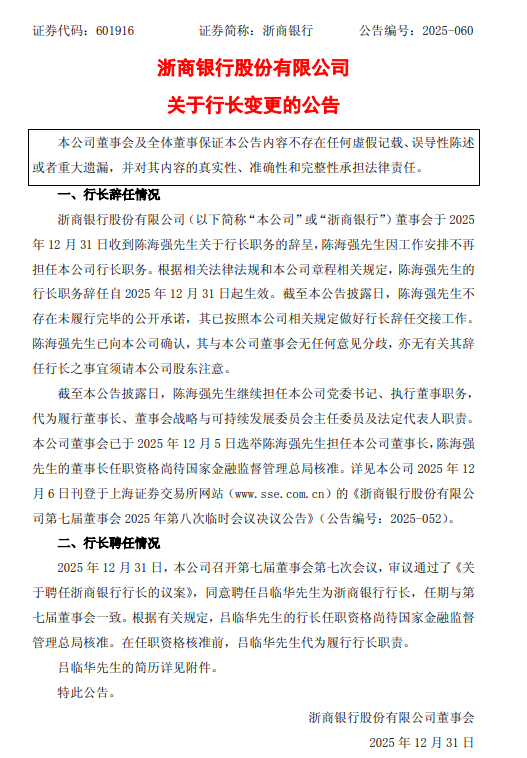
人民财讯12月31日电,浙商银行(601916)12月31日公告,公司董事会于12月31日收到陈海强关于行长 职务的辞呈,陈海强因工作安排不再担任本公司行长职务。根据相关法律法规和本公司章程相关规定, 陈海强的行长职务辞任自2025年12月31日起生效。2025年12月31日,公司召开第七届董事会第七次会 议,审议通过了《关于聘任浙商银行行长的议案》,同意聘任吕临华为浙商银行行长,任期与第七届董 事会一致。根据有关规定,吕临华先生的行长任职资格尚待国家金融监督管理总局核准。在任职资格核 准前,吕临华先生代为履行行长职责。 ...

浙商银行:聘任周伟新、潘华枫为公司副行长
Xin Lang Cai Jing· 2025-12-31 10:24
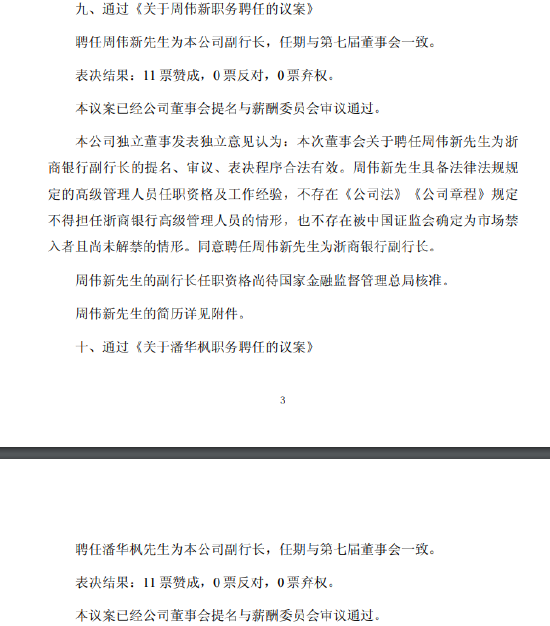
12月31日金融一线消息,浙商银行今日发布公告称,第七届董事会第七次会议审议通过了《关于周伟新 职务聘任的议案》和《关于潘华枫职务聘任的议案》,聘任周伟新、潘华枫为公司副行长,任期与第七 届董事会一致。 简历显示,周伟新1971 年 6 月出生,公司党委委员、行长助理。大学本科,经济师,高级注册信贷分 析师。周伟新曾任中国银行临安支行副行长(主持工作)、行长,中国银行杭州市高新支行行长,中国 银行浙江省分行公司业务部杭州公司业务中心主任,中国银行杭州市庆春支行行长,中国银行舟山市分 行党委书记、行长,中国银行浙江省分行风险管理部总经理、办公室主任、个人金融部总经理,中国银 行安徽省分行党委委员、副行长(其间:2019.11-2021.12 挂职蚌埠市党组成员、副市长);浙商银行 浙江业务总部总裁。 潘华枫1972 年 1 月出生,公司党委委员、行长助理、首席风险官。大学本科,经济师。潘华枫曾任中 国银行宁波市分行信贷管理处管理科副科长、风险管理处管理科科长,中国银行鄞州支行副行长,中国 银行宁波市分行风险管理处副处长(主持工作)、处长 ;浙商银行宁波分行党委委员、纪委副书记、 风险监控官、行长助理、副行长、纪 ...

浙商银行:行长陈海强因工作安排辞任 吕临华接任
Xin Lang Cai Jing· 2025-12-31 10:18
12月31日金融一线消息,浙商银行今日发布公告称,公司董事会于2025年12月31日收到陈海强关于行长 职务的辞呈,陈海强因工作安排不再担任公司行长职务。陈海强的行长职务辞任自2025年12月31日起生 效。截至本公告披露日,陈海强继续担任公司党委书记、执行董事职务,代为履行董事长、董事会战略 与可持续发展委员会主任委员及法定代表人职责。 公司已于2025年12月31日召开第七届董事会第七次会议,审议通过了《关于聘任浙商银行行长的议 案》,同意聘任吕临华先生为浙商银行行长,任期与第七届董事会一致。根据有关规定,吕临华的行长 任职资格尚待国家金融监督管理总局核准。在任职资格核准前,吕临华代为履行行长职责。 简历显示,吕临华1978 年5月出生,公司党委副书记。硕士研究生。吕临华曾任中国保险监督管理委员 会浙江监管局统计研究处处长助理,办公室(党委办公室)主任助理、副主任、主任;中国银行保险监 督管理委员会浙江监管局政策法规处处长,办公室(党委办公室、党委巡察办公室)主任、一级调研 员;浙江农村商业联合银行党委委员、副行长。 简历显示,吕临华1978 年5月出生,公司党委副书记。硕士研究生。吕临华曾任中国保险监督 ...
浙商银行:陈海强辞任行长 吕临华接任
Xin Lang Cai Jing· 2025-12-31 10:18
浙商银行公告,公司董事会于2025年12月31日收到陈海强先生关于行长职务的辞呈,陈海强先生因工作 安排不再担任公司行长职务。陈海强先生的行长职务辞任自2025年12月31日起生效。公司已于2025年12 月31日召开第七届董事会第七次会议,审议通过了《关于聘任浙商银行行长的议案》,同意聘任吕临华 先生为浙商银行行长,任期与第七届董事会一致。 ...
股份制银行板块12月31日跌0.01%,平安银行领跌,主力资金净流入1.77亿元
Zheng Xing Xing Ye Ri Bao· 2025-12-31 09:07
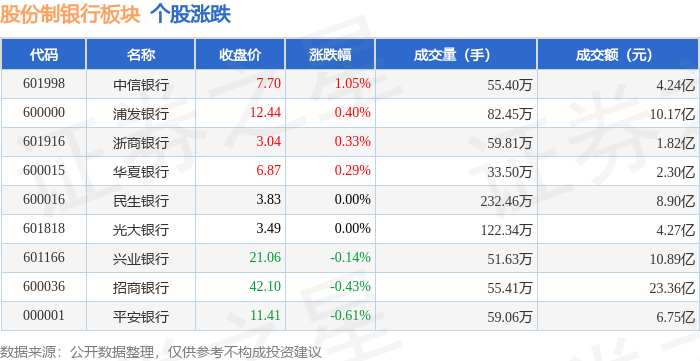
Group 1 - The banking sector experienced a slight decline of 0.01% on December 31, with Ping An Bank leading the drop [1] - The Shanghai Composite Index closed at 3968.84, up 0.09%, while the Shenzhen Component Index closed at 13525.02, down 0.58% [1] - Major banks such as CITIC Bank and Shanghai Pudong Development Bank saw positive price movements, with CITIC Bank increasing by 1.05% to 7.70 and Shanghai Pudong Development Bank rising by 0.40% to 12.44 [1] Group 2 - The net inflow of main funds in the banking sector was 177 million yuan, while retail funds saw a net inflow of 25.68 million yuan [1] - Retail investors showed a mixed response, with significant outflows from major banks like Ping An Bank and Minsheng Bank, while some smaller banks attracted retail inflows [2] - The data indicates that institutional investors favored certain banks, as seen in the net inflow percentages for banks like CITIC Bank and Shanghai Pudong Development Bank [2]





“消失”的银行监事长
Shang Hai Zheng Quan Bao· 2025-12-30 19:26
Core Viewpoint - The bank supervisory board system, in operation for nearly 30 years, is approaching its end as banks begin to abolish this structure in favor of audit committees, following new regulations from the China Securities Regulatory Commission (CSRC) and the Financial Regulatory Bureau [2][3][4]. Regulatory Framework for Reform - The new Company Law, effective from July 2024, allows financial institutions to replace supervisory boards with audit committees, fundamentally changing the requirement for supervisory boards as mandatory entities [3][4]. - The Financial Regulatory Bureau has issued policies that support the transition, allowing financial institutions to choose between retaining supervisory boards or establishing audit committees to perform supervisory functions [3][4]. Differences in Implementation - There is a differentiation in the approach to abolishing supervisory boards between listed and non-listed banks, with listed banks required to eliminate supervisory boards by 2026, while non-listed banks have the option to retain them [4][5]. - Major state-owned banks have already initiated the process of abolishing supervisory boards, with the five largest banks voting to remove them in April 2025 [5]. Effectiveness and Challenges of Supervisory Boards - The supervisory board has been criticized for its lack of independence, professionalism, and efficiency, often leading to overlapping functions and ineffective oversight [6][7]. - The costs associated with maintaining a supervisory board are significant, with estimates suggesting that listed banks could save millions annually by abolishing this structure [7]. Transition Paths for Supervisory Board Members - Former supervisory board members may transition to roles within the audit committee, take on positions in other financial institutions, or retire from the industry [8]. - The governance mechanism is expected to become more efficient, with fewer decision-making layers and a more direct oversight structure through audit committees [8].



破局立新,价值回归:2025年银行业十大动向勾勒发展新图景
Mei Ri Jing Ji Xin Wen· 2025-12-29 13:22
Group 1 - The banking industry is accelerating transformation and restructuring, focusing on enhancing quality over quantity, with a clear path of reforms including consumer loan interest subsidies, penetrating regulation, and optimizing liability structures [12][28] - The introduction of the personal consumer loan interest subsidy policy marks a significant central government initiative to stimulate domestic demand, effective from September 1, 2025, providing a 1% subsidy on loans under certain conditions [13] - The cancellation of the cash withdrawal registration requirement for amounts over 50,000 yuan aims to balance risk prevention and service optimization, enhancing customer convenience [14] Group 2 - The ongoing decline in deposit rates reflects a broader trend in the banking sector, with many banks reducing rates to alleviate pressure on net interest margins, as one-year fixed deposit rates have fallen below 1% [17][24] - The restructuring of small and medium-sized banks is underway, with over 400 institutions expected to exit the market in 2025, indicating a significant consolidation phase [18] - The expansion of financial asset investment companies (AIC) is being promoted, with new AICs being established to enhance investment opportunities and support market-oriented debt-to-equity swaps [19] Group 3 - The issuance of technology innovation bonds (科创债) has gained momentum, with 64 banks participating and a total issuance nearing 300 billion yuan, reflecting a multi-tiered participation structure in the market [20] - The abolition of supervisory boards in several major banks aims to streamline governance and improve decision-making efficiency, with over 20 banks making similar adjustments [21] - The consensus against "involution" in the banking sector emphasizes a shift from scale-driven growth to value-driven strategies, promoting rational competition and operational stability [22][28] Group 4 - The rise in gold prices, surpassing 4,500 USD per ounce, has led banks to increase the minimum thresholds for gold accumulation products, reflecting the impact of international market trends [15][26] - The proposed amendments to the Banking Supervision Law aim to enhance regulatory measures and consumer protection, extending oversight to major shareholders and actual controllers of banking institutions [16]






最低持有期理财榜单出炉!股份行代销产品收益居前
2 1 Shi Ji Jing Ji Bao Dao· 2025-12-29 01:20
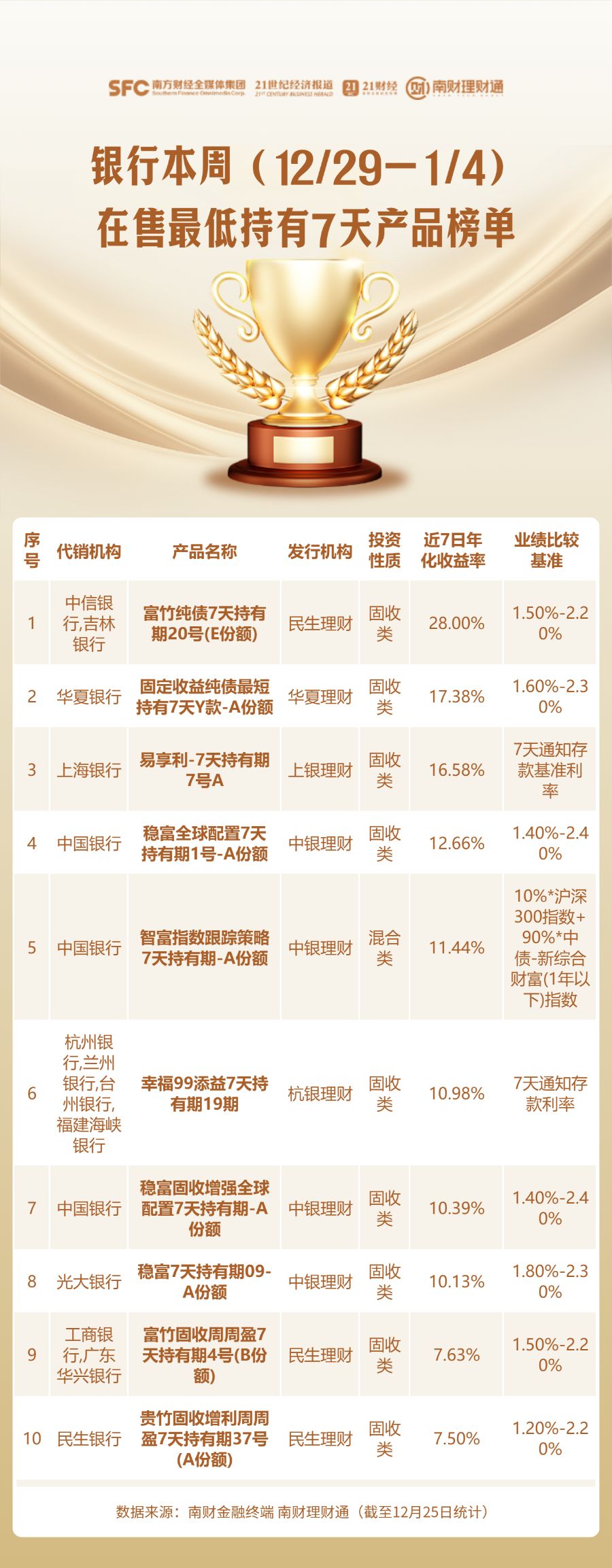
Core Insights - The report focuses on the performance of minimum holding period RMB public funds, ranking them based on annualized returns over various holding periods: 7 days, 14 days, 30 days, and 60 days [1] - The ranking is based on annualized yield calculations, with the calculation period matching the holding period [1] Group 1: 7-Day Holding Period Products - The top-performing product is "富竹纯债7天持有期20号(E份额)" from 民生理财 with an annualized return of 28.00% [3] - Other notable products include "固定收益纯债最短持有7天Y款-A份额" from 华夏银行 with a return of 17.38% and "易享利-7天持有期7号A" from 上海银行 with a return of 16.58% [4] Group 2: 14-Day Holding Period Products - The leading product is "景前固收增利双周窓14天持有期28号" from 中信银行 with an annualized return of 15.59% [6] - Other significant products include "富竹纯债14天持有期14号(E份额)" from 民生理财 with a return of 11.68% and "嘉鑫(歳刊)固收类最低持有14天第13期-B份额" from 建信理财 with a return of 9.77% [7] Group 3: 30-Day Holding Period Products - The highest return is from "幸福99鸡益(金盈) 30天持有期" from 杭州银行 with an annualized return of 25.44% [10] - Other notable products include "盈30天持有期27号" from 民生银行 with a return of 18.61% and "易享利-28天持有期6号A" from 上海银行 with a return of 12.19% [11] Group 4: 60-Day Holding Period Products - The top product is "贵竹固收增利双月盈60天持有期3号" from 中信银行 with an annualized return of 15.26% [14] - Other significant products include "富竹纯债60天持有期12号(E份额)" from 民生理财 with a return of 7.00% and "智富指数跟踪策略60天持有期-A份额" from 中银理财 with a return of 4.63% [15]

股份制银行板块12月26日跌0.18%,中信银行领跌,主力资金净流入4.48亿元
Zheng Xing Xing Ye Ri Bao· 2025-12-26 09:07
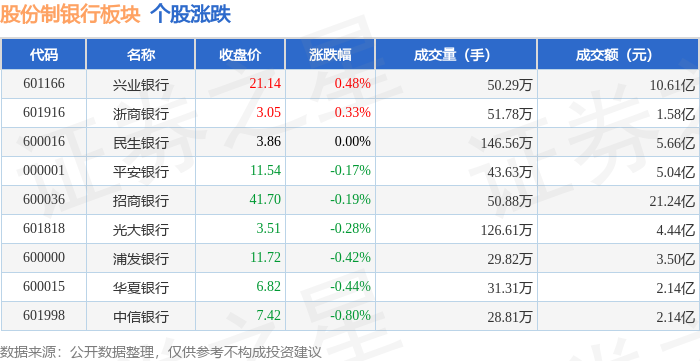
Market Overview - On December 26, the share price of the banking sector fell by 0.18% compared to the previous trading day, with CITIC Bank leading the decline [1] - The Shanghai Composite Index closed at 3963.68, up 0.1%, while the Shenzhen Component Index closed at 13603.89, up 0.54% [1] Individual Bank Performance - Industrial Bank (601166) closed at 21.14, up 0.48% with a trading volume of 502,900 shares and a transaction value of 1.061 billion [1] - Zhejiang Commercial Bank (601916) closed at 3.05, up 0.33% with a trading volume of 517,800 shares and a transaction value of 158 million [1] - Minsheng Bank (600016) closed at 3.86, unchanged with a trading volume of 1,465,600 shares and a transaction value of 566 million [1] - Ping An Bank (000001) closed at 11.54, down 0.17% with a trading volume of 436,300 shares and a transaction value of 504 million [1] - China Merchants Bank (600036) closed at 41.70, down 0.19% with a trading volume of 508,800 shares and a transaction value of 2.124 billion [1] - Everbright Bank (601818) closed at 3.51, down 0.28% with a trading volume of 1,266,100 shares and a transaction value of 444.1 million [1] - Shanghai Pudong Development Bank (600000) closed at 11.72, down 0.42% with a trading volume of 298,200 shares and a transaction value of 350 million [1] - Huaxia Bank (600015) closed at 6.82, down 0.44% with a trading volume of 313,100 shares and a transaction value of 214 million [1] - CITIC Bank (601998) closed at 7.42, down 0.80% with a trading volume of 288,100 shares and a transaction value of 214 million [1] Fund Flow Analysis - The banking sector saw a net inflow of 448 million from main funds, while retail funds experienced a net outflow of 231 million and 217 million respectively [1] - In terms of individual banks, China Merchants Bank had a main fund net inflow of 241 million, while retail funds saw a net outflow of 79.09 million [2] - Industrial Bank had a main fund net inflow of 159 million, with retail funds experiencing a net outflow of 108 million [2] - Shanghai Pudong Development Bank recorded a main fund net inflow of 62.09 million, while retail funds had a net outflow of 776,980 [2] - Everbright Bank had a main fund net inflow of 39.78 million, with retail funds seeing a net outflow of 1.45 million [2] - Ping An Bank had a main fund net inflow of 29.27 million, while retail funds experienced a net outflow of 4.01 million [2] - Minsheng Bank had a significant main fund net outflow of 67.19 million, but retail funds saw a net inflow of 27.19 million [2]


科创金融的浙江样板
Cai Jing Wang· 2025-12-26 04:50
Group 1 - The core viewpoint emphasizes the importance of integrating technology and finance to enhance productivity and achieve high-quality development, as highlighted in the "14th Five-Year Plan" [1] - Zhejiang province is positioned as a strategic hub in the Yangtze River Delta, fostering a vibrant environment for private enterprises and tech innovation [1] - The banking sector plays a crucial role in developing "tech finance," with various banks in Zhejiang implementing innovative financing solutions tailored to the needs of tech enterprises [2][3] Group 2 - The central financial work conference identified "tech finance" as a priority, aiming to create a virtuous cycle among technology, industry, and finance [2] - Financial institutions are restructuring their service logic to better support tech enterprises characterized by light assets and long cycles, focusing on talent value and intellectual property [2][3] - Zhejiang banks have developed a comprehensive service system covering the entire lifecycle of tech enterprises, offering differentiated products based on the specific needs of companies at various stages [4] Group 3 - Innovative financing solutions, such as intellectual property pledge loans, have been introduced to support tech companies like Zhejiang Deshman Technology, which has over 200 patents and is expanding rapidly [3] - Banks in Zhejiang are creating diverse product matrices and service systems to support tech enterprises through different growth phases, including specialized loans for various stages of development [4][11] - The collaboration between banks and local governments is essential for building a supportive ecosystem for tech finance, as seen in the strategic partnerships formed in regions like Jiaxing [12][10] Group 4 - Banks are enhancing their internal capabilities to better serve tech enterprises, developing proprietary evaluation models to assess the future value of companies [5][13] - The establishment of a comprehensive tech finance service network by banks, including specialized branches and dedicated teams, is aimed at improving service efficiency and coverage [14][15] - Collaborative efforts among banks and other stakeholders are being made to address the financing challenges faced by small and micro tech enterprises, ensuring a more inclusive financial environment [15][16]
