
CCB(601939)

Search documents
建行官宣 增资获批!
Zhong Guo Ji Jin Bao· 2025-12-09 16:22
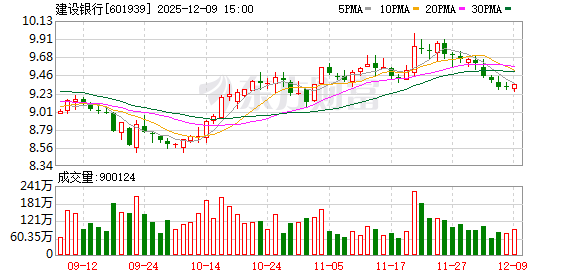
Core Points - China Construction Bank (CCB) announced the completion of a private placement of approximately 11.589 billion A-shares, increasing its registered capital from RMB 250.011 billion to RMB 261.6 billion by June 2025 [1][4] - The approval for the capital increase was granted by the National Financial Regulatory Administration, marking CCB as the first among the four major state-owned banks to complete the capital registration process [1][4] - The total fundraising target for the four major state-owned banks, including CCB, is capped at RMB 520 billion, with CCB specifically aiming to raise up to RMB 105 billion [4] Financial Metrics - Following the capital increase, CCB's core Tier 1 capital adequacy ratio remains the highest among the four major state-owned banks at 14.36% as of the end of Q3 2025 [5][6] - The core Tier 1 capital adequacy ratios for the other three banks are 12.58% for Bank of China, 11.37% for Bank of Communications, and 10.65% for Postal Savings Bank [6] - CCB's stock price closed at RMB 9.34 per share on December 9, with a total market capitalization of RMB 24,433 billion [7]


建行官宣,增资获批!
Zhong Guo Ji Jin Bao· 2025-12-09 16:17
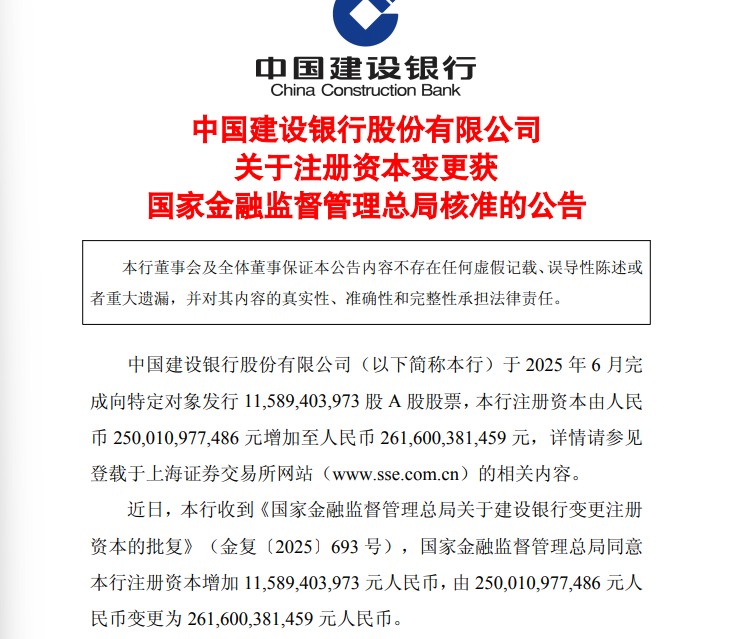
【导读】建设银行官宣,注册资本获批增至2616亿元 12月9日,建设银行(601939)发布公告称,该行于2025年6月完成向特定对象发行约115.89亿股A股股票,注册资本由人民币2500.11亿元增加至人民币 2616亿元。 建设银行表示,该行于近日收到国家金融监督管理总局行政批复,同意该行注册资本增加115.89亿元人民币,由2500.11亿元增加至人民币2616亿元。 这也标志着,建设银行此前定向增发的115.89亿股A股股票正式完成资本登记程序,同时也是四大国有银行中率先完成资本登记的商业银行。 简单来说,资本就像银行的"自有血库",资本越充足,银行在遭遇不良贷款、市场波动等冲击时,就越有底气渡过难关,保护存款人和投资者的利益。 银河证券认为,增资后,国有大行的风险抵御和信贷投放能力将进一步增强。当前,全球政治经济面临不确定性,增资落地有利于保持我国金融系统稳定 性,有望配合"两重""两新"等扩内需增量政策落实,并结合未来科技、消费、外贸等重点领域优化结构性货币政策工具,加大相关领域信贷投放力度,助 力金融"五篇大文章"建设。 从最新财报数据来看,截至2025年三季度末,建设银行、中国银行、交通银行 ...
建设银行官宣,注册资本获批增至2616亿元
Zhong Guo Ji Jin Bao· 2025-12-09 16:16
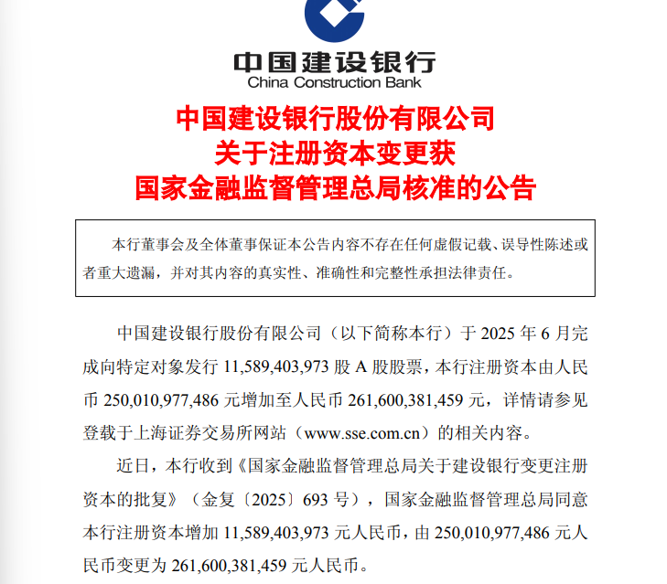
建设银行表示,该行于近日收到国家金融监督管理总局行政批复,同意该行注册资本增加115.89亿元人 民币,由2500.11亿元增加至人民币2616亿元。 【导读】建设银行官宣,注册资本获批增至2616亿元 中国基金报记者嘉合 12月9日,建设银行发布公告称,该行于2025年6月完成向特定对象发行约115.89亿股A股股票,注册资 本由人民币2500.11亿元增加至人民币2616亿元。 银河证券认为,增资后,国有大行的风险抵御和信贷投放能力将进一步增强。当前,全球政治经济面临 不确定性,增资落地有利于保持我国金融系统稳定性,有望配合"两重""两新"等扩内需增量政策落实, 并结合未来科技、消费、外贸等重点领域优化结构性货币政策工具,加大相关领域信贷投放力度,助力 金融"五篇大文章"建设。 从最新财报数据来看,截至2025年三季度末,建设银行、中国银行、交通银行、邮储银行的核心一级资 本充足率分别为14.36%、12.58%、11.37%、10.65%,其中建设银行核心一级资本充足率仍保持四大国 有银行中最高。 这也标志着,建设银行此前定向增发的115.89亿股A股股票正式完成资本登记程序,同时也是四大国有 银行中率 ...
四家国有大行12月份派发A股中期分红
Zheng Quan Ri Bao· 2025-12-09 15:48
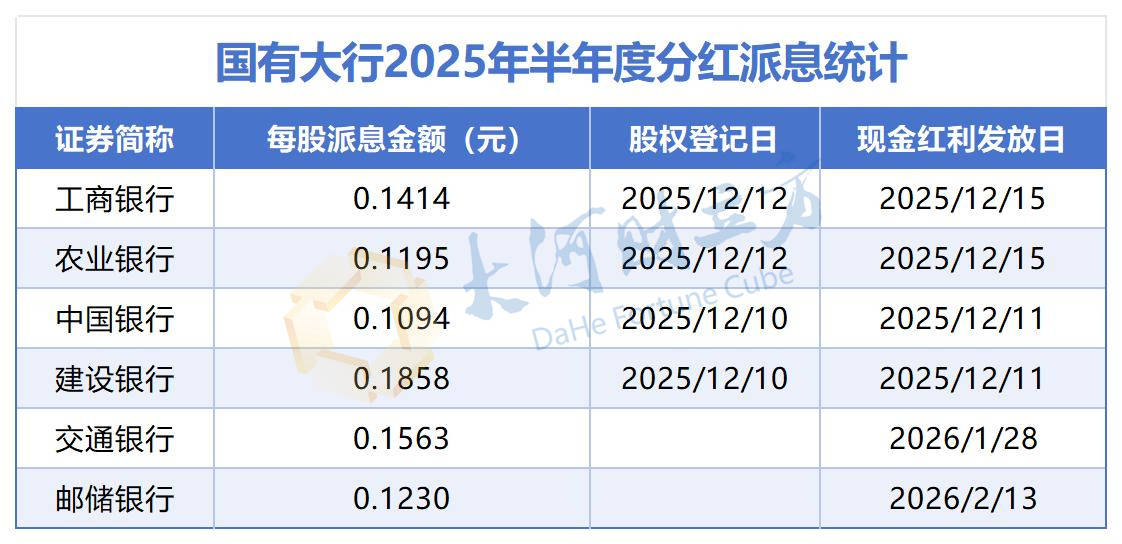
工商银行、农业银行定于12月15日进行A股派发:工商银行每股派发现金红利0.1414元,A股派发现金红利共计约381.23亿 元;农业银行每股派发现金红利0.1195元,A股派发现金红利共计约381.5亿元。 本报记者 彭妍 近日,多家国有大行陆续公告2025年中期分红派息方案,并相继落地实施。作为上市银行中期分红的"主力军",国有六大 行本次中期现金分红总额预计超2000亿元,分红比例均维持在归母净利润的30%水平,且多家银行将于12月份进行派发。 南开大学金融学教授田利辉在接受《证券日报》记者采访时表示,国有大行实施中期分红既是资本市场高质量发展的标志 性事件,也是今年上市银行经营稳健、现金流充裕的直接体现。此举向市场传递了"经营有方、回报有信"的积极信号,有利于 增强投资者信心,促进资本市场健康发展,为"业绩稳健、分红提升、估值修复"的良性循环注入新动力。 多家银行于本月分红 据此前半年报及相关公告披露,国有六大行2025年中期现金分红金额合计达2046.57亿元,其中工商银行以503.96亿元位居 首位,建设银行、农业银行紧随其后,分别达486.05亿元、418.23亿元;中国银行、邮储银行和交通银行 ...



12月9日信用债异常成交跟踪
SINOLINK SECURITIES· 2025-12-09 14:59
Report Summary 1. Report Industry Investment Rating No information provided in the content. 2. Core View of the Report - Among the bonds with discounted transactions, "24 Zhonghua MTN004" had a relatively large deviation in valuation price; among the bonds with rising net prices, "25 ABC Tier 2 Capital Bond 01B(BC)" had a relatively large deviation in valuation price; among the second-tier perpetual bonds with rising net prices, "25 ABC Tier 2 Capital Bond 01B(BC)" had a relatively large deviation in valuation price; among the commercial financial bonds with rising net prices, "25 ABC TLAC Non-capital Bond 02C(BC)" had a relatively large deviation in valuation price. Real estate bonds ranked high among the bonds with a transaction yield higher than 5% [2]. - The changes in credit bond valuation yields were mainly distributed in the [-5,0) range. The transaction terms of non-financial credit bonds were mainly distributed between 2 and 3 years, with the highest proportion of discounted transactions in the 4 - 5 year variety; the transaction terms of second-tier perpetual bonds were mainly distributed between 4 and 5 years, with the highest proportion of discounted transactions in the within-1-year variety. In terms of industries, the bonds in the national defense and military industry had the largest average deviation in valuation price [2]. 3. Summary According to Relevant Catalogs 3.1 Discounted Transaction Tracking - The report tracked the discounted transactions of multiple bonds, including "24 Zhonghua MTN004" with a residual term of 28.65 years, a valuation price deviation of -0.34%, and a transaction volume of 18.58 million yuan; "24 Chanrong 08" with a residual term of 3.35 years, a valuation price deviation of -0.30%, and a transaction volume of 3.29 million yuan, etc. [4]. 3.2 Tracking of Bonds with Rising Net Prices - The report tracked the transactions of bonds with rising net prices, such as "25 ABC Tier 2 Capital Bond 01B(BC)" with a residual term of 9.53 years, a valuation price deviation of 0.29%, and a transaction volume of 539.4 million yuan; "25 ABC Tier 2 Capital Bond 02B(BC)" with a residual term of 9.63 years, a valuation price deviation of 0.27%, and a transaction volume of 916.26 million yuan [5]. 3.3 Tracking of Second-tier Perpetual Bond Transactions - The report tracked the transactions of second-tier perpetual bonds, including those of state-owned banks, joint-stock banks, and city commercial banks. For example, "25 ABC Tier 2 Capital Bond 01B(BC)" of state-owned banks had a residual term of 9.53 years, a valuation price deviation of 0.29%, and a transaction volume of 539.4 million yuan; "21 Industrial Bank Tier 2 03" of joint-stock banks had a residual term of 5.96 years, a valuation price deviation of 0.12%, and a transaction volume of 108.07 million yuan [7]. 3.4 Tracking of Commercial Financial Bond Transactions - The report tracked the transactions of commercial financial bonds, such as "25 ABC TLAC Non-capital Bond 02C(BC)" with a residual term of 9.66 years, a valuation price deviation of 0.17%, and a transaction volume of 48.68 million yuan; "25 Nanjing Bank Bond 01BC" with a residual term of 2.78 years, a valuation price deviation of 0.06%, and a transaction volume of 250.01 million yuan [8]. 3.5 Tracking of Bonds with a Transaction Yield Higher than 5% - The report tracked the bonds with a transaction yield higher than 5%, mainly including real estate and non-financial bonds. For example, "21 Vanke 02" in the real estate industry had a residual term of 0.12 years, a valuation price deviation of 22.72%, and a transaction volume of 25.76 million yuan; "23 Chanrong 04" in the non-financial industry had a residual term of 0.20 years, a valuation price deviation of -0.01%, and a transaction volume of 10.16 million yuan [9]. 3.6 Distribution of Credit Bond Transaction Valuation Deviations - The changes in credit bond valuation yields were mainly distributed in the [-5,0) range [2]. 3.7 Distribution of Non-financial Credit Bond Transaction Terms - The transaction terms of non-financial credit bonds were mainly distributed between 2 and 3 years, with the highest proportion of discounted transactions in the 4 - 5 year variety [2]. 3.8 Distribution of Second-tier Perpetual Bond Transaction Terms - The transaction terms of second-tier perpetual bonds were mainly distributed between 4 and 5 years, with the highest proportion of discounted transactions in the within-1-year variety [2]. 3.9 Proportion of Discounted Transactions and Transaction Volume of Non-financial Credit Bonds in Each Industry - The bonds in the national defense and military industry had the largest average deviation in valuation price [2].
提前近1个月!国有大行“红包”来了
Sou Hu Cai Jing· 2025-12-09 11:42
Core Viewpoint - The major state-owned banks in China have announced their mid-term cash dividends for 2025, with the distribution date set for December 15, which is nearly a month earlier than last year [1][2]. Group 1: Dividend Announcements - Industrial and Commercial Bank of China (ICBC) will distribute a total dividend of 50.396 billion yuan, with 38.123 billion yuan allocated for A-shares [1]. - Agricultural Bank of China (ABC) will distribute a total dividend of 41.823 billion yuan, with 38.150 billion yuan for A-shares [1]. - Bank of China (BOC) will distribute a total dividend of 35.250 billion yuan, with 26.102 billion yuan for A-shares [1]. - China Construction Bank (CCB) will distribute a total dividend of 48.605 billion yuan, with 3.936 billion yuan for A-shares [1]. - The dividends for the other two state-owned banks, Bank of Communications and Postal Savings Bank, are set at 1.563 yuan and 1.230 yuan per 10 shares, respectively [1]. Group 2: Market Performance and Trends - As of December 9, the A-shares of the six major state-owned banks showed mixed performance, with Agricultural Bank leading with a 2.55% increase [2]. - A total of 24 out of 42 listed banks in A-shares have announced mid-term dividends, surpassing the 23 banks from the same period in 2024 [3]. - The banking sector has been viewed as a "yield asset" due to its low volatility and stable dividends, attracting many investors seeking steady cash returns [3]. - Since the introduction of the new "National Nine Articles" on April 12, 2024, the banking index has increased by 30.34%, ranking 12th among 31 industry indices, providing investors with both capital appreciation and stable dividends [3]. - The chief economist of Qianhai Kaiyuan Fund anticipates a more pronounced trend in mid-term dividends from banks, with the possibility of more banks joining the dividend distribution [3].


建设银行:注册资本增加至约2616亿元
Bei Jing Shang Bao· 2025-12-09 11:31
北京商报讯(记者 宋亦桐)12月9日,建设银行发布公告指出,该行于2025年6月完成向特定对象发行 约115.89亿股A股股票,该行注册资本由人民币约2500.11亿元增加至人民币约2616亿元。近日,建设银 行收到《国家金融监督管理总局关于建设银行变更注册资本的批复》,国家金融监督管理总局同意该行 注册资本增加约115.89亿元人民币,由约2500.11亿元人民币变更为约2616亿元人民币。 ...
建设银行:400亿元二级资本债券完成发行
Bei Jing Shang Bao· 2025-12-09 11:31
Core Viewpoint - China Construction Bank has announced the issuance of up to 200 billion RMB equivalent of contingent convertible bonds or qualified secondary capital instruments, approved during the first extraordinary shareholders' meeting of 2024 [1] Group 1: Capital Instrument Plan - The bank's shareholders approved a proposal for the issuance of capital instruments amounting to no more than 200 billion RMB [1] - The issuance is aimed at supplementing the bank's secondary capital, subject to applicable laws and regulatory approvals [1] Group 2: Bond Issuance Details - Recently, the bank issued the 2025 second-tier capital bonds (third phase) in the national interbank bond market, with a total issuance scale of 40 billion RMB [1] - The bonds have a fixed interest rate of 2.24% and a maturity of 10 years, with a conditional redemption option for the issuer at the end of the fifth year [1] - The issuance was completed on December 8, 2025, and is part of the bank's strategy to enhance its capital structure [1]
建设银行完成发行400亿境内2025年二级资本债券(第三期)
Zhi Tong Cai Jing· 2025-12-09 11:16
Group 1 - The company has issued a new tranche of subordinated capital bonds, specifically the China Construction Bank Co., Ltd. 2025 Subordinated Capital Bonds (Third Tranche) [1] - The total issuance size of the bonds is RMB 40 billion, with a fixed interest rate of 2.24% over a 10-year term [1] - The bonds include a conditional redemption option for the issuer at the end of the fifth year [1] Group 2 - The funds raised from this bond issuance will be used to supplement the company's Tier 2 capital, subject to applicable laws and regulatory approvals [1]
四大行即将派发中期“红包” 上市银行超2600亿元分红在途
2 1 Shi Ji Jing Ji Bao Dao· 2025-12-09 11:09
Core Viewpoint - Major Chinese banks are set to distribute significant cash dividends, with a total of approximately 762 billion yuan to be paid out by Industrial and Agricultural Banks on December 15, 2025, reflecting a robust trend in mid-term dividend announcements among listed banks [1][2]. Group 1: Dividend Announcements - As of now, 32 listed banks have announced plans for mid-term dividends, an increase of 8 banks compared to 2024, with 9 banks planning to implement dividends for the first time [3]. - The average dividend payout ratio among the 26 banks that have disclosed specific profit distribution plans is 24.9%, with a total dividend amount of 2,645.66 billion yuan, representing a 2.55% increase from the previous year [3][4]. - The Industrial Bank will distribute a cash dividend of 0.1414 yuan per share, totaling approximately 503.96 billion yuan, while the Agricultural Bank will distribute 0.1195 yuan per share, totaling around 418.23 billion yuan [2]. Group 2: Dividend Timing and Trends - The mid-term dividend distribution by major state-owned banks has accelerated this year, with announcements made nearly a month earlier than the same period last year [2][4]. - A total of 18 listed banks have disclosed their dividend payment dates, with many A-shares and H-shares scheduled for earlier payouts compared to the previous year [3]. - The average dividend yield for listed banks is currently 4.48%, with 12 banks yielding over 5% and 26 banks yielding over 4% [4]. Group 3: Shareholder and Executive Buybacks - There have been 15 buyback plans disclosed by 13 banks this year, indicating strong confidence from major shareholders and executives in the banks' strategic planning and long-term investment value [6][7]. - Notable buybacks include significant purchases by shareholders of Chengdu Bank and Nanjing Bank, with the latter seeing an increase in foreign investment from BNP Paribas [6][7][8]. - The banking sector has attracted approximately 90.3 billion yuan in net buybacks from shareholders and executives, ranking first among 31 industries [7][8].