
二永债

Search documents
3月25日信用债异常成交跟踪
SINOLINK SECURITIES· 2026-03-25 15:38
1. Report Industry Investment Rating - Not provided in the document 2. Core View of the Report - Based on Wind data, among the bonds traded at a discount, '24 Chanrong 02' has a relatively large deviation in bond valuation price. Among the bonds with rising net prices, '19 Jintou 27' ranks high in terms of valuation price deviation. Among the Tier 2 and perpetual bonds with rising net prices, '24 Pufa Bank Tier 2 Capital Bond 01B' has a relatively large deviation in valuation price; among the commercial financial bonds with rising net prices, '25 Agricultural Bank TLAC Non - capital Bond 01C(BC)' ranks high in terms of valuation price deviation. Among the bonds with a trading yield higher than 5%, non - banking financial bonds rank high. Credit bond valuation yield changes are mainly distributed in the [-5,0) range. The trading terms of non - financial credit bonds are mainly distributed between 2 and 3 years, with the highest proportion of discount transactions in the 0.5 - 1 - year variety; the trading terms of Tier 2 and perpetual bonds are mainly distributed between 4 and 5 years, with the highest proportion of discount transactions in the within - 1 - year variety. By industry, the bonds in the light manufacturing industry have the largest average deviation in valuation price [2] 3. Summary According to Relevant Catalogs 3.1 Discounted Bond Transaction Tracking - Bonds such as '24 Chanrong 02', '24 Chanrong 04', etc. in the non - banking financial sector have a relatively large negative deviation in valuation price, with a deviation of - 1.36%. Bonds in the urban investment and comprehensive sectors also have varying degrees of negative deviation, such as '20 Shuanglong 01' with a deviation of - 0.18% [3] 3.2 Tracking of Bonds with Rising Net Prices - '19 Jintou 27' in the urban investment sector has a relatively large positive deviation in valuation price, with a deviation of 0.47%. Other bonds in sectors such as public utilities, comprehensive, and non - banking financial also show different degrees of positive deviation [5] 3.3 Tracking of Tier 2 and Perpetual Bond Transactions - '24 Pufa Bank Tier 2 Capital Bond 01B' in the share - holding bank category has a relatively large deviation in valuation price, with a deviation of 0.11%. Bonds of state - owned banks and city commercial banks also have certain valuation price deviations [6] 3.4 Tracking of Commercial Financial Bond Transactions - '25 Agricultural Bank TLAC Non - capital Bond 01C(BC)' in the state - owned bank category has a relatively large deviation in valuation price, with a deviation of 0.16%. Other bonds in the state - owned bank, share - holding bank, and city commercial bank categories also show varying degrees of deviation [7] 3.5 Tracking of Bonds with a Trading Yield Higher than 5% - Bonds in the non - banking financial and real estate sectors, such as '23 Chanrong 08', '21 Jindi 04', 'H3 Vanke 01', etc., have a trading yield higher than 5% [8] 3.6 Distribution of Credit Bond Transaction Valuation Deviations on the Day - Credit bond valuation yield changes are mainly concentrated in the [-5,0) range [2] 3.7 Distribution of Non - financial Credit Bond Transaction Terms on the Day - The trading terms of non - financial credit bonds are mainly distributed between 2 and 3 years, and the 0.5 - 1 - year variety has the highest proportion of discount transactions [2] 3.8 Distribution of Tier 2 and Perpetual Bond Transaction Terms on the Day - The trading terms of Tier 2 and perpetual bonds are mainly distributed between 4 and 5 years, and the within - 1 - year variety has the highest proportion of discount transactions [2] 3.9 Discount Transaction Ratio and Transaction Scale of Non - financial Credit Bonds in Each Industry - The bonds in the light manufacturing industry have the largest average deviation in valuation price [2]
3月12日信用债异常成交跟踪
SINOLINK SECURITIES· 2026-03-13 01:49
Report Industry Investment Rating - Not provided in the given content Core Viewpoints - According to Wind data, among the bonds traded at a discount, "24 Chanrong 04" has a relatively large deviation in bond valuation price. Among the bonds with rising net prices, "21 Vanke 02" ranks high in terms of valuation price deviation. Among the Tier 2 and perpetual bonds with rising net prices, "24 ICBC Perpetual Bond 01" has a relatively large deviation in valuation price; among the commercial financial bonds with rising net prices, "24 CCB TLAC Non - capital Bond 01A" ranks high in terms of valuation price deviation. Among the bonds with a trading yield higher than 5%, real - estate bonds rank high. The changes in credit bond valuation yields are mainly distributed in the [-5,0) range. The trading terms of non - financial credit bonds are mainly distributed between 2 and 3 years, with the highest proportion of discount trading for varieties within 0.5 years; the trading terms of Tier 2 and perpetual bonds are mainly distributed between 4 and 5 years, with the highest proportion of discount trading for 4 - 5 - year - term varieties. By industry, the bonds in the computer industry have the largest average deviation in valuation price [3]. Summary by Relevant Catalogs 1. Discounted Bond Trading Tracking - The report lists 40 bonds with large discount trading, including "24 Chanrong 04", "24 Chanrong 02", etc. Information such as remaining term, valuation price deviation, valuation net price, valuation yield, and trading volume is provided. For example, "24 Chanrong 04" has a remaining term of 2.88 years, a valuation price deviation of - 0.39%, a valuation net price of 76.72 yuan, a valuation yield of 13.20%, and a trading volume of 13980,000 yuan [5]. 2. Bonds with Rising Net Prices Trading Tracking - The report lists 42 bonds with large positive deviations in trading, including "21 Vanke 02", "22 Vanke 06", etc. Information such as remaining term, valuation price deviation, valuation net price, valuation yield, and trading volume is provided. For example, "21 Vanke 02" has a remaining term of 1.87 years, a valuation price deviation of 6.56%, a valuation net price of 51.48 yuan, a valuation yield of 115.38%, and a trading volume of 25330,000 yuan [6]. 3. Tier 2 and Perpetual Bonds Trading Tracking - The report lists 42 Tier 2 and perpetual bonds, including "24 ICBC Perpetual Bond 01", "24 BOC Perpetual Bond 01", etc. Information such as remaining term, valuation price deviation, valuation net price, valuation yield, and trading volume is provided. For example, "24 ICBC Perpetual Bond 01" has a remaining term of 3.34 years, a valuation price deviation of 0.03%, a valuation net price of 101.32 yuan, a valuation yield of 1.93%, and a trading volume of 1177760,000 yuan [7]. 4. Commercial Financial Bonds Trading Tracking - The report lists 25 commercial financial bonds, including "24 CCB TLAC Non - capital Bond 01A", "24 BOC TLAC Non - capital Bond 01A", etc. Information such as remaining term, valuation price deviation, valuation net price, valuation yield, and trading volume is provided. For example, "24 CCB TLAC Non - capital Bond 01A" has a remaining term of 1.42 years, a valuation price deviation of 0.05%, a valuation net price of 100.48 yuan, a valuation yield of 1.65%, and a trading volume of 20050,000 yuan [9]. 5. Bonds with a Trading Yield Higher than 5% - The report lists 17 bonds with a trading yield higher than 5%, including "21 Vanke 02", "22 Vanke 06", etc. Information such as remaining term, valuation price deviation, valuation net price, valuation yield, and trading volume is provided. For example, "21 Vanke 02" has a remaining term of 1.87 years, a valuation price deviation of 6.56%, a valuation net price of 51.48 yuan, a valuation yield of 115.38%, and a trading volume of 25330,000 yuan [10]. 6. Distribution of Credit Bond Valuation Deviations on the Day - The changes in credit bond valuation yields are mainly distributed in the [-5,0) range [3]. 7. Distribution of Trading Terms of Non - financial Credit Bonds on the Day - The trading terms of non - financial credit bonds are mainly distributed between 2 and 3 years, with the highest proportion of discount trading for varieties within 0.5 years [3]. 8. Distribution of Trading Terms of Tier 2 and Perpetual Bonds on the Day - The trading terms of Tier 2 and perpetual bonds are mainly distributed between 4 and 5 years, with the highest proportion of discount trading for 4 - 5 - year - term varieties [3]. 9. Discount Trading Proportion and Trading Volume of Non - financial Credit Bonds by Industry - By industry, the bonds in the computer industry have the largest average deviation in valuation price [3].



3月10日信用债异常成交跟踪
SINOLINK SECURITIES· 2026-03-10 15:20
Report Industry Investment Rating - Not provided in the given content Core Viewpoints - According to Wind data, among the bonds traded at a discount, "24 Chanrong 08" had a relatively large deviation in bond valuation price. Among the bonds with rising net prices, "H2 Vanke 04" had a relatively high degree of deviation in valuation price. Among the Tier 2 and perpetual bonds with rising net prices, "25 Chongqing Three Gorges Bank Perpetual Bond 01" had a relatively large deviation in valuation price; among the commercial financial bonds with rising net prices, "25 Xiamen International Bank Bond 02" had a relatively high degree of deviation in valuation price. Among the bonds with a trading yield higher than 5%, real estate bonds ranked high. The changes in credit bond valuation yields were mainly distributed in the [-5,0) range. The trading terms of non-financial credit bonds were mainly distributed between 2 and 3 years, with the 3 - 4 year term variety having the highest proportion of discounted trades; the trading terms of Tier 2 and perpetual bonds were mainly distributed between 4 and 5 years, with the variety with a term of less than 1 year having the highest proportion of discounted trades. By industry, the bonds in the commercial and retail industry had the largest average deviation in valuation price [3]. Summary by Relevant Catalogs 1. Discounted Bond Trading Tracking - Bonds such as "24 Chanrong 08", "24 Chanrong 06", "24 Chanrong 04" in the non - banking financial industry and "24 Puzhi 03", "26 Puzhi 01" in the urban investment industry had relatively large deviations in valuation price and were traded at a discount. The trading scale of "23 AVIC Chanrong MTN001 (Sci - tech Innovation Note)" was 64.08 million yuan, which was relatively large among the discounted bonds [5]. 2. Tracking of Bonds with Rising Net Prices - "H2 Vanke 04", "H2 Vanke 06", "H2 Vanke 02" in the real estate industry and "26 Runtou V1" in the commercial and retail industry had relatively large positive deviations in valuation price and rising net prices. The trading scale of "26 Runtou V1" was 362.83 million yuan, which was relatively large among the bonds with rising net prices [6]. 3. Tracking of Tier 2 and Perpetual Bond Trading - "25 Chongqing Three Gorges Bank Perpetual Bond 01", "25 Luzhou Bank Perpetual Bond", "25 Beibu Gulf Bank Perpetual Bond 01" and other Tier 2 and perpetual bonds had a certain degree of deviation in valuation price. The trading scale of "25 Zhonghang Secondary Capital Bond 03A(BC)" was 433.483 million yuan, which was relatively large among the Tier 2 and perpetual bonds [7]. 4. Tracking of Commercial Financial Bond Trading - "25 Xiamen International Bank Bond 02", "25 CITIC Bank Green Bond 01BC", "25 Zheshang Bank Green Bond 01BC" and other commercial financial bonds had a certain degree of deviation in valuation price. The trading scale of "24 Nanjing Bank 02" was 613.72 million yuan, which was relatively large among the commercial financial bonds [8]. 5. Tracking of Bonds with a Trading Yield Higher than 5% - Bonds such as "H2 Vanke 04", "H2 Vanke 06", "H2 Vanke 02" in the real estate industry and "24 Chanrong 05", "23 Chanrong 10" in the non - banking financial industry had a trading yield higher than 5%. The trading scale of "23 AVIC Chanrong MTN001 (Sci - tech Innovation Note)" was 64.08 million yuan, which was relatively large among the high - yield bonds [9]. 6. Distribution of Credit Bond Valuation Deviations - The changes in credit bond valuation yields were mainly distributed in the [-5,0) range [3]. 7. Distribution of Non - financial Credit Bond Trading Terms - The trading terms of non - financial credit bonds were mainly distributed between 2 and 3 years, with the 3 - 4 year term variety having the highest proportion of discounted trades [3]. 8. Distribution of Tier 2 and Perpetual Bond Trading Terms - The trading terms of Tier 2 and perpetual bonds were mainly distributed between 4 and 5 years, with the variety with a term of less than 1 year having the highest proportion of discounted trades [3]. 9. Discounted Trading Proportion and Trading Scale of Non - financial Credit Bonds by Industry - The bonds in the commercial and retail industry had the largest average deviation in valuation price [3].

3月3日信用债异常成交追踪
SINOLINK SECURITIES· 2026-03-04 00:56
1. Report Industry Investment Rating - Not provided in the content 2. Core View of the Report - According to Wind data, among the bonds traded at a discount, "23 Development 01" had a relatively large deviation in valuation price. Among the bonds with rising net prices, "H3 Vanke 01" had a relatively high degree of deviation in valuation price. Among the secondary and perpetual bonds with rising net prices, "25 Changsha Bank Secondary Capital Bond 01" had a relatively large deviation in valuation price; among the commercial financial bonds with rising net prices, "25 Jiangsu Bank Bond 04BC" had a relatively high degree of deviation in valuation price. Among the bonds with a trading yield higher than 5%, real estate bonds ranked high. The changes in credit bond valuation yields were mainly distributed in the [-5,0) range. The trading terms of non-financial credit bonds were mainly distributed between 2 and 3 years, with the 3 - 4 year term variety having the highest proportion of discounted transactions; the trading terms of secondary and perpetual bonds were mainly distributed between 4 and 5 years, with the 4 - 5 year term variety having the highest proportion of discounted transactions. By industry, the bonds in the building decoration industry had the largest average deviation in valuation price [3]. 3. Summary According to Relevant Catalogs 3.1 Discounted Transaction Tracking - The report listed 30 bonds with discounted transactions, including "23 Development 01", "23 Industrial Finance 09", etc., and provided information such as their remaining term, valuation price deviation, valuation net price, valuation yield deviation, etc. The building decoration and non - bank finance industries had more bonds in this list [5]. 3.2 Tracking of Bonds with Rising Net Prices - The report listed 38 bonds with rising net prices, including "H3 Vanke 01", "H1 Vanke 04", etc., and provided information such as their remaining term, valuation price deviation, valuation net price, valuation yield deviation, etc. Real estate, non - bank finance, and urban investment industries had more bonds in this list [6]. 3.3 Tracking of Secondary and Perpetual Bond Transactions - The report listed 40 secondary and perpetual bonds, including "25 Changsha Bank Secondary Capital Bond 01", "25 Tangshan Bank Secondary Capital Bond 01", etc., and provided information such as their remaining term, valuation price deviation, valuation net price, valuation yield deviation, etc. The bonds were mainly from city commercial banks, rural commercial banks, and state - owned banks [7]. 3.4 Tracking of Commercial Financial Bond Transactions - The report listed 29 commercial financial bonds, including "25 Jiangsu Bank Bond 04BC", "25 Everbright Bank Science and Technology Innovation Bond 01", etc., and provided information such as their remaining term, valuation price deviation, valuation net price, valuation yield deviation, etc. The bonds were mainly from city commercial banks, joint - stock banks, and rural commercial banks [8]. 3.5 Bonds with a Trading Yield Higher than 5% - The report listed 15 bonds with a trading yield higher than 5%, including "H3 Vanke 01", "H1 Vanke 04", etc., and provided information such as their remaining term, valuation price deviation, valuation net price, valuation yield deviation, etc. Real estate and non - bank finance industries had more bonds in this list [9]. 3.6 Distribution of Credit Bond Valuation Deviations on the Day - The changes in credit bond valuation yields were mainly distributed in the [-5,0) range [3]. 3.7 Distribution of Trading Terms of Non - Financial Credit Bonds on the Day - The trading terms of non - financial credit bonds were mainly distributed between 2 and 3 years, with the 3 - 4 year term variety having the highest proportion of discounted transactions [3]. 3.8 Distribution of Trading Terms of Secondary and Perpetual Bonds on the Day - The trading terms of secondary and perpetual bonds were mainly distributed between 4 and 5 years, with the 4 - 5 year term variety having the highest proportion of discounted transactions [3]. 3.9 Discounted Transaction Proportion and Trading Volume of Non - Financial Credit Bonds in Each Industry - By industry, the bonds in the building decoration industry had the largest average deviation in valuation price [3].


浙商证券浙商早知道-20260206
ZHESHANG SECURITIES· 2026-02-06 01:41
Market Overview - On February 5, the Shanghai Composite Index fell by 0.64%, the CSI 300 decreased by 0.6%, the STAR 50 dropped by 1.44%, the CSI 1000 declined by 1.69%, and the ChiNext Index decreased by 1.55%. In contrast, the Hang Seng Index rose by 0.14% [5][4]. - The best-performing sectors on February 5 were beauty care (+3.21%), banking (+1.57%), food and beverage (+1.31%), retail (+0.9%), and textiles and apparel (+0.74%). The worst-performing sectors included non-ferrous metals (-4.57%), electric equipment (-3.41%), telecommunications (-2.39%), coal (-2.22%), and steel (-2.15%) [5][4]. - The total trading volume for the A-share market on February 5 was 21,943 billion yuan, with net inflow from southbound funds amounting to 24.977 billion Hong Kong dollars [5][4]. Important Recommendations - The report highlights New Dairy Industry (002946) as a leading player in the low-temperature milk sector, with significant potential for profit growth due to its strong product competitiveness. The net profit margin is expected to exceed expectations, opening up mid-term profit space [6]. - The recommendation logic includes the anticipated elasticity of net profit margin over the next three years, driven by product structure optimization, increased D2C channel share, and stabilization of raw milk costs [6]. - Revenue projections for New Dairy Industry are estimated at 11,274 million yuan in 2025, 12,187 million yuan in 2026, and 13,137 million yuan in 2027, with growth rates of 5.70%, 8.10%, and 7.80% respectively. The net profit is projected to be 710 million yuan, 863 million yuan, and 1,026 million yuan for the same years, with growth rates of 32.04%, 21.53%, and 18.92% respectively [6]. Important Insights - The report discusses the bond market, specifically focusing on the supply of "two eternal bonds" (二永债) in the context of special government bond increases and local state-owned capital injections into city and rural commercial banks. The supply of these bonds has shown a significant downward trend in recent years [7]. - For 2026, the total supply of "two eternal bonds" is projected to be between 1.4 trillion yuan and 1.6 trillion yuan, with a net financing scale estimated at 260 billion yuan to 460 billion yuan [7].
长久期二永债还有交易空间吗?
China Post Securities· 2026-01-27 04:49
1. Report Industry Investment Rating No information provided in the content. 2. Core Viewpoints of the Report - The secondary perpetual bond market shows a distinct feature of "long - end leading the rise", with long - end yields falling significantly more than short - end yields. The long - term spread of secondary perpetual bonds has been repaired, forming a steep term spread compression pattern. Insurance institutions increase their allocation of 7 - 10 - year bonds, and funds increase their allocation of 3 - 5 - year bonds. [2][12] - After the structural differentiation market, the transmission from the long - end to the short - end is not smooth, and the downward momentum of the long - end is limited. The trading difficulty of medium - and long - term secondary perpetual bonds remains relatively large. It is recommended to use 3 - 5 - year varieties as the bottom position and wait for opportunities in the adjustment of relatively long - term varieties. [4][5] 3. Summary According to Relevant Catalogs 3.1 1. Market Review: Insurance Institutions Increase Allocation, and Long - Term Secondary Perpetual Bonds of Large Banks Have an Independent Market - **Yield Performance**: In the third week of January, the yields of secondary perpetual bonds decreased, with long - end varieties performing particularly prominently. The 7 - year and 10 - year yields of secondary capital bonds decreased by 9.61bp and 8.84bp respectively, while the 1 - year yield only decreased by about 1bp. Perpetual bonds showed a similar pattern. In contrast, the long - end yields of other credit bonds such as medium - and short - term notes and commercial financial bonds decreased more moderately. [12] - **Spread Compression**: The credit spread quantiles of secondary perpetual bonds generally showed a compression trend, and the long - term spread repair of secondary perpetual bonds was the most prominent. The 10 - year and 7 - year spread quantiles of secondary capital bonds decreased by 20.70 and 15.61 percentage points respectively. The 7Y - 5Y term spread quantile decreased significantly, indicating a greater decline in the 7 - year yield and an obvious increase in the preference of allocation funds for this term variety. [16] - **Institutional Allocation**: Insurance institutions increased their allocation of 7 - 10 - year and 20 - 30 - year bonds, with net purchases of 12.44 billion yuan and 42.66 billion yuan respectively. Fund institutions' net purchases were mainly concentrated in the medium - and long - end, with a large - scale net purchase of 243.13 billion yuan in the 3 - 5 - year period. Other institutions had different allocation and reduction behaviors. [17] - **Transaction of Individual Bonds**: The trading of 7 - year secondary capital bonds was concentrated in state - owned banks, with Agricultural Bank of China and China Construction Bank accounting for more than 90%. The representative bonds of the two banks had significant trading volumes and their yields decreased. [19] 3.2 2. Outlook: Limited Transmission from the Long - End to the Short - End, and Relatively Large Trading Difficulty - **Analysis of Historical Market Conditions**: Five periods of similar duration differentiation market conditions since 2022 were selected. In these periods, long - term bonds generally had a greater decline in yields than short - term bonds. After that, the transmission from the long - end to the short - end was not smooth, and the long - end's downward momentum was limited. [23] - **Market Outlook**: The differentiation of spread quantiles is usually a leading signal for market differentiation. When secondary capital bond yields show a structural differentiation where long - term varieties decline more than short - term ones, there is no smooth transmission from long - to medium - and short - term bonds. Short - end yields are at relatively low historical quantiles, with limited downward space and low allocation cost - effectiveness. In a non - bull market environment, it is difficult for secondary perpetual bonds to achieve a rotation between long and short market conditions after term spread compression, and the subsequent trend of long - term secondary perpetual bonds is more likely to be volatile. [29][30] - **Trading Suggestions**: Since the end of 2025, the short - end yield and credit spread quantiles of secondary capital bonds have decreased significantly, while the long - term yield quantiles have remained around 50% and the credit spread quantiles around 80%. Although there is no obvious supply pressure for long - term secondary perpetual bonds and moderately lengthening the duration has certain feasibility, the trading difficulty is still relatively large. It is recommended to use 3 - 5 - year varieties as the bottom position and wait for adjustment opportunities in relatively long - term varieties. [32][33]
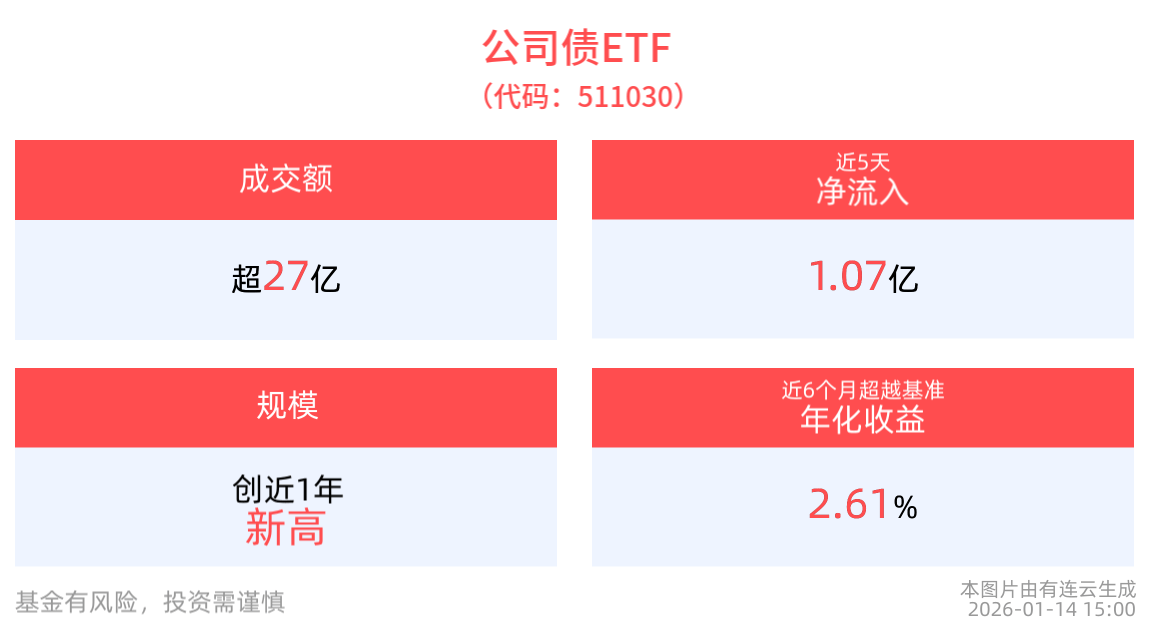
成交额超27亿元,公司债ETF(511030)近5个交易日净流入1.07亿元
Sou Hu Cai Jing· 2026-01-15 01:46
Group 1: Credit Bond Market Performance - Credit bond yields showed mixed results, with 10Y major bank secondary bonds down by 2.05 basis points, while 7Y bonds increased by 0.5 basis points [1] - In the industrial bond sector, yields varied, with notable decreases in 25 Hebei Zhongfeng MTN001A by 4.22 basis points and 25 BWS SCP006 by 3.35 basis points, while 25 Anhui Investment MTN002 increased by 10.13 basis points [1] - City investment bonds also exhibited mixed performance, with 25 Linggui City Investment SCP002 down by 12.83 basis points and 21 Gantou 01 up by 47.59 basis points [1] Group 2: Institutional Investment Trends - Institutions recommend continuing to favor equities over bonds, with net selling of long-term bonds decreasing significantly [2] - On January 14, net buying of 10Y government bonds by securities firms reached 17 billion, while insurance funds increased their holdings by 65 billion [2] - The trading volume in the stock market reached 4 trillion, contributing to the recent rise in DR001 rates [2] Group 3: Company Bond ETF Insights - As of January 14, 2026, the company bond ETF (511030) was priced at 106.76, with a 1.48% increase over the past year [5] - The latest scale of the company bond ETF reached 34.115 billion, marking a one-year high, with a recent inflow of 1.07 million over the last five trading days [6] - The company bond ETF has maintained a tracking error of 0.003% this year, closely following the China Bond - Medium to High Grade Corporate Bond Spread Factor Index [7]

1月14日信用债异常成交跟踪
SINOLINK SECURITIES· 2026-01-14 15:33
Report Industry Investment Rating - Not provided in the given content Core Viewpoints - Among the bonds with discounted transactions, "24 Chanrong 08" had a relatively large deviation in bond valuation price. Among the bonds with rising net prices, "24 Hongjian 01" had a relatively high deviation in valuation price. Among the Tier 2 and perpetual bonds with rising net prices, "24 CCB Tier 2 Capital Bond 02B" had a relatively large deviation in valuation price; among the commercial financial bonds with rising net prices, "25 CEB Bond 02" had a relatively high deviation in valuation price. Among the bonds with a transaction yield higher than 5%, transportation bonds ranked high [2]. - The changes in credit bond valuation yields were mainly distributed in the [-5,0) interval. The transaction terms of non - financial credit bonds were mainly distributed between 2 and 3 years, with the highest proportion of discounted transactions for varieties within 0.5 years; the transaction terms of Tier 2 and perpetual bonds were mainly distributed between 4 and 5 years, with the highest proportion of discounted transactions for varieties within 1 year. By industry, the bonds in the household appliances industry had the largest average deviation in valuation price [2]. Summaries by Related Catalogs Discounted Transaction Tracking - Bonds such as "24 Chanrong 08", "24 Chanrong 06", etc. in the non - bank financial industry had relatively large deviations in valuation price and high valuation yield deviations. "24 Zhonghua 08" in the comprehensive industry and "26 Lanhua MTN001" in the coal industry also had certain deviations in valuation price [3]. Tracking of Bonds with Rising Net Prices - "24 Hongjian 01" in the urban investment industry had a relatively high deviation in valuation price. Many bank - related Tier 2 and perpetual bonds also had positive deviations in valuation price, such as "24 CCB Tier 2 Capital Bond 02B", "24 BOC Tier 2 Capital Bond 02B", etc. [5]. Tracking of Tier 2 and Perpetual Bond Transactions - Bonds of state - owned banks such as "24 CCB Tier 2 Capital Bond 02B", "24 BOC Tier 2 Capital Bond 02B" had relatively large deviations in valuation price. Some bonds of joint - stock banks and city commercial banks also showed certain deviations [7]. Tracking of Commercial Financial Bond Transactions - Bonds like "25 CEB Bond 02", "25 Huishang Bank 01" had small positive deviations in valuation price and relatively stable valuation yields [8]. Tracking of Bonds with Transaction Yield Higher than 5% - Bonds such as "24 Ruimao 02" in the transportation industry and "23 Chanrong 05" in the non - bank financial industry had high transaction yields [9]. Distribution of Credit Bond Transaction Valuation Deviations on the Day - The changes in credit bond valuation yields were mainly distributed in the [-5,0) interval [2]. Distribution of Non - financial Credit Bond Transaction Terms on the Day - The transaction terms of non - financial credit bonds were mainly distributed between 2 and 3 years, and the proportion of discounted transactions for varieties within 0.5 years was the highest [2]. Distribution of Tier 2 and Perpetual Bond Transaction Terms on the Day - The transaction terms of Tier 2 and perpetual bonds were mainly distributed between 4 and 5 years, and the proportion of discounted transactions for varieties within 1 year was the highest [2]. Discounted Transaction Proportion and Transaction Scale of Non - financial Credit Bonds in Each Industry - The bonds in the household appliances industry had the largest average deviation in valuation price [2].
1月8日信用债异常成交跟踪
SINOLINK SECURITIES· 2026-01-09 01:13
Report Industry Investment Rating - Not provided in the given content Core Viewpoints - Among the bonds with discounted transactions, "24 Chanrong 08" had a relatively large deviation in bond valuation price. Among the bonds with rising net prices, "22 Vanke 02" had a prominent deviation in valuation price. Among the Tier 2 and perpetual bonds with rising net prices, "25 ABC Tier 2 Capital Bond 04B(BC)" had a relatively large deviation in valuation price; among the senior unsecured bonds with rising net prices, "25 ABC TLAC Non - Capital Bond 02C(BC)" had a prominent deviation in valuation price. Among the bonds with a transaction yield higher than 5%, real - estate bonds ranked high [2]. - The changes in credit bond valuation yields were mainly distributed in the [-5,0) interval. The transaction terms of non - financial credit bonds were mainly distributed within 0.5 years, and the proportion of discounted transactions for bonds with terms between 0.5 and 1 year was the highest; the transaction terms of Tier 2 and perpetual bonds were mainly distributed between 4 and 5 years, and the proportion of discounted transactions for bonds within 1 year was the highest. By industry, the bonds in the light manufacturing industry had the largest average deviation in valuation price [2]. Summary by Relevant Catalogs Discounted Transaction Tracking - Bonds such as "24 Chanrong 08", "24 Chanrong 06", etc. in the non - banking finance industry had relatively large deviations in valuation price, with deviations ranging from - 1.17% to - 0.82%. Bonds like "20 Boshui 02" in the agriculture, forestry, animal husbandry and fishery industry and "25 Qingcheng 09" in the urban investment industry also had certain deviations in valuation price [4]. Tracking of Bonds with Rising Net Prices - Real - estate bonds such as "22 Vanke 02", "22 Vanke 06" etc. had a valuation price deviation of 3.98%. Bonds in the banking industry like "25 ABC Tier 2 Capital Bond 04B(BC)" and "25 ABC TLAC Non - Capital Bond 02C(BC)" also had certain deviations in valuation price [6]. Tracking of Tier 2 and Perpetual Bond Transactions - Bonds such as "25 ABC Tier 2 Capital Bond 04B(BC)", "24 Fudian Bank Tier 2 Capital Bond 01" etc. had different degrees of deviation in valuation yield, with deviations ranging from - 5.35bp to - 0.56bp [8]. Tracking of Senior Unsecured Bond Transactions - Bonds such as "25 ABC TLAC Non - Capital Bond 02C(BC)", "25 CITIC Baixin Bank Small and Micro - enterprise Bond 01" etc. had deviations in valuation yield, with deviations ranging from - 1.46bp to - 0.58bp [10]. Tracking of Bonds with a Transaction Yield Higher than 5% - Real - estate bonds such as "22 Vanke 02", "22 Vanke 06" etc. and non - banking finance bonds like "23 Chanrong 05", "23 AVIC Chanrong MTN001 (Science and Technology Innovation Note)" had a transaction yield higher than 5% [11]. Distribution of Credit Bond Valuation Deviations on the Day - The changes in credit bond valuation yields were mainly distributed in the [-5,0) interval [2]. Distribution of Non - financial Credit Bond Transaction Terms on the Day - The transaction terms of non - financial credit bonds were mainly distributed within 0.5 years, and the proportion of discounted transactions for bonds with terms between 0.5 and 1 year was the highest [2]. Distribution of Tier 2 and Perpetual Bond Transaction Terms on the Day - The transaction terms of Tier 2 and perpetual bonds were mainly distributed between 4 and 5 years, and the proportion of discounted transactions for bonds within 1 year was the highest [2]. Discounted Transaction Proportion and Transaction Scale of Non - financial Credit Bonds by Industry - The bonds in the light manufacturing industry had the largest average deviation in valuation price [2].

1月6日信用债异常成交跟踪
SINOLINK SECURITIES· 2026-01-06 15:08
1. Report Industry Investment Rating No relevant content provided. 2. Core Viewpoints of the Report - Credit - related data shows that among discounted - traded bonds, "23 Chanjin 09" has a large deviation in bond valuation price; among bonds with rising clean prices, "22 Vanke 06" ranks high in valuation price deviation; among secondary and perpetual bonds with falling clean prices, "22 Industrial Bank Secondary 01" has a small valuation price deviation; among commercial financial bonds with falling clean prices, "25 Weihai Bank Small - and - Micro - enterprise Bond" has a small valuation price deviation; among bonds with a trading yield higher than 5%, real - estate bonds rank high [2]. - Credit bond valuation yield changes are mainly distributed in the (0, 5] range. Non - financial credit bond trading terms are mainly distributed between 2 and 3 years, with the 3 - to 4 - year variety having the highest proportion of discounted trades; secondary and perpetual bond trading terms are mainly distributed between 4 and 5 years. By industry, bonds in the agriculture, forestry, animal husbandry, and fishery industry have the largest average valuation price deviation [2]. 3. Summary According to Relevant Catalogs 3.1 Discounted - Traded Bond Tracking - Bonds such as "23 Chanjin 09", "24 Chanjin 08", etc. in the non - bank financial industry have relatively large valuation price deviations, with "23 Chanjin 09" having a deviation of - 1.05% and a remaining term of 2.69 years, and a trading volume of 16 million yuan [4]. - Bonds in other industries like "20 Boshui 02" in agriculture, forestry, animal husbandry, and fishery, and "Shaanxi Coal KY13" in the coal industry also have certain valuation price deviations [4]. 3.2 Tracking of Bonds with Rising Clean Prices - "22 Vanke 06", "22 Vanke 04", and "22 Vanke 02" in the real - estate industry have large positive deviations in valuation prices, with "22 Vanke 06" having a deviation of 4.15% and a trading volume of 297 million yuan [5]. - Many urban investment bonds also show positive deviations in valuation prices, such as "20 Zunhe 02" and "25 Raochuang 04" [5]. 3.3 Secondary and Perpetual Bond Trading Tracking - Secondary and perpetual bonds of various banks, including state - owned banks, joint - stock banks, and city commercial banks, have a valuation price deviation of - 0.01%. For example, "22 Industrial Bank Secondary 01" has a trading volume of 112,946 million yuan [6]. 3.4 Commercial Financial Bond Trading Tracking - "25 Weihai Bank Small - and - Micro - enterprise Bond" and "25 Weihai Bank Green Bond" have a valuation price deviation of 0.00%, with trading volumes of 32,901 million yuan and 11,966 million yuan respectively [7]. - Some commercial financial bonds have a valuation price deviation of - 0.01%, such as "23 Beijing Rural Commercial Small - and - Micro - enterprise Bond" and "25 CITIC Baixin Bank Small - and - Micro - enterprise Bond 01" [7]. 3.5 Tracking of Bonds with a Trading Yield Higher than 5% - Real - estate bonds like "22 Vanke 06", "22 Vanke 04", etc., and non - bank financial bonds such as "23 Chanjin 05", "23 Chanjin 13" are among the bonds with a trading yield higher than 5% [8]. 3.6 Distribution of Credit Bond Trading Valuation Deviations on the Day - Credit bond valuation yield changes are mainly distributed in the (0, 5] range [2]. 3.7 Distribution of Non - financial Credit Bond Trading Terms on the Day - Non - financial credit bond trading terms are mainly distributed between 2 and 3 years, and the 3 - to 4 - year variety has the highest proportion of discounted trades [2]. 3.8 Distribution of Secondary and Perpetual Bond Trading Terms on the Day - Secondary and perpetual bond trading terms are mainly distributed between 4 and 5 years [2]. 3.9 Discounted - Trade Ratio and Trading Volume of Non - financial Credit Bonds in Each Industry - Bonds in the agriculture, forestry, animal husbandry, and fishery industry have the largest average valuation price deviation, while different industries have different trading volumes [2][18].
