
BANK OF CHINA(601988)

Search documents
中国银行股份有限公司 日常关联交易公告
Zhong Guo Zheng Quan Bao - Zhong Zheng Wang· 2025-12-20 06:21
中国银行股份有限公司 日常关联交易公告 中国银行股份有限公司(简称"本行")董事会及全体董事保证本公告内容不存在任何虚假记载、误导性 陈述或者重大遗漏,并对其内容的真实性、准确性和完整性承担法律责任。 重要内容提示: 登录新浪财经APP 搜索【信披】查看更多考评等级 证券代码:601988 证券简称:中国银行 公告编号:临2025-091 ● 本次关联交易无需提交本行股东会审议。 ● 本次关联交易是本行日常业务中所发生的正常交易,对本行经营活动及财务状况无重大影响,不会影 响本行的独立性。 一、日常关联交易基本情况 本行2025年12月19日召开的董事会会议审议通过了上海证券交易所规则下中国银行与中国中信金融资产 管理股份有限公司及中国中信金融资产国际控股有限公司日常关联交易合并金额上限的议案。本行董事 会同意本行在《上海证券交易所股票上市规则》下,与中国中信金融资产管理股份有限公司及中国中信 金融资产国际控股有限公司在2026年1月1日至2026年12月31日期间日常关联交易合并金额上限为734.60 亿元(简称"本次关联交易")。 根据《上海证券交易所股票上市规则》《中国银行股份有限公司章程》等相关规定, ...
12 月 19 日信用债异常成交跟踪
SINOLINK SECURITIES· 2025-12-19 15:38
1. Report Industry Investment Rating - No relevant content provided 2. Core Viewpoints of the Report - Among the bonds with discounted transactions, "24 Guoyuan 01" had a relatively large deviation in bond valuation price. Among the bonds with rising net prices, "22 Vanke 02" ranked high in terms of valuation price deviation. Among the Tier 2 and perpetual bonds with rising net prices, "25 Agricultural Bank of China Tier 2 Capital Bond 01A(BC)" had a relatively large deviation in valuation price. Among the commercial financial bonds with rising net prices, "25 China Everbright Bank Bond 02" ranked high in terms of valuation price deviation. Among the individual bonds with a transaction yield higher than 5%, real estate bonds ranked high [2]. - The changes in credit bond valuation yields were mainly distributed in the [-5,0) interval. The transaction terms of non - financial credit bonds were mainly distributed between 2 and 3 years, with the 1 - 1.5 - year - term varieties having the highest proportion of discounted transactions. The transaction terms of Tier 2 and perpetual bonds were mainly distributed between 4 and 5 years, with the varieties within 1 year having the highest proportion of discounted transactions. By industry, real estate industry bonds had the largest average deviation in valuation prices [2]. 3. Summaries Based on Relevant Catalogs 3.1 Discounted Transaction Tracking - Bonds such as "24 Guoyuan 01", "Jian Guan VY02", and "24 China Construction MTN002" had significant valuation price deviations in discounted transactions. The industries involved included urban investment, transportation, and building decoration. The transaction scales ranged from several million yuan to tens of millions of yuan [4]. 3.2 Tracking of Bonds with Rising Net Prices - Bonds like "22 Vanke 02", "22 Vanke 04", and "22 Vanke 06" had large positive deviations in valuation prices. The industries mainly included real estate, non - bank finance, and urban investment. The transaction scales varied from tens of thousands of yuan to hundreds of millions of yuan [5]. 3.3 Tracking of Tier 2 and Perpetual Bond Transactions - Bonds such as "25 Agricultural Bank of China Tier 2 Capital Bond 01A(BC)", "25 Industrial and Commercial Bank of China Tier 2 Capital Bond 03BC", and "25 Agricultural Bank of China Tier 2 Capital Bond 02A(BC)" had certain valuation price deviations. Banks involved included state - owned banks, joint - stock banks, and city commercial banks. The transaction scales were relatively large, reaching tens of millions of yuan to billions of yuan [6]. 3.4 Tracking of Commercial Financial Bond Transactions - Bonds like "25 China Everbright Bank Bond 02", "24 China Construction Bank Bond 01B", and "25 Jiangsu Bank Bond 02BC" had valuation price deviations. Banks included joint - stock banks, state - owned banks, and city commercial banks. The transaction scales ranged from several million yuan to hundreds of millions of yuan [7]. 3.5 Tracking of Bonds with a Transaction Yield Higher than 5% - Bonds such as "22 Vanke 02", "22 Vanke 04", and "24 Chanrong 06" had a transaction yield higher than 5%. The industries mainly included real estate and non - bank finance. The transaction scales were relatively small, mostly in the range of tens of thousands to hundreds of thousands of yuan [8]. 3.6 Distribution of Credit Bond Transaction Valuation Deviations on the Day - The changes in credit bond valuation yields were mainly distributed in the [-5,0) interval [2]. 3.7 Distribution of Non - Financial Credit Bond Transaction Terms on the Day - The transaction terms of non - financial credit bonds were mainly distributed between 2 and 3 years, with the 1 - 1.5 - year - term varieties having the highest proportion of discounted transactions [2]. 3.8 Distribution of Tier 2 and Perpetual Bond Transaction Terms on the Day - The transaction terms of Tier 2 and perpetual bonds were mainly distributed between 4 and 5 years, with the varieties within 1 year having the highest proportion of discounted transactions [2]. 3.9 Discounted Transaction Proportions and Transaction Scales of Non - Financial Credit Bonds in Each Industry - The real estate industry had the largest average deviation in non - financial credit bond valuation prices [2].



2026年贺岁纪念币和纪念钞来了,先睹为快!
Xin Hua Wang· 2025-12-19 15:07
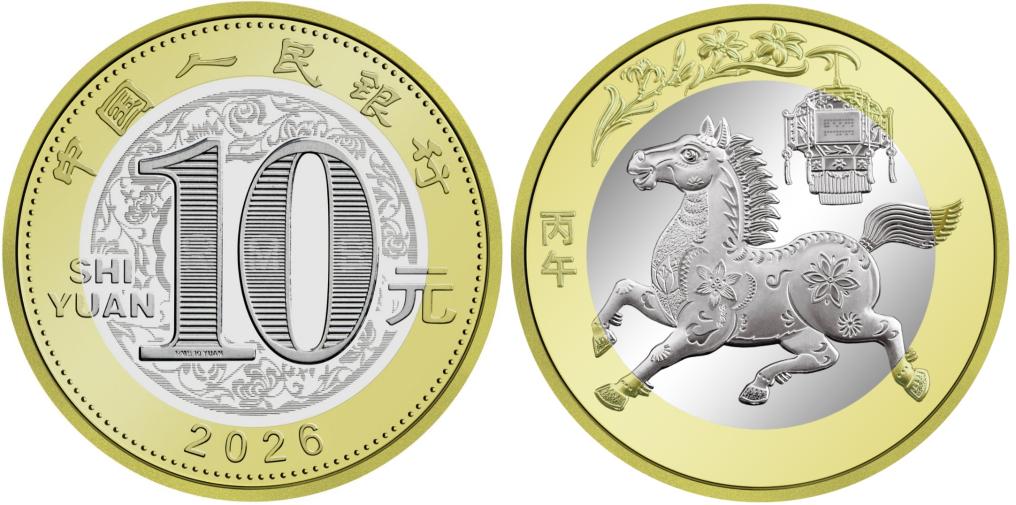
Core Viewpoint - The People's Bank of China will issue the 2026 New Year commemorative coins and banknotes starting from December 22, 2025, including a copper alloy coin, a banknote, a gold coin, and a silver coin, all of which are legal tender in the People's Republic of China [1][3]. Group 1: Commemorative Coins - The copper alloy commemorative coin features the inscription "People's Bank of China," "10 Yuan," the pinyin "SHIYUAN," and the year "2026" on the front, with a design combining traditional paper-cut art and decorative elements on the back [1]. - The gold commemorative coin has a design featuring the character "福" (Fortune) and a pouch, with a maximum issuance of 150,000 pieces [5][8]. - The silver commemorative coin features the character "福" and a scene of dancing fish lanterns, with a maximum issuance of 1,000,000 pieces [8]. Group 2: Commemorative Banknotes - The front of the commemorative banknote showcases a horse design, the national emblem, and the denomination "20 Yuan," along with various security features [3]. - The back of the banknote depicts children celebrating with drums, accompanied by Mongolian decorative patterns, and includes multiple languages for the denomination [3]. Group 3: Distribution and Exchange - The commemorative coins and banknotes will be available through a reservation system, managed by several major banks including ICBC, ABC, and BOC, among others [5]. - The reservation period is set for January 13-14, 2026, with the exchange period from January 20-26, 2026, and limits of 20 pieces for coins and 20 notes per person [5].




中国银行黑龙江省分行落地省内首笔“货币桥”业务 开辟数字时代跨境支付新通道
Zhong Guo Jin Rong Xin Xi Wang· 2025-12-19 13:32
Core Viewpoint - The successful execution of the first cross-border RMB remittance based on the multilateral central bank digital currency bridge in Heilongjiang Province marks a significant breakthrough in financial technology innovation and application by the Bank of China Heilongjiang Branch, establishing a new cross-border payment channel in the province [1] Group 1: Financial Technology Innovation - The cross-border financial infrastructure known as the "currency bridge" was jointly developed by the central banks of Thailand, the UAE, the People's Bank of China Digital Currency Research Institute, and the Hong Kong Monetary Authority [1] - This infrastructure aims to optimize traditional cross-border payment processes, addressing issues such as long processing times, low efficiency, and high costs, thereby creating a more convenient, efficient, and secure digital channel for cross-border fund flows [1] Group 2: Strategic Development - As a primary channel bank for global RMB cross-border services, the Bank of China leverages its global advantages and comprehensive features to expand new application scenarios for cross-border RMB [1] - During the 14th Five-Year Plan period, the Bank of China Heilongjiang Branch will continue to deepen the application of the multilateral central bank digital currency bridge in cross-border payments, advancing financial services in the digital realm and broadening the coverage of the digital RMB ecosystem [1]
中国银行(601988) - 中国银行股份有限公司董事和高级管理人员证券交易管理办法(2025年修订)
2025-12-19 10:17
中国银行股份有限公司董事和高级管理人员证券交易管理办法 (2025 年修订) 第一章 总 则 第二章 证券交易的基本原则 1 第一条 为规范和管理中国银行股份有限公司(以下称为"本行")董事、高级 管理人员持有本行证券及其交易的行为,根据《中华人民共和国公司 法》、《中华人民共和国证券法》、中国证券监督管理委员会《上市公 司董事和高级管理人员所持本公司股份及其变动管理规则》、本行董事 会已经采纳的《香港联合交易所有限公司证券上市规则》附录 C3《上市 发行人董事进行证券交易的标准守则》和其他法律、行政法规和规章以 及上市地上市规则,制定本办法。 第二条 董事、高级管理人员具体证券交易规则,以证券上市地的法律、行政法 规和规章以及上市地上市规则的为准,本办法旨在规定一套统一的交易 管理程序。 第三条 就本办法而言,本行证券是指本行的上市证券,可转换或交换为上市证 券的非上市证券,以及以本行上市证券为基础所发行的结构性产品(包 括衍生权证)。 第四条 本办法中董事、高级管理人员所持本行股份,是指登记在其名下和利用 他人账户持有的所有本行股份。董事、高级管理人员从事融资融券交易 的,其所持本行股份还包括记载在其信用 ...
中国银行(601988) - 中国银行股份有限公司信息披露政策(2025年修订)
2025-12-19 10:16
中国银行股份有限公司信息披露政策 (2025 年修订) 第一章 总则 第一条 为规范中国银行股份有限公司(以下简称"本 行")及相关信息披露义务人的信息披露行为,加强本行信息 披露事务管理,保护本行、本行投资者和利益相关人的合法权 益,提高本行信息披露管理水平和信息披露质量,根据《中华 人民共和国公司法》《中华人民共和国证券法》《上市公司信息 披露管理办法》《上市公司信息披露暂缓与豁免管理规定》《银 行保险机构公司治理准则》,本行股票上市地证券监督管理机 构及交易所有关规定等相关法律、法规、规章和规范性文件 (以下统称"监管规定")和本行公司章程,制定本政策。 第二条 本政策所称"信息披露",是指本行及相关信息 披露义务人,按照相关监管规定的要求,披露对本行证券及其 衍生品种交易价格或投资者的投资决策可能产生较大影响的重 大信息,以及其他依法需要披露的信息和本行自愿披露的信息。 信息披露是本行的持续责任。本行董事会、高级管理层, 总行各部门、各直属机构,各分行、附属行、代表处、综合经 营公司等各机构和相关人员(以下统称"本行各部门、各机 构"),应当支持和配合信息披露义务人履行信息披露义务。 第三条 本政策所 ...
中国银行(601988) - 中国银行股份有限公司日常关联交易公告
2025-12-19 10:16
证券代码:601988 证券简称:中国银行 公告编号:临 2025-091 中国银行股份有限公司日常关联交易公告 中国银行股份有限公司(简称"本行")董事会及全体董事保证本公告内容不 存在任何虚假记载、误导性陈述或者重大遗漏,并对其内容的真实性、准确性和完 整性承担法律责任。 重要内容提示: 一、日常关联交易基本情况 本行 2025 年 12 月 19 日召开的董事会会议审议通过了上海证券交易 所规则下中国银行与中国中信金融资产管理股份有限公司及中国中信金 融资产国际控股有限公司日常关联交易合并金额上限的议案。本行董事会 同意本行在《上海证券交易所股票上市规则》下,与中国中信金融资产管 理股份有限公司及中国中信金融资产国际控股有限公司在 2026 年 1 月 1 日至 2026年12月31日期间日常关联交易合并金额上限为734.60亿元(简 称"本次关联交易")。 本次关联交易无需提交本行股东会审议。 本次关联交易是本行日常业务中所发生的正常交易,对本行经营活 动及财务状况无重大影响,不会影响本行的独立性。 中国中信金融资产管理股份有限公司成立于1999年11月1日,注册资 本为人民币8,024,667.90 ...
中国银行(03988) - 海外监管公告-中国银行股份有限公司日常关联交易公告
2025-12-19 10:16
香港交易及結算所有限公司及香港聯合交易所有限公司對本公告的內容概不負責,對其準確性 或完整性亦不發表任何聲明,並明確表示,概不對因本公告全部或任何部分內容而產生或因倚 賴該等內容而引致之任何損失承擔任何責任。 中國銀行股份有限公司 BANK OF CHINA LIMITED (於中華人民共和國註冊成立的股份有限公司) (「本行」) (股份代號:3988) 海外監管公告 根據中華人民共和國(「中國」)的有關法例規定,本行在上海證券交易所網站及中 國報章刊登了《中國銀行股份有限公司日常關聯交易公告》。茲載列如下,謹供參 閱。 中國銀行股份有限公司 董事會 中國,北京 2025年12月19日 於本公告日期,本行董事為葛海蛟、張輝、劉進、蔡釗、張勇*、黃秉華*、劉輝*、師永彥*、 樓小惠*、李子民*、讓•路易•埃克拉 # 、喬瓦尼•特里亞 # 、劉曉蕾 # 、張然 # 、高美懿 # 、胡展雲 # 。 * 非執行董事 # 獨立非執行董事 证券代码:601988 证券简称:中国银行 公告编号:临 2025-091 中国银行股份有限公司日常关联交易公告 中国银行股份有限公司(简称"本行")董事会及全体董事保证本公告内容不 ...
中国银行(601988) - 中国银行股份有限公司董事会决议公告
2025-12-19 10:15
证券代码:601988 证券简称:中国银行 公告编号:临 2025-090 中国银行股份有限公司董事会决议公告 中国银行股份有限公司董事会及全体董事保证本公告内容不存在任何虚假记 载、误导性陈述或者重大遗漏,并对其内容的真实性、准确性和完整性承担法律责 任。 中国银行股份有限公司(简称"本行")于 2025 年 12 月 19 日在北 京和香港以现场表决方式召开董事会会议,会议通知于 2025 年 12 月 5 日通过书面及电子邮件方式送达至本行所有董事。本次会议由董事长葛海 蛟先生主持,会议应出席董事 16 名,亲自出席董事 14 名。执行董事刘进 先生因其他重要公务未能亲自出席会议,委托执行董事蔡钊先生代为出席 并表决;独立董事高美懿女士因其他重要公务未能亲自出席会议,委托独 立董事胡展云先生代为出席并表决。高级管理层成员列席了会议。会议的 召开符合《中华人民共和国公司法》等有关法律、行政法规、部门规章、 规范性文件和《中国银行股份有限公司章程》(简称"《公司章程》") 的规定。出席会议的董事审议并以记名方式投票表决通过了如下议案: 一、中国银行股份有限公司信息披露政策(2025 年修订) 详情请查阅本行 ...
中国银行(03988) - 海外监管公告-中国银行股份有限公司董事和高级管理人员证券交易管理办法(2...
2025-12-19 10:12
香港交易及結算所有限公司及香港聯合交易所有限公司對本公告的內容概不負責,對其準確性 或完整性亦不發表任何聲明,並明確表示,概不對因本公告全部或任何部分內容而產生或因倚 賴該等內容而引致之任何損失承擔任何責任。 中国银行股份有限公司董事和高级管理人员证券交易管理办法 (2025 年修订) 第一章 总 则 中國銀行股份有限公司 BANK OF CHINA LIMITED (於中華人民共和國註冊成立的股份有限公司) (「本行」) (股份代號:3988) 海外監管公告 根據中華人民共和國(「中國」)的有關法例規定,本行在上海證券交易所網站刊 登了《中國銀行股份有限公司董事和高級管理人員證券交易管理辦法(2025年修 訂)》。茲載列如下,謹供參閱。 中國銀行股份有限公司 董事會 中國,北京 2025年12月19日 於本公告日期,本行董事為葛海蛟、張輝、劉進、蔡釗、張勇*、黃秉華*、劉輝*、師永彥*、 樓小惠*、李子民*、讓•路易•埃克拉 # 、喬瓦尼•特里亞 # 、劉曉蕾 # 、張然 # 、高美懿 # 、胡展雲 # 。 * 非執行董事 # 獨立非執行董事 第二章 证券交易的基本原则 1 第一条 为规范和管理中国银行股份 ...