
BANK OF CHINA(601988)

Search documents
外媒关注:中国人民币贷款猛增将超海外美元贷款
Sou Hu Cai Jing· 2025-12-22 06:32
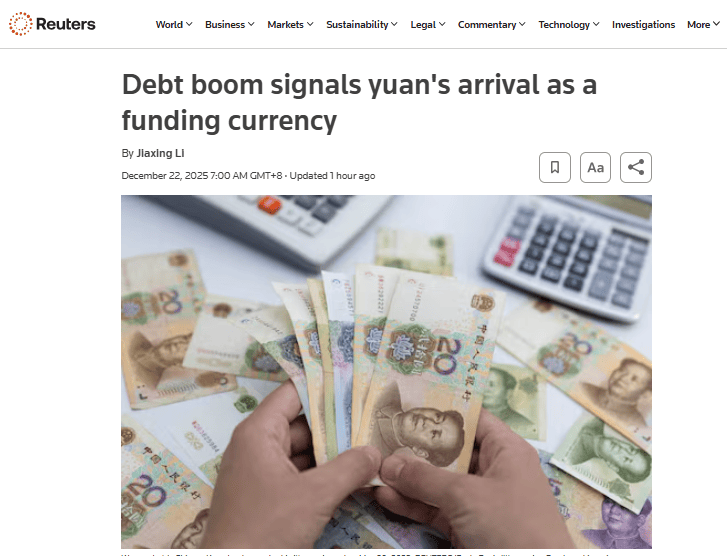
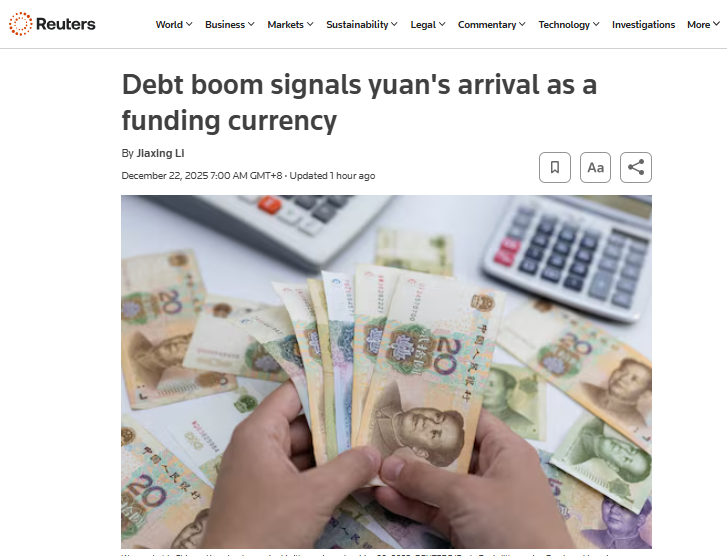
中国央行近日公布数据显示,截至11月底,以美元为主的外币贷款余额降至37500亿元人民币,低于 2022年的峰值58700亿元人民币,而人民币贷款金额达到35700亿元人民币。 标普全球则表示:"人民币相对于美元和欧元的相对稳定性进一步增强了这一吸引力,通过最小化昂贵 的货币对冲需求,减少了对外币发行人的汇率风险。" 路透社近日发文称,过去四年中国海外银行贷款增长三倍,达到2.52万亿元人民币;在岸和离岸人民币 债券销售连续第二年创纪录。得益于吸引人的利率定价,中国银行的人民币贷款余额猛增,即将超过海 外美元贷款,正推动人民币在全球舞台上的地位。 银行家对此表示,这种热潮受到了成本推动,因为人民币利率较低。但市场也正在产生自己的动力,以 及越来越多的持有和消费人民币的需求,这表明即使资本账户的放松还没有取得进展,但中国在全球化 的道路上仍取得进展。 德国商业银行中国境内债务资本市场负责人萨尔曼·费舍尔(Samuel Fischer)表示:"我认为这个阶段现 在更多是由人民币融资的基本兴趣驱动的。"他还提到:"越来越多的国际投资者不再只是将此视为套 利,而是真正有人民币预算,还有来自中国以外的大宗订单。美元正处 ...

中国银行山东省分行全方位支持科技产业提质升级
Feng Huang Wang Cai Jing· 2025-12-22 06:22
Core Viewpoint - Shandong Bank is actively enhancing its financial services to support the development of technology-driven enterprises in Shandong Province, focusing on traditional industry upgrades, emerging industry cultivation, and future industry layout during the "14th Five-Year Plan" period [1] Group 1: Financial Support for Technology Enterprises - As of the end of November, Shandong Bank's technology financial loan balance exceeded 133 billion yuan, serving over 6,800 technology enterprises [1] - The bank is customizing comprehensive credit solutions for enterprises based on their funding needs and project construction requirements, being the first in the industry to approve project loans [2] Group 2: Commercial Aerospace Industry Development - The commercial aerospace industry in Shandong Province is developing a full-chain industrial chain from rocket manufacturing to satellite applications, centered around the Haiyang Oriental Spaceport [2] - A technology company is leading the space information industry layout and is involved in a key project for green, low-carbon, high-quality development in Shandong Province for 2024 [2] Group 3: Focus on "Neck-Choking" Technologies - The "信创" (Xinchuang) initiative aims to achieve self-reliance in information technology through independent research and innovation, reducing dependence on external technologies [3] - Shandong Bank is focusing on breakthrough innovations in "neck-choking" technology barriers and has identified a technology company as a target client for credit support [3] - The bank is collaborating with China Bank Asset and China Bank Securities to provide integrated financial services, laying a solid foundation for future business cooperation [3]

贵州金融监管局核准李峰中国银行贵安新区分行行长任职资格
Jin Tou Wang· 2025-12-22 04:08
Core Viewpoint - The Guizhou Financial Regulatory Bureau has approved the appointment of Li Feng as the president of the Guizhou branch of the Bank of China, emphasizing the importance of compliance with financial regulations and ongoing education in economic and financial laws [1] Group 1 - The Guizhou Financial Regulatory Bureau has issued a formal approval for Li Feng's appointment as the president of the Bank of China Guian New Area branch [1] - The approval requires the appointed individual to adhere to the regulations set by the financial regulatory authority and to report their onboarding status within three months [1] - The Bank of China is mandated to ensure that the approved personnel continuously learn and understand relevant economic and financial laws, maintain a strong risk compliance awareness, and fulfill their job responsibilities diligently [1]
云南中行“沃土新声”行动 以金融之水浇灌高原特色农业
Xin Hua Wang· 2025-12-22 02:51
Core Viewpoint - The China Bank Yunnan Branch is actively promoting rural revitalization through financial innovation, focusing on highland特色 agriculture and addressing financing challenges in rural areas [1] Group 1: Financial Initiatives - The company is leveraging industry chain financial innovation to break traditional agricultural constraints [1] - Digital finance is being utilized to solve rural financing difficulties [1] - Inclusive finance is being promoted to support the development of county-level industries [1] Group 2: Agricultural Focus - The focus is on highland特色 agricultural products such as Yunnan tea, flowers, and coffee [1] - The aim is to transform "small but beautiful" Yunnan products into a "golden business card" for the province, enhancing its economic strength [1] Group 3: Overall Impact - The financial initiatives are designed to provide precise support to the entire chain of highland特色 agriculture [1] - The company positions itself as a key player in the local economic development landscape [1]

中国海外银行贷款猛增,推动人民币在全球舞台上的地位
Huan Qiu Wang· 2025-12-22 01:07
Core Insights - The People's Bank of China reported that as of the end of November, foreign currency loans in USD terms decreased to 37.5 trillion RMB, down from a peak of 58.7 trillion RMB in 2022, while RMB loans reached 35.7 trillion RMB [1] - Over the past four years, China's overseas bank loans have tripled to 2.52 trillion RMB, and onshore and offshore RMB bond sales have set records for the second consecutive year, driven by attractive interest rate pricing [1] - The surge in RMB loans is expected to surpass overseas USD loans, enhancing the global standing of the RMB [1] Group 1 - The current surge in RMB financing is primarily driven by fundamental interest rather than just arbitrage, with increasing demand for holding and spending RMB [2] - International investors are increasingly viewing RMB not just as a speculative asset but as a legitimate budget currency, indicating a diversification away from the USD [2] - The relative stability of the RMB compared to the USD and EUR has further enhanced its attractiveness, minimizing costly currency hedging needs and reducing exchange rate risks for foreign currency issuers [2]
2026年贺岁纪念币、纪念钞今起陆续发行 预约方式→
Xin Lang Cai Jing· 2025-12-21 21:43
Core Points - The People's Bank of China is issuing the 2026 New Year commemorative banknotes and coins starting from December 22, 2023, which includes one banknote and three types of coins, all recognized as legal tender in the People's Republic of China [1][7]. Commemorative Banknote - The commemorative banknote features a horse design on the front, along with the national emblem, the name of the bank, and various security features such as a holographic pattern and a transparent window. The denomination is 20 yuan [1][3]. - The back of the banknote showcases a festive scene with children celebrating, accompanied by Mongolian decorative patterns, and includes the denomination in multiple languages [3]. - The banknote has a face value of 20 yuan, dimensions of 145mm by 70mm, is made of plastic, and has a total issuance of 100 million pieces, including 20,000 for historical archives [5]. Commemorative Coins - The commemorative coins include a 10 yuan dual-color copper alloy coin, which features traditional Chinese paper-cut art and a horse image on the back, with a total issuance of 100 million pieces, including 10,000 for historical archives [6]. - The dual-color copper alloy coin has a diameter of 27mm and will be available for reservation from January 13 to 14, 2026, through designated banks [6]. - Additionally, a set of gold and silver commemorative coins is being issued, which includes a 1-gram round gold coin and an 8-gram diamond-shaped silver coin, both featuring traditional auspicious designs [7][9]. - The 1-gram gold coin has a face value of 10 yuan, a diameter of 10mm, and a maximum issuance of 150,000 pieces, while the 8-gram silver coin has a face value of 3 yuan, a side length of 23mm, and a maximum issuance of 1 million pieces [8][9]. Sales Channels - The sales channels for these commemorative coins and banknotes will be detailed on the China Gold Coin website and the "China Gold Coin" WeChat official account [10].



财经聚焦|破解科技企业融资痛点 金融“活水”涌向创新高地
Xin Hua She· 2025-12-21 10:09
Group 1 - The article emphasizes the importance of financial support in fostering technological innovation and highlights the ongoing efforts by financial institutions to improve service quality and address the financing challenges faced by tech companies [1][5] - Financial institutions are increasingly exploring new pathways to provide continuous financial support to innovative sectors, as evidenced by the "Common Growth Plan" initiated by the People's Bank of China in Anhui, which has served over 15,000 enterprises and issued loans exceeding 210 billion yuan [2][3] - The balance of loans to technology-based small and medium-sized enterprises has maintained a year-on-year growth rate of over 20%, with new technology loans accounting for nearly 30% of total loan growth, indicating a significant shift in the financial landscape [3][4] Group 2 - The article discusses the successful collaboration between financial institutions and tech companies, exemplified by Nanjing Anze Information Technology Co., which received a 7 million yuan "patent conversion loan" without traditional collateral requirements, focusing instead on the value of the company's patent technology [4][6] - The integration of investment, loans, and guarantees has proven effective for startups like Guangdong Blue Potential Marine Technology Co., which has seen an average annual order growth rate exceeding 200% due to a collaborative credit model [6][8] - The establishment of a multi-layered financial service system tailored to the entire chain of technological innovation has led to an average annual growth rate of 27.2% in research and technology loans during the 14th Five-Year Plan period [8][9]

财经聚焦|破解科技企业融资痛点 金融“活水”涌向创新高地
Xin Hua She· 2025-12-21 06:58
Core Insights - The article emphasizes the importance of financial support in fostering technological innovation and highlights the ongoing efforts to improve financing conditions for tech companies across various regions in China [1][9]. Group 1: Financing Initiatives - Financial institutions are increasingly exploring new pathways to provide continuous financial support to innovative companies, particularly in regions like Anhui, Jiangsu, and Guangdong [1]. - The "Common Growth Plan" initiated by the People's Bank of China in Anhui has facilitated over 1.5 million enterprises, with loans exceeding 210 billion yuan by the end of November 2025 [2]. - The scale of re-loans for technological innovation and technological transformation has been expanded to 800 billion yuan, with a reduced re-loan interest rate of 1.5% [3]. Group 2: Collaborative Financing Models - The integration of investment, loans, and guarantees has proven effective, as seen in the case of Guangdong's Blue Potential Marine Technology Company, which received nearly 20 million yuan through a collaborative credit model [6]. - The introduction of specialized loan products, such as the "Patent Transformation Loan" by China Bank, has allowed companies to secure funding based on the value of their patent technologies rather than traditional collateral [4]. Group 3: Impact of Technology on Finance - Financial institutions are leveraging AI and big data to enhance their understanding of tech companies, improving the accuracy of credit assessments and enabling faster loan approvals [5]. - The establishment of dynamic databases for 4.01 million enterprise clients has allowed banks to identify credit potential and generate pre-approval limits, significantly reducing financing cycles by over 60% [4]. Group 4: Policy Support and Future Directions - The Chinese government is committed to fostering a supportive financial environment for tech companies, as indicated by the recent Central Economic Work Conference, which emphasizes innovation-driven growth [9]. - A multi-departmental approach is being adopted to create a cohesive financial support system for technological innovation, enhancing policy coordination and information sharing [8].

财经聚焦 | 破解科技企业融资痛点 金融“活水”涌向创新高地
Xin Hua She· 2025-12-21 05:02
Group 1 - The article emphasizes the importance of financial support for technology enterprises, highlighting the increasing flow of financial resources towards innovation hubs due to supportive policies [1][2] - Financial institutions are exploring new pathways to improve the financing environment for technology companies, addressing issues such as lack of collateral and valuation difficulties [2][3] - The People's Bank of China has expanded the scale of re-loans for technological innovation and reduced re-loan interest rates, significantly increasing financial support for technology research and development [3][7] Group 2 - Companies like Anhui Zhongke Haoyin Intelligent Technology Co., Ltd. have benefited from innovative financial products such as the "Common Growth Plan," which provides credit loans to support R&D [2][4] - The integration of technology and finance is evident as banks utilize data analytics to enhance credit assessments and streamline loan processes for technology firms [4][5] - Collaborative financing models, combining equity investment, credit funding, and guarantees, have proven effective in supporting the growth of technology startups [6][7] Group 3 - The article notes that the average annual growth rate of scientific and technological loans is projected to reach 27.2% during the 14th Five-Year Plan period, indicating a robust demand for financial support in the tech sector [6][7] - The establishment of a differentiated financial support system for technology innovation is crucial, with various departments working together to enhance the overall financing ecosystem [6][7] - The recent Central Economic Work Conference has reaffirmed the commitment to innovation-driven development, emphasizing the role of financial services in supporting technological advancements [7]
破解科技企业融资痛点 金融“活水”涌向创新高地
Xin Hua Wang· 2025-12-21 04:18
Group 1 - The core viewpoint emphasizes the importance of financial support in fostering technological innovation and addressing the financing challenges faced by tech companies [1][5] - Financial institutions are increasingly exploring new pathways to provide continuous financial support to innovative enterprises, particularly in regions like Anhui, Jiangsu, and Guangdong [1][2] - The "Common Growth Plan" initiated by the People's Bank of China in Anhui has successfully provided over 210 billion yuan in loans to more than 15,000 enterprises, addressing the financing difficulties of tech companies [2][3] Group 2 - The People's Bank of China has expanded the scale of re-loans for technological innovation and technical transformation to 800 billion yuan and reduced the re-loan interest rate to 1.5%, enhancing financial services for tech R&D and commercialization [3][8] - The loan balance for tech SMEs has maintained a year-on-year growth rate of over 20%, with tech loans accounting for nearly 30% of new loans, becoming a significant driver of credit growth [3][4] - Financial institutions are optimizing lending processes and utilizing technology to transform the "soft power" of tech companies into "hard currency" for financing, thereby improving the efficiency of financial services [4][5] Group 3 - The collaborative credit model integrating investment, loans, and guarantees has significantly supported the rapid growth of startups like Guangdong Blue Potential Marine Technology Co., which has seen an annual order growth rate exceeding 200% [7] - The average annual growth rate of research and technology loans during the 14th Five-Year Plan period is projected to reach 27.2%, with the A-share tech sector accounting for over a quarter of total market capitalization [7][8] - A multi-departmental approach is essential for developing tech finance, as highlighted by the joint efforts of the Ministry of Science and Technology and the People's Bank of China to establish a supportive financial ecosystem for tech innovation [6][8]
