CNCB(601998)

Search documents
机遇“金闪闪” 银行贵金属业务规模大增
Shang Hai Zheng Quan Bao· 2025-11-03 18:11
Core Viewpoint - The strong international gold prices and rising global risk aversion are driving the growth of banks' precious metals businesses, with significant year-on-year increases reported in the third-quarter financial results of listed banks. However, the recent fluctuations in gold prices present new challenges for these banking operations [1]. Group 1: Growth in Precious Metals Business - The precious metals business of banks has rapidly expanded due to the sustained rise in gold prices, with smaller banks showing particularly impressive growth. As of the end of September, Nanjing Bank's precious metals business reached 7.201 billion yuan, a staggering increase of 11,914.36% compared to the end of 2024. Hangzhou Bank's precious metals business grew to 1.217 billion yuan, up 1,523.57% from the end of 2024 [2]. - Joint-stock banks also experienced significant growth in their precious metals business. By the end of September, compared to the end of 2024, the precious metals business of Shanghai Pudong Development Bank increased by over 350%, while China CITIC Bank saw an increase of over 200%. Other banks like Zhejiang Commercial Bank, Industrial Bank, China Merchants Bank, and Minsheng Bank all reported growth exceeding 100% [2]. - Major banks maintained steady growth from a high base, with the precious metals business of Bank of China, China Construction Bank, and Agricultural Bank of China all increasing by over 10% compared to the end of 2024 [2]. Group 2: Strategic Focus on Precious Metals - The precious metals business combines wealth management and increased intermediary income, potentially becoming a significant factor in banks' intermediary income. Precious metals, especially gold, are seen as irreplaceable in banks' wealth management offerings and are crucial for customer asset allocation [3]. - Analysts note that the demand for gold as a hedge and a store of value is rising among residents. Banks, as key channels for gold bar sales and coin distribution, are well-positioned to meet this demand through the continued popularity of online investment products like account gold and gold accumulation [3]. - The decline in gold jewelry consumption may lead banks to reduce reliance on traditional jewelry sales and instead focus on innovation and promotion of their precious metals business [3]. Group 3: Risk Management Amid Price Volatility - Despite the growth, the high volatility of precious metals, particularly gold and silver, poses challenges for banks. Since October, these metals have entered a period of high volatility, prompting banks to enhance their risk management strategies [4]. - In response to market fluctuations, banks have adjusted trading rules and increased the minimum purchase thresholds for gold accumulation products to a range of 950 to 1,200 yuan, compared to around 500 yuan last year. Additionally, some banks have modified their precious metals wallet services to align with real-time gold price fluctuations [4]. - Looking ahead, institutions expect gold to retain its upward potential, maintaining its importance in asset allocation. The profitability of banks' precious metals business will increasingly depend on their internal capabilities, including the establishment of robust risk management systems to mitigate price volatility risks and the optimization of asset allocation for stable returns [4].





理财市场“吸金”效应凸显,存款到期重定价为银行负债端“减负”
Zhong Guo Zheng Quan Bao· 2025-11-03 12:11
Group 1 - The core viewpoint is that the recent maturity of high-interest deposits is leading customers to diversify their investments into wealth management products, as these products currently offer higher yields compared to similar-term deposits [1][2][3] - The banking industry is experiencing a shift in deposit structure, with an increase in demand for wealth management products, stocks, and funds as alternatives to traditional savings [1][3] - As of the end of Q3 2025, the total number of wealth management products in the market reached 43,900, a year-on-year increase of 10.01%, with a total scale of 32.13 trillion yuan, up 9.42% year-on-year [2] Group 2 - Recent reports from listed banks indicate a growth in demand for demand deposits, with a notable increase in the proportion of these deposits, suggesting a positive trend in the banking sector [3] - The decline in deposit rates is expected to accelerate the re-pricing of high-interest deposits, which may alleviate the pressure on banks' net interest margins and create room for future monetary easing [4] - The overall trend indicates that as the capital market stabilizes, there is a growing need for asset reallocation among residents, further influencing the banking liability structure [3][4]



42上市银行信披考评出炉:5家升级1家降级
2 1 Shi Ji Jing Ji Bao Dao· 2025-11-03 12:08
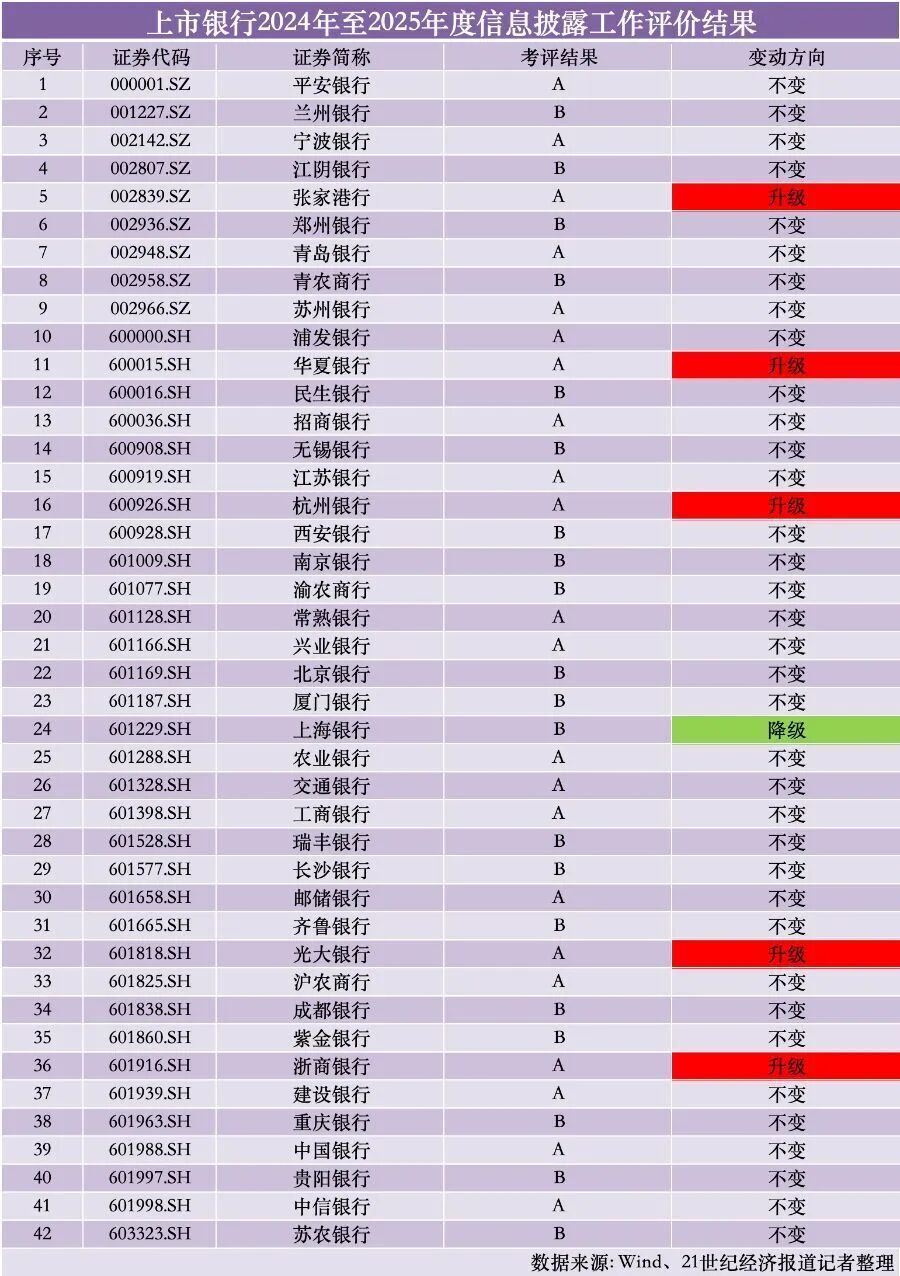
Core Viewpoint - The quality of information disclosure is a crucial indicator of the quality of listed companies and serves as an important basis for investors' decision-making. The Shanghai and Shenzhen Stock Exchanges have emphasized the importance of this quality and have set higher requirements for listed companies in their recent evaluation guidelines [1][3]. Summary by Sections Information Disclosure Evaluation - In 2024-2025, 42 A-share listed banks received ratings of B or above for their information disclosure, with 22 banks rated A. The ratings remained consistent with the previous year for most banks, with only six experiencing changes [1][2][6]. Evaluation Criteria - The evaluation of information disclosure quality includes eight main aspects: compliance, effectiveness, investor relations management, return to investors, social responsibility disclosure, penalties and regulatory measures, support for exchange operations, and other factors recognized by the exchange [3][5]. Impact on Financing and Mergers - The evaluation results are considered in the review of refinancing and mergers and acquisitions. Companies rated A will receive various supports, such as exemptions from post-review for certain disclosures and prioritized training opportunities [6][7]. Bank Responses and Commitments - Several banks, including Hangzhou Bank and Citic Bank, have publicly committed to enhancing their information disclosure quality following their A ratings. They emphasize transparency, effective communication, and adherence to regulations as key components of their strategies [9][10][11].




上市银行信披考评出炉:光大、华夏、浙商提级,上海银行降级
2 1 Shi Ji Jing Ji Bao Dao· 2025-11-03 10:57
Core Viewpoint - The quality of information disclosure is a crucial indicator of the quality of listed companies and serves as an important basis for investors' decision-making. The Shanghai and Shenzhen Stock Exchanges have emphasized the importance of information disclosure quality and have implemented comprehensive evaluations of listed companies' disclosure practices [1][3]. Group 1: Regulatory Framework - In March, the Shanghai and Shenzhen Stock Exchanges released guidelines focusing on enhancing information disclosure regulation, punishing financial fraud, strengthening cash dividend supervision, and promoting the enhancement of investment value for listed companies [1][3]. - The evaluation criteria for information disclosure quality include eight aspects: normative disclosure, effective disclosure, investor relations management, return to investors, social responsibility disclosure, penalties and regulatory measures, support for exchange work, and other factors recognized by the exchange [3][5]. Group 2: Evaluation Results - Among the 42 A-share listed banks, all received ratings of B or above, with 22 banks rated A. Most banks maintained their ratings from the previous year, with only six experiencing changes [3][6]. - The banks rated A include major state-owned banks such as Industrial and Commercial Bank of China, Agricultural Bank of China, and China Bank, as well as several joint-stock and city commercial banks [6][7]. Group 3: Impact on Capital Activities - The evaluation results of information disclosure will influence the review of refinancing and mergers and acquisitions for listed banks, establishing a strong market incentive and constraint mechanism [5][8]. - Both the Shanghai and Shenzhen Stock Exchanges provide various supports and conveniences for companies rated A, such as exemptions from post-review for temporary reports and reduced inquiry rounds for restructuring audits [8][9]. Group 4: Commitment to Improvement - Several banks, including Hangzhou Bank and China CITIC Bank, have publicly committed to further enhancing their information disclosure quality following their A ratings, emphasizing transparency, effective communication, and governance [10][11]. - China CITIC Bank has highlighted its commitment to investor rights protection, having distributed over RMB 170 billion in cash dividends and planning to increase its mid-term dividend payout ratio [11].


“社保”+“金融”服务大湾区居民,中信银行广州分行落地“湾区社保服务通”
Zhong Guo Jin Rong Xin Xi Wang· 2025-11-03 10:28
Core Viewpoint - The collaboration between CITIC Bank Guangzhou Branch and the Guangzhou Social Insurance Fund Management Center aims to enhance social insurance services for Hong Kong residents in the Guangdong-Hong Kong-Macao Greater Bay Area through the "Bay Area Social Insurance Service Pass" initiative [1][2]. Group 1: Partnership and Collaboration - CITIC Bank Guangzhou Branch signed a cooperation agreement with the Guangzhou Social Insurance Fund Management Center and CITIC Bank (International) to implement the "Bay Area Social Insurance Service Pass" [1]. - This initiative follows the successful launch of the project in Foshan last year, indicating a strategic expansion of services within the Greater Bay Area [1]. Group 2: Service Enhancement - The "Bay Area Social Insurance Service Pass" utilizes technology to optimize processes, providing Hong Kong residents with convenient and high-quality social insurance services, allowing them to handle matters without leaving their location [1]. - The collaboration aims to deepen connectivity among residents in the Greater Bay Area, promoting a model of "social insurance + finance" [1]. Group 3: Future Development - CITIC Bank Guangzhou Branch plans to lead the implementation of this initiative and strengthen cooperation with provincial and municipal social insurance departments to promote high-quality development in social insurance services [2].
中信银行(00998) - 中信银行股份有限公司关於召开2025年第三季度业绩说明会的公告
2025-11-03 09:14
中信銀行股份有限公司 China CITIC Bank Corporation Limited (在中華人民共和國註冊成立的股份有限公司) (股份代號:998) 香港交易及結算所有限公司及香港聯合交易所有限公司對本公告的內容概不負責,對其準確 性或完整性亦不發表任何聲明,並明確表示,概不就因本公告全部或任何部份內容而產 生或 因依賴該等內容而引致的任何損失承擔任何責任。 於其他市場發佈的公告 本公告乃根據香港聯合交易所有限公司證券上市規則第 13.10B 條刊登。 茲載列該公告(於上海證券交易所網站刊登)如下,僅供參閱。 承董事會命 中信銀行股份有限公司 方合英 董事長 中國•北京 2025年11月3日 於本公告日期,本行執行董事為方合英先生(董事長)、蘆葦先生(行長)及胡罡先生;非執 行董事為王彥康先生及付亞民先生;及獨立非執行董事為廖子彬先生、周伯文先生、王化成先 生及宋芳秀女士。 本行董事会及全体董事保证本公告内容不存在任何虚假记载、误导性陈述或者重 大遗漏,并对其内容的真实性、准确性和完整性承担法律责任。 重要内容提示: 中信银行股份有限公司(以下简称本行)已于2025年10月31日在上海证券交易所 ...
中信银行(00998) - 截至二零二五年十月三十一日止月份之股份发行人的证券变动月报表
2025-11-03 09:11
FF301 股份發行人及根據《上市規則》第十九B章上市的香港預託證券發行人的證券變動月報表 截至月份: 2025年10月31日 狀態: 新提交 | 2. 股份分類 | 普通股 | 股份類別 | A | | 於香港聯交所上市 (註1) | | 否 | | | --- | --- | --- | --- | --- | --- | --- | --- | --- | | 證券代號 (如上市) | 601998 | 說明 | A股 | | | | | | | | | 法定/註冊股份數目 | | | 面值 | | 法定/註冊股本 | | | 上月底結存 | | | 40,762,999,287 | RMB | | 1 RMB | | 40,762,999,287 | | 增加 / 減少 (-) | | | 0 | | | RMB | | 0 | | 本月底結存 | | | 40,762,999,287 | RMB | | 1 RMB | | 40,762,999,287 | | 3. 股份分類 | 優先股 | 股份類別 | 其他類別 (請註明) | 於香港聯交所上市 (註1) | 否 | | --- | --- | ...
中信银行(601998) - 中信银行股份有限公司关于召开2025年第三季度业绩说明会的公告
2025-11-03 09:00
证券代码:601998 证券简称:中信银行 公告编号:临2025-077 中信银行股份有限公司 关于召开 2025 年第三季度业绩说明会的公告 本行董事会及全体董事保证本公告内容不存在任何虚假记载、误导性陈述或者重 大遗漏,并对其内容的真实性、准确性和完整性承担法律责任。 重要内容提示: 中信银行股份有限公司(以下简称本行)已于2025年10月31日在上海证券交易所 网站(www.sse.com.cn)和本行网站(www.citicbank.com)披露本行2025年第三季度 报告,为便于广大投资者更全面深入了解本行2025年第三季度业绩和经营情况,本行 拟于2025年11月11日(星期二)下午15:00-16:00召开业绩说明会,就投资者普遍关注 的问题进行交流。 一、会议类型 本次会议通过网络互动方式召开,本行将针对2025年第三季度业绩及经营情况等 与投资者进行交流,并对投资者普遍关注的问题进行回答。 二、会议召开的时间、方式 召开时间:2025年11月11日(星期二)下午15:00-16:00 1 会议召开时间:2025年11月11日(星期二)下午15:00-16:00。 会议召开方式:本次会议通过网 ...
中信银行(601998) - H股公告-截至二零二五年十月三十一日止月份之股份发行人的证券变动月报表
2025-11-03 09:00
FF301 股份發行人及根據《上市規則》第十九B章上市的香港預託證券發行人的證券變動月報表 截至月份: 2025年10月31日 狀態: 新提交 致:香港交易及結算所有限公司 公司名稱: 中信銀行股份有限公司(「本行」) 呈交日期: 2025年11月3日 I. 法定/註冊股本變動 | 1. 股份分類 | 普通股 | 股份類別 | H | | | 於香港聯交所上市 (註1) | 是 | | | | --- | --- | --- | --- | --- | --- | --- | --- | --- | --- | | 證券代號 (如上市) | 00998 | 說明 | H股 | | | | | | | | | | 法定/註冊股份數目 | | | 面值 | | | 法定/註冊股本 | | | 上月底結存 | | | 14,882,162,977 | RMB | | 1 | RMB | | 14,882,162,977 | | 增加 / 減少 (-) | | | 0 | | | | RMB | | 0 | | 本月底結存 | | | 14,882,162,977 | RMB | | 1 RMB | | | 14,8 ...
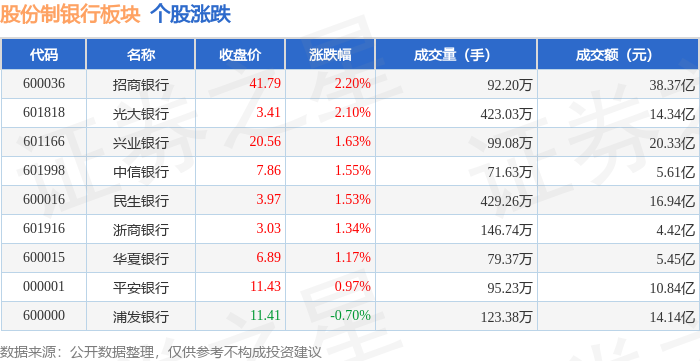
股份制银行板块11月3日涨1.41%,招商银行领涨,主力资金净流入6.63亿元
Zheng Xing Xing Ye Ri Bao· 2025-11-03 08:43
Group 1 - The banking sector saw an increase of 1.41% on November 3, with China Merchants Bank leading the gains [1] - The Shanghai Composite Index closed at 3976.52, up 0.55%, while the Shenzhen Component Index closed at 13404.06, up 0.19% [1] - Major banks such as China Merchants Bank and Everbright Bank reported significant price increases of 2.20% and 2.10% respectively [1] Group 2 - The banking sector experienced a net inflow of 663 million yuan from institutional investors, while retail investors saw a net outflow of 222 million yuan [1] - China Merchants Bank had a net inflow of 2.41 billion yuan from institutional investors, indicating strong institutional interest [1] - Everbright Bank and Minsheng Bank also attracted significant institutional inflows of 1.47 billion yuan and 1.10 billion yuan respectively [1]