
HAI TIAN(603288)

Search documents
2026年第3周:食品饮料行业周度市场观察
艾瑞咨询· 2026-01-22 00:07
Industry Environment - The emergence of diverse business formats such as fresh food restaurants, smart products, and health management is noted, with the pet economy driving demand for quality and refined consumption [3][4] - The Chinese baking market has expanded to 365,000 stores, with a focus on health-conscious options and social experiences, while pet baking is growing rapidly with a year-on-year growth rate of 51.43% [5] - A report by Hema outlines five consumer trends for 2025, including the rise of night economy, increased demand for health products, and the popularity of new Chinese-style products among young consumers [6] - The ready-to-drink coffee market is being reshaped by local brands like Dongpeng and Nongfu Spring, with a sales growth of 50.49% and a shift towards affordable pricing and innovative flavors [7] Key Brand Dynamics - The acquisition of yogurt brand Suan Nai Guan by Mo Yogurt reflects a trend of consolidation in the ready-to-drink tea and coffee industry, as brands adapt to a competitive landscape [25] - Yili is engaging in significant capital operations, including repaying 36 billion yuan in short-term debt and establishing five investment subsidiaries, amidst a challenging dairy market [26][27] - Huabin Group is revitalizing its "War Horse" brand to compete with Dongpeng, launching new sugar-free products to align with health trends [28] - The retail market in Shanghai is witnessing a shift from traditional hypermarkets to new hybrid formats that integrate supermarkets, markets, and restaurants, emphasizing supply chain integration [29] Emerging Trends - The market for sugar-free beverages is expected to double in the next five years, driven by rising health awareness, with a projected market size of 22.74 billion yuan by 2025 [21] - The new trend of "lazy health" is emerging, with new Chinese health drinks gaining popularity, indicating a shift towards convenient health solutions [11][12] - The rise of community bakeries is characterized by precise targeting and emotional connections with customers, enhancing loyalty and operational efficiency [10]







超200股已跌破“924”!千亿市值权重占一成,这些板块临近行情起点
Xin Lang Cai Jing· 2026-01-21 09:28
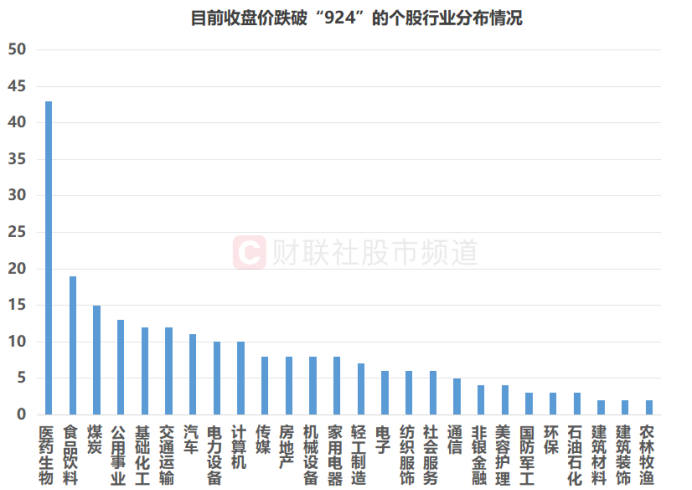
Core Viewpoint - The A-share market has shown overall stability, but nearly 230 stocks have seen their closing prices fall below the level recorded on September 24, 2024, accounting for approximately 4.3% of the total market [1]. Industry Analysis - The pharmaceutical sector has the highest number of stocks below the September 24 closing price, making up 18.7% of the total. Other sectors with significant representation include food and beverage, coal, public utilities, basic chemicals, and transportation, each exceeding 10% [2]. - Among the sub-sectors, stocks in the liquor, traditional Chinese medicine, thermal coal, coking coal, and residential development categories are the most affected, with a notable presence of chemical preparations, in vitro diagnostics, and medical consumables [2]. Market Capitalization Insights - The average total market capitalization of the over 200 stocks currently below the September 24 closing price is approximately 43.6 billion, with a median market capitalization of 10.8 billion. Stocks with a market capitalization below 5 billion account for nearly 30%, while those above 100 billion represent close to 10% [5]. - Notably, China Mobile, the only stock with a market capitalization exceeding 1 trillion, has seen a decline of about 3.7% from its September 24 closing price, currently fluctuating around 96 yuan [5]. Performance of Major Stocks - Key large-cap stocks that have fallen below the September 24 closing price include China Petroleum, Yangtze Power, China Telecom, Wuliangye, and others. Six stocks, including Pizaihuang and Daqin Railway, have experienced declines exceeding 10% [7]. - The performance of the dividend index has lagged behind the broader market, with a cumulative increase of only 5.9% since September 24, while other indices have shown more substantial gains [8]. Index Performance Overview - As of January 21, all 31 first-level industry indices are above their September 24 levels, with an average increase of approximately 58.12% and a median increase of 53.42%. The communication, non-ferrous metals, electronics, and comprehensive sectors have seen increases exceeding 130% [10]. - Conversely, sectors such as coal, food and beverage, public utilities, banking, and transportation have shown relatively lower growth, with the coal sector only increasing by 0.6% [10].






调味发酵品板块1月21日跌0.92%,安记食品领跌,主力资金净流出4777.85万元
Zheng Xing Xing Ye Ri Bao· 2026-01-21 08:53
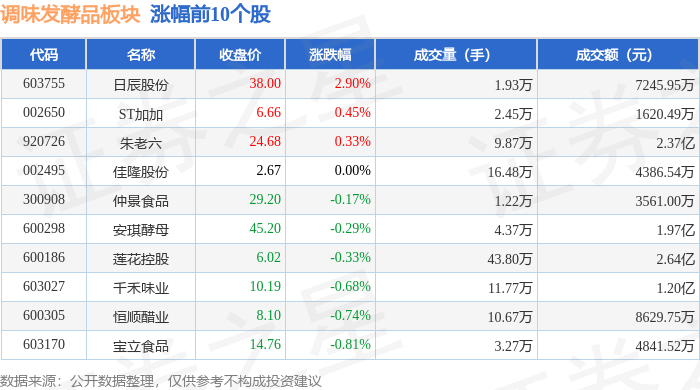
Group 1 - The seasoning and fermentation sector experienced a decline of 0.92% on January 21, with Anji Food leading the drop [1] - The Shanghai Composite Index closed at 4116.94, up 0.08%, while the Shenzhen Component Index closed at 14255.12, up 0.7% [1] - Key stocks in the seasoning and fermentation sector showed varied performance, with Dayin Co. rising by 2.90% to a closing price of 38.00, while Anji Food fell by 2.84% to 20.89 [1][2] Group 2 - The net outflow of main funds in the seasoning and fermentation sector was 47.78 million yuan, while retail funds saw a net outflow of 21.44 million yuan [2] - The sector's overall fund flow indicates a mixed sentiment, with speculative funds showing a net inflow of 69.22 million yuan [2] - Individual stock fund flows revealed that Jieling Pickles had a main fund net outflow of 10.21 million yuan, while Hai Tian Food saw a net inflow of 6.37 million yuan [3]


调味发酵品板块1月20日涨0.11%,天味食品领涨,主力资金净流出4702.35万元
Zheng Xing Xing Ye Ri Bao· 2026-01-20 08:51
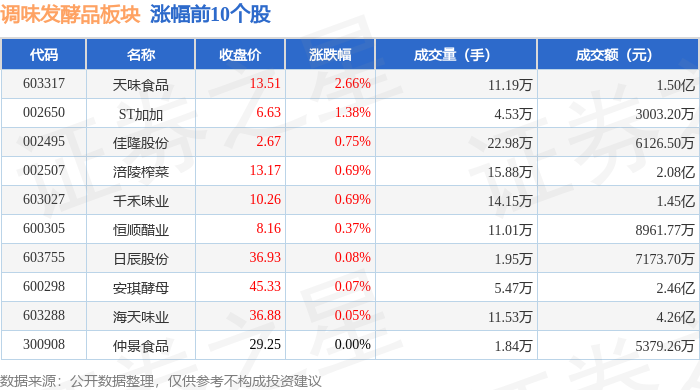
Group 1 - The seasoning and fermentation sector saw a slight increase of 0.11% on January 20, with Tianwei Food leading the gains [1] - The Shanghai Composite Index closed at 4113.65, down 0.01%, while the Shenzhen Component Index closed at 14155.63, down 0.97% [1] - Key stocks in the seasoning and fermentation sector showed varied performance, with Tianwei Food closing at 13.51, up 2.66%, and other notable stocks like ST Jiajia and Jialong Co. also experiencing gains [1] Group 2 - The sector experienced a net outflow of 47.02 million yuan from institutional investors, while retail investors saw a net inflow of 41.85 million yuan [2] - The individual stock performance indicated that Hai Tian Wei Ye had a significant net outflow of 35.27 million yuan from institutional investors, while retail investors contributed a net inflow of 30.45 million yuan [3] - Other stocks like Jialong Co. and ST Jiajia had mixed net inflows and outflows from different investor categories, reflecting varied investor sentiment within the sector [3]


食品ETF鹏华(560130)红盘向上,政策加快培育消费新的增长点
Xin Lang Cai Jing· 2026-01-20 03:29
Group 1 - The National Development and Reform Commission emphasizes the need to enhance the synergy between reform and consumption investment policies, focusing on easing access and optimizing regulation in the consumption sector [1] - Wanlian Securities notes that the dairy product costs are stabilizing and demand is recovering, with low-temperature and deep-processed dairy products experiencing healthy growth [1] - The condiment industry is seeing customized development driven by chain restaurants and strong terminal growth, while raw material costs are stabilizing at low absolute price levels, supporting profit release [1] - The frozen food sector is witnessing a slowdown in price wars, leading to profit recovery and a return to positive growth [1] - The beverage sector is experiencing "structural upgrades" that contribute to incremental growth, particularly in the functional beverage segment, which is considered a high-growth area [1] - The snack industry is facing "increased revenue without increased profit," with platform-type and health-focused single-product companies being worthy of attention [1] - By 2026, leading volume retailers are expected to continue improving profitability, while the profitability of snack companies will need to be monitored based on raw material costs, efficiency optimization, sustainability of major products, and category expansion capabilities [1] Group 2 - As of January 20, 2026, the CSI All Food Index (H30192) has increased by 0.07%, with notable stock performances including Hongmian Co. up 10.13% and Bailong Chuangyuan up 5.46% [2] - The Penghua Food ETF (560130) has risen by 0.20%, currently priced at 1.01 yuan, closely tracking the CSI All Food Index [2] - The CSI All Food Index is structured to reflect the overall performance of different industry companies within its sample, categorized into 11 primary industries, 35 secondary industries, over 90 tertiary industries, and more than 200 quaternary industries [2] - As of December 31, 2025, the top ten weighted stocks in the CSI All Food Index include Haitian Flavoring, Yili, Shuanghui Development, and Angel Yeast, collectively accounting for 49.88% of the index [2]




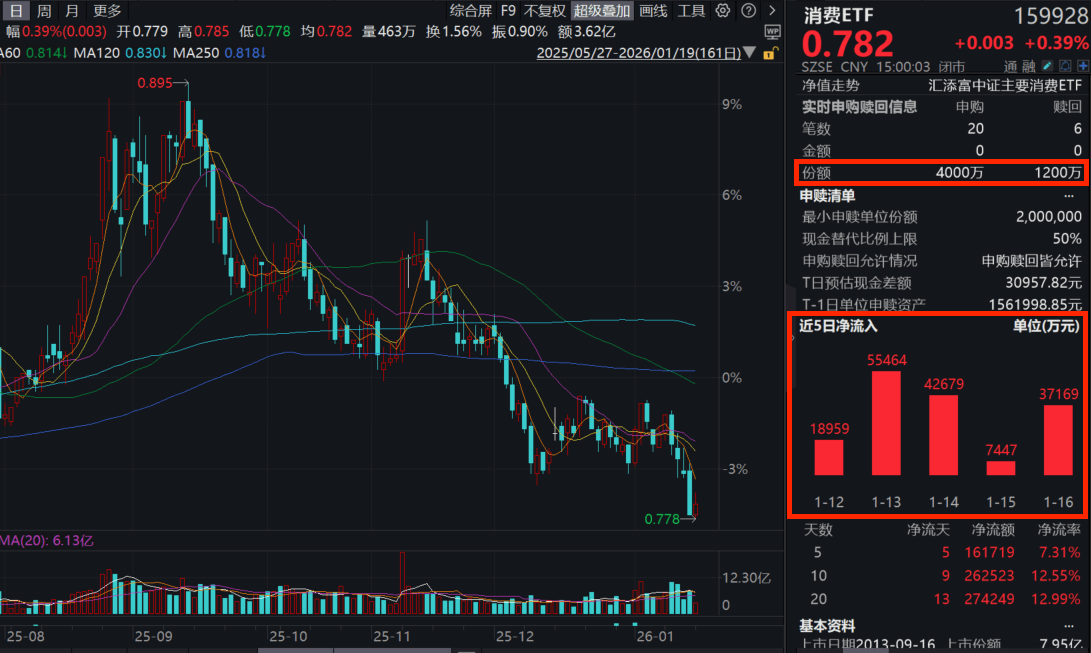
2025年社零同比增长3.7%!消费ETF(159928)收涨0.39%结束四连阴,近5日净流入超16亿元!政策加码下消费动能将持续释放!
Sou Hu Cai Jing· 2026-01-19 09:33
Group 1: Market Performance - A-shares experienced a slight increase with the consumer sector performing well, as evidenced by the leading consumer ETF (159928) rising by 0.39% and achieving a trading volume exceeding 360 million yuan [1] - The consumer ETF has seen a net subscription of 28 million units today, accumulating over 1.6 billion yuan in the past five days [1] Group 2: Economic Data - The National Bureau of Statistics reported that China's GDP for the year reached 14,018.79 billion yuan, reflecting a 5% growth year-on-year at constant prices [3] - In December 2025, the retail sales of consumer goods grew by 0.9% year-on-year, a decrease of 0.4 percentage points compared to November [3] - The per capita disposable income for residents in 2025 was 43,377 yuan, marking a nominal increase of 5% year-on-year, with a real growth of 5% after adjusting for price factors [3] Group 3: Consumer Trends and Policies - The focus on enhancing service consumption is evident, with a CAGR of approximately 9.6% in per capita service consumption from 2020 to 2024, expected to reach 46.1% of total consumption by 2024 [7] - The government aims to boost domestic demand and has outlined key tasks for 2026, emphasizing the importance of "domestic demand as the main driver" [3][7] - Policies are expected to support sectors such as elderly care, cultural tourism, and sports, with a focus on new consumption scenarios and enhancing service quality [4][8] Group 4: Investment Opportunities - The consumer ETF (159928) is noted for its resilience across economic cycles, with a TTM price-to-earnings ratio of 18.91, which is lower than 99% of the historical data over the past decade [4][9] - The top ten holdings in the consumer ETF account for over 68.55% of its weight, with significant representation from leading liquor brands and agricultural companies [9][10] - The Hong Kong Stock Connect Consumer 50 ETF (159268) is highlighted as an efficient investment vehicle for the consumer sector, particularly appealing to the younger generation [10]



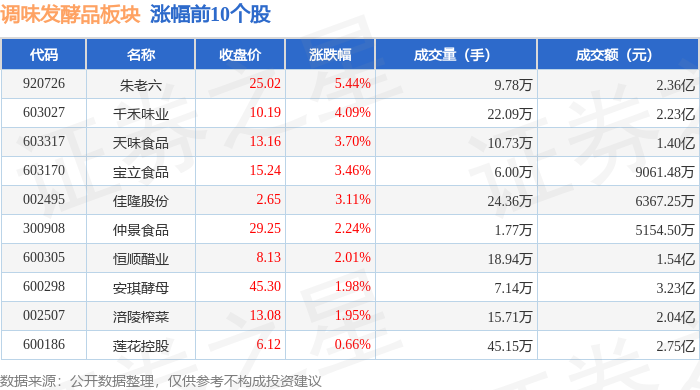
调味发酵品板块1月19日涨0.41%,朱老六领涨,主力资金净流出6624.48万元
Zheng Xing Xing Ye Ri Bao· 2026-01-19 08:52
Market Overview - The seasoning and fermentation sector increased by 0.41% on January 19, with Zhu Laoliu leading the gains [1] - The Shanghai Composite Index closed at 4114.0, up 0.29%, while the Shenzhen Component Index closed at 14294.05, up 0.09% [1] Stock Performance - Zhu Laoliu (code: 920726) closed at 25.02, up 5.44% with a trading volume of 97,800 shares and a transaction value of 236 million [1] - Qianhe Flavor (code: 603027) closed at 10.19, up 4.09% with a trading volume of 220,900 shares and a transaction value of 223 million [1] - Tianwei Food (code: 603317) closed at 13.16, up 3.70% with a trading volume of 107,300 shares and a transaction value of 140 million [1] - Other notable stocks include Baoli Food (code: 603170) up 3.46%, Jialong Co. (code: 002495) up 3.11%, and Zhongjing Food (code: 300908) up 2.24% [1] Capital Flow - The seasoning and fermentation sector experienced a net outflow of 66.24 million from institutional investors, while retail investors saw a net inflow of 21.38 million [2] - The sector's overall capital flow indicates a mixed sentiment among different investor types [2] Individual Stock Capital Flow - Zhu Laoliu had a net outflow of 23.53 million from institutional investors, with a retail net inflow of 1.83 million [3] - Hai Tian Flavor (code: 603288) saw a net inflow of 16.67 million from institutional investors but a net outflow of 24.60 million from retail investors [3] - Hengshun Vinegar (code: 600305) had a net inflow of 12.32 million from institutional investors, while retail investors experienced a net outflow of 13.99 million [3]
食品饮料月月谈-如何展望春节旺季备货
2026-01-19 02:29
Summary of Key Points from Conference Call Records Industry Overview - **Industry**: Baijiu (Chinese liquor) and Soft Drinks - **Key Insights**: The Baijiu industry is nearing a bottom in terms of valuation, expectations, and holdings, with a potential turning point expected in Q3 2026. The soft drink market is showing strong performance from leading companies, with expectations for revenue growth above the industry average in 2026 [1][9]. Baijiu Industry Insights - **Market Dynamics**: The overall sentiment for Baijiu sales during the Spring Festival is cautious, with expectations of a year-on-year decline potentially reaching double digits. However, Moutai's significant price reduction may stimulate sales during low-frequency consumption scenarios [2][8]. - **Company Strategies**: - **Moutai**: Plans to stabilize overall product supply while adjusting the product mix to increase the availability of premium Moutai and 500ml Flying Moutai. This strategic shift is expected to have a profound impact on pricing and growth logic [4]. - **Luzhou Laojiao**: Focuses on maintaining stable apparent prices and ensuring stability in pricing, channels, and organizational structure to provide growth momentum during the recovery phase [5]. - **Investment Recommendations**: Companies such as Moutai, Fenjiu, and local brands like Gujing Gongjiu are recommended for their market share logic, while Wuliangye and Luzhou Laojiao are noted for their dividend security [1][8]. Soft Drink Market Insights - **Market Performance**: Leading companies in the soft drink sector are expected to maintain revenue growth above the industry average in 2026. Notable performers include Nongfu Spring and Dongpeng Special Drink, while Master Kong and Uni-President are seen as stable defensive investments [9][10]. - **Current Trends**: The market is experiencing significant competition, but leading companies are expected to leverage their channel and product advantages to maintain robust performance [9]. Tea Beverage Market - **Key Players**: Companies like Guming and Shanghai Auntie are rapidly expanding, with Guming planning to promote breakfast scenarios and Shanghai Auntie introducing coffee and health products. Both companies express confidence in same-store sales for 2026 [11]. Dairy Industry Insights - **Market Condition**: The dairy sector is currently experiencing weak demand but is expected to see a recovery in 2026. Companies like Yili, Mengniu, and New Dairy are recommended due to their stable fundamentals and growth potential [3][12][13]. Frozen Food Industry Insights - **Market Outlook**: The frozen food sector is showing positive prospects for 2026, with strong winter stocking and improved confidence among distributors. Companies like Anjijia, Qianwei Yangchun, and Sanquan Foods are optimistic about their outlook [14][15]. Seasonality and Consumer Behavior - **Consumer Trends**: The upcoming Spring Festival is expected to influence consumer behavior significantly, with increased stocking efforts noted across various sectors, including snacks and frozen foods. Companies are adjusting their strategies to meet this seasonal demand [17][18]. Recommendations for Investment - **Baijiu**: Focus on companies with strong market share logic and dividend security, such as Moutai and Luzhou Laojiao [8]. - **Soft Drinks**: Invest in leading brands like Nongfu Spring and Dongpeng, which are expected to outperform the market [9][10]. - **Dairy and Frozen Foods**: Look for opportunities in Yili, Mengniu, and Anjijia, which are positioned for growth in the recovering market [12][14]. Conclusion - The Baijiu industry is at a critical juncture, with potential for recovery in 2026, while the soft drink and dairy sectors are showing resilience and growth potential. Investors are advised to focus on companies with strong fundamentals and strategic positioning to capitalize on upcoming market opportunities [6][9][12].



【转|太平洋食饮-26年度策略】底部向阳,寻找结构性亮点
远峰电子· 2026-01-18 11:38
Overall Sector Review - The food and beverage sector significantly underperformed the market, with a year-to-date decline of -0.62%, lagging behind the Shanghai Composite Index by 15.0 percentage points [2] - The sector experienced a deep correction after an initial rebound driven by expectations of consumption recovery and supportive policies, but the actual recovery rate was lower than anticipated, leading to a consensus on weak domestic demand [2] Subsector Performance - The snack sector outperformed with a year-to-date increase of 28.88%, driven by channel expansion and a revenue growth rate of 30.97% in the first three quarters [4] - Soft drinks also showed resilience with a 10.11% stock price increase, benefiting from strong travel demand and low-cost, high-frequency consumption [4] - The restaurant chain sector saw a rebound with gains of approximately 10.34% and 10.29% for pre-processed and baked goods, respectively [4] - The liquor sector, particularly high-end liquor, faced challenges with weaker sales and declining prices, while beer performance was supported but affected by high-end market constraints [4] Investment Insights - The sector is under pressure from deflationary trends and a weak recovery, with consumer confidence remaining low, indicating a shift to a "new normal" of low growth [8] - High-end consumption has shown slight recovery due to stock market wealth effects, but sustainability remains a concern [9] - The food and beverage sector's valuation is at historical lows, with a current PE (TTM) of 21.9X, indicating potential investment opportunities in undervalued segments [12] Fund Holdings - As of Q3 2025, the food and beverage sector's fund holdings decreased to 6.38%, nearing levels seen in 2016, with the liquor segment comprising 5.52% of this [14] - Fund holdings in the liquor sector increased for certain subsectors, including white liquor and seasoning products, while others saw declines [16] Long-term Trends - The liquor industry is undergoing its longest adjustment period since 2003, with significant price corrections and a potential bottoming out of valuations [21] - The white liquor sector has underperformed the market with a year-to-date return of -4.87%, reflecting weak demand and a divergence from broader market trends [24] - The third quarter of 2025 saw a significant decline in revenue and net profit for the white liquor sector, indicating a deep adjustment phase [27] Pricing Dynamics - The white liquor market is experiencing a general decline in prices, particularly in high-end segments, while lower price segments show resilience [29] - The average price of high-end products like Moutai has dropped significantly, while mid-range and lower-range products have maintained stability or slight increases [31] Investment Recommendations - The white liquor sector is advised to focus on inventory reduction and demand recovery, with a preference for leading brands that can maintain pricing power and product stability [32]


“老醯”新变记
Xin Lang Cai Jing· 2026-01-18 04:04
Core Insights - The article emphasizes the transformation and upgrading of the Shanxi aged vinegar industry, particularly focusing on the "Qingxu Aged Vinegar" as a representative of regional characteristics and modernization efforts [1][2]. Industry Overview - The Shanxi aged vinegar industry is experiencing significant growth, with a projected production of 880,000 tons by 2025, accounting for 20% of national output and over 80% of provincial output, generating a value of 7.5 billion yuan [2]. - The industry is characterized by a high concentration of brands, with "Qingxu Aged Vinegar" synonymous with "Shanxi Aged Vinegar," reinforcing its reputation as "China's Vinegar Capital" [1]. Technological Advancements - The production process has evolved from manual to mechanized operations, significantly increasing efficiency, with one machine equating to the labor of 30 workers [3]. - Innovations include the development of an intelligent brewing system and a microbial strain library to enhance fermentation processes and product quality [3]. Environmental Sustainability - Companies are adopting green production methods, such as using natural gas and solar energy for steam systems, achieving a 99% utilization rate of steam networks [4]. - Full-process pipeline transportation ensures no grain is wasted, contributing to sustainability [4]. Market Expansion and Diversification - Companies are diversifying their product lines beyond traditional vinegar, entering health food and seasoning markets, with products like functional vinegars targeting health benefits [7]. - The industry is also expanding into e-commerce, with significant sales growth through online platforms, exemplified by a company achieving nearly 1 billion yuan in sales within a year [10]. Consumer Engagement and Branding - Innovative marketing strategies are being employed, such as creating unique products like vinegar ice cream and collaborating with travel agencies to enhance brand visibility [6]. - The focus is shifting from merely selling vinegar to creating experiences and expanding the brand's influence in new markets [6][9]. Government Support - Local government initiatives are providing financial support and infrastructure development to bolster the vinegar industry, including the establishment of a provincial-level key professional town for aged vinegar [10].