
Shanghai Yashi(603329)

Search documents
上海雅仕:关于参加2025年上海辖区上市公司集体接待日暨中报业绩说明会活动的公告
Zheng Quan Ri Bao Zhi Sheng· 2025-09-08 09:07
Core Viewpoint - Shanghai Yashi announced participation in the 2025 Shanghai Stock Exchange collective reception day and mid-term performance briefing, scheduled for September 19, 2025, from 15:00 to 17:00 via online remote format [1] Group 1 - The event will focus on the company's mid-term performance and provide an opportunity for investors to engage with the management [1]

上海雅仕(603329) - 2025年第二次临时股东会会议资料
2025-09-08 08:30
上海雅仕投资发展股份有限公司 SHANGHAI ACE INVESTMENT&DEVELOPMENT CO., LTD. (中国(上海)自由贸易试验区浦东南路 855 号 33H 室) (证券代码:603329 证券简称:上海雅仕) 2025 年第二次临时股东会 会 议 资 料 上海雅仕投资发展股份有限公司 2025 年第二次临时股东会会议资料 目 录 | 2025 | 年第二次临时股东会会议须知 2 | | --- | --- | | 2025 | 年第二次临时股东会会议议程 4 | | | 议案一:关于变更注册资本、取消监事会并修订《公司章程》的议案 6 | | | 议案二:关于修订部分公司管理制度的议案 22 | 1 上海雅仕投资发展股份有限公司 2025 年第二次临时股东会会议资料 2025 年第二次临时股东会会议须知 根据《公司法》《证券法》《上市公司股东会规则》以及上海雅仕投资发展股 份有限公司(以下简称"公司""上海雅仕")《公司章程》《股东会议事规则》相 关规定,为维护投资者的合法权益,确保股东会议的正常秩序和议事效率,特制 定会议须知如下,请出席股东会的全体人员共同遵守: 3、出席本次会议的 ...
上海雅仕(603329) - 关于参加2025年上海辖区上市公司集体接待日暨中报业绩说明会活动的公告
2025-09-08 08:00
(问题征集专题页面二维码) 证券代码:603329 证券简称:上海雅仕 公告编号:2025-059 上海雅仕投资发展股份有限公司 关于参加 2025 年上海辖区上市公司集体接待日 暨中报业绩说明会活动的公告 本公司董事会及全体董事保证本公告内容不存在任何虚假记载、误导性陈述 或者重大遗漏,并对其内容的真实性、准确性和完整性承担法律责任。 为进一步加强与投资者的互动交流,上海雅仕投资发展股份有限公司(以下 简称"公司")将参加由中国证券监督管理委员会上海监管局指导、上海上市公司 协会及深圳市全景网络有限公司联合举办的"2025 年上海辖区上市公司集体接待 日暨中报业绩说明会活动",现将有关事项公告如下: 本次活动将采用网络远程的方式举行,投资者可登录"全景路演"网站 (http://rs.p5w.net);或关注微信公众号(名称:全景财经);或下载全景路演 APP, 参与本次互动交流。 活动时间为 2025 年 9 月 19 日(周五)15:00-17:00。届时公司董事长、独立 董事和部分高管将在线就公司 2025 半年度业绩、公司治理、发展战略、经营状况 等投资者关心的问题,与投资者进行沟通与交流,欢迎广大 ...
上海雅仕投资发展股份有限公司关于日常经营重大合同的进展公告
Zhong Guo Zheng Quan Bao - Zhong Zheng Wang· 2025-09-05 04:54
Group 1 - The company has approved a significant procurement and sales contract for bauxite with Alcoa World Alumina LLC and Shanxi Aokeda Chemical Co., Ltd, involving a total of 1,080,000 wet tons of bauxite to be executed in six batches [1][2] - As of the announcement date, the first five batches, approximately 900,000 wet tons of bauxite, have been delivered, and the sixth batch of about 180,000 wet tons has been procured and is at the port [2] - A supplementary agreement has been signed with Aokeda, allowing the company to sell the sixth batch of bauxite to a third party at the original contract price, with any price difference being borne by Aokeda [2][4] Group 2 - The company has entered into additional sales contracts for bauxite with other third-party customers [3] - The signing of the supplementary agreement is a result of mutual agreement and will not adversely affect the company's business, financial, or operational status [4] - The company will continue to monitor the progress of subsequent matters and fulfill its information disclosure obligations in accordance with relevant laws and regulations [4]
上海雅仕(603329) - 关于日常经营重大合同的进展公告
2025-09-04 08:15
一、日常经营重大合同基本情况 2024 年 2 月 6 日,上海雅仕投资发展股份有限公司(以下简称"公司")召 开第三届董事会第十八次会议,审议通过了《关于公司拟签订重大采购和销售合 同的议案》,同意公司与 Alcoa World Alumina LLC (AWA LLC)(美国铝业公司) (以下简称"美国铝业")和山西奥凯达化工有限公司(以下简称"奥凯达公司") 签订铝土矿采购和销售合同,采购和销售 1,080,000 湿吨铝土矿,分六批次执行; 2024 年 3 月 8 日,公司召开 2024 年第一次临时股东大会,审议通过了上述事项。 具体内容详见公司分别于 2024 年 2 月 7 日和 2024 年 3 月 9 日在上海证券交易所 网站(www.sse.com.cn)披露的《关于公司拟签订重大采购和销售合同的公告》 (公告编号:2024-011)和《2024 年第一次临时股东大会决议公告》(公告编号: 2024-019)。 证券代码:603329 证券简称:上海雅仕 公告编号:2025-058 上海雅仕投资发展股份有限公司 关于日常经营重大合同的进展公告 本公司董事会及全体董事保证本公告内容不存在任 ...
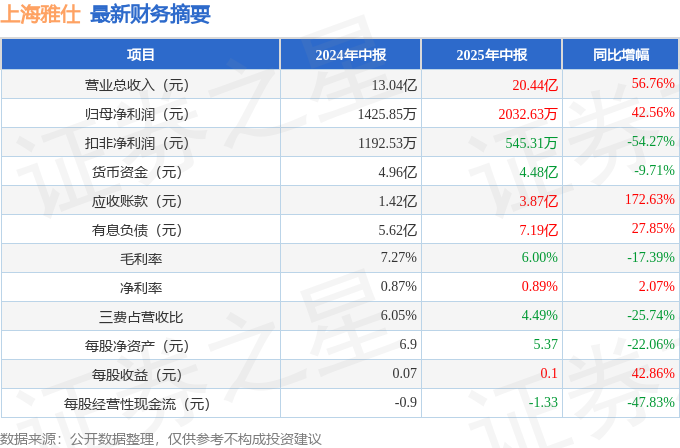
上海雅仕2025年中报简析:营收净利润同比双双增长,应收账款上升
Zheng Quan Zhi Xing· 2025-08-28 22:59
Core Viewpoint - Shanghai Yashi (603329) reported a significant increase in revenue and net profit for the first half of 2025, but also showed concerning trends in accounts receivable and profitability metrics [1][2]. Financial Performance - Total revenue reached 2.044 billion yuan, a year-on-year increase of 56.76% - Net profit attributable to shareholders was 20.3263 million yuan, up 42.56% year-on-year - In Q2 alone, total revenue was 1.243 billion yuan, increasing by 56.28% year-on-year, while net profit for Q2 was 10.5777 million yuan, a 5.61% increase year-on-year [1]. Profitability Metrics - Gross margin stood at 6.0%, a decrease of 17.39% year-on-year - Net margin was 0.89%, reflecting a year-on-year increase of 2.07% - Total selling, administrative, and financial expenses amounted to 91.8611 million yuan, accounting for 4.49% of revenue, a decrease of 25.74% year-on-year [1]. Cash Flow and Debt Situation - Operating cash flow per share was -1.33 yuan, a decline of 47.83% year-on-year - The company has a cash flow situation that raises concerns, with cash and cash equivalents to current liabilities at only 34.37% and a three-year average operating cash flow to current liabilities of -3.08% [2]. - The debt situation is also concerning, with interest-bearing debt ratio reaching 22.01% and a negative average operating cash flow over the past three years [2]. Accounts Receivable - Accounts receivable increased significantly, with a year-on-year growth rate of 172.63% - The ratio of accounts receivable to profit reached 910.62%, indicating potential liquidity issues [3].

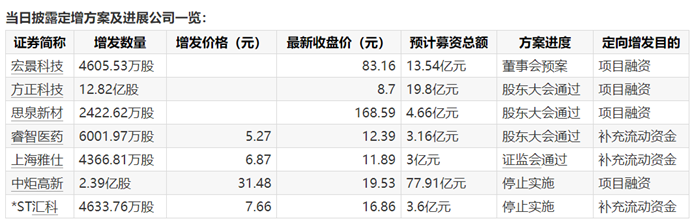
今日7家A股公司披露定增进展,年内已有91家A股完成定增
Huan Qiu Wang· 2025-08-28 02:06
Group 1 - A total of 7 A-share companies announced related to private placement on August 28, with 1 company disclosing a private placement plan, 3 plans approved by the shareholders' meeting, 1 plan approved by the CSRC, and 2 plans halted [1] - The highest proposed fundraising amount is from Hongjing Technology, aiming to raise no more than 1.354 billion yuan [2] - This year, 91 companies have announced completed private placement plans, with 40 companies raising over 1 billion yuan [3] Group 2 - The companies with the highest fundraising amounts include Bank of China, Postal Savings Bank, and Bank of Communications, raising 165 billion yuan, 130 billion yuan, and 120 billion yuan respectively [3] - Specific details of the private placements include the number of shares to be issued and the intended use of funds, such as project financing and supplementing working capital [2]



上海雅仕: 总经理工作细则(2025年8月修订)
Zheng Quan Zhi Xing· 2025-08-27 16:18
General Provisions - The guidelines for the General Manager's work are established to regulate the management and operational responsibilities of the General Manager, enhance leadership functions, and improve organizational efficiency [1][2] - The General Manager is appointed by the Board of Directors and is responsible for the daily operations and management of the company, implementing board resolutions, and reporting to the board [1][2] Responsibilities of the General Manager - The General Manager has the authority to manage production and operations, implement annual business plans, and propose internal management structures [2][3] - The General Manager is responsible for drafting basic management systems, specific regulations, and proposing the hiring or dismissal of senior management [2][3] - The General Manager can make decisions on investments, asset disposals, and major borrowing within specified limits, such as a single transaction not exceeding 10% of the latest audited net assets [2][3] General Manager's Office Meeting System - The General Manager's office meeting is a key decision-making format for the company's management, where significant operational matters are discussed [3][4] - Meetings are attended by the General Manager, Deputy General Managers, financial heads, and department heads, with the Secretary of the Board allowed to attend [3][4] - The meetings are held at least once a month, with the agenda proposed by relevant senior management and documented by a designated recorder [4][5] Reporting System - The General Manager is required to report to the Board of Directors on matters such as external investments, major contracts, financial execution, and profit and loss situations [6][7] - Reports must be timely and truthful, ensuring compliance with the company's regulations and guidelines [7] Supplementary Provisions - The General Manager's authority in financial asset management, major contracts, and related transactions must adhere to the company's articles of association and relevant regulations [7] - The interpretation and amendment of these guidelines are under the authority of the Board of Directors, and these guidelines serve as a supplementary document to the company's articles of association [7]
上海雅仕: 董事、高级管理人员持有公司股份及其变动管理制度(2025年8月修订)
Zheng Quan Zhi Xing· 2025-08-27 16:18
Core Points - The document outlines the management system for shares held by directors and senior management of Shanghai Yashi Investment Development Co., Ltd, ensuring compliance with relevant laws and regulations [1][2][3] Summary by Sections General Principles - The system is established to regulate the management of shares held by directors and senior management in accordance with the Company Law and Securities Law of the People's Republic of China [1] - It applies to all shares held by directors and senior management, including those held in multiple accounts [1] Share Declaration - Directors and senior management must declare their shareholdings and any changes within specified timeframes, including upon new appointments and changes in personal information [5][6] - The company is responsible for ensuring the accuracy and timeliness of these declarations [6][7] Share Lock-up - Shares held by directors and senior management will be locked upon declaration, with specific conditions for transfer during events like public offerings or equity incentive plans [8][9] - Upon resignation, shares will be locked for six months, after which they will be automatically unlocked [12][13] Share Trading - Directors and senior management must notify the board secretary before trading shares and are prohibited from trading under certain conditions, such as during specific reporting periods [14][15] - There are restrictions on the percentage of shares that can be transferred annually, with specific rules for shares acquired through inheritance or legal division [17][19] Information Disclosure - Plans for share reduction must be reported to the stock exchange 15 trading days in advance, detailing the number of shares, method, and reasons for reduction [21][22] - Any changes in shareholdings must be reported within two trading days [24] Responsibilities - The chairman is the primary responsible person for managing shareholdings, while the board secretary oversees compliance and reporting [28][29] - Violations of the regulations may result in legal consequences and internal disciplinary actions [30] Supplementary Provisions - The system will be executed in accordance with national laws and regulations, and any conflicts with future regulations will be resolved in favor of the latter [31][32] - The system becomes effective upon approval by the board of directors, replacing the previous management system [33]
上海雅仕: 董事会秘书工作规则(2025年8月修订)
Zheng Quan Zhi Xing· 2025-08-27 16:18
Core Points - The document outlines the working rules for the secretary of the board of directors of Shanghai Yashi Investment Development Co., Ltd, aiming to standardize the secretary's behavior and protect investors' rights [1] - The secretary is a senior management position responsible for the company and the board, with specific qualifications and duties defined [2][4] Group 1: Responsibilities and Qualifications - The board secretary must possess necessary financial, management, and legal knowledge, along with good professional ethics [4] - The main responsibilities include managing information disclosure, investor relations, organizing board meetings, and ensuring compliance with regulations [8] - The company must provide necessary conditions for the board secretary to perform their duties effectively [4] Group 2: Appointment and Dismissal - The board secretary is nominated by the chairman and appointed by the board, with specific conditions under which they can be dismissed [3][10] - In case of dismissal, the company must report the reasons to the Shanghai Stock Exchange [10] - The company is required to appoint a new board secretary within three months of a vacancy [14]