Proya(603605)

Search documents
中国化妆品:抗老赛道升级 —— 肌肤长效与品牌持久力的长期互动;建议买入敷尔佳与巨子生物-China Cosmetics_ Anti-aging upcycle_ Long-term interplay between skin longevity and enduring brand strength; Buy Forest Cabin & Giant Biogene
2026-03-01 17:23
Summary of China Cosmetics Conference Call Industry Overview - The focus is on the **anti-aging beauty market** in China, which includes traditional anti-aging skincare, medical aesthetics (MA), and dermocosmetics. - The market is expected to grow at a **high single-digit CAGR** over the period from 2025 to 2030, with medical aesthetics and dermocosmetics leading at **9%** and anti-aging skincare at **6%** [1][22]. Key Insights Market Penetration and Demographics - The current penetration of the MA market in China is low, estimated at **5%** for the core consumer group aged **20-60**, compared to **10%-20%** in developed markets. It is expected to rise to **8%** by **2030E**, supporting a **10% CAGR** for MA users [2][22]. - Anti-aging skincare is seeing earlier adoption among younger consumers, with approximately **40%** of this demographic engaging with the category, which is expected to drive further expansion [2][22]. Pricing Dynamics - More resilient pricing is anticipated from **2026E** due to stricter regulations and healthier competition, with limited supply tailwinds favoring recombinant collagen. The MA market has experienced sharp price reductions due to intense competition, but future pricing is expected to stabilize [3][22]. - Factors contributing to this stabilization include more accessible pricing in China and a narrower price gap with Korea following recent policy changes [3][22]. Company Recommendations - **Forest Cabin** is initiated with a **Buy** rating, expected to benefit from growth in oil-based anti-aging skincare, with a projected **48% sales CAGR** from **2022-2025E** and **32%/29% sales/NP CAGR** from **2025-2028E** [4][22]. - **Giant Biogene** is also rated **Buy** due to its integrated value chain from MA to dermocosmetics, enhancing R&D and brand recognition [4][22]. - **Proya** is viewed as a domestic leader in the anti-aging sector but is rated **Neutral** pending further evidence of the new management's execution track record [4][22]. Market Growth Projections - The overall anti-aging market in China is projected to grow from **RMB 214 billion** in **2024E** to **RMB 398 billion** by **2030E**, reflecting a **CAGR of 8%** [20][22]. - Medical aesthetics is expected to contribute significantly to this growth, with a **10.3% volume CAGR** over the same period, despite ongoing pricing pressures in certain categories [17][22]. Additional Insights - The report emphasizes the importance of companies with larger sales exposure to growth segments, stronger market positions, and better operational execution, including R&D capabilities [10][22]. - The anti-aging skincare segment is projected to see a shift towards functionalities beyond basic moisturizing, with penetration expected to increase from **25.6% to 29.0%** from **2025 to 2030E** [19][22]. Conclusion - The anti-aging beauty market in China presents significant growth opportunities driven by demographic shifts, evolving consumer perceptions, and technological advancements. Companies like Forest Cabin and Giant Biogene are well-positioned to capitalize on these trends, while pricing dynamics and market penetration will play crucial roles in shaping the competitive landscape.


化妆品医美行业周报:38大促进行时,国货经典大单品合作超头主播-20260301
Shenwan Hongyuan Securities· 2026-03-01 14:14
Investment Rating - The report maintains a "Positive" outlook on the cosmetics and medical beauty industry [2] Core Insights - The cosmetics and medical beauty sector has underperformed the market, with the Shenwan Beauty Care Index declining by 0.9% from February 6 to February 27, 2026, which is 4.9 percentage points lower than the Shenwan A Index [4][5] - The 38th promotional event on Tmall is ongoing, featuring collaborations with top influencers and significant sales from domestic brands like Proya and Maogeping [10] - Huaxi Biological reported a net profit of 291 million yuan for 2025, a 67.03% increase year-on-year, indicating a positive strategic transformation [4] Summary by Sections Industry Performance - The Shenwan Cosmetics Index fell by 0.9%, underperforming the Shenwan A Index by 4.9 percentage points, while the Shenwan Personal Care Index rose by 2.8%, lagging behind the Shenwan A Index by 1.2 percentage points [4][5] Promotional Activities - The Tmall 38 Festival is a major promotional event, running for over two weeks, with significant participation from domestic brands and influencers [10] - Brands like Proya, Maogeping, and Betaini are collaborating on popular products, with sales performance to be analyzed post-event [10] Company Highlights - Huaxi Biological's net profit for 2025 is projected at 291 million yuan, a 67.03% increase year-on-year, with expectations for continued growth in 2026 [4] - The company is transitioning from an agency model to a multi-brand strategy in the sports nutrition sector, showing stable revenue growth from 1.447 billion yuan in 2023 to 1.609 billion yuan in the first three quarters of 2025 [11][12] Market Trends - The global beauty giant Cosmax reported a revenue of 2.39 trillion KRW (approximately 11.514 billion yuan) for 2025, a 10.7% year-on-year increase, driven by the K-Beauty trend [22][24] - The Chinese skincare market is projected to reach 271.2 billion yuan in 2024, with domestic brands gaining market share against international competitors [27][28]
化妆品掘金增长系列:品类视角拆解竞争格局
Changjiang Securities· 2026-03-01 14:05
Investment Rating - The report maintains a positive outlook on the industry, indicating a "Buy" rating [11] Core Insights - The beauty industry shows stable growth, with core categories still having room for domestic market penetration. The skincare market is projected to reach CNY 271.2 billion by 2024, with a compound annual growth rate (CAGR) of 2.1% over five years [20][21] - The competitive landscape in beauty can be analyzed through product categories and channels, leading to two main conclusions: established brands with a leading advantage in categories like lotions and serums are likely to maintain their dominance, especially on platforms like Tmall, while brands seeking growth can leverage emerging channels like Douyin [4][10] Summary by Sections Overall Market - The skincare industry is experiencing stable growth, with essential categories such as cleansing, sun protection, and moisturizing products showing strong growth stability. Since 2020, the industry's growth center has shifted downward, highlighting the resilience of these essential categories [20][21] - The domestic penetration rate for face masks, toners, and sun protection has rapidly increased since 2015, while other categories like moisturizers and cleansers still have room for growth [23][26] Category Breakdown - The concentration of leading brands in major categories is increasing, with significant head concentration observed in lotions, masks, and serums. The inter-category linkage rate is improving, particularly for core categories like serums and lotions, which are central to brand strategies [8][30] - The head concentration in the Tmall channel has shown a significant upward trend since 2019, with the exception of cleansers and toners, indicating a "stronger gets stronger" phenomenon [30][65] Channel Comparison - The competitive landscape on Tmall is relatively stable, while Douyin presents structural opportunities for brands with strong operational capabilities. The concentration ratio (CR50) for core categories on Tmall has increased, indicating a stable market structure [9][10] - Brands that have established strong brand recognition in specific categories, such as Proya in lotions and serums, are likely to maintain their leading positions [9][10] Investment Recommendations - The report suggests focusing on two main investment lines: 1. For stable configurations, brands with strong recognition in core categories and a stable Tmall presence, such as Proya and Betaini, present investment opportunities [10] 2. For growth configurations, brands that continue to expand their categories and possess strong operational capabilities on Douyin, such as Shiseido, are recommended [10]
商贸零售行业周报:老铺黄金调价幅度超预期,巩固品牌高端调性-20260301
KAIYUAN SECURITIES· 2026-03-01 07:58
Investment Rating - The industry investment rating is "Positive" (maintained) [1] Core Insights - The report highlights that the price adjustment by Laopu Gold exceeded expectations, reinforcing its high-end brand positioning. The price increase for most products ranged from 20% to 30%, significantly higher than previous adjustments [5][27] - The report emphasizes the shift in consumer demand towards self-wearing and aesthetic-driven purchases, suggesting that brands with differentiated product offerings are likely to navigate price increases more smoothly [31] Summary by Sections Industry Trends - The retail and social service indices reported a decline of 1.64% and an increase of 1.68% respectively during the week from February 24 to February 27, 2026. The retail index ranked 30th among 31 primary industries [7][16] - The jewelry sector has shown the highest growth, with a year-to-date increase of 10.59% [19] Investment Recommendations - Investment Theme 1: Focus on high-end gold and fashion jewelry brands, recommending Laopu Gold and Chaohongji, with beneficiaries including Liu Fu Group and Zhou Shengsheng [8][33] - Investment Theme 2: Highlighting retail companies adapting to trends and AI-enabled cross-border e-commerce leaders, recommending Yonghui Supermarket and Aiyingshi [8][33] - Investment Theme 3: Emphasizing beauty brands that meet emotional value and safety ingredient innovation, recommending Maogeping and Pola [8][33] - Investment Theme 4: Focusing on differentiated medical beauty product manufacturers and leading medical beauty institutions, recommending Meilitiantian Medical Health and Aimeike [8][33] Company-Specific Insights - Laopu Gold reported a revenue of 12.354 billion yuan for the first half of FY2025, a year-on-year increase of 250.9%, with a net profit of 2.268 billion yuan, up 285.8% [35] - Chaohongji is expected to achieve a net profit of 436 to 533 million yuan in 2025, reflecting a growth of 125% to 175% [35] - Yonghui Supermarket is projected to have a net profit of -2.14 billion yuan in 2025, indicating a significant operational challenge [35] - Meilitiantian Medical Health anticipates a net profit growth of no less than 34% in 2025, showcasing strong resilience and potential for growth [43]



深度 | 57%之后,国货美妆进入“能力淘汰赛”
FBeauty未来迹· 2026-02-28 13:12
Core Viewpoint - The domestic beauty industry in China has reached unprecedented heights, with domestic brands capturing 57.37% of the market share by 2025, marking a significant milestone. However, the industry is now facing new challenges as it transitions from a phase of rapid growth to one focused on capability and efficiency [3][9]. Group 1: Industry Transition - The industry is shifting from "opportunity-driven" to "capability-driven," indicating a maturation phase where brand value and organizational efficiency are becoming critical for sustained growth [4][9]. - The overall market growth has slowed to around 2% annually, leading to increased costs for online traffic and a lack of recovery in offline channels, prompting brands to reassess their strategies [9][10]. - Companies are now focusing on internal efficiency and profit recovery rather than merely expanding their scale, as evidenced by the proactive measures taken by brands like Huaxi Biological and Shanghai Jahwa [10][13]. Group 2: Case Studies of Brand Adjustments - Huaxi Biological faced a significant decline in net profit, over 70% in 2024, due to resource dispersion and cost structure imbalances. In response, the company decided to streamline operations by shutting down non-core brands and focusing on four key brands, leading to a projected profit increase of 54.93% to 83.63% in 2025 [10][12]. - Shanghai Jahwa has also undergone deep adjustments, expecting to turn a profit in 2025 after significant losses in previous years. The company emphasized "four focuses" to ensure competitive pricing and brand strength in key categories [13][15]. Group 3: New Market Entrants and IPOs - New brands like HBN, Banmu Huatian, and Lin Qingxuan are entering the capital market, with HBN showing a net profit growth of over 190% and Banmu Huatian achieving a 495% increase in a specific product category [18][19]. - The focus of capital markets is shifting from growth speed to profit quality, indicating a more mature investment landscape where certainty is prioritized over mere growth narratives [20][21]. Group 4: Future Growth Models - The Chinese cosmetics market is expected to grow at a stable rate of 2.83% in 2025, with a shift in narrative from expansion to quality improvement, emphasizing supply-side capability upgrades [29][31]. - The new growth model is defined as "technical barriers × brand value × organizational efficiency × global layout = quality growth," contrasting with the previous model that relied on traffic and explosive product efficiency [32][39]. - Companies are increasingly focusing on technological advancements and brand building as core assets for long-term competitiveness, with an emphasis on establishing a stable profit structure [34][36]. Group 5: Global Expansion and Organizational Efficiency - Companies are looking to expand into international markets, particularly Southeast Asia and Europe, with a focus on establishing brand recognition and technical standards abroad [38][39]. - The ability to navigate through competitive pressures and establish organizational efficiency will be crucial for brands to sustain growth in a maturing market [37][39].


美妆公司投资短剧 还是一门好生意吗?
2 1 Shi Ji Jing Ji Bao Dao· 2026-02-27 23:13
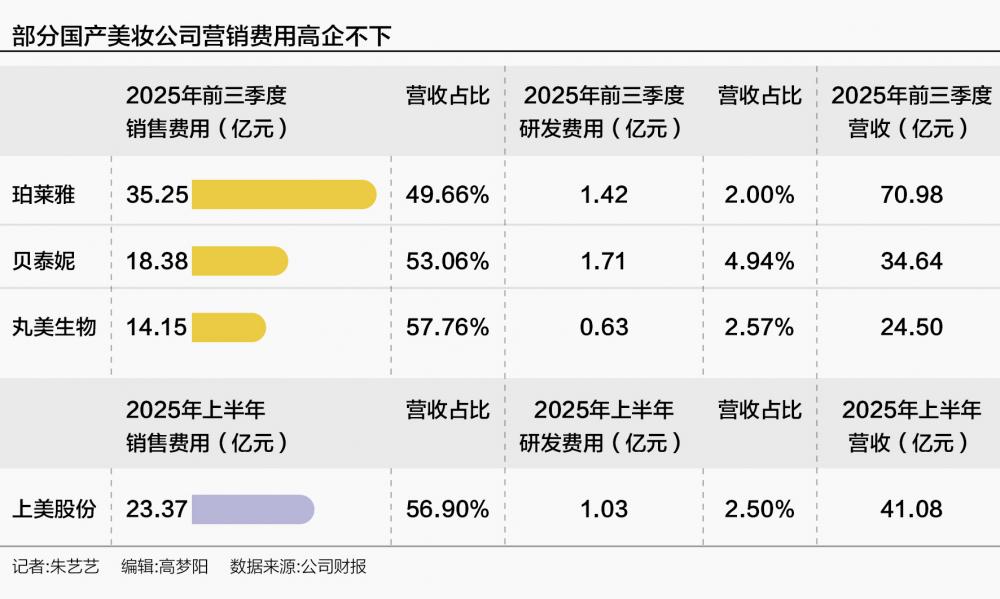
Core Insights - The rise of short dramas in the Chinese market has attracted significant investment from beauty companies, with major players like Proya, Shiseido, Marubi, and Bethany actively participating in this trend [1][2][4] - Short dramas have proven to be effective marketing tools, generating substantial viewership and sales for brands, with some series achieving over 10 billion views [1][2][3] - However, the increasing competition in the short drama space has led to concerns about diminishing returns and effectiveness, prompting some companies to reconsider their strategies [5][6][7] Company Summaries - **Proya**: Launched multiple short dramas in 2023, including "The Full-Time Husband Training Plan," which garnered 3.6 billion views. The brand's sales through Douyin reached approximately 33.4 billion yuan in 2023, a 374.4% increase year-on-year [2][3] - **Shiseido**: Released nearly 30 short dramas from 2023 to 2024, with significant viewership and sales impact, including a notable 793.6 million units sold of a featured product [2][4] - **Marubi**: Continued to invest in short dramas, with a total viewership exceeding 12 billion across various series. The company reported a 39.31% increase in sales expenses in 2025, reflecting the rising costs of online marketing [4][9][10] - **Bethany**: Although previously involved in short dramas, the company has indicated a shift away from this strategy in the coming years [6][7] Industry Trends - The short drama marketing strategy has become increasingly popular among beauty brands, with many integrating product placements into their narratives to drive sales [1][4] - The cost of producing short dramas has risen significantly, with estimates for high-quality productions ranging from 6 to 8 million yuan per episode, leading to increased marketing expenses for companies [7][10] - Despite initial success, the market for short dramas is becoming saturated, leading to concerns about the effectiveness and ROI of such marketing efforts [5][6][7]
2025年,珀莱雅稳居淘宝天猫化妆品榜首,韩束蝉联抖音化妆品榜首
Jianghai Securities· 2026-02-26 08:34
Investment Rating - The industry rating is "Overweight" (maintained) [6] Core Insights - In January 2026, the sales of beauty and skincare products on Tmall increased by 24% year-on-year, with skincare/body/essential oils growing by 27.5%, makeup/perfume/beauty tools by 15.6%, and hair care/wigs by 24.3% [6] - Douyin's beauty category saw a month-on-month growth of 11.1% in January 2026, although high-end beauty consumption (products priced above 500 yuan) experienced a decline of 4.6% year-on-year [6] - In 2025, Tmall's cosmetics sales reached 168.451 billion yuan, with domestic brands holding a market share of 31.8% and foreign brands 68.2% [6] - The top 100 brands on Tmall had five high-end cosmetics brands with an average price of 500 yuan or more, an increase of one compared to 2024 [6] - Douyin's cosmetics GMV grew by over 16% year-on-year in 2025, with domestic brands capturing 65.9% of the market share [6] Summary by Sections Market Performance - The beauty and skincare industry has shown a relative return of -2.51% over the past month, -5.22% over the past three months, and -14.9% over the past year [3] Competitive Landscape - The market concentration in Tmall's beauty segment is increasing, with the top 20 brands accounting for 28.7% of sales [6] - The leading brands in Tmall for three consecutive months include L'Oreal, Proya, La Mer, Lancôme, and Estée Lauder [6] - Douyin's top 20 beauty brands saw a GMV share of 19.5%, a decrease of 2.5 percentage points [6] Investment Recommendations - The report suggests focusing on leading domestic beauty companies with strong multi-channel operational capabilities and comprehensive product matrices, such as Proya, Shuyuan, Shanghai Jahwa, Betaini, Aimeike, Marubi, and Jinbo Biological [6]
招银国际:26年春节消费景气度符合预期 品类分化持续
Zhi Tong Cai Jing· 2026-02-26 08:01
Group 1: Tourism and Travel - The tourism sector shows resilience with long-distance travel and family-oriented trips as key trends, with 596 million domestic trips taken during the 2026 Spring Festival, generating a total expenditure of 803.48 billion yuan, reflecting a year-on-year increase of 5.7% in daily travel volume and 5.5% in daily spending [2] - Long-distance travel orders accounted for 59.6% of bookings, with an average travel duration of 6.4 days, an increase of 0.5 days year-on-year [2] - Domestic travel orders on the Fliggy platform increased by 80% year-on-year, with average booking amounts rising by approximately 10% [2] Group 2: Offline Consumption - Key retail and catering enterprises saw a daily sales increase of 5.7% compared to the same period in 2025, with a 1.6 percentage point acceleration from the previous year's growth rate [3] - Foot traffic and sales in 78 key pedestrian streets increased by 6.7% and 7.5% year-on-year, respectively, showing an acceleration compared to the 2025 National Day holiday [3] Group 3: Online Consumption - The performance of beauty and skincare brands during the Spring Festival was mixed, with total sales on Douyin ranging from 250 million to 378 million yuan, reflecting a year-on-year growth of about 12%, but a daily sales figure that remained nearly flat [4] - Notable brand performances included a 114.3% increase for Maogeping, driven by category expansion, and a 58.6% increase for Proya, attributed to strong brand performance [4] Group 4: Jewelry Sector - The jewelry sector experienced a decline in sales, with total sales dropping to a range of 260 million to 309 million yuan, a year-on-year decrease of 8.5%, primarily due to high sales bases from the previous year and fluctuating gold prices [5] - Brands like Chow Tai Fook and Luk Fook achieved good growth rates of 100% and 66.7%, respectively, while mass-market brands saw significant declines [5] Group 5: Investment Recommendations - The company maintains a positive outlook on service-oriented and emotional consumption, particularly in travel and beauty sectors, recommending attention to companies like Trip.com and Tongcheng [6] - In the beauty sector, companies with superior category matrix layouts, such as Ying Tong Holdings, are highlighted for potential investment [6]


从双11霸榜到扎堆开店,国货美妆为何突然变“重”了?
Hua Er Jie Jian Wen· 2026-02-25 13:49
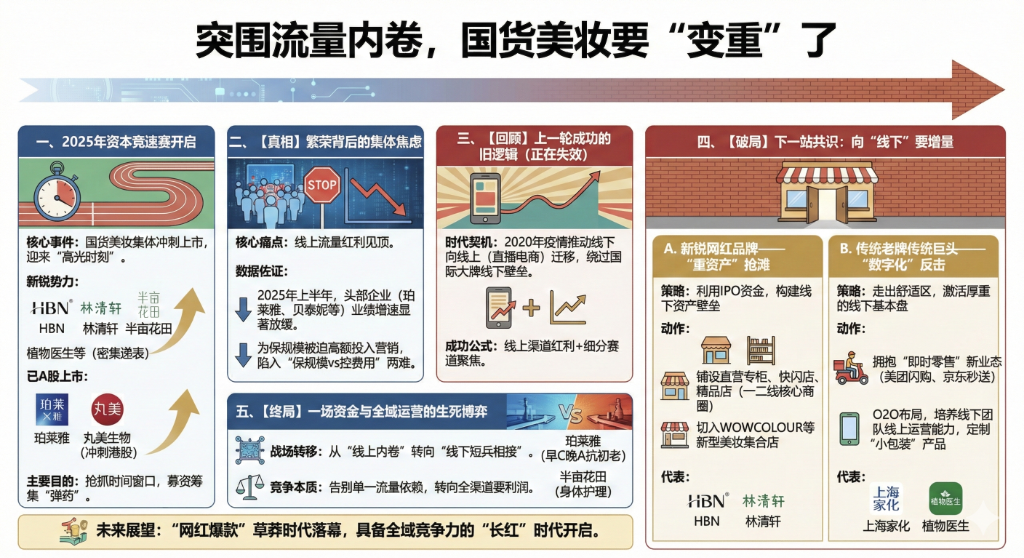
Core Insights - The Chinese beauty industry has entered a capital race since 2025, with numerous domestic brands filing for IPOs, including Lin Qingxuan, HBN, and others [1][2] - Despite the apparent boom, there is significant industry anxiety due to the saturation of online traffic and diminishing returns from traditional growth strategies [2][14] - The consensus among brands is to seek growth through offline retail, with new brands aggressively expanding their physical presence to build asset barriers [2][18] Industry Dynamics - The current wave of domestic brands represents a channel battle, as they seek to break through the dominance of international brands that have historically controlled retail spaces [4][5] - The COVID-19 pandemic in 2020 marked a turning point, shifting consumer habits and enabling domestic brands to leverage online platforms for growth [6][7] - Brands like HBN have rapidly grown, achieving over 2 billion yuan in annual revenue within seven years, while others like Winona have captured significant market share [6][7] Brand Strategies - Emerging brands are adopting differentiated strategies, focusing on niche markets rather than broad brand narratives [8] - For instance, HBN targets the "night owl" lifestyle, while other brands focus on specific skincare needs, allowing them to avoid competition in saturated markets [8][9] - Established brands like Proya and Shiseido have also found renewed success by targeting specific segments and enhancing their online presence [9][10] Financial Performance - The financial performance of major brands has shown signs of slowing growth, with Proya and others experiencing significant declines in revenue growth rates [13][14] - New brands aiming for IPOs have also reported modest growth, with a median revenue increase of 23% in 2024 [13] Offline Expansion - Many new brands are prioritizing offline expansion to counteract the challenges of online marketing, with plans to open stores in key urban areas [18][19] - The need for substantial funding for these offline initiatives highlights the urgency for brands to secure IPOs to support their growth strategies [20][21] Competitive Landscape - The rise of new beauty brands is putting pressure on established players, who must adapt to the changing landscape by enhancing their online and offline strategies [23][29] - Traditional brands are increasingly investing in instant retail and digital transformation to maintain their market positions [29][30] Future Outlook - The current IPO rush reflects a critical phase in the evolution of the beauty industry, marking both an assessment of past strategies and the beginning of a new competitive era [12][33] - The transition from a focus on online sales to a more integrated approach involving both online and offline channels will be crucial for long-term success [32][33]
出海2026:当国货美妆开始争夺全球市场“定义权”
FBeauty未来迹· 2026-02-25 09:36
Core Viewpoint - The narrative of Chinese beauty brands going global is visibly shifting from relying on cross-border e-commerce and price advantages to establishing a significant presence in key global markets, such as flagship stores in Tokyo's Ginza and New York's Sephora [3][4]. Group 1: Channel Strategy - The channel layout reflects the brands' strategies for going global, with two parallel paths: entering high-end retail landmarks to establish brand positioning and systematically penetrating mainstream retail networks for scale growth [5]. - High-end landmark occupation includes the first Chinese beauty brand, Huaxizi, opening a flagship store in Tokyo's Ginza, marking a significant step in global market expansion [5]. - Scale penetration involves brands like Huaxizi entering major U.S. beauty retail platforms like Ulta Beauty, enhancing the perception of "Chinese beauty" among North American consumers [7]. Group 2: Local Market Adaptation - In Southeast Asia, brands are adopting a more direct and rapid penetration strategy, with FAN BEAUTY entering over a hundred Watsons stores in Singapore and planning further expansion into Thailand, Vietnam, and Indonesia [9]. - Successful brands often rely on local marketing partners to navigate the complexities of different Southeast Asian markets, emphasizing the need for localized strategies rather than a one-size-fits-all approach [11][12]. - Localized product development is crucial, as seen with brands like Ziyuan, which tailored products for the Malaysian market, addressing specific consumer needs related to the local climate [12][14]. Group 3: Research and Innovation - The increasing research capabilities of Chinese beauty brands are evident, with significant participation in international cosmetic science conferences, showcasing advancements in product formulation and technology [16][20]. - Brands like Pechoin and Proya have received prestigious awards at global scientific conferences, indicating a shift towards competitive research and innovation in the beauty industry [17][18]. Group 4: Value Proposition and Brand Storytelling - The concept of "value export" is emerging, with brands like Pechoin exploring new pricing strategies for their products based on cultural value and scarcity, as demonstrated by their participation in high-end auctions [22][24]. - The competition is evolving from market share to establishing a unique value system that resonates globally, as brands engage in deeper cultural dialogues and aesthetic philosophies [25][28]. Group 5: Organizational and Competitive Dynamics - The future of successful brands lies in their ability to integrate global organizational capabilities with local market agility, emphasizing the importance of building teams that understand local consumer behavior [26][27]. - The competitive landscape is becoming multifaceted, requiring brands to excel in high-end channel negotiations, localized product development, cutting-edge research, and cultural content creation [25].