Marubi(603983)

Search documents
化妆品板块1月9日涨1.29%,水羊股份领涨,主力资金净流出3172.78万元
Zheng Xing Xing Ye Ri Bao· 2026-01-09 09:01
Market Overview - The cosmetics sector increased by 1.29% on January 9, with Shuiyang Co., Ltd. leading the gains [1] - The Shanghai Composite Index closed at 4120.43, up 0.92%, while the Shenzhen Component Index closed at 14120.15, up 1.15% [1] Individual Stock Performance - Shuiyang Co., Ltd. (300740) closed at 25.65, up 5.90% with a trading volume of 223,500 shares and a transaction value of 561 million yuan [1] - Qingsong Co., Ltd. (300132) closed at 8.70, up 2.47% with a trading volume of 253,700 shares [1] - Beitaini (300957) closed at 41.20, up 1.85% with a trading volume of 163,500 shares and a transaction value of 261 million yuan [1] - Other notable stocks include Furuida (600223) at 7.53 (+1.76%), Jiaheng Jiahua (300955) at 39.89 (+1.68%), and Huaye Fragrance (300886) at 26.64 (+1.06%) [1] Capital Flow Analysis - The cosmetics sector experienced a net outflow of 31.72 million yuan from institutional investors and 34.45 million yuan from speculative funds, while retail investors saw a net inflow of 66.18 million yuan [2] - Individual stock capital flows indicate that Qindao Jinwang (002094) had a net inflow of 13.96 million yuan from institutional investors, while it faced a net outflow of 1.23 million yuan from speculative funds [3] - Other stocks like Qingsong Co., Ltd. (300132) and Beitaini (300957) also showed mixed capital flows, with varying levels of net inflows and outflows from different investor categories [3]






13000+场线下实战之后,丸美把实体渠道做成了增长引擎
FBeauty未来迹· 2026-01-08 13:30
Core Viewpoint - The beauty industry is experiencing a complex relationship with offline channels, as brands are increasingly returning to physical stores despite the challenges posed by online growth saturation and declining advertising efficiency [2][3]. Group 1: Offline Market Trends - As of the first three quarters of 2025, the total number of CS stores in China reached 136,000, with 38,000 new stores opened in that period. Although sales saw a 2.8% year-on-year decline, the decrease has significantly narrowed, indicating a strong recovery signal in offline beauty retail [2]. - The decline in the number of department store beauty counters has also slowed to nearly 30%, suggesting a stabilization in the offline beauty market [2]. Group 2: Marubi's Offline Strategy - Marubi's founder and CEO, Dr. Sun Huaqing, emphasized a proactive approach to offline channels, advocating for continuous investment and long-term development, encapsulated in the four key terms: faith, belief, trust, and confidence [3][14]. - In 2025, Marubi launched five major new products and conducted numerous promotional events, including a nationwide "One-Day Store Manager" tour across 24 cities, which effectively converted online interest into offline store visits [5][12]. Group 3: Product and Consumer Engagement - Marubi's strategy focuses on a value chain that combines product, emotion, and experience to encourage consumer visits and conversions in stores [5][12]. - The introduction of innovative products, such as the "Small Gold Needle Hydrating Mask" and "Big Red Shield Sunscreen," addresses specific consumer needs and enhances in-store experiences [6][9][8]. Group 4: Emotional and Experiential Marketing - Marubi's marketing campaigns, such as the collaboration with spokesperson Yang Zi for International Women's Day, aim to empower women and deepen the brand's commitment to feminist themes [10]. - The brand also partnered with contemporary artist Song Santu for the Eye Cream Festival, adding emotional and cultural depth to its products [10][11]. Group 5: Building Trust and Confidence - Marubi's approach to trust involves maintaining a collaborative relationship with distribution channels, ensuring clear product strategies and stable pricing, which fosters sustainable partnerships [18][13]. - The company's confidence stems from its strong research capabilities and understanding of market trends, positioning offline channels as essential for long-term investment [20][26]. Group 6: Research and Development Strength - Marubi's commitment to R&D is evident in its substantial patent portfolio, with 673 patent applications and 384 granted, which supports its ability to innovate and maintain a competitive edge [20][24]. - Collaborations with 33 universities and research institutions have enhanced Marubi's understanding of Chinese skin, further solidifying its market position [21][24]. Group 7: Future Outlook - In 2026, Marubi plans to refine its offline strategy by focusing on core product lines and enhancing emotional marketing, while continuing to engage consumers through salons and promotional activities [26][28]. - The brand views offline channels not merely as a supplementary strategy but as a primary focus for future growth, emphasizing the importance of sustained investment in physical retail [28].

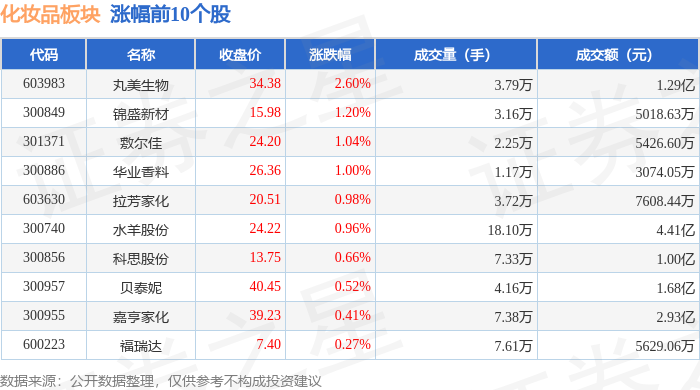
化妆品板块1月8日涨0.65%,丸美生物领涨,主力资金净流出7494.84万元
Zheng Xing Xing Ye Ri Bao· 2026-01-08 08:58
| 代码 | 名称 | 收盘价 | 涨跌幅 | 成交量(手) | 成交额(元) | | --- | --- | --- | --- | --- | --- | | 920123 | 芭薇股份 | 15.37 | -0.26% | 1.43万 | 2187.90万 | | 300132 | 青松股份 | 6.49 | 0.00% | 16.97万 | 1.44亿 | | 603605 | | 68.86 | 0.12% | 2.85万 | 1.97亿 | | 002094 | 青岛金王 | 7.57 | 0.13% | - 30.91万 | 2.33亿 | | 600315 | 上海家化 | 23.16 | 0.22% | 5.84万 | 1.35亿 | | 600223 | 福瑞达 | 7.40 | 0.27% | 7.61万 | 5629.06万 | | 300955 | 嘉亨家化 | 39.23 | 0.41% | 7.38万 | 2.93亿 | | 300957 | 贝泰妮 | 40.45 | 0.52% | 4.16万 | 1.68亿 | | 300856 | 科思股份 | + 13.75 | 0.6 ...


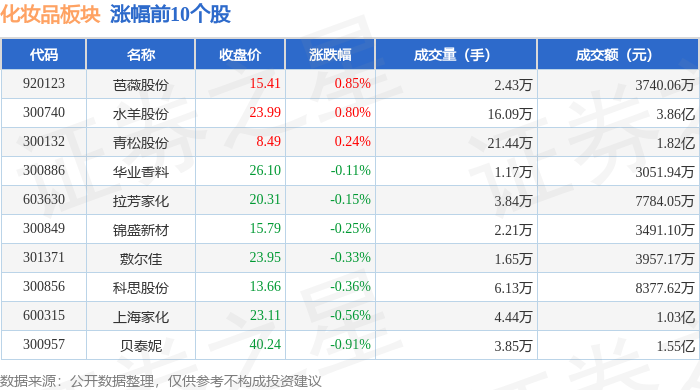
化妆品板块1月7日跌0.93%,嘉亨家化领跌,主力资金净流出5766.6万元
Zheng Xing Xing Ye Ri Bao· 2026-01-07 08:59
Group 1 - The cosmetics sector experienced a decline of 0.93% on January 7, with Jiaheng Jiahua leading the drop [1] - The Shanghai Composite Index closed at 4085.77, up 0.05%, while the Shenzhen Component Index closed at 14030.56, up 0.06% [1] - Key individual stock performances in the cosmetics sector included Bawei Co. up 0.85% and Jiaheng Jiahua down 4.96% [2] Group 2 - The net outflow of main funds in the cosmetics sector was 57.67 million yuan, while retail investors saw a net inflow of 39.72 million yuan [2] - The stock with the highest main fund inflow was Shuiyang Co. with 27.77 million yuan, while Jiaheng Jiahua had a significant outflow of 32.2 million yuan [3] - Retail investors showed a negative net flow in several stocks, including Shanghai Jahwa and Kesheng Co. [3]


轻工、美护2026年年度策略:内需筑底深挖潜力,出海突围打开新局
HUAXI Securities· 2026-01-07 02:30
Group 1: Industry Overview - The light industry and beauty sector is expected to stabilize and improve due to the dual drivers of domestic demand policies and steady export growth [3] - The "14th Five-Year Plan" marks a year of enhanced domestic demand policies, coupled with consumers' increasing pursuit of high-quality living, creating significant growth opportunities for the industry [3] - The penetration rate of cross-border e-commerce has ample room for improvement, and the recovery of international relations and demand from emerging markets will further drive market expansion [3] Group 2: Beauty Sector - The cosmetics market is projected to grow steadily, with the skincare segment being the largest, reaching a market size of 4,619 billion yuan in 2024, and expected to grow at a CAGR of 8.6% from 2024 to 2029 [19] - The high-end cosmetics market is rapidly expanding, with the market size for high-end skincare products increasing from 749 billion yuan in 2019 to 1,144 billion yuan in 2024, reflecting a CAGR of 8.84% [19] - Key companies in the beauty sector include: - **Mao Geping**: Revenue reached 25.88 billion yuan in H1 2025, with a growth rate of 31.28% [23] - **Lin Qingxuan**: Revenue grew to 10.52 billion yuan in H1 2025, marking a 98.28% increase [27] - **Marubi**: Revenue is expected to reach 29.70 billion yuan in 2024, recovering from previous declines [32] Group 3: Medical Aesthetics - The medical aesthetics sector is facing short-term pressure due to cautious consumer spending, but the long-term growth potential remains strong, with a projected CAGR of 10%-15% from 2024 to 2027 [36] - The market penetration rate for medical aesthetics in China is currently at 4-5%, indicating a growth potential of 2-5 times compared to countries like the US and South Korea [36] - Key companies in the medical aesthetics sector include: - **Jinbo Biological**: Achieved revenue of 12.96 billion yuan in Q1-Q3 2025, with a year-on-year growth of 31.10% [45] Group 4: Daily Chemicals - The daily chemical industry is benefiting from domestic demand policies, with local brands poised to capture market share [49] - Companies such as **Dengkang Oral Care** and **Runben** are highlighted for their strong market positions and growth potential [51][55] - **Shanghai Jahwa** has shown significant growth, with revenue reaching 49.61 billion yuan in Q1-Q3 2025, reflecting a 10.83% increase [59] Group 5: Home Furnishing - The home furnishing sector is under pressure due to weak real estate sales, with a 15% decline in residential investment in 2025 [65] - National subsidies for home appliances and furnishings have provided some support, but the long-term effects are limited [65] - Leading companies such as **Oppein Home** and **Kuka Home** are noted for their strong channel capabilities and multi-category layouts [65]





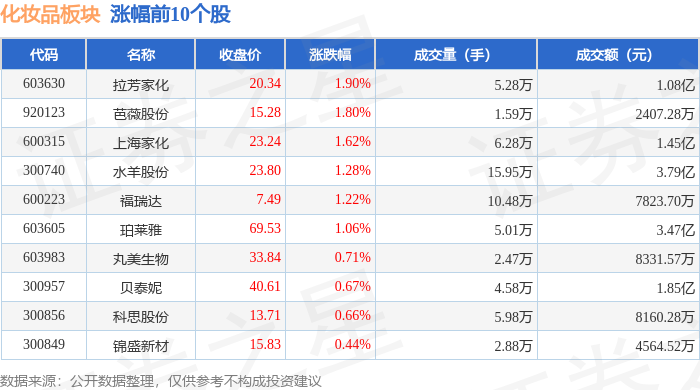
化妆品板块1月6日涨0.46%,拉芳家化领涨,主力资金净流出8196.79万元
Zheng Xing Xing Ye Ri Bao· 2026-01-06 09:03
Group 1 - The cosmetics sector experienced a rise of 0.46% on January 6, with Lafang Jiahua leading the gains [1] - The Shanghai Composite Index closed at 4083.67, up by 1.5%, while the Shenzhen Component Index closed at 14022.55, up by 1.4% [1] - Lafang Jiahua's closing price was 20.34, reflecting a 1.90% increase, with a trading volume of 52,800 shares and a transaction value of 108 million yuan [1] Group 2 - The cosmetics sector saw a net outflow of 81.97 million yuan from institutional investors, while retail investors had a net inflow of 67.35 million yuan [2] - The trading data indicates that major stocks like Shanghai Jahwa and Lafang Jiahua had mixed net inflows and outflows from different investor types [3] - Shanghai Jahwa had a net inflow of 9.64 million yuan from institutional investors, while it faced outflows from retail investors [3]

广东丸美生物技术股份有限公司 关于完成工商变更登记的公告
Zhong Guo Zheng Quan Bao - Zhong Zheng Wang· 2026-01-06 07:58
Core Viewpoint - The company has completed the registration of changes related to the cancellation of the supervisory board and the revision of its articles of association, as approved in previous board and shareholder meetings [1]. Group 1 - The company held the fifth board meeting on October 29, 2025, and the second extraordinary general meeting on November 28, 2025, where it approved the proposal to cancel the supervisory board and amend the articles of association [1]. - The company has completed the necessary business registration changes and the filing of the revised articles of association, with no changes to the business license registration information [1].
丸美生物(603983) - 广东丸美生物技术股份有限公司关于完成工商变更登记的公告
2026-01-05 09:45
证券代码:603983 证券简称:丸美生物 公告编号:2026-001 广东丸美生物技术股份有限公司(以下简称"公司")于 2025 年 10 月 29 日、2025 年 11 月 28 日分别召开了第五届董事会第九次会议、2025 年第二次临 时股东大会,审议通过了《关于取消监事会并修订<公司章程>及修订、新增公司 部分治理制度的议案》,具体内容详见公司于 2025 年 10 月 31 日在上海证券交易 所网站(www.sse.com.cn)披露的《关于取消监事会并修订<公司章程>及修订、 新增公司部分治理制度的公告》。 近日,公司已完成上述事项相关的工商变更登记及《公司章程》备案手续, 营业执照登记信息不变。 特此公告。 广东丸美生物技术股份有限公司董事会 2026年1月6日 广东丸美生物技术股份有限公司 关于完成工商变更登记的公告 本公司董事会及全体董事保证本公告内容不存在任何虚假记载、误导性陈述 或者重大遗漏,并对其内容的真实性、准确性和完整性承担个别及连带责任。 ...
解码美妆新质生产力:头部品牌的智造实践与研发深耕
艾瑞咨询· 2026-01-04 05:31
Core Viewpoint - The Chinese cosmetics industry is projected to reach a market size of 1.1 trillion yuan, with domestic brands surpassing international brands in market share and consumer preference [1][2]. Group 1: High-Quality Development and New Productive Forces - The domestic cosmetics market retail sales are expected to reach 470 billion yuan by 2025, indicating a significant growth trajectory for the industry [2]. - New productive forces are essential for the high-quality development of the cosmetics industry, transitioning from traditional manufacturing to intelligent and lean production [4]. - New productive forces enhance production efficiency and product consistency through automation and intelligent equipment, addressing quality control challenges [4]. Group 2: Intelligent Manufacturing Practices of Domestic Brands - The past decade has seen a shift in the cosmetics manufacturing industry from experience-driven to data-driven processes, evolving through three stages: semi-automated, automated, and now data-driven intelligent stages [6]. - Leading brands like Han Shu and Pechoin have made significant investments in intelligent manufacturing, achieving production capacity increases and improved quality control [8][10]. - Domestic brands have made historical advancements in intelligent manufacturing, with automation rates rising from approximately 40% to levels comparable to international brands [10]. Group 3: R&D Innovation and Cost Management - R&D expenditure rates vary across different categories, with skincare products averaging 1.5%-5% and medical beauty products at 2%-5%, reflecting a focus on compliance and clinical data [21][23]. - Domestic brands like Han Shu and Pechoin have R&D personnel ratios comparable to international leaders, indicating strong R&D capabilities [24]. - The production cost rates for various product categories range from 15% to 30%, with domestic brands leveraging self-researched technologies and integrated supply chains to maintain competitive pricing [27][28]. Group 4: International Competitiveness of Domestic Brands - Domestic brands have achieved significant breakthroughs in the cosmetics sector, enhancing core competitiveness through new productive forces [31]. - Intelligent manufacturing has enabled micro-level quality control, establishing trust in product quality [33]. - The integration of AI and 5G technologies in manufacturing processes positions domestic brands at the forefront of global standards, driving high-quality development in the industry [33].


美容护理系列深度报告2:技术、需求双轮驱动,PDRN应用提速
Orient Securities· 2025-12-31 15:40
Investment Rating - The report maintains a "Positive" investment rating for the beauty and personal care industry, specifically focusing on PDRN applications [6]. Core Insights - The report highlights that PDRN (Polydeoxyribonucleotide) is expected to unleash stronger commercial potential due to increasing registrations and search metrics. The extraction of PDRN is transitioning from animal sources to microbial fermentation and synthetic biology, laying a solid foundation for accelerated applications in the medical beauty and skincare sectors [3][4]. - The report emphasizes that domestic beauty companies are likely to redefine the value boundaries of PDRN, with leading firms accelerating their strategies in this competitive landscape [3][4]. Summary by Sections PDRN Overview - PDRN, derived from salmon and other sources, has a high similarity to human DNA (98%) and is known for its skin repair and cell regeneration properties. Its historical development spans from the 15th century to its current applications in medical aesthetics and cosmetics [8][13][19]. Market Growth Potential - The PDRN market is projected to grow significantly, with estimates indicating an increase from USD 0.72 billion in 2024 to USD 8.55 billion by 2031, reflecting a CAGR of 43%. The demand for anti-aging products is a core driver of this growth [8][30]. Competitive Landscape - Domestic companies are actively entering the PDRN medical and skincare sectors, with significant advancements in extraction technologies. Companies like Huaxi Biological and Lepu Medical are leading the charge in developing PDRN-based products [8][30][34]. Key Mechanisms and Benefits - PDRN operates through two main mechanisms: acting as an agonist for the adenosine A2A receptor to suppress inflammation and providing nucleotides for DNA synthesis, thus promoting cell regeneration and tissue repair [34][36]. - The primary benefits of PDRN include skin repair, anti-inflammatory effects, and anti-aging properties, making it suitable for various cosmetic and medical applications [34][39].