Marubi(603983)

Search documents
新股消息 | 丸美生物(603983.SH)递表港交所 为重组胶原蛋白护肤品细分领域的中国第三大美妆企业
智通财经网· 2025-12-11 23:28
Core Viewpoint - Mamei Biotechnology is a leading Chinese beauty company focused on anti-aging solutions, leveraging synthetic biology technology and core innovations in skincare products to drive growth in the industry [4][5]. Company Overview - Mamei Biotechnology has over 20 years of experience in the anti-aging skincare sector, emphasizing research and development, particularly in recombinant collagen technology [4]. - The company has developed recombinant double collagen, a unique engineered protein that combines type I and type III collagen into a single molecule, enhancing its product offerings [4]. - Mamei has been recognized as a key contributor to the industry standard for "recombinant soluble collagen" and is the only company in China approved as a national research center for recombinant functional protein technology [4][5]. Market Position - Mamei has ranked first in the Chinese eye care brand market from 2021 to 2024 based on retail sales, while its brand "Lianhuo" ranks third among domestic foundation brands and fifth overall in the foundation category [5]. - Lianhuo has achieved a compound annual growth rate (CAGR) of 77.5% in retail sales from 2022 to 2024, the highest among the top five foundation brands in China [5]. Product Development - The company has established a comprehensive value chain for core raw materials, developing over 80 proprietary ingredients, with more than 30 achieving large-scale production [7]. - Mamei operates two production bases in Guangzhou, which support high-density fermentation and purification processes for recombinant collagen production [7]. Financial Performance - Mamei's revenue for the fiscal years ending December 31 from 2022 to 2025 is projected to be RMB 1.73 billion, RMB 2.23 billion, RMB 2.97 billion, and RMB 2.45 billion respectively [8]. - The company reported profits of RMB 167.43 million, RMB 277.59 million, RMB 342.36 million, and RMB 246.65 million for the same periods [9]. - Gross profits for the same periods are RMB 1.18 billion, RMB 1.56 billion, RMB 2.18 billion, and RMB 1.83 billion respectively [10]. Industry Overview - The Chinese beauty market is projected to grow from RMB 460.3 billion in 2019 to RMB 566.3 billion by 2024, with a CAGR of 4.2% [10]. - The skincare market is expected to expand from RMB 355.9 billion in 2019 to RMB 451.4 billion by 2024, with a CAGR of 4.9% [13]. - The makeup market is anticipated to grow from RMB 104.5 billion in 2019 to RMB 114.8 billion by 2024, with a CAGR of 1.9% [16].


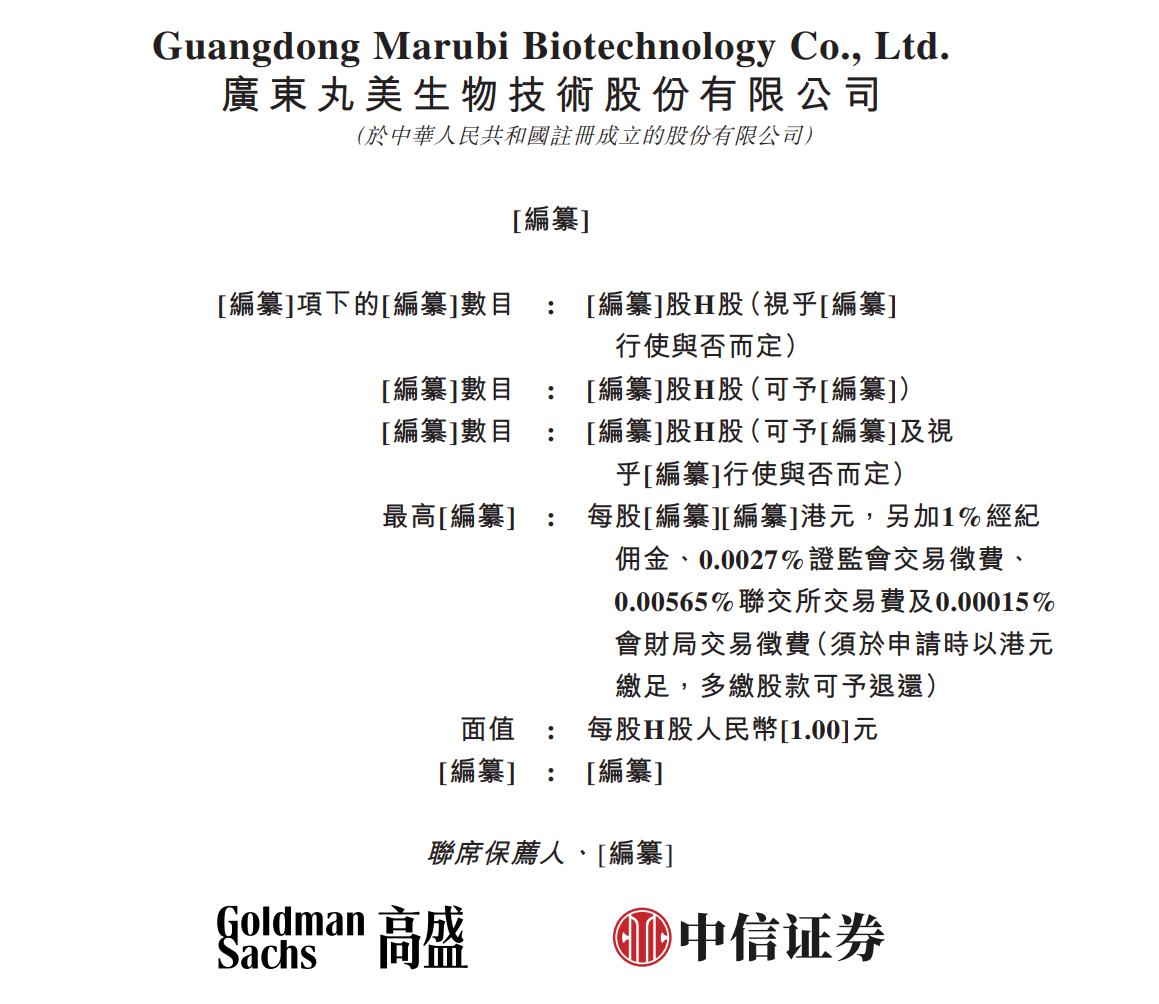
丸美生物递表港交所
Zhi Tong Cai Jing· 2025-12-11 23:15
Group 1 - The core viewpoint of the article is that Guangdong Marubi Biotechnology Co., Ltd. has submitted an application for listing on the Hong Kong Stock Exchange, with Goldman Sachs and CITIC Securities as joint sponsors [1] - Marubi Biotechnology is a leading Chinese beauty company focused on providing anti-aging solutions, leveraging synthetic biology technology and over 20 years of experience in the anti-aging skincare industry [1] - The company emphasizes research and development, particularly in core technologies such as recombinant collagen, to innovate skincare products with anti-wrinkle, firming, and repairing effects [1] Group 2 - According to a report by Frost & Sullivan, Marubi Biotechnology is the third largest beauty company in China in the recombinant collagen skincare segment, based on retail sales projected for 2024 [1]
新股消息 | 丸美生物(603983.SH)递表港交所
智通财经网· 2025-12-11 23:15
Group 1 - The core viewpoint of the article is that Guangdong Marubi Biotechnology Co., Ltd. has submitted a listing application to the Hong Kong Stock Exchange, with Goldman Sachs and CITIC Securities as joint sponsors [1] - Marubi Biotechnology is a leading Chinese beauty company focused on providing anti-aging solutions, leveraging synthetic biology technology and over 20 years of experience in the anti-aging skincare industry [1] - The company emphasizes research and development, particularly in core technologies such as recombinant collagen, to create skincare products with anti-wrinkle, firming, and repairing effects [1] Group 2 - According to a report by Frost & Sullivan, Marubi is the third largest beauty company in China in the recombinant collagen skincare segment, based on retail sales projected for 2024 [1]
据港交所文件:广东丸美生物技术股份有限公司向港交所提交上市申请书。
Xin Lang Cai Jing· 2025-12-11 14:49
据港交所文件:广东丸美生物技术股份有限公司向港交所提交上市申请书。 ...
Guangdong Marubi Biotechnology Co., Ltd.(H0213) - Application Proof (1st submission)
2025-12-10 16:00
The Stock Exchange of Hong Kong Limited and the Securities and Futures Commission take no responsibility for the contents of this Application Proof, make no representation as to its accuracy or completeness and expressly disclaim any liability whatsoever for any loss howsoever arising from or in reliance upon the whole or any part of the contents of this Application Proof. Application Proof of Guangdong Marubi Biotechnology Co., Ltd. 廣東丸美生物技術股份有限公司 (the "Company") (A joint stock company incorporated in the ...
广东丸美生物技术股份有限公司(H0213) - 整体协调人公告-委任
2025-12-10 16:00
香港聯合交易所有限公司及證券及期貨事務監察委員會對本公告的內容概不負責,對其準確性 或完整性亦不發表任何聲明,並明確表明概不就因本公告全部或任何部分內容而產生或因依賴 該等內容而引致的任何損失承擔任何責任。 Guangdong Marubi Biotechnology Co., Ltd. 廣東丸美生物技術股份有限公司 1 (a) 在聯交所網站登載本公告,並不會引致本公司、其聯席保薦人、整體協調 人、顧問或承銷團成員須於香港或任何其他司法權區進行發售或配發活動的 任何責任。概不保證本公司將會進行發售或配發; (b) 本公告所涉及的上市申請並未獲批准,聯交所及證監會或會接納、發回或拒 絕有關的公開發售及╱或上市申請; (c) 本公告不應被視為勸誘認購或購買任何證券,亦不擬構成該等勸誘; (d) 本公司或其任何聯屬人士、顧問或承銷團成員概無透過刊發本公告而於任何 司法權區發售任何證券或招攬要約認購或購買任何證券; (e) 本公告(及其所載資料)僅供參考,並不構成或組成在美國(包括其領土及屬 地、美國任何州及哥倫比亞特區)或有關要約或出售即屬違法的任何其他司 法權區發行或出售本公司任何證券的任何要約,或招攬購買、認購 ...
广东丸美生物技术股份有限公司(H0213) - 申请版本(第一次呈交)
2025-12-10 16:00
香港聯合交易所有限公司與證券及期貨事務監察委員會對本申請版本的內容概不負責,對其準確性或完整 性亦不發表任何意見,並明確表示概不就因本申請版本全部或任何部分內容而產生或因倚賴該等內容而引 致的任何損失承擔任何責任。 Guangdong Marubi Biotechnology Co., Ltd. 廣東丸美生物技術股份有限公司 (「本公司」) (於中華人民共和國註冊成立的股份有限公司) 的申請版本 警告 本申請版本乃根據香港聯合交易所有限公司(「聯交所」)及證券及期貨事務監察委員會(「證監會」)的要求 而刊發,僅用作提供信息予香港公眾人士。 本申請版本為草擬本,其內所載資料並不完整,亦可能會作出重大變動。 閣下閱覽本文件,即代表 閣 下知悉、接納並向本公司、本公司的聯席保薦人、整體協調人、顧問或包銷團成員表示同意: 本公司招股章程根據香港法例第32章公司(清盤及雜項條文)條例送呈香港公司註冊處處長登記前,本公 司不會向香港公眾人士提出要約或邀請。倘於適當時候向香港公眾人士提出要約或邀請,有意投資者務請 僅依據向香港公司註冊處處長註冊的本公司招股章程作出投資決定;招股章程的文本將於發售期內向公眾 刊發。 (a) ...
化妆品板块12月9日跌0.37%,嘉亨家化领跌,主力资金净流出8817.78万元
Zheng Xing Xing Ye Ri Bao· 2025-12-09 09:11
Core Insights - The cosmetics sector experienced a decline of 0.37% on December 9, with Jiaheng Jiahua leading the drop [1] - The Shanghai Composite Index closed at 3909.52, down 0.37%, while the Shenzhen Component Index closed at 13277.36, down 0.39% [1] Company Performance - Qing Song Co. (300132) saw a closing price of 8.17, with an increase of 4.34% and a trading volume of 475,200 shares, amounting to a transaction value of 383 million [1] - Kesheng Co. (300856) closed at 15.70, up 3.36%, with a trading volume of 158,000 shares and a transaction value of 252 million [1] - Jiaheng Jiahua (300955) closed at 36.00, down 2.91%, with a trading volume of 64,600 shares and a transaction value of 23.4 million [2] Capital Flow - The cosmetics sector experienced a net outflow of 88.18 million from main funds, while retail investors saw a net inflow of 55.04 million [2] - Main funds showed a net inflow in Qing Song Co. of 20.05 million, while Jiaheng Jiahua experienced a net outflow of 2.01 million [3] - Retail investors contributed a net inflow of 804.95 million to Shuiyang Co. (300740), while Qingdao Jinwang (002094) saw a net outflow of 264.27 million [3]



研判2025!中国胶原蛋白面膜行业产业链全景、发展现状、企业布局及未来发展趋势分析:重组技术领航赛道,千亿市场潜力迸发[图]
Chan Ye Xin Xi Wang· 2025-12-09 01:09
Industry Overview - Collagen masks are mainstream skincare products focused on anti-aging and repair, utilizing collagen as the core ingredient along with auxiliary components to achieve hydration and skin barrier repair [1][2] - The Chinese mask industry is expected to reach a market size of 72.986 billion yuan in 2024, entering a period of adjustment and transformation, facing growth slowdown and intensified competition [1][6] - The collagen market is experiencing explosive growth, with a compound annual growth rate (CAGR) of 41.9% from 2020 to 2023, and retail scale expected to exceed 269.5 billion yuan by 2030 [1][7] Market Dynamics - The market structure in China shows that sheet masks remain dominant, while cream masks are rapidly growing, focusing on hydration and repair needs [1][7] - The competitive landscape features local leaders dominating, niche players breaking through, and international brands penetrating the market, with a clear price gradient and significant differentiation between high, medium, and low-end markets [1][8] Industry Chain - The upstream of the collagen mask industry primarily uses animal-derived collagen, while recombinant collagen is rapidly developing due to its high purity and compatibility with mask formulations [6][10] - The manufacturing process involves various technologies to convert raw materials into different forms and functions of mask products, with sales channels dominated by online e-commerce and deepening offline professional channels [6][10] Current Development - The Chinese mask industry is transitioning into a phase of deep integration after rapid growth, with three emerging drivers leading market changes: consumption upgrades, male skincare market expansion, and personalized demand fostering innovative scenarios [6][7] - The market size is projected to steadily grow to 76.79 billion yuan by 2025 and potentially exceed 146.42 billion yuan by 2030, indicating robust long-term growth prospects [6][7] Key Players - Major companies in the collagen mask industry include Juzi Biotechnology, Huaxi Biotechnology, and Marubi Biotechnology, leveraging differentiated technologies and channel advantages to lead the market [2][10] - The industry is characterized by a multi-faceted competitive ecosystem, with local leaders, niche players, and international brands all contributing to the market dynamics [10] Future Trends - The industry is expected to advance towards high-end technology, refined products, and standardized ecosystems, with a focus on cross-disciplinary technology integration and precise formulations [10][12] - Regulatory tightening is anticipated to accelerate the elimination of smaller brands, increasing market concentration, while leading companies will strengthen their market positions through R&D innovation and global expansion [10][14]


化妆品医美行业周报:11月抖音表现符合预期,双12国货积极备战-20251207
Shenwan Hongyuan Securities· 2025-12-07 15:21
Investment Rating - The report maintains a "Positive" outlook on the cosmetics and medical beauty industry, despite recent underperformance compared to the market [4][5]. Core Insights - The cosmetics and medical beauty sector has shown weaker performance, with the Shenwan Beauty Care Index declining by 2.0% from November 28 to December 5, 2025, underperforming the market [4][5]. - Douyin's performance in November met expectations, with domestic brands preparing actively for the upcoming Double 12 sales event, indicating a strong competitive landscape for domestic products [4][10]. - The report highlights the leading market share of Minoxidil products, particularly from Mandi International, which has established itself as a top brand in the hair growth sector [11][12]. Summary by Sections Industry Performance - The Shenwan Cosmetics Index fell by 2.2%, while the Shenwan Personal Care Index also dropped by 2.0%, both underperforming against the Shenwan A Index [4][5]. - The top-performing stocks in the sector included Juzhibio (+5.9%) and Hongmian Co. (+3.5%), while the worst performers were Kelao Co. (-7.6%) and Baiya Co. (-4.8%) [6]. Key Market Developments - Mandi International has dominated the Minoxidil market, achieving a revenue growth from 982 million yuan in 2022 to approximately 1.455 billion yuan in 2024, with a CAGR of 21.7% [12][13]. - The company has maintained a leading position in the market for ten consecutive years, with a market share of about 57% in the hair loss treatment sector and 71% in the Minoxidil product market as of 2024 [12][14]. E-commerce Insights - In November 2025, Douyin's domestic brand GMV showed significant growth, with brands like Han Shu and New Page experiencing double-digit increases [15][18]. - The overall retail sales of cosmetics in October 2025 grew by 9.6%, driven by the Double 11 shopping festival, indicating a robust recovery in consumer spending [18][20]. Company Announcements - Lin Qingxuan updated its IPO prospectus for the Hong Kong market, reporting a revenue of 1.052 billion yuan in the first half of 2025, a year-on-year increase of 98.3% [22][19]. - The company plans to expand its research and development team and explore international markets in Southeast Asia [22][19]. Market Trends - The Chinese consumer healthcare market is projected to grow from 9.313 billion yuan in 2018 to 16.420 billion yuan in 2024, with a CAGR of 9.9% [13]. - The report emphasizes the increasing market share of domestic brands in the skincare sector, with a notable rise in the competitive landscape against international brands [24].