
Shanghai Geoharbour Construction (605598)

Search documents
上海港湾涨0.83%,成交额4.33亿元,近5日主力净流入-5736.91万
Xin Lang Cai Jing· 2025-12-17 08:11
Core Viewpoint - Shanghai Port Construction (Group) Co., Ltd. is leveraging its strong technical capabilities in the commercial aerospace sector, particularly through its subsidiary, Fuxi Xinkong, which focuses on providing innovative space energy systems solutions [2][3]. Group 1: Company Overview - Shanghai Port Construction was established on January 28, 2000, and listed on September 17, 2021, with its main business involving foundation treatment and pile foundation engineering [9]. - The company's revenue composition includes foundation treatment (64.93%), pile foundation engineering (19.49%), and other services (15.58%) [9]. - As of September 30, 2025, the company reported a revenue of 1.13 billion yuan, a year-on-year increase of 19.64%, while the net profit attributable to shareholders decreased by 27.25% to 79.20 million yuan [9]. Group 2: Business Developments - Fuxi Xinkong has successfully supported the launch of 15 satellites, with over 40 satellite power systems and solar sails currently operating in orbit, demonstrating the reliability and stability of its products [3]. - The company is actively involved in the "Belt and Road" initiative, providing green solutions for soil remediation and foundation treatment in various countries, significantly improving local ecological environments [4]. - The company has completed over 20 projects related to ultra-soft foundation treatment, extending its services to coastal provinces in China and Southeast Asian countries along the "Belt and Road" [4]. Group 3: Financial Performance and Market Position - The company reported an overseas revenue share of 83.01%, benefiting from the depreciation of the Chinese yuan [5]. - The stock has seen a recent increase in trading activity, with a turnover rate of 3.71% and a total market capitalization of 11.82 billion yuan [1]. - The average trading cost of the stock is 46.03 yuan, with current price levels between resistance at 52.62 yuan and support at 45.35 yuan, indicating potential for range trading [8].

专业工程板块12月16日跌1.4%,上海港湾领跌,主力资金净流出2.39亿元
Zheng Xing Xing Ye Ri Bao· 2025-12-16 09:06
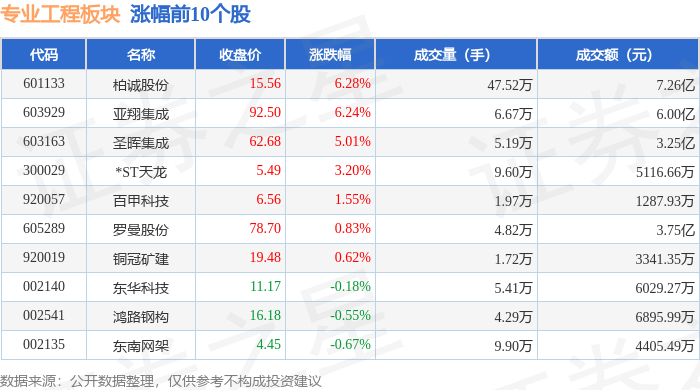
Market Overview - The professional engineering sector experienced a decline of 1.4% on December 16, with Shanghai Port leading the drop [1] - The Shanghai Composite Index closed at 3824.81, down 1.11%, while the Shenzhen Component Index closed at 12914.67, down 1.51% [1] Stock Performance - Notable gainers in the professional engineering sector included: - Xiangcheng Co., Ltd. (601133) with a closing price of 15.56, up 6.28% and a trading volume of 475,200 shares, totaling 726 million yuan [1] - Yaxiang Integration (603929) closed at 92.50, up 6.24% with a trading volume of 66,700 shares, totaling 600 million yuan [1] - Shenghui Integration (603163) closed at 62.68, up 5.01% with a trading volume of 51,900 shares, totaling 325 million yuan [1] - Conversely, significant decliners included: - Feifei History (605598) with a closing price of 47.91, down 7.12% and a trading volume of 122,200 shares, totaling 597 million yuan [2] - Nengjing Technology (301046) closed at 27.98, down 6.48% with a trading volume of 69,100 shares, totaling 197 million yuan [2] - Libet (605167) closed at 10.84, down 4.24% with a trading volume of 138,000 shares, totaling 151 million yuan [2] Capital Flow - The professional engineering sector saw a net outflow of 239 million yuan from institutional investors, while retail investors experienced a net inflow of 196 million yuan [2] - The capital flow for specific stocks indicated: - Xiangcheng Co., Ltd. (601133) had a net inflow of 101 million yuan from institutional investors, but a net outflow of 932 million yuan from retail investors [3] - Shenghui Integration (603163) recorded a net inflow of 38 million yuan from institutional investors, with a net outflow of 285 million yuan from retail investors [3] - Yaxiang Integration (603929) had a net inflow of 245 million yuan from institutional investors, but a net outflow of 813 million yuan from retail investors [3]

上海港湾20251210
2025-12-11 02:16
Summary of Shanghai Port Bay Conference Call Company and Industry Overview - **Company**: Shanghai Port Bay, focusing on commercial aerospace and space power systems through its subsidiary Shanghai Fuxi Starry Sky Technology Co., Ltd. [2][3] - **Industry**: Commercial aerospace, specifically in satellite power systems and solar energy technology. Key Points and Arguments - **Product Performance**: Shanghai Fuxi's core power systems have supported 19 successful satellite launches, with 49 satellite power systems and solar panels operating in orbit with zero faults. [2][3] - **New Orders**: In the first half of 2025, the company secured new orders worth 34.02 million yuan, participating in multiple national satellite constellation projects, covering nearly 21 leading commercial aerospace companies. [2][3] - **Patents and Technology**: The company holds 19 core patents related to commercial aerospace energy systems and focuses on space-grade perovskite power generation technology, which has been validated in harsh environmental tests. [2][5] - **Production Capacity**: In 2023, the company launched a space-grade solar cell production line and a flexible solar array assembly line, enabling short-cycle mass delivery to meet the rapid development needs of commercial aerospace. [2][5] - **Market Share**: The complete satellite power system accounts for approximately 15% of the total satellite value, with major clients including Changguang Satellite and Time Space Path. [2][7] - **Competitive Advantage**: The perovskite solar cells offer high cost-performance and stable power generation, with four related verification satellites currently operating in orbit. [2][9] - **Team and Incentives**: The core team holds a 20% stake, expected to reach 30%, with ongoing stock incentive plans to ensure long-term stability. [4][12] Additional Important Insights - **International Expansion**: The company is actively exploring overseas markets, particularly in Southeast Asia, the Middle East, and Europe, and is participating in international airshows to facilitate overseas orders. [4][14] - **Future Production Plans**: The production line is expected to support a revenue of 100 million yuan, with plans for rapid expansion to meet increasing order volumes. [15] - **Technological Development**: The company anticipates that perovskite technology will gradually enter the industrialization phase in the coming years, although challenges remain in scaling up production and addressing energy bottlenecks. [9][19] - **Market Trends**: The U.S. market is exploring new aerospace-grade solar materials, which may provide opportunities for the company to enter their supply chain if sufficient in-orbit verification data is accumulated. [13][14] - **Optimistic Outlook**: The company maintains a positive outlook for future development, expecting a return to normal profit levels in its main business by 2026, despite current domestic market challenges. [20][21]
上海港湾涨5.51%,成交额13.09亿元,近3日主力净流入2.10亿
Xin Lang Cai Jing· 2025-12-08 07:51
Core Viewpoint - Shanghai Port Construction (Group) Co., Ltd. is focusing on innovative solutions in the commercial aerospace energy sector, leveraging its strong technical capabilities and partnerships to drive growth in satellite power systems and soil remediation projects along the Belt and Road Initiative [2][3][4]. Group 1: Company Overview - Shanghai Port Construction was established on January 28, 2000, and listed on September 17, 2021, with its main business involving geotechnical engineering, including foundation treatment and pile foundation engineering [9]. - The company's revenue composition includes 64.93% from foundation treatment, 19.49% from pile foundation engineering, and 15.58% from other services [9]. - As of September 30, 2025, the company reported a revenue of 1.13 billion yuan, a year-on-year increase of 19.64%, while the net profit attributable to shareholders decreased by 27.25% to 79.20 million yuan [9]. Group 2: Business Developments - The subsidiary, Shanghai Fuxi Xinkong Technology Co., Ltd., focuses on energy solutions for satellites and spacecraft, achieving significant results with its products supporting the launch of 15 satellites and maintaining over 40 satellite power systems in stable operation [2][3]. - The company has established a robust customer base, collaborating with over 20 satellite organizations, including industry leaders such as Changguang Satellite, Jun Tian Hang Yu, and Xinguang Communication [2][3]. - The company is actively involved in soil remediation projects in coastal areas and along the Belt and Road, utilizing its proprietary "high vacuum" technology to provide green solutions and improve local ecological environments [3][4]. Group 3: Financial Performance and Market Position - The company reported an overseas revenue share of 83.01%, benefiting from the depreciation of the RMB [5]. - The stock experienced a price increase of 5.51% on December 8, with a trading volume of 1.309 billion yuan and a turnover rate of 10.71%, bringing the total market capitalization to 12.173 billion yuan [1]. - The average trading cost of the stock is 42.72 yuan, with the current price approaching a resistance level of 51.64 yuan, indicating potential for upward movement if this level is surpassed [8].
上海港湾涨停,成交额6.23亿元,近5日主力净流入1.53亿
Xin Lang Cai Jing· 2025-12-05 07:29
Core Viewpoint - Shanghai Port Construction (Group) Co., Ltd. is actively expanding its business in satellite navigation, commercial aerospace, and soil remediation, benefiting from the Belt and Road Initiative and the depreciation of the RMB [2][3][5]. Group 1: Company Overview - Shanghai Port Construction was established on January 28, 2000, and listed on September 17, 2021, focusing on geotechnical engineering services such as foundation treatment and pile foundation engineering [9]. - The company's main business revenue composition includes foundation treatment (64.93%), pile foundation engineering (19.49%), and other services (15.58%) [9]. - As of September 30, 2025, the company reported a revenue of 1.13 billion yuan, a year-on-year increase of 19.64%, while the net profit attributable to shareholders decreased by 27.25% to 79.20 million yuan [9]. Group 2: Business Developments - The subsidiary, Shanghai Fuxi Xinkong Technology Co., Ltd., focuses on providing lightweight, low-cost, and high-performance space energy system solutions, having successfully supported the launch of 15 satellites and maintained over 40 satellite power systems in stable operation [2][3]. - The company has established a robust customer matrix, collaborating with over 20 satellite organizations, including industry leaders such as Changguang Satellite, Jun Tian Aerospace, and Xingsheng Power [2][3]. - The company has implemented its technologies in various coastal provinces in China and has expanded its services to Southeast Asian countries along the Belt and Road, completing over 20 projects related to soft soil foundation treatment [4]. Group 3: Financial Performance and Market Activity - The company achieved an overseas revenue share of 83.01%, benefiting from the depreciation of the RMB [5]. - On December 5, the stock price of Shanghai Port Construction reached its daily limit, with a trading volume of 623 million yuan and a turnover rate of 5.56%, resulting in a total market capitalization of 11.54 billion yuan [1]. - The main capital inflow for the day was 212 million yuan, with a slight increase in main capital positions over the past two days [6][7].
上海港湾跌9.03%,成交额7.78亿元,近3日主力净流入-9954.39万
Xin Lang Cai Jing· 2025-12-03 10:34
Core Viewpoint - Shanghai Port Construction (Group) Co., Ltd. is focusing on innovative solutions in the commercial aerospace energy sector, leveraging its strong technical capabilities and partnerships to drive growth in satellite power systems and soil remediation projects along the Belt and Road Initiative [2][3][4]. Company Overview - Shanghai Port Construction was established on January 28, 2000, and listed on September 17, 2021, with its main business involving foundation treatment and pile foundation engineering [9]. - The company's revenue composition includes foundation treatment (64.93%), pile foundation engineering (19.49%), and other services (15.58%) [9]. Financial Performance - For the period from January to September 2025, the company achieved a revenue of 1.13 billion yuan, representing a year-on-year growth of 19.64%, while the net profit attributable to shareholders decreased by 27.25% to 79.20 million yuan [9]. - The company has distributed a total of 102 million yuan in dividends since its A-share listing, with 95.92 million yuan distributed over the past three years [10]. Business Segments - The company’s subsidiary, Shanghai Fuxi Xinkong Technology Co., Ltd., specializes in providing lightweight, low-cost, and high-performance space energy systems, having successfully supported the launch of 15 satellites and maintained over 40 satellite power systems in stable operation [2][3]. - The company is actively involved in soil remediation and foundation treatment projects in coastal provinces and along the Belt and Road countries, completing over 20 projects that enhance local ecological environments and contribute to sustainable development [3][4]. Market Dynamics - The company benefits from the depreciation of the RMB, with overseas revenue accounting for 83.01% of total revenue [5]. - The stock has experienced a recent decline, with a drop of 9.03% on December 3, 2023, and a trading volume of 778 million yuan, indicating a high turnover rate of 7.34% [1].
商业航天:奇点时刻,航天强国
Soochow Securities· 2025-12-03 07:30
Investment Rating - The report provides a positive investment outlook for the commercial aerospace industry, highlighting significant growth opportunities driven by technological advancements and market demand [2]. Core Insights - The commercial aerospace sector is characterized by market-driven activities involving both private and mixed-ownership enterprises, focusing on investment, operation, and risk management across the entire aerospace value chain [2][38]. - Global satellite frequency and orbital resources are becoming increasingly scarce, leading to a surge in satellite constellation construction, with countries competing for these critical resources [2][46]. - The Starlink project by SpaceX is leading the global satellite constellation efforts, while China is rapidly advancing with its own satellite constellation plans [2][47]. - The era of reusable rockets in China is beginning, with several new commercial rocket models expected to launch by the end of 2025, which could accelerate the deployment of low Earth orbit satellite constellations [2][34]. - Investment recommendations include focusing on satellite manufacturing, rocket launching, and space computing, with specific companies highlighted for their potential in these areas [2][34]. Summary by Sections Commercial Aerospace Overview - Commercial aerospace is defined as market-driven activities involving investment, operation, and risk management by enterprises, covering the entire aerospace technology development, manufacturing, launching, and application [2][38]. - The industry is segmented into upstream manufacturing, midstream launching, and downstream application and operation [2][38]. Satellite Industry Overview - The global aerospace industry is projected to reach $415 billion by 2024, with satellite industry revenues estimated at $293 billion [20]. - Satellite services account for 37% of the total satellite industry revenue, while satellite manufacturing and launching services contribute 6.9% and 3.2%, respectively [25]. Satellite Communication Market - The satellite communication market is expected to grow significantly, with China's satellite internet market projected to reach 75.1 billion yuan by 2025 and 151.2 billion yuan by 2030 [34]. - The demand for satellite communication is primarily driven by commercial and government sectors, accounting for 55% and 31% of the market, respectively [28]. Domestic Satellite Constellation Plans - China has ambitious plans for satellite constellations, with three major projects aiming to deploy over 30,000 satellites, including the GW constellation, G60 constellation, and Honghu-3 constellation [79][81]. - As of October 2025, the GW constellation has launched 116 satellites, marking significant progress in China's satellite internet development [84].




商业航天概念震荡走弱 航天动力触及跌停
Xin Lang Cai Jing· 2025-12-03 02:13
Group 1 - The commercial aerospace sector is experiencing a downturn, with significant declines in stock prices [1] - Aerospace Power has hit the daily limit down, indicating severe market pressure [1] - Other companies in the sector, including Qianzhao Optoelectronics, Aerospace Hongtu, Shanghai Port Bay, Aerospace Huanyu, Aerospace Technology, Aerospace Morning Light, Leike Defense, and Tianyi New Materials, have also seen declines, with Qianzhao Optoelectronics dropping over 9% [1]


把服务器“送上天”,提前布局哪些产业链?丨每日研选
Shang Hai Zheng Quan Bao· 2025-12-02 01:17
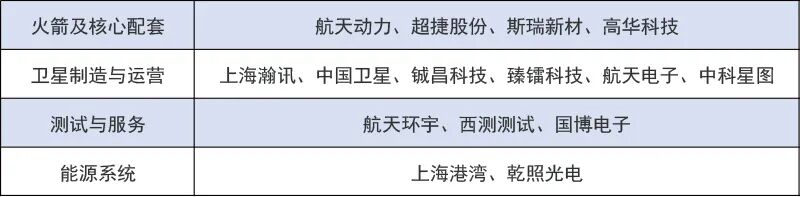
Core Insights - The establishment of a new department by the National Space Administration marks a significant step towards the commercialization of space, driven by policy and disruptive applications [1] - The concept of "space computing power" is emerging as a focal point for global tech giants, with plans for large-scale data centers in orbit to enhance AI capabilities [2] - Investment opportunities are identified in various sectors of the space industry, including rocket launch chains, satellite manufacturing, and testing services [3] Policy Developments - The National Space Administration's creation of a Commercial Space Department aims to improve the efficiency of launch approvals and licensing, promoting high-quality development in China's commercial space sector [1] - The release of the "Action Plan for Promoting High-Quality and Safe Development of Commercial Space (2025-2027)" provides a framework for long-term industry growth through research project openness and national fund establishment [1] Industry Trends - The trend of deploying data centers in space is expected to overcome limitations faced by terrestrial data centers, with significant investments from companies like NVIDIA, SpaceX, and Google [2] - The demand for AI computing and decreasing rocket launch costs are anticipated to drive substantial growth in space computing power globally [2] Investment Opportunities - Key sectors for investment include: - Rocket and core supporting fields: Companies such as Aerospace Power, Superjet, Srey New Materials, and Gaohua Technology [3][4] - Satellite manufacturing and operation: Companies like China Satellite, Chengchang Technology, Zhenlei Technology, Aerospace Electronics, and Zhongke Xingtou [3][4] - Testing and service sectors: Companies including Aerospace Universe, West Measurement Testing, and Guobo Electronics [3][4] - Energy systems: Companies such as Shanghai Port and Qianzhao Optoelectronics [3][4]

商业航天司官宣!回顾前期天上能源及商业火箭推荐观点
2025-12-01 00:49
Summary of Key Points from the Conference Call Industry Overview - The conference call focuses on the commercial aerospace industry, particularly developments in satellite launches and space computing capabilities [1][2][4]. Core Insights and Arguments - **Satellite Launches**: China Star Network is accelerating satellite launches, with an expectation to complete around 120 first-generation satellites by the end of 2025. A total of 324 enhanced satellites will be launched in the coming years, with a large-scale tender for second-generation satellites expected to start in early 2026, potentially reaching close to 1,000 satellites [1][2][3]. - **Production Capacity**: The Hainan Wenchang Aerospace City is set to produce its first satellite by the end of this year, aiming for a production capacity of 100 rockets and 1,000 satellites by 2027, and increasing to 150 rockets and 1,500 satellites by 2028 [1][3]. - **Reusable Rocket Technology**: Breakthroughs in reusable rocket technology are anticipated by 2027, which will significantly reduce launch costs. The cost per kilogram for heavy rockets could drop to a few hundred dollars with multiple recoveries [2][3][12]. - **Space Data Centers**: Beijing's "Starry Future" and "Orbital Dawn" are developing a space data center with a capacity of 1 GW, planned to be operational in phases from 2025 to 2035. The first phase aims for 200 kW and 1,000 PFlops of computing power [4][5]. - **Commercialization of Space Computing**: Domestic space computing has begun commercial operations, with "Trinity Computing" deploying 12 satellites with 5 PFlops of computing power, planning to expand to 2,800 satellites for a total of 10 billion FLOPS [4][5]. Additional Important Content - **Advantages of Space Data Centers**: Space data centers can operate 24/7 using solar energy, achieving five times the efficiency of ground-based systems. Their deployment and operational costs are significantly lower, with costs being one-fourth of ground-based centers [9][10]. - **Challenges in Space Computing**: The demand for data processing in space is increasing, with traditional methods being inefficient. The need for onboard processing to reduce data transmission back to Earth is critical [7][8]. - **Investment Opportunities**: Companies involved in solar energy systems for space data centers, such as Shanghai Port Bay and Tianzhou Optoelectronics, are highlighted as potential investment opportunities. The demand for solar arrays is expected to surge, with significant market potential for companies providing these technologies [10][18]. Conclusion - The commercial aerospace industry is poised for significant growth, driven by advancements in satellite technology, reusable rockets, and space computing capabilities. Investors are encouraged to focus on companies that are positioned to benefit from these trends, particularly in the areas of satellite production and space data center development [11][16][17].



