QuantumCTek(688027)

Search documents
科创板百元股达65只,寒武纪-U股价最高
Zheng Quan Shi Bao Wang· 2025-11-17 09:59
Core Insights - The average stock price of the STAR Market is 39.93 yuan, with 65 stocks priced over 100 yuan, the highest being Cambrian-U at 1303.10 yuan [1][2] - A total of 243 stocks rose while 344 stocks fell today on the STAR Market, with the average price of stocks over 100 yuan increasing by 0.08% [1] - The average premium of stocks over their issue price for those priced over 100 yuan is 509.29%, with the highest premiums seen in companies like Shuwei New Materials and Cambrian-U [1] Stock Performance - Cambrian-U closed at 1303.10 yuan, down 1.65%, followed by Yuanjie Technology at 527.01 yuan and GuoDun Quantum at 488.18 yuan [1][2] - Among the stocks priced over 100 yuan, 29 stocks increased, with notable gainers including Tengjing Technology and Xinyuan Shares, while 36 stocks decreased, with significant losses in companies like JiaoCheng Ultrasound and TuoJing Technology [1][2] Fund Flow - The net outflow of main funds from stocks priced over 100 yuan today was 1.42 billion yuan, with significant inflows into Xinyuan Shares and Tengjing Technology [2] - The total margin balance for stocks priced over 100 yuan is 89.03 billion yuan, with Cambrian-U and SMIC having the highest margin balances [2] Industry Distribution - The stocks priced over 100 yuan are primarily concentrated in the electronics, pharmaceutical, and computer industries, with 31, 9, and 8 stocks respectively [1]


通信设备板块11月17日涨1.22%,富士达领涨,主力资金净流出14.18亿元
Zheng Xing Xing Ye Ri Bao· 2025-11-17 09:00
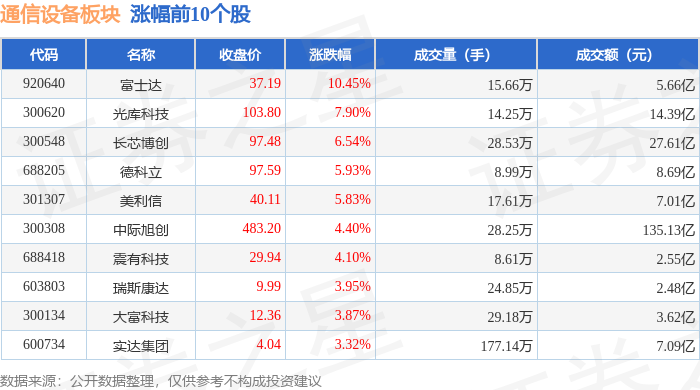
Core Insights - The communication equipment sector experienced a rise of 1.22% on November 17, with Fujitsu leading the gains [1] - The Shanghai Composite Index closed at 3972.03, down 0.46%, while the Shenzhen Component Index closed at 13202.0, down 0.11% [1] Stock Performance - Fujitsu (920640) closed at 37.19, up 10.45% with a trading volume of 156,600 shares and a transaction value of 566 million [1] - Other notable gainers include: - Guangku Technology (300620) at 103.80, up 7.90% [1] - Changxin Bochuang (300548) at 97.48, up 6.54% [1] - Dekeli (688205) at 97.59, up 5.93% [1] - Meilixin (301307) at 40.11, up 5.83% [1] Fund Flow Analysis - The communication equipment sector saw a net outflow of 1.418 billion from institutional investors and 156 million from speculative funds, while retail investors had a net inflow of 1.574 billion [2] - Key stocks with significant fund flow include: - Zhongji Xuchuang (300308) with a net inflow of 705 million from institutional investors [3] - Guodun Quantum (688027) with a net inflow of 144 million [3] - Changfei Fiber (601869) with a net inflow of 100 million [3]




公司问答丨国盾量子:公司可提供除芯片外的量子计算机整机解决方案 主要技术路线聚焦在超导领域
Ge Long Hui A P P· 2025-11-17 08:51
Core Viewpoint - The company, GuoDun Quantum, is actively engaged in the development of quantum computing technology, focusing on superconducting technology and collaborating with research institutions to enhance its capabilities in this field [1] Group 1: Quantum Computing Development - The company has established horizontal collaborations with research institutions such as the University of Science and Technology of China to develop quantum computing chips [1] - GuoDun Quantum offers complete quantum computing solutions beyond just chips, including measurement and control systems, dilution refrigerators, and other core components [1] - The company is committed to core technology breakthroughs and product development through self-research and partnerships with leading research teams [1] Group 2: Market Positioning - The company has successfully delivered products to downstream research and industrial clients, indicating its active role in the market [1] - The focus on superconducting technology positions the company strategically within the quantum computing industry [1]
搭载“祖冲之三号”同款芯片超导量子计算机“天衍-287”建成
Ke Ji Ri Bao· 2025-11-17 08:49
Core Insights - China Telecom's Quantum Research Institute announced the completion of the "Tianyan-287" superconducting quantum computer, which features 105 data qubits and 182 coupling qubits, developed in collaboration with Keda Guo Shield Quantum Technology Co., Ltd [1] - The quantum computing system demonstrates "quantum computing superiority," processing specific problems 450 million times faster than the fastest supercomputer, marking a significant step in China's push for practical quantum computing [1] - The "Tianyan" quantum computing cloud platform will be launched globally, providing application services and enhancing China's competitiveness in the quantum computing sector [1] Group 1 - The construction of the quantum computer reflects breakthroughs in three areas: "fully domestic," "AI empowerment," and "super quantum integration" [2] - The hardware and components used in the construction were entirely domestically produced, establishing a fully domestic supply chain for superconducting quantum computing [2] - An AI-enabled automatic calibration system for superconducting chips was developed, achieving efficient and precise calibration and maintenance of the quantum computing system [2] Group 2 - The "Tianyan" quantum computing cloud platform integrates Tianyi Cloud supercomputing capabilities with 176 qubits of superconducting quantum computing, currently serving over 37 million users across more than 60 countries [2] - The number of experimental tasks on the "Tianyan" platform has exceeded 2.7 million, indicating strong user engagement and application potential [2] - The company aims to provide computational support to more industry users and research institutions, expanding the application boundaries of quantum computing [3]
国盾量子(688027.SH):在量子计算领域,公司可提供除芯片外的量子计算机整机解决方案
Ge Long Hui· 2025-11-17 08:02
Core Viewpoint - GuoDun Quantum (688027.SH) emphasizes its collaboration with research institutions like the University of Science and Technology of China for the development of quantum computing chips and solutions [1] Company Overview - The company provides complete quantum computing solutions beyond just chips, focusing on superconducting technology [1] - It engages in both self-research and collaboration with leading research teams to tackle core technology challenges and product development [1] Product Offerings - GuoDun Quantum offers key components such as measurement and control systems, dilution refrigerators, and complete quantum computing systems [1] - The products have already been delivered to downstream research and industrial clients [1]
触摸“十五五”产业脉搏丨产业链“拼图”加速完善 量子科技厚积薄发
Xin Hua She· 2025-11-17 02:08
Core Insights - Quantum technology is transitioning from theoretical research to practical applications, with significant advancements in quantum computing, communication, and precision measurement [2][3][4] - The industry is experiencing rapid development, with key breakthroughs in quantum computing technology and the establishment of a more complete industrial chain [4][5][6] - Government policies are increasingly supportive of quantum technology, aiming to make it a new economic growth point during the 14th Five-Year Plan period [7][8] Industry Overview - Quantum technology encompasses three main sectors: quantum computing, quantum communication, and quantum precision measurement, each at different stages of development [2] - The market potential for quantum computing is enormous, with expectations for commercial breakthroughs in the next two years [2][4] - Quantum communication has already seen practical applications, providing solutions for secure communication in various sectors [2][3] Technological Advancements - Recent advancements include the development of the "Han Yuan 1" quantum computer, which has begun commercial applications and secured orders exceeding 40 million yuan [4] - The emergence of domestic companies capable of producing dilution refrigerators marks a significant step in supporting quantum computing infrastructure [5][6] - Companies are focusing on miniaturizing quantum key distribution devices and enhancing quantum computing hardware capabilities [6] Policy and Future Outlook - The Chinese government is prioritizing quantum technology in its economic planning, indicating a strong commitment to fostering this sector [7] - The introduction of targeted financial support mechanisms is expected to mitigate risks and enhance investment in quantum technology [7] - The industry anticipates significant growth in the next five years, driven by improved research and development, productization, and application of quantum technologies [8]
超导量子计算机“天衍-287”搭建完成,全球量子竞赛加速,产业进入蓬勃发展阶段
Xin Lang Cai Jing· 2025-11-15 08:29
Core Insights - The "Tianyan-287" superconducting quantum computer, equipped with the same chip as "Zuchongzhi 3," has been completed and demonstrates "quantum computing superiority," processing specific problems 450 million times faster than the fastest supercomputers [1] - The "Tianyan" quantum computing cloud platform, launched in November 2023, has surpassed 37 million visits and serves users from over 60 countries, with more than 2.7 million experimental tasks completed [1] - The global quantum computing landscape is still in the research and early application exploration phase, with significant contributions from both domestic and international players, including Google, IBM, and various Chinese companies [2] Industry Overview - Quantum computing's parallel computing capabilities offer advantages in critical areas such as cryptography, big data optimization, materials design, and drug analysis, but practical applications are still under development [2] - Major companies, including Google, IBM, and Microsoft, have launched quantum computing cloud services to lower usage barriers and costs, fostering industry collaboration [3] - The UK National Quantum Computing Centre predicts that by 2027, the market demand for NISQ quantum computers will reach between £20 billion and £35 billion, equivalent to approximately RMB 180 billion to RMB 315 billion [3] Market Trends - The quantum computing commercialization race is expected to accelerate, with significant advancements anticipated in the coming years, particularly in superconducting quantum computing [4] - The "Zuchongzhi 3" chip is expected to achieve rapid performance improvements by 2025, marking a pivotal moment in the industry [4] - Investment opportunities in the quantum information sector are recommended, with companies like Guandun Quantum, Hexin Instruments, and others identified as potential beneficiaries [4]
快4.5亿倍!量子计算,有新消息
财联社· 2025-11-14 13:04
Core Viewpoint - The successful construction of the "Tianyan-287" superconducting quantum computer marks a significant advancement in China's efforts to promote the practical application of quantum computing, showcasing the country's capabilities in developing a fully domestic quantum computing supply chain and integrating AI technology for enhanced performance [1][4]. Group 1: Quantum Computer Development - The "Tianyan-287" quantum computer features 105 data qubits and 182 coupling qubits, developed by China Telecom Quantum Group in collaboration with Keda Guandun Quantum Technology Co., Ltd [1]. - This quantum computing system demonstrates "quantum computing superiority," processing specific problems 450 million times faster than the fastest supercomputers currently available [4]. Group 2: Technological Breakthroughs - The construction process highlighted three key technological breakthroughs: full domestic production, AI empowerment, and ultra-large integration [4]. - All hardware and components used in the quantum computer were developed and produced by domestic manufacturers, establishing a fully domestic superconducting quantum computing supply chain [4]. - An AI-enabled automatic calibration system for superconducting chip parameters was developed, allowing for efficient and precise calibration and maintenance of the quantum computing system [4]. Group 3: Cloud Platform Integration - In November 2023, the "Tianyan" quantum computing cloud platform was officially launched, integrating Tianyi Cloud supercomputing capabilities with 176 qubits of superconducting quantum computing power [5]. - The platform has surpassed 37 million visits and serves users in over 60 countries, with more than 2.7 million experimental tasks completed [5]. - The goal is to provide computational support to various industry users and research institutions, expanding the application boundaries of quantum computing and enhancing China's core competitiveness in this field [5].
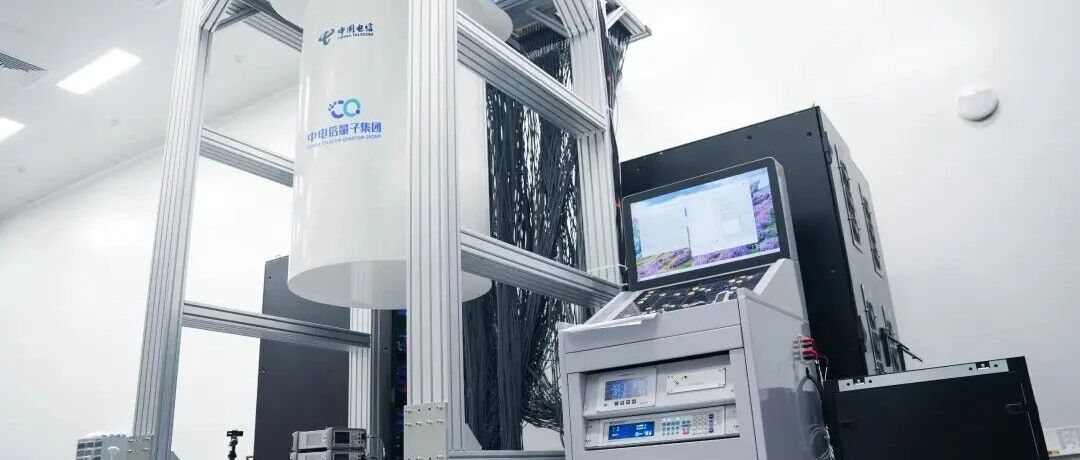
“天衍-287”搭建完成 量子计算迈出重要一步
Zheng Quan Ri Bao Wang· 2025-11-14 10:59
Core Insights - China Telecom has successfully built the superconducting quantum computer "Tianyan-287," which utilizes the same chip as "Zuchongzhi No. 3" and demonstrates "quantum computing superiority" by processing specific problems 450 million times faster than the fastest supercomputers [1][2] - The "Tianyan-287" quantum computing system is set to connect to the "Tianyan" quantum computing cloud platform, marking it as China's first cloud platform with quantum computing superiority, a significant step towards practical applications of quantum computing [1][2] Technical Aspects - "Tianyan-287" features 105 data qubits and 182 coupling qubits, developed by China Telecom's subsidiary, China Telecom Quantum Information Technology Group, in collaboration with GuoDun Quantum Technology Co., Ltd [2] - The construction of the quantum computer showcases breakthroughs in "fully domestic," "AI empowerment," and "super fusion" technologies, with all critical components sourced from domestic manufacturers, establishing a fully localized superconducting quantum computing supply chain [2] System Integration - The integration and debugging of the entire system were key focuses during the construction process, ensuring the stability of the domestic quantum "refrigerator" under high thermal loads, which is essential for the superconducting chip's low-temperature and low-noise operational environment [2] Industry Implications - The quantum computing cloud platform serves as a crucial infrastructure for future applications and is a strategic pivot for building a complete quantum industry ecosystem, facilitating the transition of quantum computing from laboratory research to practical applications [3] - The platform aims to provide computational support to various industry users and research institutions, expanding the application boundaries of quantum computing and enhancing China's core competitiveness and influence in this international frontier [3]

解密主力资金出逃股 连续5日净流出632股
Zheng Quan Shi Bao Wang· 2025-11-14 09:34
Core Insights - As of November 14, a total of 632 stocks in the Shanghai and Shenzhen markets have experienced a net outflow of main funds for five consecutive days or more [1] - The stock with the longest continuous net outflow is Jianyan Institute, with 19 days, followed by Baoding Technology with 18 days [1] - The largest total net outflow amount is from Zhinan Zhen, totaling 5.913 billion yuan over 12 days, followed by Sanhua Intelligent Control with 4.755 billion yuan over 6 days [1] Summary by Categories Continuous Net Outflow Stocks - Jianyan Institute has the longest net outflow at 19 days [1] - Baoding Technology follows with 18 days of net outflow [1] Total Net Outflow Amount - Zhinan Zhen leads with a net outflow of 5.913 billion yuan over 12 days [1] - Sanhua Intelligent Control has a net outflow of 4.755 billion yuan over 6 days [1] - Shenghong Technology and Zhongke Shuguang have net outflows of 3.628 billion yuan and 2.374 billion yuan respectively over 6 days [1] Proportion of Net Outflow to Trading Volume - ST Jinhong has the highest proportion of net outflow to trading volume, with a 6-day decline of 8.77% [1] - Other notable stocks with significant net outflows include Guodun Quantum and China Shipbuilding, with respective net outflows of 2.249 billion yuan and 2.019 billion yuan [1]