
INTCO RECYCLING(688087)

Search documents
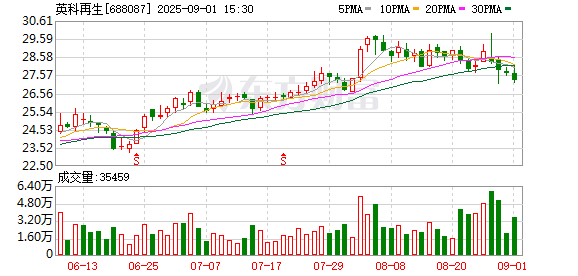
英科再生:累计回购公司股份848200股
Zheng Quan Ri Bao· 2025-09-01 11:41
Core Viewpoint - The company announced a share buyback program, indicating confidence in its financial health and future prospects [2] Summary by Categories Company Actions - The company plans to repurchase 848,200 shares, which represents 0.44% of its total share capital [2]


英科再生(688087) - 英科再生资源股份有限公司关于以集中竞价方式回购股份的进展公告
2025-09-01 08:30
证券代码:688087 证券简称:英科再生 公告编号:2025-051 英科再生资源股份有限公司 关于以集中竞价方式回购股份的进展公告 本公司董事会及全体董事保证本公告内容不存在任何虚假记载、误导性陈述 或者重大遗漏,并对其内容的真实性、准确性和完整性承担法律责任。 重要内容提示: 公司 2024 年度权益分派实施后,公司以集中竞价交易方式回购股份价格上限由 不超过人民币 41.44 元/股(含)调整为不超过人民币 41.38 元/股(含)。具体情况 详见公司披露于上海证券交易所网站(www.sse.com.cn)的《英科再生资源股份有 限公司关于 2024 年年度权益分派实施后调整回购股份价格上限的公告》(公告编 号:2025-036)。 二、回购股份的进展情况 根据《上市公司股份回购规则》《上海证券交易所上市公司自律监管指引第 7 号——回购股份》的相关规定,公司在回购期间,应当在每个月的前 3 个交易日 内公告截至上月末的回购进展情况。现将公司回购股份进展情况公告如下: | 回购方案首次披露日 | 2025/4/8 | | | | | --- | --- | --- | --- | --- | | 回购 ...
英科再生(688087.SH):已回购0.44%公司股份
Ge Long Hui A P P· 2025-09-01 08:12
Core Viewpoint - The company, 英科再生 (688087.SH), has announced a share buyback program, indicating a strategic move to enhance shareholder value and confidence in the company's future prospects [1] Summary by Categories Share Buyback Details - The company repurchased a total of 848,200 shares, which represents 0.44% of its total share capital [1] - The highest price paid for the shares was 28.48 CNY per share, while the lowest price was 25.43 CNY per share [1] - The total amount spent on the buyback was 23,011,177.05 CNY, excluding transaction fees [1]
【机构调研记录】金鹰基金调研迈瑞医疗、捷顺科技等11只个股(附名单)
Sou Hu Cai Jing· 2025-09-01 00:13
Group 1: Company Highlights - Mindray Medical launched the world's first clinically implemented critical care AI model and established an animal healthcare subsidiary [1] - Jieshun Technology's cloud-managed SaaS service increased to 16,600 lanes, with software and cloud service revenue reaching 125 million yuan, a year-on-year growth of 26.11% [1] - State Grid Information Technology reported a revenue of 3.525 billion yuan, a decrease of 4.55% year-on-year, while its virtual power plant business is being applied in multiple cities [2] - Inke Recycling focuses on high-value applications of recycled plastics, with significant growth in non-European markets and a projected dividend of 1.00 yuan per 10 shares [3] - ZaiJing Pharmaceutical achieved a revenue of 376 million yuan, a 56% increase, driven by sales growth of its drugs [4] - Tianzhihang reported a revenue of approximately 125 million yuan, a year-on-year increase of 114.89%, with significant growth in orthopedic surgical robot sales [5] - Aibo Medical's revenue reached 787 million yuan, a 14.72% increase, with a gross margin of 65.25% [6] - Mankalon's strategy focuses on expanding its presence in core urban areas and enhancing profitability of franchise stores [7] - Oulu Tong's revenue reached 2.12 billion yuan, a 32.59% increase, with data center power business revenue growing by 94.30% [8] - Sun Paper's special paper project is operational, with plans for further production capacity expansion [9] - Taili Technology is enhancing its market penetration and focusing on customized material solutions for various industries [10] Group 2: Financial Performance - Jieshun Technology's parking asset operation revenue grew by 49.86%, with new orders totaling 677 million yuan [1] - State Grid Information Technology's net profit decreased by 11.01% due to increased corporate income tax [2] - Inke Recycling's non-U.S. market revenue grew by 31.15% year-on-year [3] - ZaiJing Pharmaceutical's new drug approvals are expected to boost future sales [4] - Tianzhihang's orthopedic robot surgeries exceeded 22,000 cases, indicating strong market demand [5] - Aibo Medical's second-quarter revenue was 430 million yuan, a 14.44% increase year-on-year [6] - Oulu Tong's R&D expenses increased by 28.26%, reflecting investment in innovation [8] - Sun Paper's projects are expected to enhance its competitive position in the market [9]





英科再生(688087):2025H1中报点评:剔除汇兑损益后业绩同增32%,装饰建材业务增长强劲
Soochow Securities· 2025-08-28 12:45
Investment Rating - The investment rating for the company is "Buy" (maintained) [1] Core Views - The company achieved a revenue of 1.666 billion yuan in H1 2025, representing a year-on-year increase of 16.13%. The net profit attributable to shareholders was 146 million yuan, a decrease of 6.01% year-on-year, primarily due to foreign exchange losses. Excluding these losses, the net profit would have increased by 31.59% [7] - The revenue from the decoration and building materials business grew significantly, with a year-on-year increase of 38% in H1 2025, contributing to over 75% of total revenue [7] - The company plans to distribute a cash dividend of 0.1 yuan per share, totaling 19 million yuan, reflecting a dividend payout ratio of 13.3% [7] - The company is positioned as a leader in recycled plastics, with a global presence and a focus on high-value utilization of recycled plastic products, which is expected to enhance profitability as product categories expand and channels develop [7] Financial Summary - For 2023A, total revenue is projected at 2.455 billion yuan, with a year-on-year growth of 19.41%. The net profit attributable to shareholders is expected to be 195.65 million yuan, a decrease of 15.22% [1] - The company forecasts a net profit of 386.09 million yuan for 2025E, representing a growth of 25.63% [1] - The earnings per share (EPS) for 2025E is estimated at 1.99 yuan, with a price-to-earnings (P/E) ratio of 14.53 [1] - The company’s operating cash flow for H1 2025 was 245 million yuan, an increase of 17.50% year-on-year [7] - The company’s total assets are projected to reach 6.441 billion yuan by 2025E, with total liabilities of 3.439 billion yuan [8]
机构风向标 | 英科再生(688087)2025年二季度已披露前十大机构持股比例合计下跌1.31个百分点
Sou Hu Cai Jing· 2025-08-28 10:56
Group 1 - In the first half of 2025, 18 institutional investors disclosed holdings in Yingke Recycling (688087.SH), totaling 105 million shares, which represents 56.13% of the company's total share capital [1] - The top ten institutional investors hold a combined 55.67% of the shares, with a decrease of 1.31 percentage points compared to the previous quarter [1] Group 2 - One public fund, Qianhai Kaiyuan Event-Driven Mixed A, increased its holdings, while four new public funds were disclosed, including Guotai Juxin Value Advantage Flexible Allocation Mixed A and others [2] - Three social security funds reduced their holdings, with a total decrease of 0.55%, and one social security fund was not disclosed in the current period [2]
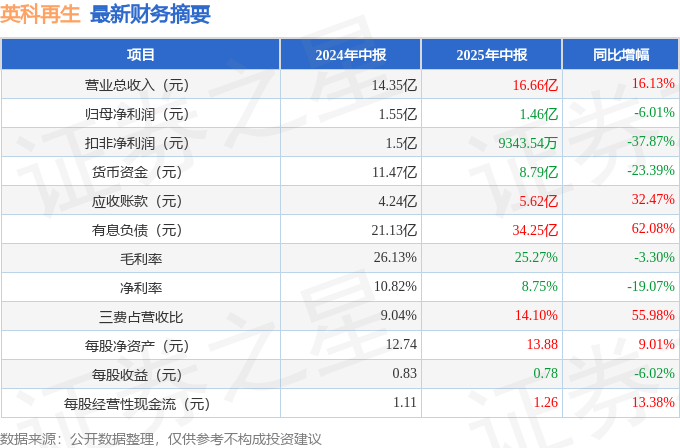
英科再生2025年中报简析:增收不增利,三费占比上升明显
Zheng Quan Zhi Xing· 2025-08-27 22:56
Core Viewpoint - The recent financial report of Inke Recycling (688087) shows a mixed performance with a revenue increase but a decline in net profit, highlighting rising operational costs and potential concerns regarding financial health [1] Financial Performance - Total revenue for the first half of 2025 reached 1.666 billion yuan, a year-on-year increase of 16.13% [1] - Net profit attributable to shareholders was 146 million yuan, down 6.01% year-on-year [1] - In Q2 2025, total revenue was 873 million yuan, up 8.98% year-on-year, while net profit was 73.5 million yuan, down 11.28% year-on-year [1] - Gross margin decreased to 25.27%, a decline of 3.3% year-on-year, and net margin fell to 8.75%, down 19.07% year-on-year [1] - Total expenses (selling, administrative, and financial) amounted to 235 million yuan, representing 14.1% of total revenue, an increase of 55.98% year-on-year [1] Key Financial Ratios - Return on Invested Capital (ROIC) for the previous year was 6.43%, indicating average capital returns [3] - Historical median ROIC since listing is 12.01%, with the worst year being 2023 at 6.04% [3] - Cash assets are reported to be healthy, but the company relies heavily on capital expenditures for performance [4] Debt and Cash Flow Analysis - The company has a debt ratio of 49.76% for interest-bearing liabilities, with total interest-bearing debt reaching 3.425 billion yuan, a 62.08% increase year-on-year [1][5] - Cash flow metrics indicate that cash assets cover only 72.55% of current liabilities, and the average operating cash flow over the past three years covers only 7.93% of current liabilities [5] Market Position and Fund Holdings - The largest fund holding Inke Recycling is the Yuanxin Yongfeng Youyue Life Mixed Fund, with 350,000 shares newly entered into the top ten holdings [7] - The fund's current size is 326 million yuan, with a recent net value of 2.2327, reflecting a 40.78% increase over the past year [7]
英科再生(688087):经营利润保持增长,越南三期提速推进,分红提升
NORTHEAST SECURITIES· 2025-08-27 07:45
Investment Rating - The report maintains a "Buy" rating for the company, indicating an expectation of stock price appreciation exceeding 15% over the next six months [5]. Core Insights - The company's operating profit continues to grow, with a reported revenue of 1.666 billion yuan for the first half of 2025, representing a year-on-year increase of 16.13%. However, the net profit attributable to shareholders decreased by 6.01% to 146 million yuan [1][2]. - The decline in net profit is primarily attributed to foreign exchange losses this year compared to gains in the same period last year. The significant drop in non-recurring net profit is due to changes in the structure of financial products [2]. - The company announced a cash dividend of 0.1 yuan per share, totaling 19 million yuan, which exceeds the total dividend for the entire year of 2024, with a payout ratio of 13.3% [1]. Financial Performance Summary - For Q2 2025, the company achieved a revenue of 873 million yuan, up 8.98% year-on-year, while the net profit attributable to shareholders was 74 million yuan, down 11.28% [1]. - The company reported a historical high in single-quarter revenue, driven by strong growth in decorative building materials and overseas markets, with non-US market revenue increasing by 31.15% year-on-year [3]. - The Vietnam subsidiary, which primarily exports to the US, generated 210 million yuan in revenue for H1 2025, marking a 49% increase year-on-year [3]. Future Outlook - The report highlights the company's advantages in the recycling-granulation-product chain and the potential for growth through new products and overseas capacity expansion. The company aims for a compound annual growth rate of 15% in revenue or net profit over the next five years [4]. - Forecasted net profits for 2025-2027 are 330 million, 374 million, and 448 million yuan, respectively, with corresponding price-to-earnings ratios of 16.98, 15.00, and 12.52 [4].
英科再生(688087):看好公司装饰建材和成品框收入增长
HTSC· 2025-08-27 05:28
Investment Rating - The report maintains a "Buy" rating for the company with a target price of RMB 31.46 [6][5]. Core Views - The company is expected to benefit from revenue growth in its finished frame and decorative building materials segments, driven by increased production capacity in Vietnam [1][4]. - The company's revenue for 1H25 reached RMB 1.666 billion, a year-on-year increase of 16.13%, while net profit attributable to shareholders was RMB 146 million, a decrease of 6.01% year-on-year [1][2]. - The report highlights the successful launch of the second phase of the Vietnam project and plans for a third phase, which is anticipated to further enhance revenue growth [4][5]. Revenue and Profitability - In 1H25, the company achieved revenue growth in its decorative building materials segment by 38.4% year-on-year, contributing significantly to overall revenue [2][3]. - The overall gross margin for the company in 1H25 was 25.27%, a slight decrease of 0.86 percentage points year-on-year [2][3]. Cost Management - The sales expense ratio decreased by 0.68 percentage points year-on-year, indicating improved efficiency in sales operations [3]. - Financial expenses increased significantly due to foreign exchange losses, primarily from the appreciation of the RMB against the USD [3]. Future Outlook - The company plans to invest approximately USD 40 million in the third phase of its Vietnam project, which is expected to be completed in 24 months and will significantly increase production capacity [4][5]. - The report projects an increase in net profit attributable to shareholders for 2025-2027, with expected earnings per share of RMB 1.63, 1.91, and 2.28 respectively [5][10].
英科再生上半年实现营收同比增长16.13% 海外产能加速释放
Zheng Quan Ri Bao Wang· 2025-08-27 01:43
Group 1 - The company achieved a revenue of 1.666 billion yuan in the first half of 2025, representing a year-on-year growth of 16.13%, with quarterly revenues of 793 million yuan in Q1 and 873 million yuan in Q2, setting historical records for the same period [1] - The net profit attributable to shareholders was 146 million yuan, with both revenue and net profit showing consistent growth, excluding non-operating factors such as exchange rate fluctuations [1] - The Chinese plastic processing industry demonstrated resilience, with total exports of plastics and related products exceeding the previous year's levels, indicating strong industry development [1] Group 2 - The company's overall export share approached 90%, serving over 130 countries, with more than 70% of revenue coming from the Europe and North America regions, showcasing sustained operational resilience [2] - The Vietnam production base, established in 2019, reported a revenue growth of 48.89% year-on-year, contributing approximately 3 percentage points to the company's overall revenue [2] - The company plans to distribute a cash dividend of 1 yuan per 10 shares to all shareholders, amounting to an estimated total cash dividend of 19.3386 million yuan [2]