
WST(688122)

Search documents
中证高端装备细分50指数下跌0.76%,前十大权重包含中航沈飞等
Jin Rong Jie· 2025-07-01 13:29
Core Insights - The A-share market indices closed mixed, with the CSI High-end Equipment Sub-index 50 declining by 0.76% to 2678.27 points, with a trading volume of 39.487 billion yuan [1] - The CSI High-end Equipment Sub-index 50 has increased by 9.78% over the past month, 10.73% over the past three months, and 10.78% year-to-date [1] - The index includes 50 representative listed companies involved in aerospace equipment manufacturing, aerospace power and control systems, microwave radar, satellite navigation, optoelectronic infrared, communication equipment, electronic components, information security, and aerospace materials [1] Index Composition - The top ten holdings of the CSI High-end Equipment Sub-index 50 are: AVIC Shenyang Aircraft (7.91%), Aero Engine Corporation of China (6.27%), AVIC Optoelectronics (6.23%), AVIC Xi'an Aircraft (4.75%), AVIC Aircraft (3.6%), China Great Wall (3.52%), Aerospace Electronics (3.37%), Haige Communication (3.31%), AVIC Chengfei (3.13%), and Western Superconducting (2.94%) [1] - The market distribution of the index holdings shows that the Shanghai Stock Exchange accounts for 54.26%, the Shenzhen Stock Exchange for 45.40%, and the Beijing Stock Exchange for 0.34% [2] - By industry, the index holdings are composed of 73.63% in industrials, 10.44% in materials, 8.17% in communication services, and 7.76% in information technology [2] Index Adjustment and Fund Tracking - The index samples are adjusted semi-annually, with adjustments implemented on the next trading day after the second Friday of June and December each year [2] - The tracking public funds for the CSI High-end Equipment Sub-index 50 include: Harvest CSI High-end Equipment Sub-index 50 Link A, Harvest CSI High-end Equipment Sub-index 50 Link C, and Harvest CSI High-end Equipment Sub-index 50 ETF [2]


中证国防指数上涨4.79%,前十大权重包含西部超导等
Jin Rong Jie· 2025-06-30 10:40
Core Viewpoint - The China Defense Index has shown significant growth, with a 7.56% increase over the past month and a 9.00% increase year-to-date, reflecting strong performance in the defense sector [1][2] Group 1: Index Performance - The China Defense Index rose by 4.79% to 1627.64 points, with a trading volume of 52.298 billion yuan [1] - The index has increased by 5.41% over the past three months [1] - The index was established on June 30, 2011, with a base value of 1000.0 points [1] Group 2: Index Composition - The top ten weighted companies in the China Defense Index include: AVIC Shenyang Aircraft (7.55%), AVIC Optoelectronics (6.24%), Aero Engine Corporation (6.03%), AVIC Xi'an Aircraft (4.62%), AVIC Avionics (3.55%), Haige Communications (3.38%), Aerospace Electronics (3.21%), Ruichuang Micro-Nano (3.03%), AVIC Chengfei (3.01%), and Western Superconducting (2.85%) [1] - The index is composed of companies that are either part of the top ten military industrial groups or have contracts with the military for equipment supply [1] Group 3: Market and Sector Breakdown - The Shanghai Stock Exchange accounts for 55.77% of the index holdings, while the Shenzhen Stock Exchange accounts for 44.23% [2] - The industrial sector dominates the index with a 74.71% share, followed by materials at 12.49%, information technology at 7.10%, and communication services at 5.70% [2] Group 4: Index Adjustment Mechanism - The index samples are adjusted biannually, with changes implemented on the next trading day after the second Friday of June and December [2] - Weight factors are generally fixed until the next scheduled adjustment, with special circumstances allowing for temporary adjustments [2]


军工周报:阅兵消息官宣,主战装备+新型作战力量将参-20250629
NORTHEAST SECURITIES· 2025-06-29 13:44
Investment Rating - The report rates the defense and military industry as "Outperforming the Market" [2] Core Views - The global geopolitical situation remains tense, with ongoing conflicts such as the Russia-Ukraine war and rising risks in the Middle East, leading to an intensified arms race and increased focus on military construction [4][38] - The defense industry is expected to see a recovery in demand as the "14th Five-Year Plan" approaches its final year, with long-term growth certainty supported by clear development goals for 2035 and 2050 [4] - The upcoming military parade on September 3 will showcase both traditional main battle equipment and new combat forces, highlighting advancements in military capabilities [3][40] Summary by Sections Market Review - The defense and military index rose by 6.90% last week, outperforming major indices such as the Shanghai Composite and Shenzhen Component [12] - The current PE (TTM) for the defense and military sector is 79.92 times, with sub-sectors showing varied valuations: aerospace equipment at 143.52 times, aviation equipment at 69.14 times, ground weapons at 174.36 times, naval equipment at 50.76 times, and military electronics at 102.36 times [20][21] Key Recommendations - Recommended companies include: 1. Downstream manufacturers: Hongdu Aviation, AVIC Shenyang Aircraft, AVIC Xi'an Aircraft, and AVIC Helicopter [4] 2. Military new technologies: Lianchuang Optoelectronics, Guangqi Technology, and Zhongjian Technology [4] 3. Underwater equipment: Hailanxin, Yaxing Anchor Chain, and Zhongke Haixun [4] 4. Missile industry chain: Feilihua, Guoke Military Industry, and Zhongbing Hongjian [4] 5. Military titanium materials: Western Superconducting [4] 6. Electronic components: Hongyuan Electronics and Aerospace Electronics [4] 7. Military trade direction: Zhongwu Drone [4] Industry Dynamics - Recent policies related to deep-sea technology indicate significant development potential, particularly for specialized equipment like UUVs, supported by top-level planning [3] - The military trade market is expanding, with recent announcements of procurement from Pakistan for Chinese fighter jets, indicating a growing opportunity in military exports [39]


西部超导: 国浩律师(西安)事务所关于西部超导材料科技股份有限公司2024年年度股东大会的法律意见书
Zheng Quan Zhi Xing· 2025-06-25 17:55
Core Viewpoint - The legal opinion letter from Guohao Law Firm confirms that the 2024 annual general meeting of Western Superconducting Technologies Co., Ltd. was convened and conducted in accordance with relevant laws and regulations, ensuring the legitimacy of the meeting and its resolutions [1][2][9]. Group 1: Meeting Procedures - The annual general meeting was scheduled for June 25, 2025, at 14:30 in the company's conference room, following the resolutions of the fifth meeting of the fifth board of directors and the company's articles of association [2][3]. - The meeting utilized a combination of on-site and online voting methods, with the on-site meeting held as planned [3][9]. Group 2: Attendance and Voting - A total of 10 shareholders and representatives attended the meeting on-site, representing 188,320,554 shares, which is 28.9874% of the total voting shares [3][5]. - Online voting was conducted through the Shanghai Stock Exchange's network voting system, with 288 shareholders participating, representing 147,490,583 shares, or 22.7026% of the total voting shares [5][9]. Group 3: Voting Results - The meeting passed various resolutions with significant support, including votes of 335,687,134 shares in favor, representing 99.9630% of the total votes cast [6][9]. - Other resolutions also received overwhelming approval, with votes in favor ranging from 99.1205% to 99.9776% across different proposals [7][8]. Group 4: Legal Compliance - The legal opinion asserts that the convening and conducting of the meeting, as well as the qualifications of attendees and the voting procedures, complied with the Company Law, Securities Law, and the company's articles of association [2][9].
西部超导(688122) - 国浩律师(西安)事务所关于西部超导材料科技股份有限公司2024年年度股东大会的法律意见书
2025-06-25 11:00
西安市高新区锦业路绿地中心 B 座 46 层 邮编:710065 联系电话:029-8819 9711 46th Floor, B Tower, Greenland Center, Jinye Road, High-tech District, Xi'an, Shaanxi, China 国浩律师(西安)事务所 关于西部超导材料科技股份有限公司 2024 年年度股东大会的 法律意见书 致:西部超导材料科技股份有限公司 根据《中华人民共和国证券法》(以下简称"证券法")《中华人民共和国 公司法》(以下简称"《公司法》")等法律、行政法规和规范性文件的规定, 国浩律师(西安)事务所(以下简称"本所"或"国浩")接受西部超导材料科 技股份有限公司(以下简称"公司"或"西部超导")的委托,指派律师出席公 司 2024 年年度股东大会(以下简称"本次股东大会"),并对本次股东大会的 相关事项进行见证,依法出具本法律意见书。 国浩及经办律师依据《证券法》《律师事务所从事证券法律业务管理办法》 和《律师事务所证券法律业务执业规则(试行)》等规定及本法律意见书出具日 以前已经发生或存在的事实,严格履行了法定职责,遵循了勤勉尽 ...
西部超导(688122) - 2024年年度股东大会决议公告
2025-06-25 11:00
本公司董事会及全体董事保证公告内容不存在任何虚假记载、误导性陈述或 者重大遗漏,并对其内容的真实性、准确性和完整性依法承担法律责任。 重要内容提示: 证券代码:688122 证券简称:西部超导 公告编号:2025-016 西部超导材料科技股份有限公司 2024年年度股东大会决议公告 本次会议是否有被否决议案:无 1、 公司在任董事9人,出席9人; 一、 会议召开和出席情况 (一) 股东大会召开的时间:2025 年 6 月 25 日 (二) 股东大会召开的地点:西部超导材料科技股份有限公司 103 会议室 (三) 出席会议的普通股股东、特别表决权股东、恢复表决权的优先股股东及 其持有表决权数量的情况: | 1、出席会议的股东和代理人人数 | 298 | | --- | --- | | 普通股股东人数 | 298 | | 2、出席会议的股东所持有的表决权数量 | 335,811,137 | | 普通股股东所持有表决权数量 | 335,811,137 | | 3、出席会议的股东所持有表决权数量占公司表决权数量的比例 | 51.6899 | | (%) | | | 普通股股东所持有表决权数量占公司表决权数量的比例(% ...
军工周报:全球地缘政治局势紧张,看好军工板块投资机会-20250622
NORTHEAST SECURITIES· 2025-06-22 11:13
Investment Rating - The report maintains a positive outlook on the defense and military industry, particularly in light of the current global geopolitical tensions, indicating a favorable investment opportunity in this sector [3][36]. Core Insights - The defense and military sector is expected to benefit from the recovery of demand and the elimination of previous disruptions, with a long-term growth certainty supported by national defense modernization goals set for 2035 and 2050 [5][38]. - The report highlights the increasing importance of drone technology in modern warfare, emphasizing its cost-effectiveness and operational advantages [4][36]. - The low-altitude economy is identified as a burgeoning sector, with significant policy support and commercial opportunities emerging [4][35]. Summary by Sections Market Review - The defense and military index fell by 2.01% last week, ranking 17th among 31 sectors, with a current PE(TTM) of 74.63 times [3][20]. - The sub-sectors show varying PE ratios, with aerospace equipment at 134.59 times and ground weaponry at 148.10 times [20]. Key Recommendations - Focus on companies with strong demand and product depth in the downstream manufacturing sector, such as Hongdu Aviation, AVIC Shenyang Aircraft, and AVIC Xi'an Aircraft [5][40]. - Highlight new technology firms in the military sector, including Lianchuang Optoelectronics and Guangqi Technology [5][40]. - Emphasize underwater equipment companies like Hailanxin and Yaxing Anchor Chain [5][41]. - Recommend missile industry chain companies such as Feilihua and Guokexun [5][42]. - Suggest companies involved in military-grade titanium materials and electronic components, including Western Superconducting and Hongyuan Electronics [5][43][44]. Industry Dynamics - The report notes that geopolitical tensions, particularly in the Middle East, are driving interest in military investments [3][36]. - The low-altitude economy is highlighted as a significant growth area, with various local governments implementing supportive measures to foster development [31][35].

小金属国外涨价有望逐步向国内传导,稀有金属ETF(562800)红盘震荡
Xin Lang Cai Jing· 2025-06-20 03:56
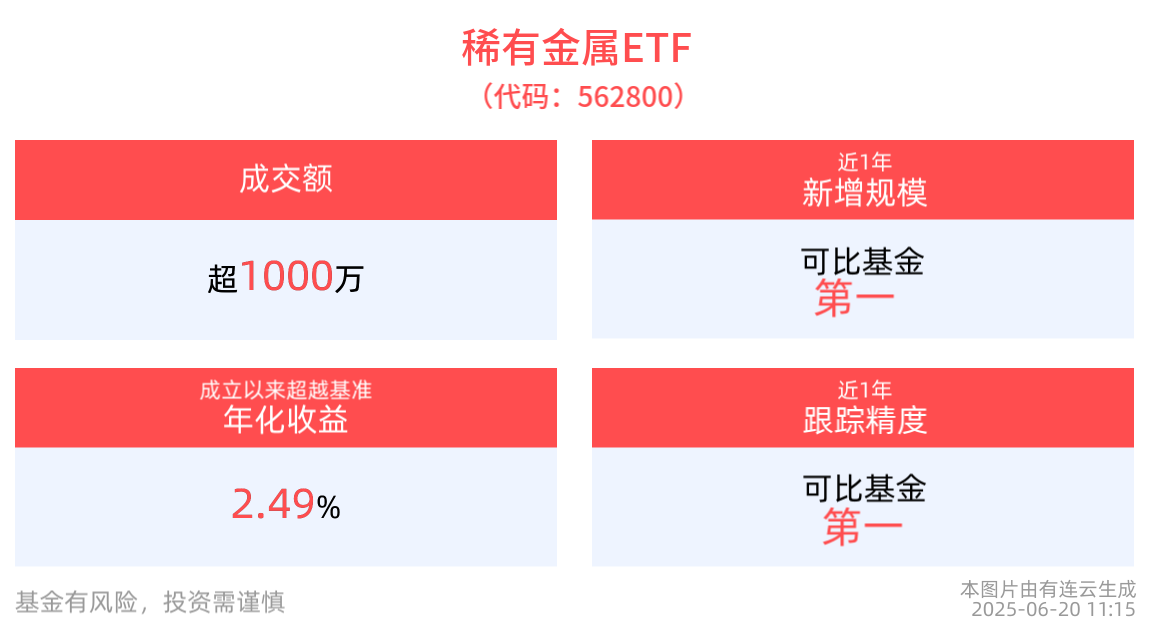
Group 1: Liquidity and Performance of Rare Metal ETF - The rare metal ETF had an intraday turnover of 1.2%, with a transaction value of 10.24 million yuan [3] - Over the past year, the average daily transaction value of the rare metal ETF was 36.11 million yuan, ranking first among comparable funds [3] - The net asset value of the rare metal ETF increased by 13.41% over the past year [3] - The highest monthly return since inception was 24.02%, with the longest consecutive monthly increase being 3 months and an average monthly return of 7.60% [3] Group 2: Growth and Valuation of Rare Metal ETF - The rare metal ETF's scale grew by 5.45 million yuan over the past year, also ranking first among comparable funds [3] - The latest financing buy-in amount reached 1.70 million yuan, with a financing balance of 25.74 million yuan [3] - The valuation of the index tracked by the ETF is at a historical low, with a price-to-book ratio (PB) of 2.21, lower than 84.84% of the time over the past five years, indicating strong valuation attractiveness [3] Group 3: Export Controls and Market Dynamics - Since 2023, China has implemented export controls on various rare metals, leading to significant price increases for most of these metals [4] - The demand for rare earth materials in domestic sectors such as new energy vehicles and air conditioning is expected to grow at rates of 37% and 19%, respectively, by 2025 [4] - The domestic rare earth market may be entering a destocking phase, with overseas price increases likely to drive domestic prices up [4] Group 4: Top Holdings in Rare Metal Index - The top ten weighted stocks in the rare metal index include Salt Lake Co., Northern Rare Earth, and others, accounting for 54.9% of the index [4] - The individual weightings of these stocks vary, with Salt Lake Co. at 9.04% and Northern Rare Earth at 8.25% [6]



红宝书20250618
2025-06-19 09:47
Summary of Key Points from Conference Call Records Industry or Company Involved - **AI Glasses**: Multiple significant products are set to be released, including those from Meta and Xiaomi [2][15] - **Liquid Cooling**: National standards for liquid cooling are about to be published, indicating growth in this sector [3] - **Superconductors**: Shanghai Superconductor's IPO application has been accepted, aiming to raise 1.2 billion yuan for high-temperature superconducting materials [4][17] - **POE Particles**: Domestic production of POE particles is being initiated to replace imports [5][16] - **High-end PCB**: Companies like Zhongjing Electronics and Yihua New Materials are involved in high-end PCB production for various applications [6][10] - **Air Conditioning Components**: Shunwei Co. is a leading supplier of air conditioning fan blades, indirectly supplying Xiaomi [7][16] - **Laser Defense Systems**: New developments in lightweight laser defense systems are being tested [12][17] Core Points and Arguments - **AI Glasses Market**: - Meta plans to release new AI glasses with expected sales of 4-5 million units in 2025 [15] - Xiaomi's AI glasses are in small-scale production with projected sales of 300,000-500,000 units [15] - Companies like Biyi Co. and Lianchuang Optoelectronics are heavily involved in AR/VR technologies [15] - **Liquid Cooling Industry**: - The market for liquid cooling servers in China is projected to reach $16.2 billion by 2029, with a CAGR of 46.8% from 2024 to 2029 [3] - Current penetration in data centers is below 10%, indicating significant growth potential [3] - **Superconductors**: - Shanghai Superconductor holds over 80% market share in domestic high-temperature superconducting materials [17] - The company reported a revenue increase of 189% year-on-year, reaching 240 million yuan in 2024 [17] - **POE Particles**: - The domestic market for POE is expected to reach 50-60 billion yuan in 2025, with significant import substitution potential [16] - The company anticipates net profits of 0.5 billion yuan in 2025, increasing to 5.2 billion yuan by 2027 [16] - **High-end PCB**: - Companies are focusing on high-end applications in AI, VR, and gaming, with significant demand for flexible circuit boards [16] - The domestic high-end PCB market is experiencing rapid growth due to increased demand from tech companies [16] - **Air Conditioning Components**: - Shunwei Co. has a global market share of over 35% in plastic air conditioning fan blades [7] - The company is also involved in the low-altitude economy through partnerships in agricultural drone technology [16] Other Important but Possibly Overlooked Content - **Market Dynamics**: The AI glasses market is highly competitive, with major players like Meta and Xiaomi launching new products [15] - **Regulatory Environment**: The upcoming national standards for liquid cooling may streamline the industry and enhance growth prospects [3] - **Investment Opportunities**: Companies involved in superconductors and liquid cooling are positioned for significant growth due to technological advancements and market demand [4][3] - **Financial Performance**: Many companies are reporting substantial year-on-year growth, indicating a robust recovery and expansion in their respective sectors [17][16] This summary encapsulates the critical insights from the conference call records, highlighting the evolving landscape of various industries and the companies poised to benefit from these trends.


西部超导: 2024年年度股东大会会议资料
Zheng Quan Zhi Xing· 2025-06-19 09:19
Core Viewpoint - The company is preparing for its 2024 Annual General Meeting (AGM), focusing on maintaining shareholder rights and ensuring orderly proceedings while discussing various proposals and reports [1][2][3]. Meeting Procedures - The AGM will require attendees to verify their identity and sign in 30 minutes before the meeting starts [1][2]. - The meeting will follow a structured agenda, allowing shareholders to exercise their rights to speak, inquire, and vote [2][3]. - Voting will be conducted through both on-site and online methods, with specific time frames for participation [5][6]. Financial Performance - In 2024, the company achieved a total sales revenue of 4.612 billion yuan, representing a year-on-year increase of 10.91% [7]. - The net profit attributable to the parent company was 801 million yuan, up 6.44% from the previous year [7]. - Total assets reached 13.609 billion yuan, a 12.62% increase from the beginning of the year, while net assets attributable to the parent company grew by 5.68% to 6.684 billion yuan [7]. Board of Directors' Activities - The Board of Directors held seven meetings during the reporting period, adhering to legal and regulatory requirements [8]. - The board's work included the approval of various reports and proposals, ensuring compliance with corporate governance standards [10][11]. Shareholder Rights and Engagement - Shareholders are encouraged to participate actively in the AGM, with provisions for speaking and questioning [2][3]. - The company emphasizes transparency and communication with shareholders, having conducted multiple investor relations activities [15]. Future Plans - The Board plans to focus on technological and industrial innovation, aiming to enhance operational efficiency and sustainability [16][17]. - The company will continue to balance immediate shareholder returns with long-term growth strategies, including active cash dividends [17].