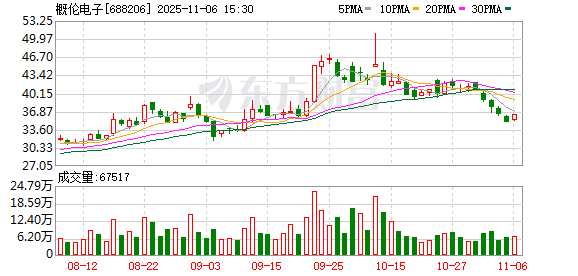
PRIMARIUS(688206)

Search documents
概伦电子11月11日获融资买入1371.09万元,融资余额3.10亿元
Xin Lang Cai Jing· 2025-11-12 01:37
Core Viewpoint - The stock of Gaolun Electronics experienced a decline of 2.79% on November 11, with a trading volume of 151 million yuan, indicating a potential market reaction to recent financial performance and trading activities [1]. Financing Summary - On November 11, Gaolun Electronics had a financing buy-in amount of 13.71 million yuan and a financing repayment of 11.93 million yuan, resulting in a net financing buy of 1.78 million yuan [1]. - The total financing and securities balance for Gaolun Electronics reached 310 million yuan, accounting for 2.11% of its market capitalization, which is above the 80th percentile of the past year, indicating a high level of financing activity [1]. - The company had no shares repaid in securities lending on November 11, with 500 shares sold short, amounting to 16,900 yuan at the closing price, and a securities lending balance of 87,800 yuan, which is below the 10th percentile of the past year, indicating low short-selling activity [1]. Financial Performance - For the period from January to September 2025, Gaolun Electronics reported a revenue of 315 million yuan, representing a year-on-year growth of 12.71%, and a net profit attributable to shareholders of 41.99 million yuan, which is a significant increase of 173.46% year-on-year [2]. - As of September 30, 2025, the number of shareholders for Gaolun Electronics was 15,700, a decrease of 3.29% from the previous period, while the average circulating shares per person increased by 3.40% to 27,681 shares [2]. Dividend and Shareholding Information - Since its A-share listing, Gaolun Electronics has distributed a total of 52.06 million yuan in dividends, with 43.38 million yuan distributed over the past three years [3]. - As of September 30, 2025, the top ten circulating shareholders included a new entrant, Southern Information Innovation Mixed A (007490), holding 5.74 million shares, while Nuoan Optimized Configuration Mixed A (006025) exited the top ten list [3].

议程发布!2025概伦电子用户大会火热报名中
半导体芯闻· 2025-11-11 10:17
Core Insights - The article highlights the upcoming 2025 Gaon Electronics User Conference, focusing on advanced EDA tools and collaborative ecosystem development in response to challenges in AI, high-performance computing, advanced storage, automotive electronics, and edge computing [2][3][4]. Event Overview - The conference will take place on November 19 at the Chengdu Zhaohuang Holiday Hotel, featuring discussions on core design challenges and competitive enhancements in the context of advanced process evolution [2][4]. - The agenda includes keynote speeches, product launches, and sessions on various topics such as advanced process EDA, circuit simulation, and design optimization for high-end chips [5][6]. Technical Focus - Key topics will cover the optimization of design capabilities based on collaborative process platforms, rapid circuit simulation, and yield and reliability optimization from unit to full-chip levels [2][3]. - The event aims to explore innovative technologies driven by application needs, enhancing design efficiency and value across all vertical applications from transistors to SoC system-level design [2][3]. Networking Opportunities - The conference will also feature a cocktail reception and dinner for attendees to foster networking and collaboration within the EDA ecosystem [8].


低频噪声测试:把看不见的问题看清楚
半导体行业观察· 2025-11-10 01:12
Core Viewpoint - The semiconductor industry faces increasing challenges from low-frequency noise, which can significantly impact device performance and reliability as transistor sizes shrink into the nanometer range [2][5][6]. Group 1: Low-Frequency Noise Challenges - Low-frequency noise includes flicker noise (1/f), random telegraph noise (RTN), thermal noise, and shot noise, closely related to the imperfections in semiconductor crystal structures [2][5]. - As transistor sizes decrease, even a single trap can cause significant current disturbances, making low-frequency noise a potential source of device failure [2][5]. - Precise quantification of low-frequency noise is essential for optimizing manufacturing processes and enhancing circuit robustness, making it a critical aspect of high-end chip design and manufacturing [2][5][6]. Group 2: Impact on Circuit Design - In analog circuits, if the input signal is lower than the noise signal, the amplified output will be completely masked by noise, determining the circuit's sensitivity [5]. - Low-frequency noise can affect RF circuits through frequency conversion and manifest as random jitter in digital circuits, leading to timing degradation [5]. - For wafer fabs, noise serves as a sensitive probe reflecting process quality and material issues, with new materials potentially introducing additional trap states that increase low-frequency noise occurrence [5][6]. Group 3: Testing and Measurement Solutions - The industry has begun incorporating noise modeling into the PDK process since 28nm, with low-frequency noise models becoming crucial for advanced nodes below 14nm [6]. - High-quality low-frequency noise test data extraction is increasingly demanded, driving accelerated research in this area [6][19]. - The 981X series noise testing systems from Gokun Electronics are recognized as the "gold standard" in the semiconductor industry for low-frequency noise testing, supporting advanced process development and device modeling [12][21]. Group 4: Market Trends and Future Outlook - The global and Chinese electronic measurement instrument markets are projected to reach approximately 112 billion and 42.1 billion respectively by 2025, with steady long-term growth [21]. - The restructuring of the global semiconductor supply chain and the rising demand for domestic industry chain autonomy are driving the development of testing and measurement equipment [21][24]. - Gokun Electronics aims to build a closed-loop testing ecosystem centered on independent research and development, enhancing its competitive advantage in the domestic testing equipment sector [24][27].

三大国产EDA龙头撕开垄断缺口
2 1 Shi Ji Jing Ji Bao Dao· 2025-11-07 11:44
Core Viewpoint - The EDA (Electronic Design Automation) industry in China is experiencing a significant divergence in performance among its major listed companies, with Huada Jiutian showing revenue growth but a drastic decline in profit, contrasting sharply with the high profit growth of competitors Gland and Gai Lun Electronics [2][4]. Revenue and Profit Performance - Huada Jiutian achieved a revenue of 805 million yuan in the first three quarters of 2025, a year-on-year increase of 8.24%, but its net profit plummeted by 84.52% to 9.06 million yuan [4]. - Gland reported a revenue of 428 million yuan, up 48.86%, with a net profit of 37.02 million yuan, reflecting a substantial increase of 380.14% [4]. - Gai Lun Electronics posted a revenue of 315 million yuan, a 12.71% increase, and a net profit of 41.99 million yuan, up 173.46% [5]. Investment and Cost Structure - Huada Jiutian's profit decline is attributed to high stock incentive costs of 104 million yuan and rising operational expenses, including a 23.99% increase in sales expenses and a 25.23% increase in financial expenses [4]. - Gland's operational expenses were 289 million yuan, showing a year-on-year increase but a decrease in expense ratio by 10.91 percentage points to 67.54% [4]. Technological Advancements - Domestic EDA companies are focusing on high-end digital chip design tools, with Huada Jiutian launching seven core EDA tools and achieving significant breakthroughs in advanced process certification [7][8]. - Huada Jiutian's new digital simulation verification tool HimaSim and static timing analysis tool HimaTime have filled gaps in domestic digital verification tools, with HimaTime achieving a 30% performance improvement [8]. Market Dynamics - The domestic EDA market remains dominated by international giants like Synopsys and Cadence, which hold 74% of the global market share, while domestic companies face challenges in gaining traction among both large and small chip design firms [13][14]. - Despite the competitive pressure, domestic EDA companies are expected to benefit from supportive policies and growing market demand, presenting opportunities for market share expansion [14].

国产EDA突围,国际巨头技术垄断已被撕开缺口
2 1 Shi Ji Jing Ji Bao Dao· 2025-11-07 10:38
Core Insights - The EDA (Electronic Design Automation) industry in China is experiencing a divergence in performance among its major listed companies, with Huada Jiutian showing significant revenue growth but a drastic decline in net profit, contrasting sharply with the high profit growth of competitors Gland and Gai Lun [1][3][4] Revenue and Profit Performance - Huada Jiutian achieved a revenue of 805 million yuan in the first three quarters of 2025, marking an 8.24% year-on-year increase, with Q3 revenue reaching 286 million yuan, up 12.3% quarter-on-quarter. However, its net profit plummeted by 84.52% to 9.06 million yuan, with a non-recurring net profit loss of 22.16 million yuan [3][4] - Gland reported a revenue of 428 million yuan, a 48.86% increase year-on-year, and a net profit of 37.02 million yuan, up 380.14% [3][4] - Gai Lun's revenue reached 315 million yuan, a 12.71% increase, with a net profit of 41.99 million yuan, up 173.46% [4] Cost and Investment Trends - Huada Jiutian's expenses increased significantly, with sales expenses up 23.99%, management expenses up 8.69%, R&D expenses up 2.7%, and financial expenses up 25.23%. The company's stock incentive costs reached 104 million yuan in the first half of the year, contributing to profit pressure [3][4] - Gland's expenses were 289 million yuan, reflecting a year-on-year increase but a decrease in expense ratio by 10.91 percentage points to 67.54%, indicating initial scale effects [3][4] Technological Advancements - Huada Jiutian launched seven core EDA tools and made significant breakthroughs in digital signature tools and advanced process certification, aiming to cover nearly 80% of digital circuit design tools by the end of 2025 [5][6] - Gland focused on DFT (Design for Testability) product iterations, achieving key advancements in tool architecture and developing an AI-driven yield diagnosis platform [7] Market Dynamics and Competitive Landscape - The domestic EDA market remains dominated by international giants like Synopsys, Cadence, and Siemens EDA, which collectively hold 74% of the global market share. Despite this, there is a growing opportunity for domestic EDA companies due to increasing market demand and supportive policies [8][9] - The competitive landscape shows a trend of consolidation and resource integration among domestic companies, with Gai Lun planning acquisitions to transition into a one-stop chip design solution platform [8][9]

85股今日获机构买入评级 6股上涨空间超20%
Zheng Quan Shi Bao Wang· 2025-11-07 09:59
Core Insights - A total of 87 buy ratings were issued by institutions today, covering 85 stocks, with Oppein Home receiving the highest attention with 3 buy ratings [1] - Among the rated stocks, 11 provided future target prices, with 6 stocks showing an upside potential exceeding 20%. Jianghuai Automobile has the highest upside potential at 49.14% based on a target price of 70.02 CNY [1] - The average performance of stocks with buy ratings today was a decline of 0.35%, underperforming the Shanghai Composite Index, with notable gainers including Enjie Co., Shanghai Hanxun, and Hualu Hengsheng [1][2] Company Summaries - **Oppein Home**: Received 3 buy ratings, with a slight decline of 0.39% today, and a dynamic P/E ratio of 12.84 [2] - **Jianghuai Automobile**: Target price set at 70.02 CNY, indicating a potential upside of 49.14%, with a decline of 2.51% today [4] - **Enjie Co.**: Notable gainer with a rise of 7.79%, specific P/E ratio not provided [4] - **Shanghai Hanxun**: Increased by 6.06%, specific P/E ratio not provided [4] - **Hualu Hengsheng**: Gained 4.20%, with a dynamic P/E ratio of 17.82 [4] - **Giant Network**: Targeted upside of 36.96% with a decline of 1.80% today [3] - **Gree Electric**: Received a buy rating with a slight increase of 0.08% and a dynamic P/E ratio of 7.83 [3] Industry Insights - The electronics industry is the most favored, with 10 stocks including Farah Electronics and Anker Innovations listed among the buy ratings [2] - The machinery and light manufacturing sectors also received significant attention, each with 9 stocks featured in the buy ratings [2]



概伦电子股价跌5.03%,宝盈基金旗下1只基金重仓,持有4200股浮亏损失7686元
Xin Lang Cai Jing· 2025-11-07 06:25
Core Points - Gaolun Electronics experienced a decline of 5.03% on November 7, with a stock price of 34.52 CNY per share and a total market capitalization of 15.022 billion CNY [1] - The company, established on March 18, 2010, and listed on December 28, 2021, specializes in providing EDA products and solutions validated by leading global integrated circuit design and manufacturing companies [1] - The revenue composition of Gaolun Electronics includes 67.95% from EDA tool licensing, 21.23% from technical development solutions, 10.63% from semiconductor device characteristic testing systems, and 0.18% from other sources [1] Fund Holdings - According to data, Baoying Fund has a significant holding in Gaolun Electronics through its Baoying Xiangyu Enhanced Return Mixed A Fund (008336), which held 4,200 shares, accounting for 0.42% of the fund's net value, making it the second-largest holding [2] - The fund has reported a floating loss of approximately 7,686 CNY as of the latest update [2] - Baoying Xiangyu Enhanced Return Mixed A Fund was established on October 27, 2020, with a current scale of 37.9229 million CNY, yielding a return of 5.85% year-to-date, ranking 6,671 out of 8,148 in its category [2] Fund Manager Information - The fund managers of Baoying Xiangyu Enhanced Return Mixed A Fund are Cai Dan and Lü Shuyi, with tenures of 8 years and 97 days, and 9 years and 160 days, respectively [3] - Cai Dan manages assets totaling 2.35 billion CNY, achieving a best return of 102.99% and a worst return of 0.99% during the tenure [3] - Lü Shuyi oversees assets of 28.809 billion CNY, with a best return of 18.7% and a worst return of -10.91% during her tenure [3]
中证1000成长ETF(562520)开盘跌0.54%
Xin Lang Cai Jing· 2025-11-07 01:40
Core Viewpoint - The China Securities 1000 Growth ETF (562520) opened down 0.54% at 1.298 yuan, reflecting a decline in several of its major holdings [1] Group 1: ETF Performance - The China Securities 1000 Growth ETF (562520) has a performance benchmark of the China Securities Select 1000 Growth Innovation Strategy Index [1] - Since its inception on March 8, 2022, the fund has returned 30.60%, while its return over the past month is -1.32% [1] Group 2: Major Holdings Performance - Key stocks in the ETF include: - Jucheng Co., Ltd. down 2.51% - Gylon Electronics down 0.96% - Gibit down 0.45% - Guangku Technology down 1.82% - Srypu down 1.34% - Lexin Technology down 0.91% - Huatu Shanding up 0.07% - Yuanjie Technology down 2.68% - Weimaisi up 0.17% - Anji Technology down 1.39% [1]





概伦电子(688206):设计类EDA保持高增 研发延续高强度投入
Xin Lang Cai Jing· 2025-11-07 00:35
Core Viewpoint - The company reported a significant improvement in financial performance for the first three quarters of 2025, with revenue growth and a return to profitability compared to the previous year [1][2]. Financial Performance - For the first three quarters of 2025, the company achieved revenue of 315 million yuan, a year-on-year increase of 12.71%, and a net profit attributable to shareholders of 41.99 million yuan, recovering from a loss of 57.16 million yuan in the same period last year [1]. - In Q3 2025, the company generated revenue of 96.17 million yuan, up 15.73% year-on-year, with a net profit attributable to shareholders of -4.19 million yuan, also an improvement from a loss of 16.28 million yuan in the previous year [1]. Business Segments - The EDA software licensing business generated revenue of 21.2 million yuan in the first three quarters of 2025, reflecting a year-on-year growth of 10.71%, primarily driven by the scale introduction of products like NanoSpice and NanoDesigner [2]. - The semiconductor device characteristic testing system business saw revenue of 40.39 million yuan, with a remarkable year-on-year increase of 40.29% in Q3, as the 981X series low-frequency noise testing system gained widespread recognition [2]. - The technology development solutions business reported revenue of 61.64 million yuan, showing a substantial year-on-year growth of 89.58% [2]. - Domestic revenue for the first three quarters was 23 million yuan, up 20.20% year-on-year, while overseas revenue reached 83.72 million yuan [2]. Research and Development - The company invested 210 million yuan in R&D during the first three quarters of 2025, with an R&D expenditure-to-revenue ratio of 66.79%, indicating a year-on-year decrease of 4.41 percentage points, suggesting the emergence of scale effects in R&D [2]. Strategic Initiatives - The company plans to issue shares and pay cash to acquire 100% of Chengdu Ruicheng Chip Micro and 45.64% of Nengneng Microelectronics, aiming to enhance its EDA and IP business synergy and position itself as a rare platform company in China [2]. Investment Outlook - The company is recognized as a rare EDA firm with global competitiveness, benefiting from the growth of the domestic semiconductor industry and opportunities for self-sufficiency. It is gradually expanding from manufacturing EDA to a full-process design EDA through internal R&D, external acquisitions, and ecosystem development [3]. - Revenue projections for 2025-2027 are 534 million yuan, 676 million yuan, and 836 million yuan, with net profits attributable to shareholders of 4 million yuan, 21 million yuan, and 50 million yuan respectively. The investment rating is maintained at Buy-A, with a target price of 43.62 yuan, equivalent to 28 times the dynamic price-to-sales ratio for 2026 [3].
概伦电子11月6日大宗交易成交632.40万元
Zheng Quan Shi Bao Wang· 2025-11-06 14:48
Group 1 - The core transaction of Gai Lun Electronics on November 6 involved a block trade of 200,000 shares, amounting to 6.324 million yuan, with a transaction price of 31.62 yuan, representing a discount of 13.01% compared to the closing price of the day [2][4] - In the last three months, Gai Lun Electronics has recorded a total of 40 block trades, with a cumulative transaction amount of 145 million yuan [3] - The closing price of Gai Lun Electronics on the day of the transaction was 36.35 yuan, reflecting an increase of 4.18%, with a daily turnover rate of 1.55% and a total transaction volume of 241 million yuan [3] Group 2 - The latest margin financing balance for Gai Lun Electronics is 320 million yuan, which has decreased by 13.7319 million yuan over the past five days, representing a decline of 4.12% [4] - Gai Lun Electronics was established on March 18, 2010, with a registered capital of 4.35177853 billion yuan [4]