
C*Core Technology(688262)

Search documents
研判2025!中国量子科技行业发展历程、政策、市场规模、重点企业及前景展望:量子科技应用前景广阔,行业规模增长潜力巨大[图]
Chan Ye Xin Xi Wang· 2025-11-23 01:24
Core Insights - Quantum technology is a strategic emerging field crucial for national information security, experiencing rapid market growth under national strategic guidance, with China's market size projected to grow from 4.523 billion yuan in 2015 to 13.104 billion yuan in 2024, reflecting a compound annual growth rate of 12.55% [1][14] - Significant breakthroughs in quantum technology are anticipated globally in 2024, transitioning from theoretical research to practical applications, with advancements in quantum computing platforms and quantum communication systems [1][14] - The development of quantum technology is expected to drive the next technological revolution, providing new tools and perspectives for exploring the unknown [1][14] Industry Overview - Quantum technology integrates principles of quantum mechanics with information science, computing, and materials science, focusing on information acquisition, processing, and transmission through quantum effects [4][13] - The industry primarily encompasses three core areas: quantum computing, quantum communication, and quantum precision measurement [4][13] Industry Development History - The Chinese government has emphasized the importance of advancing quantum technology, with strategic planning and support increasing since 2020 [6][9] - Notable achievements include the successful development of the "Zu Chongzhi No. 3" quantum computing prototype in March 2025, positioning China among the global leaders in superconducting quantum computing [1][7] - Recent advancements include the establishment of a 300-kilometer quantum direct communication network, validating the feasibility of long-distance secure communication [1][7] Industry Policies - The Chinese government has prioritized quantum technology in its "14th Five-Year Plan," aiming to implement significant national projects in frontier fields like quantum information [9][10] - The upcoming "15th Five-Year Plan" is expected to further promote quantum technology as a new economic growth point, alongside other emerging industries [9][10] Industry Value Chain - The quantum technology industry chain includes upstream components and technology development, midstream core equipment and system development, and downstream applications across various sectors such as cloud computing, finance, and defense [10][11] Market Size and Trends - The global quantum technology market is projected to reach $8.02 billion in 2024, with a year-on-year growth of 10.77%, and is expected to grow to $11.93 billion by 2025 [13] - Quantum computing dominates the market, accounting for 64.92% of the total, with North America leading in technological breakthroughs and industry applications [13][14] Key Companies - Major players in the Chinese quantum technology sector include China Great Wall Technology Group, Keda Technology, State Grid Information Communication, and others, contributing to a diverse competitive landscape [2][16] - China Great Wall Technology has reported significant growth in its computing industry, achieving a revenue of 5.148 billion yuan in the first half of 2025, a year-on-year increase of 9.63% [16] - Wuhan Guangxun Technology focuses on optical electronic devices and has seen a substantial increase in revenue from its data and access business, growing by 149.16% year-on-year in the first half of 2025 [16][17] Future Development Trends - Quantum computing is expected to overcome hardware performance bottlenecks, enhancing stability and developing new quantum bit architectures [17] - Quantum communication aims to establish broader and faster quantum key distribution networks, facilitating the construction of a future quantum internet [18] - Quantum measurement technology is anticipated to achieve significant precision improvements, expanding its applications in various fields [19]







国芯科技参股公司合肥硅臻首发基于硅光集成芯片的通用可编程光量子计算机
Zheng Quan Shi Bao Wang· 2025-11-20 11:39
Core Insights - The core focus of the news is the launch of a general-purpose programmable optical quantum computer by Silizhen, a subsidiary of Guoxin Technology, at the 2025 Quantum Technology and Industry Conference in Hefei, marking a significant advancement in quantum computing technology [1][2]. Company Developments - Silizhen's optical quantum computer is designed for general quantum computing, utilizing photons as qubit carriers and integrated photonic chips as the core, enabling self-developed key components with high fidelity, easy deployment, and scalability [1][2]. - The system architecture employs photon path encoding for qubit manipulation and utilizes an interference network for unitary evolution, ensuring efficient collaboration between the optical quantum chip and the measurement and control system [2][3]. - The device currently supports 4 physical qubits, suitable for experimental validation in small to medium quantum computing scenarios, with average fidelity exceeding 99.4% for single and two-qubit states [2][3]. Technological Advantages - The optical quantum computer features high resistance to disturbances due to its use of photons as qubit carriers, providing a stable foundation for computation and execution efficiency [3]. - The modular programmable computing core based on silicon photonic integrated chips allows for resource expansion and functional upgrades, addressing both research exploration and industrial application needs [3]. - Key components such as the entangled photon source, integrated optical quantum computing chip, and measurement and control system are all developed in-house by Silizhen, showcasing the company's technological capabilities [3]. Application Potential - The optical quantum computer is expected to serve various fields, including quantum algorithm validation in research, AI applications like autonomous driving, quantum encryption prototype development in communications, and financial market simulations [3].
国芯科技11月12日获融资买入4009.37万元,融资余额4.01亿元
Xin Lang Cai Jing· 2025-11-13 01:39
Group 1 - The core viewpoint of the news is that Guoxin Technology's stock performance and financing activities indicate a high level of market interest, despite a significant decline in revenue and net profit year-on-year [1][2]. Group 2 - On November 12, Guoxin Technology's stock rose by 0.03%, with a trading volume of 434 million yuan. The financing buy-in amount was 40.09 million yuan, while the financing repayment was 40.59 million yuan, resulting in a net financing buy-in of -495,500 yuan [1]. - As of November 12, the total balance of margin trading for Guoxin Technology was 403 million yuan, with the financing balance accounting for 3.94% of the circulating market value, indicating a high level compared to the past year [1]. - In terms of securities lending, on November 12, Guoxin Technology repaid 400 shares and sold 12,700 shares, with a selling amount of 383,300 yuan. The remaining securities lending volume was 41,200 shares, with a balance of 1.25 million yuan, also indicating a high level compared to the past year [1]. Group 3 - Guoxin Technology, established on June 25, 2001, and listed on January 6, 2022, focuses on providing IP licensing, chip customization services, and self-developed chips and modules, primarily in the fields of information security, automotive electronics, and industrial control [2]. - The revenue composition of Guoxin Technology includes 42.19% from self-developed chips and modules, 28.54% from chip customization services, 22.06% from mass production services, 6.48% from customized services, 0.70% from IP licensing, and 0.03% from other sources [2]. - As of September 30, the number of shareholders was 25,700, a decrease of 3.43% from the previous period, while the average circulating shares per person increased by 31.62% to 13,085 shares [2]. Group 4 - For the period from January to September 2025, Guoxin Technology reported a revenue of 259 million yuan, a year-on-year decrease of 44.92%, and a net profit attributable to the parent company of -127 million yuan, a slight decrease of 0.03% year-on-year [2]. Group 5 - Guoxin Technology has distributed a total of 120 million yuan in dividends since its A-share listing, with cumulative distributions of 59.99 million yuan over the past three years [3].
中科院突破!这类迄今最大规模光量子芯片构建成功,铌酸锂薄膜成核心材料之一
Xuan Gu Bao· 2025-11-13 00:10
Group 1 - The lithium niobate crystal has multiple photoelectric effects, strong tunability, stable physical and chemical properties, and a wide optical transmission range, making it widely used in SAW filters, optical modulators, phase modulators, optical isolators, and electro-optic Q-switches [2] - Thin-film lithium niobate materials are becoming an important technological direction due to their higher integration and better performance, with domestic manufacturers having a competitive advantage in the LNOI field [2] - The lithium niobate industry chain includes upstream lithium niobate crystals and thin film materials, electron beam writing, and DUV lithography equipment, as well as midstream thin-film lithium niobate modulator chips and devices, and downstream applications, with domestic manufacturers participating in all segments [2] Group 2 - Guangku Technology focuses on products including lithium niobate modulators and possesses ultra-high-speed optical communication modulator chips and modules, which are core optical devices for long-distance coherent optical transmission and ultra-high-speed data centers [3] - Guoxin Technology has established joint laboratories for quantum chips with well-known companies in the quantum field, including Anhui Wentian Quantum Technology Co., Ltd. and its subsidiary Hefei Silizhen Chip Technology Co., Ltd. [3]

国芯科技:公司目前在手订单充沛
Zheng Quan Ri Bao Zhi Sheng· 2025-11-12 14:14
Core Viewpoint - The company, Guoxin Technology, has announced its stock incentive plan and reported strong order backlog, indicating positive business performance and growth potential for the upcoming years [1] Group 1: Stock Incentive Plan - The company's stock incentive plan has been published on the Shanghai Stock Exchange website [1] - The assessment indicators for the stock incentive plan for 2025 will be detailed in a document to be released on September 12, 2025 [1] Group 2: Financial Performance - As of September 30, 2025, the company's contract liabilities amounted to 909 million yuan, reflecting a robust order backlog [1] - The revenue from the company's self-developed chip and module business for the first three quarters of 2025 reached 158.48 million yuan, representing a year-on-year growth of 40.58% [1] Group 3: Business Operations - All business lines of the company are operating normally, with the supply chain for custom chip business having returned to normal as of August 27, 2025 [1] - The company is committed to implementing the "Quality Improvement and Efficiency Enhancement" action plan for 2025 to enhance the quality of the listed company [1]
国芯科技11月11日获融资买入4594.05万元,融资余额4.02亿元
Xin Lang Cai Jing· 2025-11-12 01:37
Group 1 - The core viewpoint of the news is that Guoxin Technology's stock performance and financing activities indicate a mixed outlook, with significant financing buy-ins but declining revenue and profit figures [1][2]. Group 2 - On November 11, Guoxin Technology's stock rose by 0.10%, with a trading volume of 383 million yuan. The financing buy-in for the day was 45.94 million yuan, while the financing repayment was 37.77 million yuan, resulting in a net financing buy-in of 8.17 million yuan. The total financing and securities balance reached 403 million yuan [1]. - The financing balance of Guoxin Technology is 402 million yuan, accounting for 3.95% of the circulating market value, which is above the 80th percentile level over the past year, indicating a high level of financing activity [1]. - On the short-selling side, Guoxin Technology repaid 1,100 shares on November 11, with no shares sold short, resulting in a short-selling balance of 87.55 million yuan, which is below the 30th percentile level over the past year, indicating a low level of short-selling activity [1]. Group 3 - Guoxin Technology, established on June 25, 2001, and listed on January 6, 2022, focuses on providing IP licensing, chip customization services, and self-developed chips and modules, primarily in the fields of information security, automotive electronics, and industrial control [2]. - The revenue composition of Guoxin Technology includes 42.19% from self-developed chips and modules, 28.54% from chip customization services, 22.06% from mass production services, 6.48% from customized services, 0.70% from IP licensing, and 0.03% from other sources [2]. - For the period from January to September 2025, Guoxin Technology reported a revenue of 259 million yuan, a year-on-year decrease of 44.92%, and a net profit attributable to the parent company of -127 million yuan, a slight decrease of 0.03% year-on-year [2]. Group 4 - Since its A-share listing, Guoxin Technology has distributed a total of 120 million yuan in dividends, with 59.99 million yuan distributed over the past three years [3].
量子科技成经济新增长点 35只概念股前三季度研发费用均超1亿元
Zheng Quan Shi Bao· 2025-11-11 17:52
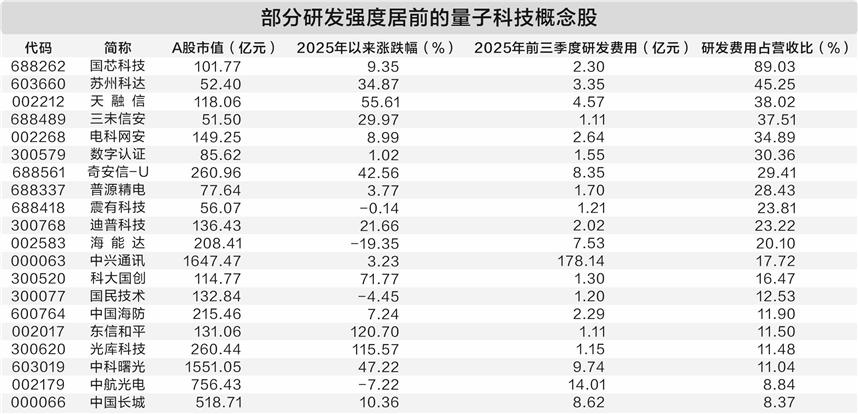
Core Insights - The quantum technology sector is experiencing significant advancements, with both policy support and technological breakthroughs driving growth [2][3][4] - The global quantum computing industry is projected to grow from $4.7 billion in 2023 to over $800 billion by 2035, indicating substantial market potential [4] - A total of over 60 A-share companies are involved in quantum technology, with significant R&D investments, particularly in quantum security chips and modules [4][5] Policy Developments - Anhui Province is focusing on scaling quantum technology applications, aiming to implement nearly 300 application scenarios by the end of this year and 1,000 by 2027 [2] Technological Breakthroughs - Domestic advancements include a new architecture for atomic quantum computing that addresses challenges in high parallelism, speed, and stability [3] - Internationally, a team from the University of Chicago has theoretically extended the connection distance between quantum computers to 2,000 kilometers [3] Industry Growth and Investment - In the first three quarters of this year, A-share companies involved in quantum technology reported a total R&D expenditure of 69.47 billion yuan, accounting for 3.86% of total revenue [4] - Notable companies with high R&D expenditure include China Mobile, ZTE, and China Telecom, with 国芯科技 leading at 89.03% of revenue spent on R&D [4][5] Market Opportunities - Quantum communication, particularly quantum key distribution (QKD), is identified as the most mature and commercially viable area within quantum technology [3] - Quantum measurement is also highlighted as an early revenue-generating sector, akin to "hidden champions" in niche markets [3]


量子科技重大突破,高研发+高增长潜力概念股仅9只(名单)
Zheng Quan Shi Bao Wang· 2025-11-11 05:10
Core Insights - Quantum technology is viewed as the "key" to the next generation of information technology revolution, with significant breakthroughs in both policy and technology [1][3]. Policy Developments - The Anhui Provincial Development and Reform Commission announced that quantum technology is transitioning from technological breakthroughs to large-scale industrial applications, aiming to implement nearly 300 application scenarios by the end of this year and 1,000 by 2027 [1]. - The United Nations Educational, Scientific and Cultural Organization (UNESCO) has declared 2025 as the "International Year of Quantum Science and Technology" to commemorate the 100th anniversary of quantum mechanics [3]. Technological Advancements - A team from the Chinese Academy of Sciences has made significant progress in neutral atom quantum computing, proposing a new architecture based on fiber arrays that addresses challenges in achieving high parallelism, speed, and stability [1]. - Researchers at the University of Chicago have theoretically extended the connection distance between quantum computers to 2,000 kilometers, making the construction of a global quantum internet more feasible [2]. Industry Growth Potential - Quantum technology, encompassing quantum computing, quantum communication, and quantum precision measurement, is identified as a future industry with substantial growth potential, as highlighted in the 14th Five-Year Plan [3]. - The global quantum computing industry is projected to grow from $4.7 billion in 2023 to over $800 billion by 2035 [3]. R&D Investment - Over 60 companies in the A-share market are involved in quantum technology, with a total R&D expenditure of 69.47 billion yuan, accounting for 3.86% of total revenue [4]. - Among these, 35 companies reported R&D expenses exceeding 100 million yuan in the first three quarters, with seven companies surpassing 1 billion yuan [5]. Key Players and Financial Metrics - Notable companies include Guoxin Technology, which has the highest R&D expense-to-revenue ratio at 89.03%, and has successfully commercialized quantum security chips [5][6]. - Other companies with significant R&D investments include Suzhou Keda, Tianrongxin, and Digital Certification, with varying R&D expense ratios [5][6]. Institutional Interest - Institutional interest is high for companies like ZTE Corporation and China Mobile, with ZTE receiving ratings from 23 institutions [7]. - Forecasts indicate that nine companies are expected to achieve net profit growth rates exceeding 15% from 2025 to 2027 [7]. Market Predictions - Several stocks, including China Haifang and Keda Technology, are projected to have significant upside potential based on institutional target prices [8].



国芯科技:截至9月30日公司汽车电子芯片累计出货超过2000万颗
Zheng Quan Shi Bao Wang· 2025-11-10 08:48
Core Insights - Company has achieved large-scale mass production and sales in automotive electronic chips, including airbag control chips, body and gateway control chips, and vehicle networking security chips [1] - The company is in the ramp-up phase for high-end automotive electronic chips, with over 100 ongoing development projects [1] - Revenue from automotive electronic chip business reached 79.98 million yuan in the first three quarters, a year-on-year increase of 73.52% [1] - Cumulative shipments of automotive electronic chips are expected to exceed 20 million units by September 30, 2025 [1]
国芯科技(688262.SH):RISC-V GPGPU当前阶段的研发工作已结束
Ge Long Hui· 2025-11-10 08:36
Core Viewpoint - The company is actively developing AI technology in collaboration with various institutions, focusing on NPU (Neural Processing Unit) IP cores for edge applications, indicating a strong commitment to advancing AI capabilities in multiple sectors [1] Group 1: NPU Development - The company has partnered with the Hong Kong Applied Science and Technology Research Institute to develop AI technology for edge applications, resulting in the CNN20, CNN100, and CNN200 series NPU IP cores [1] - The CNN20 and CNN100 have completed design and are available for external licensing, while the CNN200 is still under development [1] - The CNN20 and CNN100 have a single-core computing power of 1 Tops@INT8, suitable for low-power AI MCU chips, while the CNN200 can achieve 10 Tops@INT8, applicable for various edge computing AI SoC chips [1] Group 2: AI Applications - The NPU IP cores are designed for a wide range of AI applications, including use in robotic dogs and other edge computing scenarios [1] - The company is collaborating with Longqing Technology to develop the CNN300 NPU IP core for AI PC applications, which combines scalar and vector processing units [1] - The CNN300 is expected to reach a single-core performance of 8 Tops, with multi-core consistency interface (MLS) allowing for higher computing power through stacking, achieving up to 32 Tops with four cores [1] Group 3: RISC-V GPGPU Development - The company is working with the Shanghai Tsinghua International Innovation Center on GPGPU (General-Purpose Graphics Processing Unit) core development based on the open-source RISC-V instruction architecture [1] - The first version of the RTL code design for the RISC-V GPGPU has been completed and publicly released as of July 2024 [1] - Current R&D efforts for RISC-V GPGPU have concluded, with future plans dependent on the international development of open-source RISC-V GPGPU technology [1]