UIH(688271)

Search documents
“千亿产业新势能”之医疗器械篇: 联合攻关、链式发展 深圳医疗器械“南研发、北创造”密码
Zheng Quan Shi Bao· 2025-05-15 17:41
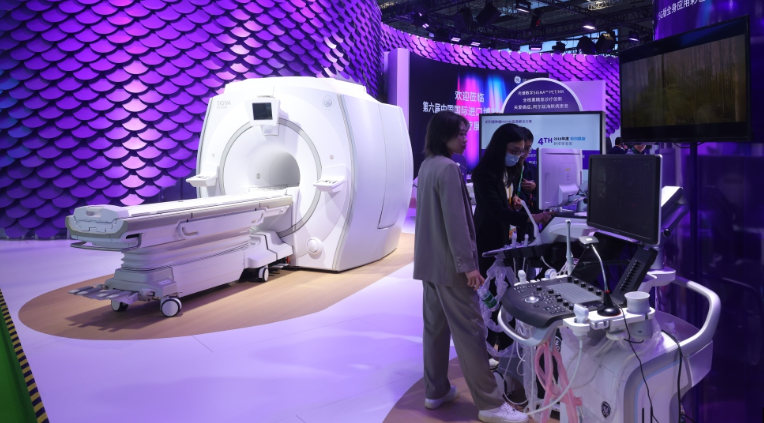
Core Viewpoint - The high-end medical device industry in Shenzhen is a significant indicator of national manufacturing capability and technological development, with a projected revenue of 200 billion yuan by 2025, highlighting its importance in the global medical device market [1]. Group 1: Industry Overview - Shenzhen's medical device output reached 99 billion yuan in 2023, accounting for approximately 10% of the national total, with exports also around 10% [1]. - The city is home to leading companies like Mindray Medical and BGI, which are recognized among the top 100 global medical device firms [1]. Group 2: Technological Advancements - The brain-computer interface technology developed by Shenzhen Ruihan Medical has shown significant promise in rehabilitation, with patients experiencing better recovery outcomes compared to traditional methods [2][3]. - Ruihan Medical's brain-computer interface rehabilitation robot system is the first commercialized product of its kind globally, with over 100 patents and a focus on practical application [3]. Group 3: Collaborative Innovation - The National High-Performance Medical Device Innovation Center in Shenzhen is addressing core technological challenges in the medical device sector through collaborative projects with key enterprises [6][7]. - The center has successfully developed a 5.0T whole-body MRI system, marking a significant breakthrough in high-field MRI technology [6]. Group 4: Market Dynamics - The medical device industry in Shenzhen is characterized by a "chain development" model, where breakthroughs in technology stimulate growth across the entire supply chain [8]. - Companies like Mindray Medical and Libang Instruments have successfully disrupted international monopolies in their respective fields, leading to increased domestic production capabilities [9][10]. Group 5: Spatial and Policy Support - Shenzhen's medical device industry faces challenges such as limited industrial space, prompting local governments to create favorable conditions for business growth [11][12]. - The city has introduced comprehensive support measures for the medical and pharmaceutical sectors, aiming to solidify its position as a leading hub for medical device innovation [13].




中国医疗器械市场的替代性机会出现了 | 海斌访谈
Di Yi Cai Jing· 2025-05-15 14:39
Core Viewpoint - The deep localization of medical device manufacturing in China is becoming a key competitive advantage for domestic companies, driven by trade tensions and the need for innovation [1][7]. Group 1: Industry Changes - The trade friction has created opportunities for domestic medical device companies to replace imports, particularly in high-performance piezoelectric materials [1][3]. - Major international companies like GE Healthcare and Siemens are increasingly localizing their production in China to maintain market position amid rising competition from domestic firms [7][6]. - The domestic market for medical imaging equipment is evolving, with companies like New Hong Electronics developing products that can compete with established international brands [4][5]. Group 2: Market Dynamics - The price increase of transducers in the U.S. is prompting American medical device companies to seek local suppliers in China, presenting an opportunity for Chinese firms to enter the international supply chain [3][6]. - The market share of imported high-end X-ray tubes is around 85%, indicating significant room for growth for domestic manufacturers [5]. - The Chinese market for mid-to-low-end X-ray tubes has a localization rate of approximately 30%-40%, suggesting that there is still potential for further domestic production [5]. Group 3: Innovation and Collaboration - Companies are encouraged to focus on material and technological innovation rather than relying solely on tariff barriers for competitive advantage [10]. - Collaborative research and development between domestic companies and hospitals is essential for validating new technologies and products in the medical imaging sector [5][4]. - The need for continuous investment in research and development is highlighted as crucial for maintaining competitiveness in the medical device industry [10]. Group 4: Future Outlook - The ongoing U.S.-China trade tensions are expected to have a long-term impact on multinational companies and Chinese enterprises, creating a sustained push for deep localization [9][10]. - The medical device sector is seen as a strong regulatory environment where rapid technological change is more challenging compared to other industries like photovoltaics and batteries [9][8]. - The establishment of a robust ecosystem of domestic suppliers and innovation is critical for the future success of Chinese medical device companies [7][10].


AI医疗重构诊疗流程,效率与市场增长下的投资机会
Caixin Securities· 2025-05-15 02:25
Investment Rating - The report maintains an investment rating of "Outperform the Market" for the medical device industry [2]. Core Insights - The report emphasizes that AI in healthcare is restructuring diagnostic and treatment processes, creating investment opportunities driven by efficiency and market growth. The global healthcare sector faces challenges such as aging populations and uneven distribution of medical resources, which AI can address by optimizing the healthcare value chain and promoting equitable access to medical resources [5][6]. Summary by Sections 1. AI Healthcare Development Environment - The domestic AI healthcare development environment is mature, supported by data resources and services that enhance algorithm accuracy and generalization [11]. - AI technology is breaking the uneven distribution of medical resources, addressing the growing demand for healthcare services due to an aging population [18][19]. 2. AI Medical Imaging - AI medical imaging is the most mature application of AI in healthcare, with a complete ecosystem covering various imaging modalities such as CT, MRI, and X-ray. The market for AI medical imaging in China is projected to reach 6.17 billion yuan by 2025 [5][39]. - Companies like Mindray and United Imaging are leveraging hardware advantages to build "device + AI" ecosystems, while pure AI companies focus on lesion recognition and cross-disease generalization capabilities [5][39]. 3. AI In Vitro Diagnostics - The AI in vitro diagnostics market is rapidly growing, with applications in hematology, microbiology, and pathology. Companies like BGI and Anbiping are innovating with AI-driven solutions to enhance diagnostic efficiency [5][6]. 4. AI Wearable Devices - AI wearable devices are transforming health management by providing real-time monitoring and data analysis, becoming essential for chronic disease management. The market for smart wearable devices in China is expected to exceed 15 billion yuan in 2023 and reach 33 billion yuan by 2026, with a compound annual growth rate of 18.1% [6]. 5. Investment Recommendations - The report suggests that the industry is poised for multidimensional development, transitioning from scale expansion to higher-level growth. It highlights long-term investment opportunities in leading companies like Mindray, United Imaging, Yuyue Medical, and Kefu Medical, which are early adopters of AI healthcare solutions [6].


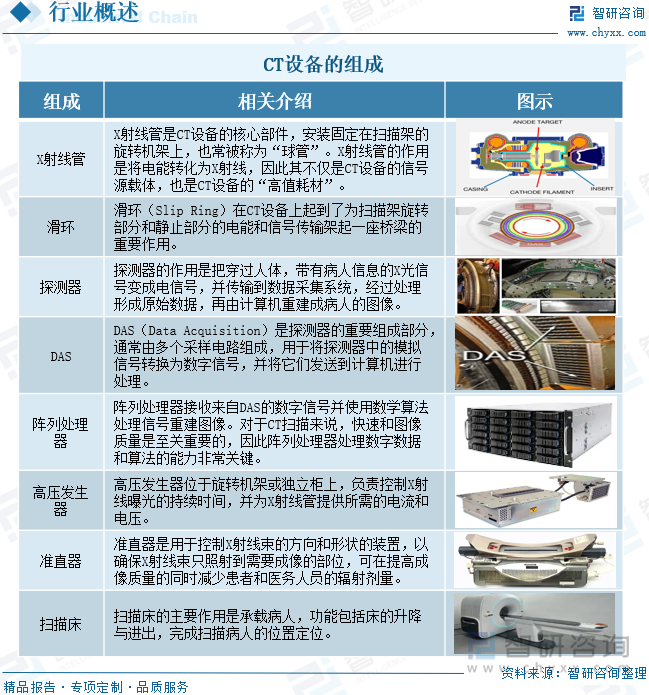
趋势研判!2025年中国CT设备行业产业链、保有量、市场规模、竞争格局及前景展望:CT设备市场保持高速发展,优秀国产CT设备占比超6成[图]
Chan Ye Xin Xi Wang· 2025-05-15 01:33
Core Insights - The CT equipment market in China is projected to reach approximately 25.5 billion yuan in 2024, driven by increasing clinical demand due to an aging population and rising chronic disease prevalence [1][20] - The market is expected to maintain rapid growth as investments in healthcare increase and the implementation of hierarchical medical care continues [1][20] Industry Overview - CT, or computed tomography, is a medical imaging technology that utilizes X-rays to create detailed images of the body's internal structures, widely used for diagnosing various diseases [3][7] - The CT equipment industry is characterized by high technical barriers, requiring long-term technological accumulation for both core component development and complete device manufacturing [16] Market Dynamics - The demand for CT equipment is increasing due to the aging population and the growing need for medical examinations, with the number of CT devices in China expected to reach approximately 55,133 units by 2024 [21] - The domestic CT equipment market's localization rate is projected to be around 53% in 2024, with over 66% of sales coming from high-quality domestic brands [23] Competitive Landscape - The CT equipment industry in China exhibits a tiered competitive structure, with leading companies like GE Healthcare, United Imaging, and Siemens dominating the high-end market, while domestic firms are rapidly catching up through technological innovation [26][28] - Companies such as United Imaging and Wandong Medical are focusing on high-performance imaging equipment and innovative solutions to enhance their market presence [28][30] Policy Environment - The Chinese government has implemented strict regulatory frameworks for medical devices, promoting high-quality development and technological innovation in the CT equipment sector [9][11] - Recent policies aim to enhance the regulatory system for medical devices, ensuring safety and effectiveness while fostering innovation and competitiveness in the industry [9][11] Future Trends - The industry is witnessing a shift towards technological innovation and domestic substitution, with local manufacturers making significant strides in core component production and image quality [32] - The demand for CT equipment in grassroots medical institutions is expected to grow, driven by the hierarchical medical care policy and the increasing number of private hospitals [33] - The integration of AI and digital technologies in CT equipment is anticipated to enhance diagnostic capabilities and operational efficiency, aligning with the industry's move towards sustainability and environmental compliance [34]


中证全指医疗保健设备与服务指数下跌0.23%,前十大权重包含联影医疗等
Sou Hu Cai Jing· 2025-05-14 15:39
Core Viewpoint - The China Securities Index for Healthcare Equipment and Services has shown a slight decline of 0.23% recently, reflecting a mixed performance over different time frames, with a year-to-date decrease of 0.88% [1]. Group 1: Index Performance - The China Securities Index for Healthcare Equipment and Services closed at 13,568.19 points with a trading volume of 15.409 billion yuan [1]. - Over the past month, the index has increased by 2.13%, while it has decreased by 5.63% over the last three months [1]. - The index has a year-to-date decline of 0.88% [1]. Group 2: Index Composition - The index is composed of listed companies in the healthcare sector, selected from the broader China Securities Index to reflect the overall performance of healthcare-related securities [1]. - The top ten weighted companies in the index include Mindray Medical (9.73%), Aier Eye Hospital (8.29%), and United Imaging Healthcare (7.73%) [1]. - The index is primarily composed of companies listed on the Shenzhen Stock Exchange (61.00%) and the Shanghai Stock Exchange (39.00%) [1]. Group 3: Fund Tracking - Several public funds track the China Securities Index for Healthcare Equipment and Services, including Southern Asset Management's various funds and Tianhong's ETF [2].



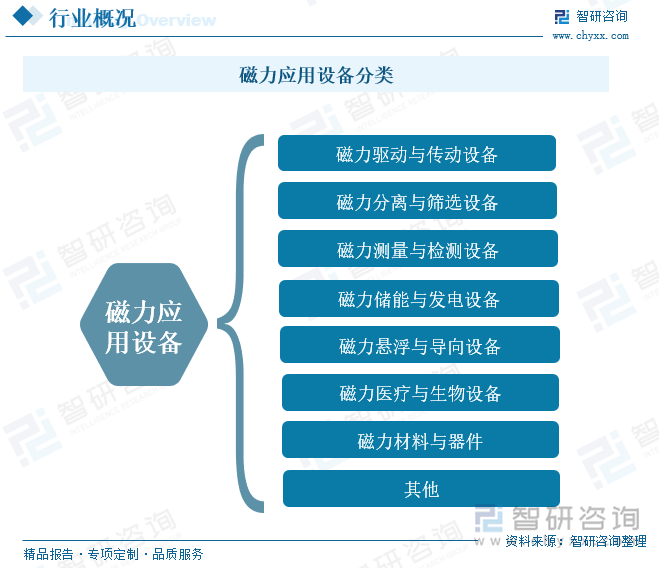
研判2025!中国磁力应用设备行业产业链图谱、发展现状、竞争格局及发展趋势分析:磁力应用设备市场规模有望持续增长 [图]
Chan Ye Xin Xi Wang· 2025-05-14 01:10
Industry Overview - The magnetic application equipment industry in China is experiencing steady growth, with a market size reaching approximately 27.623 billion yuan in 2023, representing a year-on-year increase of 6% [1][9] - The market size is projected to reach 28.981 billion yuan in 2024, with a growth rate of 6.3% [1][9] - The future growth of the industry is supported by national policies promoting industrial upgrades, the development of new energy, and the rise of high-end manufacturing [1][9] Industry Chain Analysis - The industry chain includes upstream suppliers of magnetic materials, midstream manufacturers of magnetic application equipment, and downstream users across various sectors such as mining, industrial manufacturing, transportation, energy, and healthcare [3] - Upstream suppliers provide essential materials like rare earth metals for high-performance permanent magnets and soft magnetic materials [3] Development History - The industry has evolved through several stages, starting from the mid-20th century with limited technology and small-scale production, to a rapid development phase in the 21st century characterized by high-end technology breakthroughs and an expanding international presence [5] Current Market Analysis - The magnetic application equipment market is projected to continue expanding, driven by increasing demand in sectors such as electric vehicles and mining [9][11] - The industrial manufacturing sector accounts for 38% of the market, followed by the energy sector at 30%, and healthcare at 10% [11] Key Enterprises - Major companies in the industry include Zhongke Electric, Longi Electromagnetic, Huate Magnetic, and others, each focusing on different aspects of magnetic application technology [13][14] - Zhongke Electric reported a revenue of 5.581 billion yuan in 2024, with a year-on-year growth of 13.71% [16] - Longi Electromagnetic achieved a revenue of 679 million yuan in 2023, with a growth of 9.75% [18] Future Development Trends - High-performance material research is crucial for the industry's growth, focusing on improving the properties of rare earth permanent magnets and superconducting materials [20] - The integration of smart technology and automation is transforming equipment operation, enhancing efficiency and product quality [21][22] - The industry is shifting towards high-end manufacturing and upgrading, with a focus on collaboration among companies to enhance competitiveness [23]


联影医疗:2024年及2025年一季报点评报告:需求恢复,利润高增可期-20250514
ZHESHANG SECURITIES· 2025-05-13 10:45
Investment Rating - The investment rating for the company is "Accumulate" [6] Core Views - The company is expected to see a recovery in demand and significant profit growth in 2025, driven by the resumption of hospital bidding and the introduction of high-end products [1][2] - The company's revenue for 2024 is projected to be 10.3 billion yuan, a decrease of 9.7% year-on-year, while the net profit attributable to the parent company is expected to be 1.262 billion yuan, down 36.1% year-on-year [1] - The first quarter of 2025 shows positive revenue growth of 5.4% year-on-year, with net profit attributable to the parent company increasing by 1.9% [1][2] Summary by Sections Revenue and Profitability - In Q4 2024, the company reported revenue of 3.346 billion yuan, a decline of 15.9% year-on-year but a 106% increase quarter-on-quarter [1] - The company’s revenue for Q1 2025 is 2.478 billion yuan, reflecting a year-on-year growth of 5.4% [1] - The net profit for Q1 2025 is 370 million yuan, up 1.9% year-on-year, while the non-recurring net profit is 379 million yuan, showing a significant increase of 26.1% [1] Market Position and Product Development - The company’s market share increased by over 3 percentage points in 2024, particularly in high-end products, which saw a nearly 5 percentage point increase in market share [2] - New product launches in 2024 include the uLinacHalosTx precision radiotherapy system and the uMRMax next-generation 3.0T MRI, which are expected to enhance the company's competitive position [2] International Expansion - The company achieved overseas revenue of 2.22 billion yuan in 2024, a year-on-year increase of 33.81%, with overseas revenue accounting for 21.55% of total revenue [3] - The company has received CE certification for 46 products and FDA approval for 49 products, enhancing its international market presence [3] Profitability Forecast - The gross profit margin for 2024 is expected to be 48.54%, with a slight increase anticipated in 2025 [4] - The net profit margin for 2024 is projected at 12.06%, with expectations for improvement in 2025 as the company benefits from economies of scale [4] Financial Projections - Revenue projections for 2025, 2026, and 2027 are 12.251 billion yuan, 14.478 billion yuan, and 17.325 billion yuan, respectively, with year-on-year growth rates of 18.94%, 18.18%, and 19.67% [5] - The net profit attributable to the parent company is expected to reach 1.799 billion yuan in 2025, reflecting a year-on-year growth of 42.59% [5]
联影医疗(688271):2024年及2025年一季报点评报告:需求恢复,利润高增可期
ZHESHANG SECURITIES· 2025-05-13 10:12
Investment Rating - The investment rating for the company is "Accumulate" [6] Core Views - The company is expected to see a recovery in demand and significant profit growth in 2025 due to the resumption of hospital bidding and the introduction of high-end products [2][4] - The company's revenue for 2024 is projected to be 10.3 billion yuan, a decrease of 9.7% year-on-year, while the net profit attributable to the parent company is expected to be 1.262 billion yuan, down 36.1% year-on-year [1][5] - The company is expanding its overseas market presence, with overseas revenue reaching 2.22 billion yuan in 2024, a year-on-year increase of 33.81% [3] Summary by Sections Financial Performance - In Q4 2024, the company reported revenue of 3.346 billion yuan, a year-on-year decrease of 15.9%, but a quarter-on-quarter increase of 106% [1] - For Q1 2025, revenue is expected to be 2.478 billion yuan, a year-on-year increase of 5.4%, with net profit attributable to the parent company at 370 million yuan, up 1.9% year-on-year [1][5] Growth Potential - The company’s market share in high-end products is expected to continue to rise, with a nearly 5 percentage point increase in 2024 [2] - The introduction of innovative products such as the uLinacHalosTx precision radiotherapy system and the uMRMax next-generation 3.0T MRI is anticipated to drive growth [2] Profitability Outlook - The gross profit margin for 2024 is projected to be 48.54%, with an expected increase to 49.94% in Q1 2025 [4] - The net profit margin for 2024 is expected to be 12.06%, with an anticipated increase in 2025 due to the recovery of hospital bidding and improved operational efficiency [4] Revenue Forecast - The company’s total revenue is forecasted to be 12.251 billion yuan in 2025, representing a year-on-year growth of 18.94% [5] - The net profit attributable to the parent company is expected to reach 1.799 billion yuan in 2025, a year-on-year increase of 42.59% [5]
1.50亿主力资金净流入,阿尔茨海默概念涨1.74%
Zheng Quan Shi Bao Wang· 2025-05-13 09:18
截至5月13日收盘,阿尔茨海默概念上涨1.74%,位居概念板块涨幅第5,板块内,24股上涨,华大基 因、迪安诊断、美年健康等涨幅居前,分别上涨14.55%、8.27%、6.72%。跌幅居前的有*ST双成、金凯 生科、联影医疗等,分别下跌4.96%、1.15%、0.80%。 今日涨跌幅居前的概念板块 | 代码 | 简称 | 今日涨跌幅 | 今日换手率 | 主力资金流量(万 | 主力资金净流入比率 | | --- | --- | --- | --- | --- | --- | | | | (%) | (%) | 元) | (%) | | 300676 | 华大基 因 | 14.55 | 5.13 | 12606.52 | 10.91 | | 000766 | 通化金 马 | 4.09 | 4.77 | 7912.36 | 9.04 | | 600789 | 鲁抗医 药 | 2.26 | 11.15 | 6213.39 | 5.96 | | 688068 | 热景生 物 | 2.40 | 3.98 | 3651.30 | 9.40 | | 002044 | 美年健 康 | 6.72 | 5.71 | 3326.88 ...


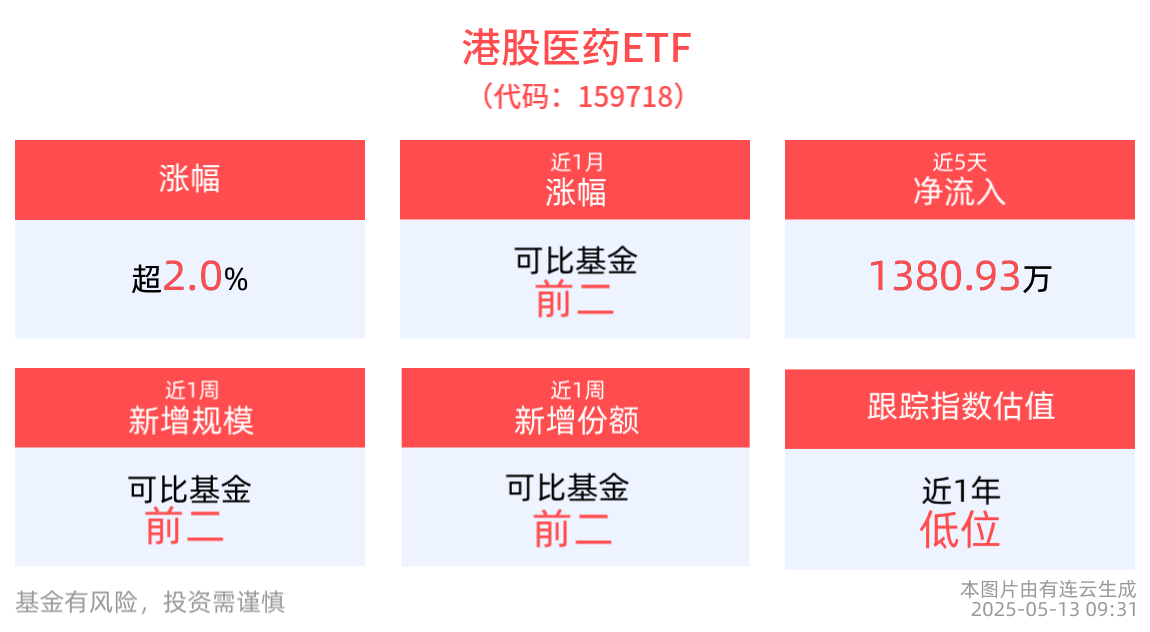
大幅反弹!港股医药ETF(159718)高开高走涨超2%!医疗创新ETF(516820)小幅拉升
Xin Lang Cai Jing· 2025-05-13 01:56
Core Viewpoint - The recent policy announced by Trump to align U.S. drug prices with the lowest global prices could lead to a significant decrease in prescription drug prices in the U.S., potentially by 30% to 80%, raising concerns among pharmaceutical companies, especially those exporting to the U.S. [1][2] Group 1: Market Performance - As of May 13, 2025, the CSI Hong Kong Stock Connect Pharmaceutical and Healthcare Composite Index (930965) rose by 2.42%, with notable increases in stocks such as BeiGene (06160) up 4.15% and Innovent Biologics (01801) up 3.14% [1] - The Hong Kong Pharmaceutical ETF (159718) opened high and increased by 2.04%, with a latest price of 0.70 yuan, and a one-month cumulative increase of 3.32% [1] - The CSI Pharmaceutical and Medical Device Innovation Index (931484) increased by 0.87%, with stocks like East China Pharmaceutical (000963) rising by 2.23% [4] Group 2: Trading Volume and Liquidity - The Hong Kong Pharmaceutical ETF had a turnover of 1.72% during the trading session, with a transaction volume of 4.0999 million yuan, and an average daily transaction volume of 95.7602 million yuan over the past month [1] - The latest scale of the Medical Innovation ETF (516820) reached 1.588 billion yuan [4] Group 3: Index Composition - The top ten weighted stocks in the CSI Hong Kong Stock Connect Pharmaceutical and Healthcare Composite Index accounted for 60.54% of the index, including BeiGene (06160) and WuXi Biologics (02269) [5] - The top ten weighted stocks in the CSI Pharmaceutical and Medical Device Innovation Index represented 66.51% of the index, featuring companies like Hengrui Medicine (600276) and WuXi AppTec (603259) [8]