
XGIMI(688696)

Search documents
盘前公告淘金:格力电器重视铝代铜技术研究,奥瑞德拟1.45亿投算力设备,乐鑫科技/极米科技拟回购股份
Jin Rong Jie· 2026-02-03 00:30
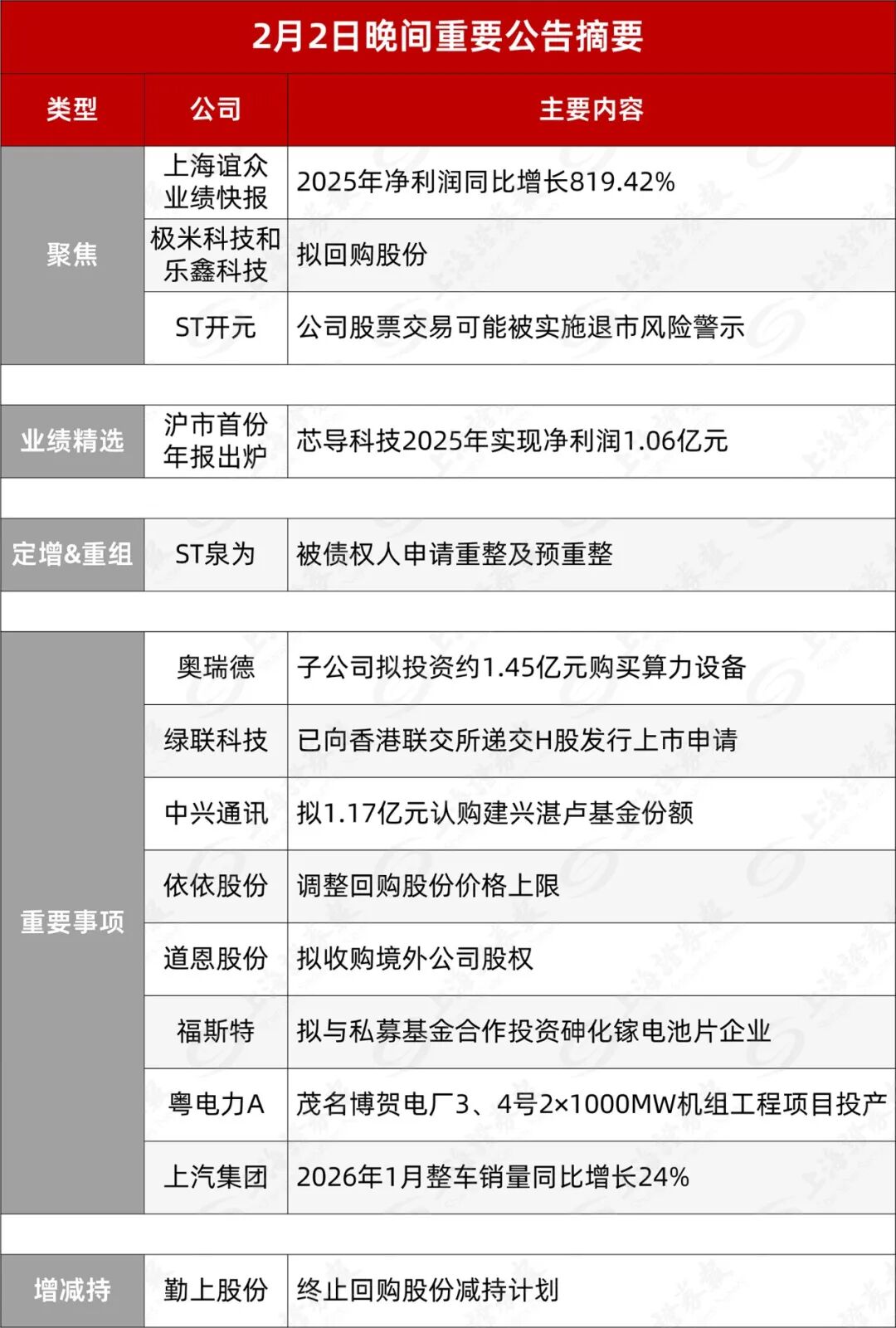
Important Matters - Haoshi Electromechanical has delivered samples of core products such as harmonic reducers and planetary reducers to certain humanoid robot manufacturers, resulting in small batch orders [1] - Aorui De's subsidiary plans to invest approximately 145 million yuan in computing power equipment, primarily for server procurement [1] - Gree Electric is focusing on research related to aluminum-to-copper technology but currently has no plans for aluminum-to-copper applications [1] - Longfly Fiber's global optical fiber and cable industry market environment is normal, with data center-related products accounting for a small proportion of total demand [1] - Hikvision reports that the price increase of hard disks has a slight positive contribution to the company's net impact [1] - Purun Co. will consider market supply and production costs for future product price adjustments [1] - Changchun High-tech's subsidiary GS3-007a dry mixed suspension drug registration clinical trial application has been accepted [1] - Litong Electronics is still in the early discussion stage for liquid cooling product development, with no AI data center project in Malaysia [1] - Rundu Co. has uncertainty regarding the approval of its innovative drug, hydrochloride dextromethorphan injection [1] - Science plans to engage in molybdenum processing and sales, while also investing in equipment for the recovery of rhenium resources during processing [1] Capital Operations - Hongxiang Co. intends to transfer 100% equity of Nantong Hanlan to Fujian Mingao [1] - Aorui De's subsidiary plans to invest approximately 145 million yuan in computing power equipment, primarily for server procurement [1] - Jichuan Pharmaceutical's wholly-owned subsidiary has signed an exclusive commercialization cooperation agreement [1] - XGIMI Technology plans to repurchase shares worth 50 million to 100 million yuan for employee stock ownership plans or equity incentives [1][2] Performance - Shanghai Yizhong reported a net profit growth of 819.42% year-on-year for 2025, with core products included in medical insurance [2] - Lianyun Technology's net profit for 2025 is expected to grow by 20.36%, benefiting from the recovery of the storage industry and increased AI demand, with growth in PCIe 3.0/4.0 and enterprise-level SATA main control chip shipments [2] Buybacks - Lexin Technology plans to repurchase shares worth 50 million to 100 million yuan, with a repurchase price not exceeding 170.29 yuan per share for employee stock ownership or equity incentives [2] - XGIMI Technology also plans to repurchase shares worth 50 million to 100 million yuan, with a repurchase price not exceeding 159.51 yuan per share for employee stock ownership plans or equity incentives [2]


财经早报:亚太股市,经历“黑色星期一”,金银闪崩引发13个期货品种跌停丨2026年2月3日
Xin Lang Cai Jing· 2026-02-02 23:40
Group 1 - Chinese government emphasizes the implementation of policies to promote high-quality development and new growth points [2][39] - Local governments are urged to enhance service awareness and improve administrative efficiency to address business concerns [2][39] - The "14th Five-Year Plan" should focus on practical and systematic planning, avoiding overly ambitious projects [2][39] Group 2 - Recent incidents of Chinese enterprise personnel being detained in the US have raised concerns about the impact on business exchanges [3][40] - The Chinese government has expressed strong opposition to the US's actions and called for the cessation of such practices [3][40] Group 3 - The South Korean stock market experienced a significant drop, triggering temporary trading halts [5][42] - The KOSPI index fell by 5.26%, closing at 4949.67 points, after previously reaching a historic high [6][42][7] - The Indonesian stock market also faced turbulence, with the Jakarta Composite Index dropping by 4.88% [8][43] Group 4 - The domestic futures market saw a rare plunge, with 13 commodity futures hitting the limit down due to panic selling [9][44] - The decline was attributed to a combination of factors, including excessive leverage and market structure vulnerabilities [9][44] Group 5 - The National Investment Silver LOF fund announced a significant adjustment in its valuation method for silver futures contracts [10][45] - This adjustment aims to better reflect international market price fluctuations [10][45] Group 6 - The gaming industry reported record revenue per user, with several A-share companies expecting positive performance [17][52] - The humanoid robot industry is accelerating, with institutions actively researching companies with promising earnings [17][52] Group 7 - Shanghai Yizhong reported a net profit increase of 819.42% for 2025, driven by the inclusion of its core product in the national medical insurance directory [19][53] - The company plans to continue investing in R&D for innovative drugs [19][53] Group 8 - XGIMI Technology and Espressif Systems announced share buyback plans, with total amounts not less than 50 million yuan [20][54] - ST Kaiyuan may face delisting risk due to negative net assets projected for 2025 [21][55]




极米科技股份有限公司 关于以集中竞价交易方式回购股份的预案暨回购报告书
Zheng Quan Ri Bao· 2026-02-02 23:09
证券代码:688696 证券简称:极米科技 公告编号:2026-003 本公司董事会及全体董事保证本公告内容不存在任何虚假记载、误导性陈述或者重大遗漏,并对其内容 的真实性、准确性和完整性依法承担法律责任。 重要内容提示: ● 回购股份金额: 不低于人民币5,000万元(含),不超过人民币10,000万元(含)。 ● 回购股份资金来源:极米科技股份有限公司(以下简称"公司")自有资金。 ● 回购股份用途:本次回购的股份将在未来适宜时机全部用于实施员工持股计划或股权激励。若公司未 能在股份回购实施结果暨股份变动公告日后3年内使用完毕已回购股份,尚未使用的已回购股份将予以 注销。如国家对相关政策作调整,则本回购方案按调整后的政策实行。 ● 回购股份价格:不超过人民币159.51元/股(含),该价格不超过董事会通过回购决议前30个交易日公 司A股股票交易均价的150%。 登录新浪财经APP 搜索【信披】查看更多考评等级 ● 回购股份方式:集中竞价交易方式。 ● 回购股份期限:自公司董事会审议通过本次股份回购方案之日起 12 个月内。 ● 相关股东是否存在减持计划:截至本公告披露日,公司董事、高级管理人员、控股股东、 ...
688091 净利增长819.42%
Shang Hai Zheng Quan Bao· 2026-02-02 16:05
Core Viewpoint - Shanghai Yizhong reported a significant increase in net profit for 2025, driven by the inclusion of its core product in the national medical insurance directory and increased R&D investments [2]. Group 1: Company Performance - Shanghai Yizhong's total revenue for 2025 reached approximately 317.08 million yuan, a year-on-year increase of 82.72%, with net profit soaring by 819.42% to about 64.13 million yuan [2]. - Chipway Technology achieved a revenue of 394 million yuan in 2025, reflecting an 11.52% increase, while net profit decreased by 4.91% to 10.6 million yuan [5]. Group 2: Share Buybacks - XGIMI Technology plans to repurchase shares with a total fund of no less than 50 million yuan and no more than 100 million yuan, at a price not exceeding 159.51 yuan per share [3]. - Lexin Technology also intends to repurchase shares with a similar financial commitment, with a maximum price of 170.29 yuan per share [3]. Group 3: Risk Warnings - ST Kaiyuan anticipates a potential delisting risk warning due to expected negative net assets for 2025 [4]. Group 4: Important Investments - Aorui Technology's subsidiary plans to invest approximately 145 million yuan in computing power equipment [7]. - ZTE Corporation intends to invest 117 million yuan in a fund focused on new generation information technology and advanced manufacturing [10]. - Dawn Holdings is set to acquire a plastic and engineering plastic compound business in Vietnam for approximately 15.74 million USD [11]. Group 5: New Projects and Developments - Guangdong Electric Power A announced the successful commissioning of its Maoming Bohua Power Plant, with a total investment of 7.48 billion yuan and an expected annual power generation of 8.6 billion kWh [12]. - Ugreen Technology has submitted an application for H-share listing on the Hong Kong Stock Exchange [12].



极米科技拟0.5亿元至1亿元回购股份
Zhi Tong Cai Jing· 2026-02-02 13:40
极米科技(688696.SH)发布公告,公司拟0.5亿元至1亿元回购股份,回购股份价格不超过159.51元/股,回 购的股份将在未来适宜时机全部用于实施员工持股计划或股权激励。 ...
今日晚间重要公告抢先看——歌尔股份:已耗资11.08亿元回购公司1.14%股份;美的集团:已耗资19.98亿元回购公司0.35%股份
Jin Rong Jie· 2026-02-02 13:06
Buyback Announcements - GoerTek has repurchased 1.14% of its shares, spending 1.108 billion yuan, with a total of 40.5481 million shares repurchased at prices ranging from 20.35 to 34.09 yuan per share [18] - Midea Group has repurchased 0.35% of its shares, spending 1.998 billion yuan, with a total of 26.9437 million shares repurchased at prices ranging from 69.50 to 80.44 yuan per share [17] - SF Holding has repurchased approximately 48.2887 million A-shares, with a total amount of about 1.899 billion yuan [1] Stock Trading Anomalies - Maoye Commercial has experienced a significant stock price increase, with a cumulative deviation of 20% over two trading days, indicating potential market overheating and high speculation risk [2] - Jinhui Liquor reported a cumulative stock price deviation of over 20% over three trading days, confirming normal production and no undisclosed major information [3] - Yangtze Optical Fiber has noted that the global optical fiber and cable market environment is normal, with new products related to data centers representing a small proportion of total demand [4] Profit Distribution Plans - Ningbo Fuda plans to distribute a cash dividend of 0.7 yuan per 10 shares, totaling 101 million yuan, which accounts for 59.85% of the net profit attributable to shareholders for the first three quarters of 2025 [5] Corporate Investments - Southwest Securities has received approval from the China Securities Regulatory Commission to issue bonds totaling up to 14 billion yuan [6] - Guoneng Rixin plans to increase its stake in Sanas Zhihui to 31% through an investment of 17.625 million yuan, enhancing its capabilities in new energy asset operation services [7] Production Updates - Weiyuan Co. has successfully launched a 250,000 tons/year electrolyte solvent project, enhancing its production capacity for various chemical products [8] Financial Performance - Lianyun Technology reported a net profit of 142 million yuan for 2025, a year-on-year increase of 20.36%, driven by growth in storage product demand [12] - Shanghai Yizhong reported a net profit of 64.132 million yuan for 2025, a significant increase of 819.42%, attributed to the inclusion of its core product in the national medical insurance directory [13]



2月2日晚间公告 | 长岭液压拟获新进大股东要约收购12%股份;美的集团、歌尔股份已耗资数十亿元回购
Xuan Gu Bao· 2026-02-02 12:15
Mergers and Acquisitions - Changling Hydraulic plans to acquire 12% of the company's shares at an offer price of 35.82 yuan per share [1] - Chip导科技 intends to purchase 100% equity of Jishun Technology for 403 million yuan and 17.15% equity of Shunlei Technology [2] Share Buybacks - Lexin Technology plans to repurchase shares worth between 50 million to 100 million yuan for employee stock ownership or equity incentives [3] - XGIMI Technology intends to repurchase shares worth between 50 million to 100 million yuan [3] - Lingyun Optical plans to change the purpose of 348.08 million shares for repurchase and cancel them [3] - Midea Group has spent 1.998 billion yuan to repurchase 0.35% of its shares [4] - GoerTek has spent 1.108 billion yuan to repurchase 1.14% of its shares [4] External Investments and Daily Operations - Weiyuan Co. has launched a 250,000 tons/year electrolyte solvent project [5] - Far East Co. signed contracts worth 3.075 billion yuan in January through its subsidiary [6] - Changchun Gaoxin's subsidiary GS3-007a has received approval for clinical trial application for a drug [7] - Aorui De plans to invest approximately 145 million yuan in purchasing computing power equipment to provide services to clients [7] - Electric Power Water Power intends to raise funds not exceeding 3.604 billion yuan through acquisition loans [7] - Guoneng Rixin plans to increase investment of 17.625 million yuan in controlling Sanas Zhihui to enhance new energy asset operation service capabilities [7] - Science plans to engage in molybdenum processing and sales to secure a stable resource supply for rhenium recycling [7] - Panlong Pharmaceutical has received approval for clinical trials of the drug Fluorobiphenyl Patch [8] - Hongxiang Co. plans to transfer 100% equity of Nantong Hanlan New Energy for 120 million yuan [9] - Daon Co. intends to acquire equity in a Vietnamese company for a total purchase price of approximately 15.737 million USD [10] Performance Changes - Shanghai Yizhong expects a net profit of 64.132 million yuan in 2025, a year-on-year increase of 819.42%, with its core product, injectable paclitaxel polymer micelles, included in the national medical insurance directory [11] - Lianyun Technology anticipates a 20.36% year-on-year increase in net profit in 2025, driven by growth in data storage main control chips [12]


极米科技(688696.SH):拟斥资5000万元至1亿元回购股份
Ge Long Hui A P P· 2026-02-02 12:06
格隆汇2月2日丨极米科技(688696.SH)公布,公司本次回购的股份将在未来适宜时机全部用于实施员工 持股计划或股权激励。回购股份金额不低于人民币5,000万元(含),不超过人民币10,000万元(含)。 回购股份价格不超过人民币159.51元/股(含)。 ...
极米科技:2月2日召开董事会会议
Mei Ri Jing Ji Xin Wen· 2026-02-02 10:37
每经AI快讯,极米科技2月2日晚间发布公告称,公司第三届第七次董事会会议于2026年2月2日在公司 会议室以现场结合通讯的方式召开。会议审议了《关于以集中竞价交易方式回购公司股份方案的议案》 等文件。 每经头条(nbdtoutiao)——曾卖劳斯莱斯、保时捷等豪车,汽车销售巨头宝利德如今破产清算:杭州 总部已人去楼空,义乌子公司贴上了封条 (记者 王晓波) ...
极米科技(688696) - 关于以集中竞价交易方式回购公司股份的预案暨回购报告书
2026-02-02 10:31
证券代码:688696 证券简称:极米科技 公告编号:2026-003 极米科技股份有限公司 关于以集中竞价交易方式回购股份的预案暨回购报告 书 本公司董事会及全体董事保证本公告内容不存在任何虚假记载、误导性陈述 或者重大遗漏,并对其内容的真实性、准确性和完整性依法承担法律责任。 重要内容提示: 2、若在本次回购股份的回购期限内发生对公司股票交易价格产生重大影响的 重大事项,或公司生产经营、财务情况、外部客观情况发生重大变化,或其他导 ● 回购股份金额:不低于人民币 5,000 万元(含),不超过人民币 10,000 万元(含)。 ● 回购股份资金来源:极米科技股份有限公司(以下简称"公司")自有资金。 ● 回购股份用途:本次回购的股份将在未来适宜时机全部用于实施员工持股计划 或股权激励。若公司未能在股份回购实施结果暨股份变动公告日后 3 年内使用完 毕已回购股份,尚未使用的已回购股份将予以注销。如国家对相关政策作调整, 则本回购方案按调整后的政策实行。 ● 回购股份价格:不超过人民币 159.51 元/股(含),该价格不超过董事会通过回 购决议前 30 个交易日公司 A 股股票交易均价的 150%。 ● 回 ...