Moore Threads Technology(688795)

Search documents
上证早知道|规范动力和储能电池产业竞争秩序 多部门部署;摩尔线程 最新发布;这家无人机公司 签大单
Shang Hai Zheng Quan Bao· 2026-01-08 22:59
Group 1 - The Ministry of Industry and Information Technology, along with other regulatory bodies, is focusing on regulating the competition order in the power and energy battery industry, emphasizing market supervision and quality control [2] - The commercial aerospace industry is entering a rapid development phase, supported by policies aimed at advancing reusable rocket technology and enhancing launch capabilities [4] - The water conservancy engineering construction industry is expected to maintain high growth, with a projected annual compound growth rate of 8.5% from 2025 to 2030, driven by increasing demand for water resources [7] - The implementation of the Atomic Energy Law is set to encourage research and development in controlled nuclear fusion, with significant long-term growth potential anticipated in the fusion market [8] Group 2 - Companies like Mengsheng Electronics and Changjiang Communication are involved in satellite navigation and communication, indicating a focus on the satellite industry [5] - Companies such as Aerospace Electric and others are actively participating in the commercial aerospace sector, with significant investments in new technologies and projects [12][13] - The sales performance of Cai Bai Co. has shown improvement, driven by cultural product sales and effective inventory management strategies [14]
AI进化速递 | 摩尔线程发布SimuMax的1.1版本
Di Yi Cai Jing· 2026-01-08 12:53
Group 1 - Moole Technology released version 1.1 of the open-source large model distributed training simulation tool SimuMax [1] - Alibaba Cloud launched a multimodal interaction development kit aimed at AI hardware [1] - Xiaopeng Motors Chairman He Xiaopeng announced plans for mass production of humanoid robots and flying cars this year [1] Group 2 - JD.com established a "Chameleon Business Unit" to undertake AI initiatives [1] - Tesla CEO Elon Musk stated that within three years, robot surgeons will surpass top human doctors, and China's AI computing power will lead the world [1] - Caterpillar partnered with NVIDIA to transform heavy industry through physical AI and robotics technology [1] Group 3 - Anthropic, a rising star in artificial intelligence, plans to raise $10 billion, with its valuation nearing that of OpenAI [1] - Arm restructured the company and established a physical AI department [1] - Datavault AI expanded its collaboration with IBM [1] - Tensu Zhixin will unveil the roadmap for its next three generations of GPGPU on January 26 [1] - Leju Robotics formed a full-stack AI partnership with Alibaba Cloud [1]
摩尔线程发布开源大模型分布式训练仿真工具SimuMax的1.1版本
Bei Jing Shang Bao· 2026-01-08 12:05
Core Viewpoint - Moer Technology has released version 1.1 of its open-source large model distributed training simulation tool, SimuMax, which enhances its capabilities and provides systematic support for model training simulation and tuning [1] Group 1: Product Update - The new version builds on the high-precision simulation capabilities of version 1.0 and transitions from a single tool to an integrated full-stack workflow platform [1] - Key innovations in this update include a user-friendly visual configuration interface, intelligent parallel strategy search, and a System-Config generation pipeline that integrates computing and communication efficiency modeling [1] - The update improves compatibility with the mainstream training framework Megatron-LM and enhances the modeling accuracy of complex communication behaviors in mixed parallel training, making the simulation environment closer to real production scenarios [1] Group 2: Market Reaction - On January 8, Moer Technology's stock price increased by 9.15%, closing at 674.02 yuan per share, with a total market capitalization of 316.8 billion yuan [1]
摩尔线程发布开源大模型分布式训练仿真工具SimuMax v1.1
Bei Jing Shang Bao· 2026-01-08 11:52
Core Viewpoint - Moore Threads has officially released version 1.1 of its open-source distributed training simulation tool, SimuMax, which enhances the capabilities of large model training simulation and tuning [1] Group 1: Key Innovations - The new version builds on the high-precision simulation capabilities of v1.0 and transitions from a single tool to an integrated full-stack workflow platform [1] - Three core innovations are highlighted: a user-friendly visual configuration interface, intelligent parallel strategy search, and a System-Config generation pipeline that integrates computing and communication efficiency modeling [1] - The update improves compatibility with the mainstream training framework Megatron-LM and enhances the modeling accuracy of complex communication behaviors in mixed parallel training, making the simulation environment closer to real production scenarios [1]
摩尔线程正式发布开源大模型分布式训练仿真工具SimuMax的1.1版本
Xin Lang Cai Jing· 2026-01-08 11:47
Core Insights - Moore Threads has officially released version 1.1 of its open-source large model distributed training simulation tool, SimuMax, which upgrades from a single tool to an integrated full-stack workflow platform for systematic support in large model training simulation and tuning [1] Group 1: Key Innovations - The new version focuses on three core innovations: a user-friendly visual configuration interface, intelligent parallel strategy search, and a System-Config generation pipeline that integrates computing and communication efficiency modeling [1] - Enhanced compatibility with the mainstream training framework Megatron-LM has been achieved, along with improved modeling accuracy for complex communication behaviors in mixed parallel training [1]
摩尔线程发布SimuMax v1.1:新增可视化配置界面
Feng Huang Wang· 2026-01-08 11:45
Core Insights - The core viewpoint of the article is the release of version 1.1 of SimuMax, an open-source distributed training simulation tool by Moore Threads, which has evolved into an integrated full-stack workflow platform [1] Group 1: Product Features - SimuMax v1.1 has upgraded from a single simulation tool to a comprehensive platform, introducing features such as a visual configuration interface, intelligent parallel strategy search, and system configuration generation pipeline [1] - The new version continues to support distributed training simulation from single-card to ten-thousand-card clusters, allowing for simulation of memory usage and training performance [1] - Enhanced compatibility with the training framework Megatron-LM and improved modeling accuracy for network bandwidth competition in mixed parallel training are key updates in this version [1] Group 2: Purpose and Utility - The tool is designed to assist users in evaluating and optimizing training efficiency without the need to execute a complete training process [1]
摩尔线程发布SimuMax v1.1
Zheng Quan Shi Bao Wang· 2026-01-08 11:11
Core Insights - Moore Threads has officially released version 1.1 of its open-source large model distributed training simulation tool, SimuMax, which upgrades from a single tool to an integrated full-stack workflow platform for systematic support in large model training simulation and tuning [1] Group 1: Key Innovations - The update focuses on three core innovations: a user-friendly visual configuration interface, intelligent parallel strategy search, and a System-Config generation pipeline that integrates computing and communication efficiency modeling [1] - The new version enhances compatibility with the mainstream training framework Megatron-LM and improves the modeling accuracy of complex communication behaviors in mixed parallel training, making the simulation environment closer to real production scenarios [1]
近百家中国半导体企业涌入A股港股,10家已IPO
2 1 Shi Ji Jing Ji Bao Dao· 2026-01-08 10:01
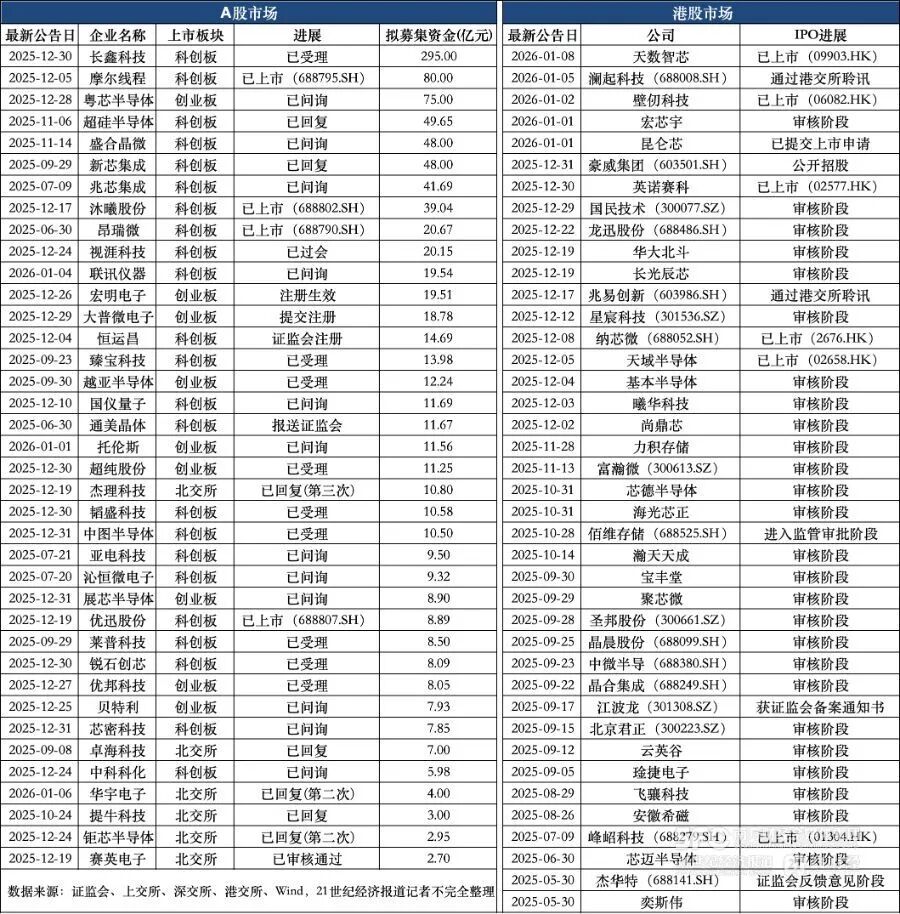
Core Insights - The Chinese semiconductor industry is experiencing an unprecedented IPO boom, with nearly all domestic chip companies vying for entry into the capital market [1][5][19] - A total of 95 semiconductor companies have initiated or accelerated their IPO processes, with 10 already listed and 85 preparing for listing [4][19] - The current IPO wave reflects strong capital interest in the domestic chip sector and indicates that key companies are poised for significant growth through capital market support [5][19] IPO Activity - Since 2025, 38 semiconductor companies have started the IPO process in the A-share market, aiming to raise nearly 100 billion yuan, averaging 26.23 million yuan per company [6] - In the Hong Kong market, 40 semiconductor companies have initiated IPO plans, covering key areas such as GPU, power semiconductors, sensors, and packaging [9][10] - Notable companies like Changxin Technology and Yuanchip Semiconductor are among those seeking substantial funding through IPOs, with Changxin aiming to raise 295 billion yuan [17][19] Market Trends - The IPO frenzy is driven by ongoing self-innovation, coupled with favorable policies and market conditions, marking a new phase of capital and technology-driven growth in the semiconductor industry [5][19] - The demand for AI computing power is surging, with projections indicating that China's smart computing demand will reach 486 EFLOPS by 2025, over ten times that of 2023 [15] - The storage chip sector is also entering an upward cycle, with companies like Changxin Technology and Zhaoyi Innovation seeking to capitalize on this trend through IPOs [17][18] Company Highlights - Companies such as Moer Technology and Muxi Co. have seen significant market interest, with their IPOs receiving oversubscription rates of 4126 times and 4498 times, respectively [15] - Wall Street's response to the IPOs has been enthusiastic, with Moer Technology's stock price soaring over 500% on its first day of trading [16] - The capital market is increasingly focusing on high-performance AI chips and storage solutions, indicating a shift in investment strategies within the semiconductor sector [13][19] Future Outlook - The collective IPO efforts signal a maturation of the domestic semiconductor industry, moving towards a critical turning point in deep self-innovation [20] - The ongoing capital influx is expected to provide essential support for the development of the domestic semiconductor landscape, especially in light of increasing global competition and supply chain uncertainties [19][20]

近百家中国半导体企业涌入A股港股,10家已IPO
21世纪经济报道· 2026-01-08 09:39
Core Viewpoint - The Chinese semiconductor industry is experiencing an unprecedented IPO boom, with nearly all domestic chip companies vying for entry into the capital market, indicating strong investor interest and potential for rapid development in the sector [1][2][20]. Group 1: IPO Activity - A total of 95 semiconductor companies have initiated or accelerated their IPO processes, with 10 already listed and 85 preparing for listing [1]. - In the A-share market, there are 55 companies involved, with 4 already listed, while 40 companies are in the Hong Kong market, with 6 listed and 34 aiming for listing [2][7]. - Since 2025, 38 semiconductor companies have started the A-share IPO process, aiming to raise nearly 100 billion yuan, averaging 26.23 million yuan per company [4]. Group 2: Capital Raising Trends - The IPO fundraising amounts are diverse, with leading companies like Changxin Technology, Moer Thread, and Guangdong Yu Chip Semiconductor raising 295 billion yuan, 80 billion yuan, and 75 billion yuan respectively [5][12]. - Many companies are raising around 10 billion yuan, covering various fields such as RF front-end chips, electronic components, and semiconductor equipment [5][12]. Group 3: Market Dynamics - The current IPO wave reflects a dual focus on capital and technology, driven by ongoing innovation and favorable policies in the Chinese semiconductor industry [2][20]. - The demand for AI computing power is surging, with projections indicating that China's smart computing demand will reach 486 EFLOPS by 2025, over ten times that of 2023 [14]. Group 4: Sector Focus - The IPOs are concentrated in key areas such as AI chips, GPU, CPU, and storage chips, with significant interest in high-performance computing and advanced manufacturing processes [12][20]. - Companies like Moer Thread and Nuxin Technology have seen massive oversubscription rates during their IPOs, indicating strong market enthusiasm for these sectors [14][15]. Group 5: Future Outlook - The collective IPO efforts signal a maturation of the domestic semiconductor industry, emphasizing the need for capital to support technological advancements and competitive positioning in the global market [20]. - The trend towards "A+H" listings is also notable, with several companies seeking to expand their market presence both domestically and internationally [8][19].
和而泰3000万元投资摩尔线程,持股市值已超25亿元!股份高比例质押实控人拟减持套现
Mei Ri Jing Ji Xin Wen· 2026-01-08 04:24
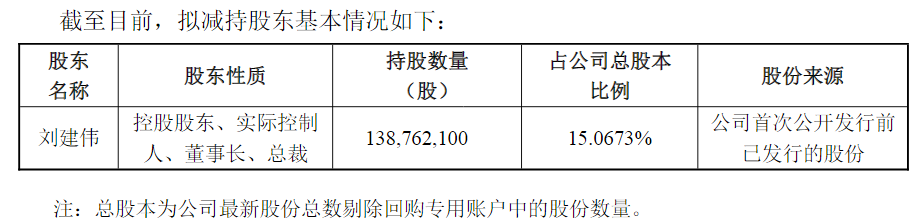
Core Viewpoint - The reduction plan announced by Liu Jianwei, the actual controller of Heertai, has caused stock price fluctuations, primarily aimed at alleviating debt pressure due to a high pledge ratio of over 55% [1][2][3] Group 1: Shareholding and Reduction Plan - Liu Jianwei plans to reduce his shareholding by up to 18,417,800 shares, accounting for no more than 2% of the company's total share capital, from January 28 to April 27, 2026 [2][3] - As of the announcement, Liu Jianwei holds approximately 139 million shares, representing 15.06% of the company's total share capital [2][3] - The reduction is intended to repay pledged financing debts and meet personal funding needs, with a total of 76.76 million shares pledged, exceeding 55% of his holdings [3][5] Group 2: Financial Performance and Market Reaction - Heertai's stock price fell by 4.69% on the first trading day following the reduction announcement, closing at 38.80 yuan, with a market capitalization of approximately 35.88 billion yuan [5] - The company reported a significant increase in revenue and net profit for the first three quarters of 2025, with revenue of 8.27 billion yuan (up 17.47%) and net profit of 603 million yuan (up 69.66%) [8] - Heertai's investment in the chip company Moer Thread is noteworthy, with shares valued at over 2.5 billion yuan, contributing positively to its financial standing [8][9] Group 3: Corporate Structure and Management - Heertai's management structure is clearly defined, with Liu Jianwei overseeing financial, investment, and human resources, while the executive president, Qin Hongwu, manages the implementation of strategies and operational goals [9]