SACL(000089)

Search documents
首个拥有4个千万级机场的省份出现了
2 1 Shi Ji Jing Ji Bao Dao· 2026-01-26 02:44
Core Insights - Guangdong has become the first province in China to have four airports with an annual passenger throughput of over 10 million, marking a significant milestone in its aviation industry [2] - The expansion of Guangzhou Baiyun Airport and Shenzhen Bao'an Airport is a revolutionary development, with Baiyun Airport becoming the first in China to have five operational runways [2][3] - The construction of a "super air corridor" in Guangdong is enhancing its connectivity to global markets, facilitating rapid logistics and transportation for local industries [5] Summary by Sections - **Airport Capacity and Expansion** - The annual passenger throughput of Guangdong's airports has reached 180 million, with the addition of Chaozhou Shantou Airport pushing the total number of million-level airports in the province to four [1][2] - Baiyun Airport's new T3 terminal and fifth runway, with an investment of 53.77 billion yuan, officially commenced operations on October 30, 2025 [2] - Shenzhen Bao'an Airport's third runway also began operations on November 29, 2025, marking its entry into the "three-runway era" [3] - **Economic Impact and Logistics** - The proximity of manufacturing hubs in Dongguan, Huizhou, and Foshan to the airports allows for rapid logistics, enabling "Made in Guangdong" products to reach global markets swiftly [5] - The development of the Guangdong-Hong Kong-Macao Greater Bay Area is accelerating the formation of a world-class airport cluster, enhancing the region's global competitiveness [5]

航空机场板块1月21日跌1.17%,中国东航领跌,主力资金净流出8483.06万元
Zheng Xing Xing Ye Ri Bao· 2026-01-21 08:54
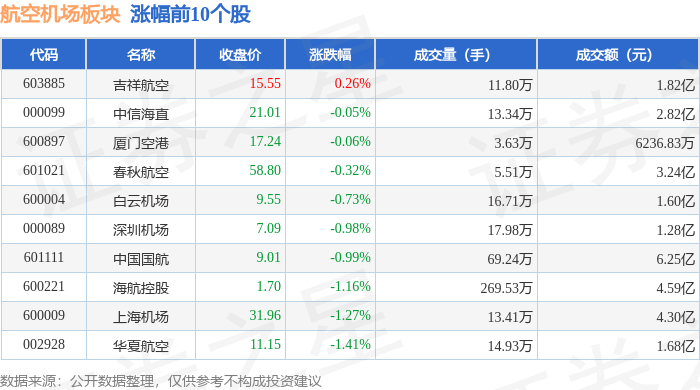
Core Viewpoint - The aviation and airport sector experienced a decline of 1.17% on January 21, with China Eastern Airlines leading the drop, while the Shanghai Composite Index rose by 0.08% and the Shenzhen Component Index increased by 0.7% [1]. Group 1: Market Performance - The closing price of China Eastern Airlines was 6.22, reflecting a decrease of 2.20% with a trading volume of 1,109,700 shares and a transaction value of 6.95 million [2]. - The aviation and airport sector saw a net outflow of 84.83 million from major funds, while retail investors experienced a net outflow of 10.9 million, and speculative funds had a net inflow of 194 million [2][3]. Group 2: Individual Stock Performance - China National Aviation (China National Airlines) had a net outflow of 22.99 million from major funds, with a net inflow of 5.52 million from speculative funds and a net outflow of 28.51 million from retail investors [3]. - Xiamen Airport reported a net outflow of 2.03 million from major funds, while speculative funds had a net inflow of 1.35 million, and retail investors saw a net inflow of 0.68 million [3]. - Shenzhen Airport experienced a net inflow of 12.93 million from major funds, with a net inflow of 2.77 million from speculative funds and a net outflow of 15.69 million from retail investors [3].





航空机场板块1月20日涨2.53%,南方航空领涨,主力资金净流入1.37亿元
Zheng Xing Xing Ye Ri Bao· 2026-01-20 08:51
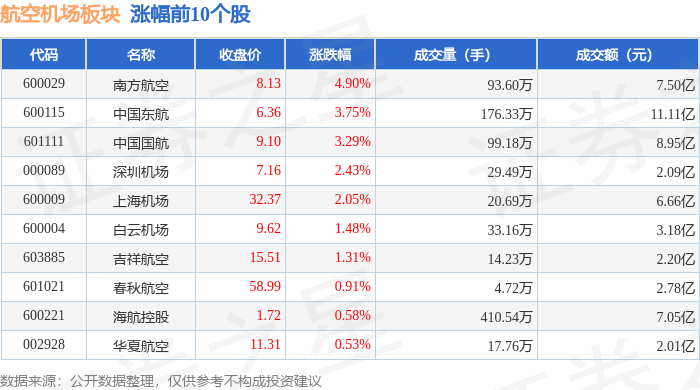
Core Viewpoint - The aviation and airport sector experienced a notable increase of 2.53% on January 20, with Southern Airlines leading the gains, while the overall stock market indices showed slight declines [1]. Group 1: Market Performance - The Shanghai Composite Index closed at 4113.65, down 0.01%, and the Shenzhen Component Index closed at 14155.63, down 0.97% [1]. - Southern Airlines saw a closing price of 8.13, with a rise of 4.90%, and a trading volume of 936,000 shares, resulting in a transaction value of 750 million yuan [1]. - China Eastern Airlines closed at 6.36, up 3.75%, with a trading volume of 1,763,300 shares and a transaction value of 1.111 billion yuan [1]. Group 2: Individual Stock Performance - China National Aviation Holdings closed at 9.10, increasing by 3.29%, with a trading volume of 991,800 shares and a transaction value of 895 million yuan [1]. - Shenzhen Airport's closing price was 7.16, up 2.43%, with a trading volume of 294,900 shares and a transaction value of 209 million yuan [1]. - Shanghai Airport closed at 32.37, rising by 2.05%, with a trading volume of 206,900 shares and a transaction value of 666 million yuan [1]. Group 3: Capital Flow - The aviation and airport sector saw a net inflow of 137 million yuan from main funds, while retail investors experienced a net outflow of 1.22 billion yuan [2]. - Southern Airlines had a net outflow of 57.22 million yuan from main funds, with retail investors also showing a net outflow of 38.10 million yuan [3]. - Shanghai Airport recorded a net inflow of 45.37 million yuan from main funds, while retail investors had a net outflow of 34.33 million yuan [3].

申万宏源:航空业“反内卷”初见成效 关注业绩持续改善的机场板块
Zhi Tong Cai Jing· 2026-01-20 07:45
Core Viewpoint - The aviation sector is recommended for continued investment, with expectations of significant improvement in airline profitability as the industry approaches a turning point, driven by historical high passenger load factors and increasing international travel demand [1] Group 1: Industry Outlook - The 2026 National Civil Aviation Work Conference emphasizes "quality improvement and efficiency enhancement," setting growth targets of 1,750 billion ton-kilometers for total transport turnover, 810 million passengers, and 1,070 thousand tons for cargo, representing year-on-year increases of 6.7%, 5.2%, and 5.2% respectively [2] - Measures to control inefficient route supply and improve airline profitability are expected to alleviate "involution" competition within the industry [2] Group 2: Supply Side - The global aircraft supply chain remains unrepaired, with Airbus and Boeing projected to deliver 793 and 600 aircraft respectively in 2025, still below pre-pandemic levels, and a backlog of over 15,000 aircraft orders [3] - The delivery cycle for new aircraft has extended to 6.8 years, leading airlines to prolong the service life of older aircraft, with a peak in retirements expected by 2030 [3] - China's airline fleet is projected to grow by only 4.0% to 4,271 aircraft by 2025, with a significant number of aircraft reaching retirement age [3] Group 3: Demand Side - Visa exemption policies are driving an increase in inbound travelers, with foreign visitors to China surpassing pre-pandemic levels in key cities [4] - The international routes are expected to be the main growth engine for demand in 2026, with a forecasted 5.3% year-on-year increase in daily passenger volume during the Spring Festival [4] - The average ticket price for the upcoming Spring Festival is expected to be 20% higher than the previous year, indicating a trend of simultaneous volume and price increases [4]

研判2026!中国地面综合服务行业政策汇总、产业链、发展现状、竞争格局及发展趋势分析:受益于国家政策持续推动,行业市场规模不断增长[图]
Chan Ye Xin Xi Wang· 2026-01-20 01:05
Core Viewpoint - The ground comprehensive service industry in China's civil aviation sector is experiencing rapid growth, driven by the recovery of air transport and supportive government policies, with the market expected to reach 230 billion yuan in 2024, reflecting a year-on-year increase of 2.2% [1][5]. Industry Overview - Ground comprehensive services encompass essential services provided when aircraft arrive and depart from airports, including management, passenger services, baggage handling, cargo services, and aircraft maintenance [3]. - The industry is crucial for aviation safety and significantly impacts the efficiency and quality of services provided to airlines and consumers [3]. Market Size and Trends - The market size of China's ground comprehensive services reached 250 billion yuan in 2019, fluctuated due to the pandemic from 2020 to 2022, and is recovering with a projected market size of 230 billion yuan in 2024 [1][5]. - The number of transport airports in China is expected to increase to 263 by the end of 2024, further driving demand for ground services [5]. Policy Support - The government has introduced various policies to enhance ground services, including guidelines for optimizing first-time passenger services and regulations for managing airport service operations [4]. Competitive Landscape - The ground comprehensive service market is highly competitive, with major players including large airlines like China Eastern Airlines and China Southern Airlines, specialized ground service companies, and airport management firms [6][7]. - Large airlines dominate the market due to their extensive service networks and operational experience, while specialized companies excel in specific service areas [6]. Development Trends - Digital transformation is reshaping the industry, enabling better demand forecasting and resource optimization through data analysis [9]. - The industry is moving towards green and sustainable practices, incorporating eco-friendly vehicles and energy-efficient equipment to reduce environmental impact [10]. - Service models are diversifying to meet individual passenger needs, introducing innovative services like exclusive transfers and smart baggage tracking [12]. - Market competition is intensifying as more companies enter the sector, leading to increased consolidation and a need for companies to enhance their competitiveness [13].


航空机场板块1月19日涨3.36%,中国东航领涨,主力资金净流入2710.67万元
Zheng Xing Xing Ye Ri Bao· 2026-01-19 08:56
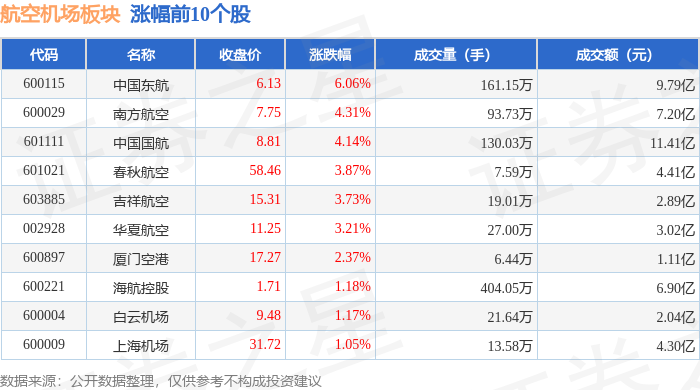
Core Insights - The aviation and airport sector experienced a significant increase of 3.36% on January 19, with China Eastern Airlines leading the gains [1] - The Shanghai Composite Index closed at 4114.0, up 0.29%, while the Shenzhen Component Index closed at 14294.05, up 0.09% [1] Stock Performance - China Eastern Airlines (600115) closed at 6.13, up 6.06%, with a trading volume of 1.6115 million shares and a transaction value of 979 million [1] - Southern Airlines (600029) closed at 7.75, up 4.31%, with a trading volume of 937,300 shares and a transaction value of 720 million [1] - Air China (601111) closed at 8.81, up 4.14%, with a trading volume of 1.3003 million shares and a transaction value of 1.141 billion [1] - Spring Airlines (601021) closed at 58.46, up 3.87%, with a trading volume of 75,900 shares and a transaction value of 441 million [1] - Other notable performances include Xiamen Airport (600897) at 17.27, up 2.37%, and Shanghai Airport (600009) at 31.72, up 1.05% [1] Capital Flow - The aviation and airport sector saw a net inflow of 27.1067 million in main funds, while retail funds experienced a net inflow of 54.5283 million [2] - The sector's overall capital flow indicates a mixed sentiment, with main funds showing a net outflow in some stocks while retail investors contributed positively [2][3] Individual Stock Capital Flow - Hainan Airlines (600221) had a main fund net outflow of 56.1893 million, while retail investors showed a net outflow of 28.2785 million [3] - Shanghai Airport (600009) recorded a main fund net inflow of 41.0025 million, but retail investors had a net outflow of 50.1886 million [3] - Southern Airlines (600029) saw a main fund net inflow of 23.9450 million, with retail investors also showing a net outflow of 13.4306 million [3] - Other stocks like Xiamen Airport (600897) and Shenzhen Airport (000089) also reflected varied capital flows, indicating differing investor sentiments across the sector [3]
航空机场板块1月16日跌0.78%,中信海直领跌,主力资金净流出4.77亿元
Zheng Xing Xing Ye Ri Bao· 2026-01-16 08:56
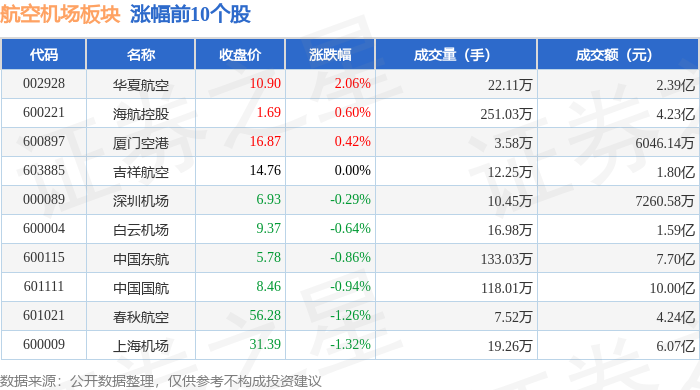
Market Overview - The aviation and airport sector declined by 0.78% on January 16, with CITIC Hainan Airlines leading the drop [1] - The Shanghai Composite Index closed at 4101.91, down 0.26%, while the Shenzhen Component Index closed at 14281.08, down 0.18% [1] Stock Performance - Notable stock performances included: - Huaxia Airlines (002928) increased by 2.06% to close at 10.90 with a trading volume of 221,100 shares and a turnover of 239 million yuan [1] - Hainan Airlines (600221) rose by 0.60% to 69.1 with a trading volume of 2.51 million shares and a turnover of 423 million yuan [1] - Xiamen Airport (600897) increased by 0.42% to 16.87 with a trading volume of 35,800 shares and a turnover of 60.46 million yuan [1] - China Eastern Airlines (600115) decreased by 0.86% to 5.78 with a trading volume of 1.33 million shares and a turnover of 770 million yuan [1] - China Southern Airlines (600029) fell by 1.46% to 7.43 with a trading volume of 795,100 shares and a turnover of 594 million yuan [2] Capital Flow - The aviation and airport sector experienced a net outflow of 477 million yuan from institutional investors, while retail investors saw a net inflow of 257 million yuan [2] - The capital flow for individual stocks showed: - Xiamen Airport had a net inflow of 121.82 million yuan from retail investors, despite a net outflow of 341.39 million yuan from institutional investors [3] - CITIC Hainan Airlines faced a significant net outflow of 75.42 million yuan from institutional investors, while retail investors contributed a net inflow of 57.25 million yuan [3] - China Eastern Airlines had a net outflow of 73.70 million yuan from institutional investors, with retail investors contributing a net inflow of 45.21 million yuan [3]



自然资源部关于深圳机场北货运区及配套站坪项目海域使用论证报告的公示
Xin Lang Cai Jing· 2026-01-15 11:14
Core Viewpoint - The recent application for sea area usage related to the Shenzhen Airport North Cargo Area and supporting apron project has been accepted, with a public announcement of the sea area usage demonstration report [1] Group 1: Project Details - The applicant for the sea area usage is Shenzhen Airport (Group) Co., Ltd. [1] - The organization responsible for compiling the sea area usage demonstration report is Qingdao Guohai Haohan Ocean Engineering Consulting Co., Ltd. [1] - The public announcement period for the sea area usage demonstration report is from January 15 to January 28, 2026, lasting for 10 working days [1]
航空机场板块1月15日跌0.29%,厦门空港领跌,主力资金净流入357.22万元
Zheng Xing Xing Ye Ri Bao· 2026-01-15 08:59
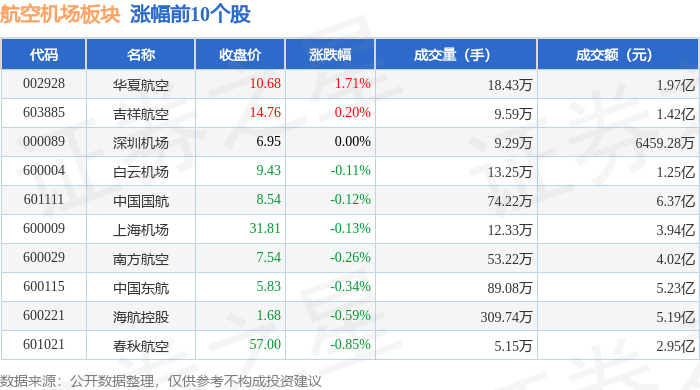
Core Viewpoint - The aviation and airport sector experienced a slight decline of 0.29% on January 15, with Xiamen Airport leading the drop. The Shanghai Composite Index closed at 4112.6, down 0.33%, while the Shenzhen Component Index rose by 0.41% to 14306.73 [1]. Group 1: Stock Performance - Xiamen Airport (600897) closed at 16.80, down 1.52% with a trading volume of 55,900 shares and a transaction value of 94.38 million [2]. - Huaxia Airlines (002928) saw a gain of 1.71%, closing at 10.68 with a trading volume of 184,300 shares and a transaction value of 197 million [1]. - China Eastern Airlines (600115) closed at 5.83, down 0.34% with a trading volume of 890,800 shares and a transaction value of 523 million [2]. Group 2: Capital Flow - The aviation and airport sector had a net inflow of 3.57 million from institutional investors, while retail investors saw a net outflow of 73.65 million [2]. - Spring Airlines (601021) had a net inflow of 27.87 million from institutional investors, representing 9.46% of its total trading [3]. - Xiamen Airport (600897) experienced a significant net outflow of 21.86 million from institutional investors, accounting for -23.17% of its total trading [3].
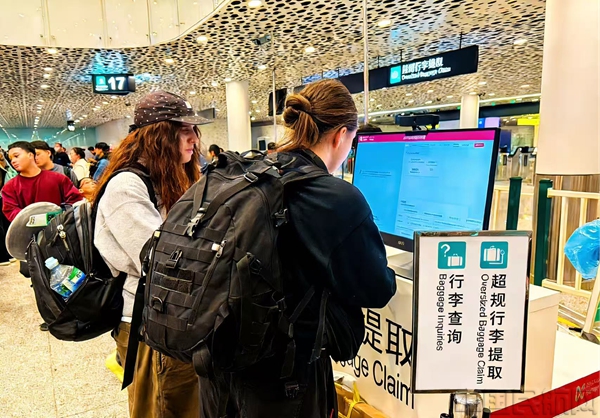
深圳机场:人工智能成果惠及万千旅客
Zhong Guo Min Hang Wang· 2026-01-15 08:25
Core Insights - Shenzhen Airport has been recognized as the second-best among 42 major airports in China for its comprehensive evaluation in smart aviation construction, highlighting its systematic and effective innovations in smart services, operations, and logistics [1] Group 1: Smart Aviation Initiatives - In 2025, Shenzhen Airport will implement the "Airport + AI" initiative, leveraging its technological innovation capabilities and diverse application scenarios to enhance operational efficiency and passenger experience [1] - The airport has developed various AI applications, including an intelligent parking allocation system and automated delivery robots, which significantly improve service quality and operational efficiency [1][6] Group 2: Innovation Ecosystem - Shenzhen Airport is fostering an innovation ecosystem through an "open scene + mechanism reform" approach, establishing a collaborative environment with both state-owned and private enterprises [2] - The airport has introduced an AI scene application management plan to streamline project management and has launched a "challenge mechanism" to attract participation from various enterprises [2] Group 3: AI and Data Integration - The airport has achieved a significant milestone by deploying a domestically developed AI model supported by Huawei's Ascend computing cluster, enabling comprehensive data integration across 18 core business areas [4] - This integration facilitates the development of specialized AI agents that enhance operational management, such as an AI safety assistant that improves document retrieval efficiency by 60 times [4] Group 4: Operational Achievements - In 2025, Shenzhen Airport's international and regional cargo throughput exceeded 1 million tons for the first time, with cross-border e-commerce cargo volume increasing by nearly 10% [3] - The airport achieved a historic high in flight takeoffs and landings, with a flight release normal rate of 91.19% [3] Group 5: AI Applications in Various Domains - In passenger services, the intelligent parking allocation system reduced flight assignment time from 4 hours to 1 minute, and the AI translation device supports real-time translation in over 100 languages [6][9] - In logistics, the introduction of AGV robots and smart monitoring systems has significantly reduced cargo dwell times and improved operational efficiency [8][9] - In safety operations, AI-assisted image recognition technology has enhanced security check efficiency by over 30% [9] Group 6: Future Directions - Shenzhen Airport aims to solidify its role as a leader in smart aviation by fully integrating AI technologies across all operational scenarios, contributing to the development of Shenzhen as a globally influential economic center [13]