
CHANGAN AUTOMOBILE-B(000625)

Search documents
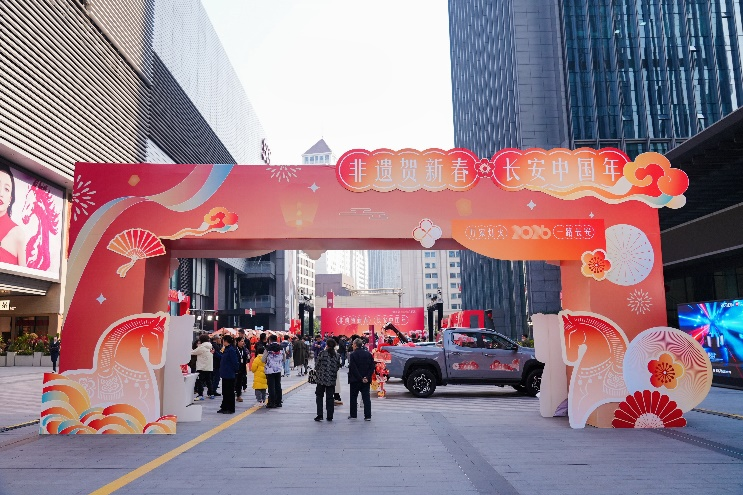
非遗贺新春,长安中国年——重庆“巴渝非遗年俗文化展”举行
Zhong Guo Jin Rong Xin Xi Wang· 2026-02-14 06:48
Group 1 - The event "2026 Year of the Horse Spring Festival Gala" and the "Bashu Intangible Cultural Heritage New Year Customs Cultural Performance" took place in Chongqing, showcasing local traditions and culture [1][3] - The performance featured national-level intangible cultural heritage artists, attracting over a thousand citizens who celebrated the event [3] - The event included a cultural experience area with traditional crafts such as sugar painting, wood carving, and paper art, appealing to both young and old attendees [3] Group 2 - Changan Automobile represented "Chongqing-made" products at the event, highlighting its achievements, including the production of the 30 millionth vehicle and obtaining the first domestic L3-level autonomous driving license [5] - During the Spring Festival, Changan Automobile will collaborate on a large drone show and display on major landmarks to send New Year blessings to global Chinese communities [5] - On February 16, Changan Qiyuan will participate in the CCTV Spring Festival Gala, further promoting the brand and celebrating the New Year with citizens [5]


重庆长安汽车高管变动:张德勇辞任总会计师,倪尔科接任
Cai Jing Wang· 2026-02-14 02:34
2月12日,重庆长安汽车(000625)股份有限公司发布公告,披露公司高层人事变动情况。公告显示, 公司董事、总会计师兼董事会秘书张德勇因工作变动,已辞去在公司的所有职务。公告称,公司将由倪 尔科出任总会计师及董事会秘书,并已提名其为公司董事候选人。另有消息称,张德勇将调任中国电气 装备集团总会计师。 ...
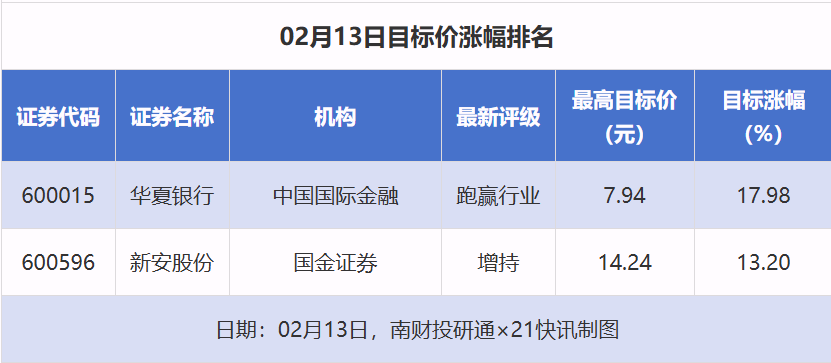
18股获推荐,华夏银行目标价涨幅超17%
2 1 Shi Ji Jing Ji Bao Dao· 2026-02-14 01:40
Group 1 - The core viewpoint of the article highlights the target price increases for listed companies, with notable gains for Huaxia Bank and Xin'an Co., with target price increases of 17.98% and 13.20% respectively [1][2] - On February 13, a total of 18 listed companies received recommendations from brokers, with Huaxia Bank, Pudong Construction, and Changan Automobile each receiving one recommendation [2] - The article mentions that on February 13, brokers provided 7 instances of initial coverage, with Changan Automobile receiving an "Overweight" rating from Shanxi Securities, and Xin'an Co. receiving an "Increase" rating from Guojin Securities [2][4] Group 2 - Huaxia Bank (600015) received a "Outperform" rating from China International Capital Corporation with a target price of 7.94 yuan, reflecting a target price increase of 17.98% [2][4] - Xin'an Co. (600596) was rated "Increase" by Guojin Securities with a target price of 14.24 yuan, indicating a target price increase of 13.20% [2][4] - Other companies receiving initial coverage include Daimai Co. with a "Buy" rating, and Ningbo Huaxiang with a "Buy" rating, both indicating positive outlooks in their respective sectors [4]


汽车早报|长安汽车已就两起自媒体涉嫌网络侵权行为提起诉讼 日本七大车商预计2025财年共计净利润减35.5%
Xin Lang Cai Jing· 2026-02-14 00:43
Group 1: Used Car Market - In January 2025, the national used car market transaction volume reached 1.7292 million units, showing a year-on-year increase of 18.33% but a month-on-month decrease of 7.59% [1] - The transaction amount for January was 110.612 billion yuan, indicating a robust market performance across various vehicle types, particularly in passenger cars and commercial vehicles [1] - The demand for MPVs continued to rise significantly, contributing to the overall market growth, while the commercial vehicle sector also showed positive year-on-year growth in both passenger and cargo vehicles [1] Group 2: Automotive Dealer Inventory - The comprehensive inventory coefficient for automotive dealers in January was reported at 1.48, reflecting a month-on-month increase of 13.0% and a year-on-year increase of 5.7% [2] Group 3: Pickup Truck Market - In January 2026, the pickup truck market saw sales of 49,000 units, marking a year-on-year growth of 22.5%, the highest level in the past five years [3] - Pickup truck production in January was 52,000 units, with a year-on-year increase of 29.3%, while exports reached 28,000 units, showing a year-on-year increase of 12% [3] Group 4: Xiaomi Automotive - Xiaomi Automotive announced the delivery of the last unit of the first-generation SU7, with production halted to prepare for the next generation, expected to launch in April [4] - The company will continue to provide maintenance and spare parts for the first-generation SU7 for at least 10 years [4] Group 5: Changan Automobile Legal Action - Changan Automobile has filed lawsuits against two media outlets for alleged online infringement, which have been accepted by the court [5] Group 6: Zeekr Automotive - Zeekr Automotive has established a new sales service company in Shenzhen with a registered capital of 10 million yuan, focusing on the sale of new energy vehicles and related services [6] Group 7: Great Wall Motors - Great Wall Motors' chairman confirmed that the company is successfully promoting its MPV models in the U.S. market through intermediaries [7] Group 8: Japanese Automakers' Profit Forecast - Seven major Japanese automakers, including Toyota and Honda, expect a 35.5% decrease in net profits for the fiscal year 2025, totaling approximately 3.765 trillion yen (about 169.7 billion yuan) [8] - Specific forecasts include a 25.1% profit reduction for Toyota and a 64.1% decrease for Honda, with Nissan anticipating a net loss of 650 billion yen [8]

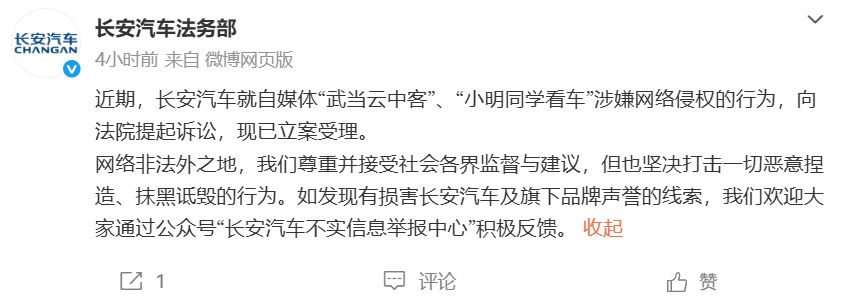
长安汽车:已向法院提起诉讼!
Mei Ri Jing Ji Xin Wen· 2026-02-13 12:01
Group 1 - Changan Automobile has filed a lawsuit against two self-media accounts, "Wudang Yunzongke" and "Xiaoming Classmate Car," for alleged online infringement, which has been accepted by the court [1] - The lawsuit is based on accusations that these accounts published maliciously fabricated and defamatory content that harms the reputation of Changan Automobile and its brands, violating relevant online dissemination regulations [4] - The self-media accounts in question have reportedly had some of their content removed, and they previously gained attention for publishing car reviews and model analyses, indicating a certain level of influence within the automotive enthusiast community [4] Group 2 - Changan Automobile has established a reporting center for false information, encouraging the public to report any damaging content, with a reward of up to 1 million yuan for verified leads [2] - The specific reasons for the lawsuit likely include the publication of unverified claims regarding vehicle quality defects and false advertising, which mislead consumers and damage the brand image of Changan Automobile [4]
机构调研策略周报(2026.02.09-2026.02.13)-20260213
Yuan Da Xin Xi· 2026-02-13 11:16
Group 1: Industry Research Highlights - The most popular industries for institutional research in the week of February 9-13, 2026, ranked by the total number of institutional surveys, are machinery, automotive, basic chemicals, and electronics, with a notable focus on power equipment and machinery in the past five days [11][13]. - Over the past 30 days, the industries with the highest number of institutional surveys are machinery, electronics, pharmaceuticals, and basic chemicals, with machinery and electronics receiving significant attention [13][14]. Group 2: Company Research Highlights - In the week of February 9-13, 2026, the companies with the highest number of institutional surveys, where the number of institutional ratings exceeds 10, include Huari Precision, China National Heavy Duty Truck Group, and Guoneng Rixin [17][20]. - Over the past 30 days, the companies with the most institutional surveys and ratings exceeding 10 are Jiemai Technology, Ice Wheel Environment, and Shanghai Bank [19][21]. Group 3: Key Company Insights 1. **Guoneng Rixin** - Focused on strategic upgrades driven by electricity trading and policies, leveraging its self-developed "Kuangming" new energy model 3.0 to create a closed loop of "prediction-decision-execution-optimization" [23][24]. - The National Development and Reform Commission's new pricing mechanism for independent energy storage significantly enhances project return expectations, driving demand for electricity trading operations [24]. - The company is expanding its investment in new energy assets through its subsidiary Rixin Hongsheng [23]. 2. **Changan Automobile** - Announced a share repurchase plan of 1-2 billion yuan to optimize capital structure and enhance shareholder confidence, alongside a product roadmap that includes 43 new models over the next three years, with over 80% being new energy vehicles [25][26]. - The Avita 06T, a product of its collaboration with Huawei, features advanced technologies and aims to produce the world's first sodium-ion battery passenger vehicle [27]. 3. **Huari Precision** - Expected to achieve a net profit of 180-200 million yuan in 2025, representing a year-on-year increase of 68-87%, driven by recovering downstream demand and product performance improvements [29]. - The company ranks second in domestic production of hard alloy CNC blades and is transitioning towards becoming a comprehensive cutting solution provider [28][29]. - It has a strong focus on R&D, with 32 authorized invention patents and a commitment to high-precision manufacturing capabilities [29][30].


年销2700万辆,中国汽车又一个世界冠军
3 6 Ke· 2026-02-13 09:55
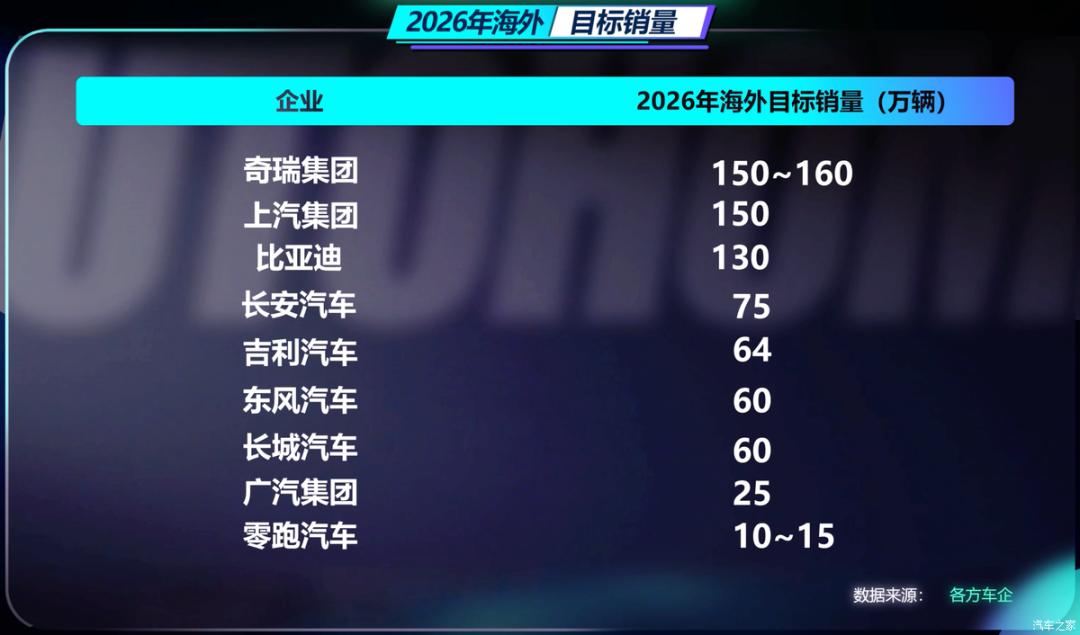
Core Insights - In 2025, Chinese automakers achieved a total global sales volume of 27 million vehicles, surpassing Japan for the first time in over 20 years, marking a significant milestone in the automotive industry [1] - Chinese automobile exports reached 8.32 million units in 2025, maintaining the title of the world's largest exporter for the third consecutive year, with Japan trailing at 4.21 million units [1] - Nine Chinese automakers have already set ambitious overseas sales targets for 2026, indicating confidence in continued growth in international markets [1][2] Group 1: Sales Performance - In 2025, Chery, SAIC, and BYD each exceeded 1 million units in overseas sales, with Chery selling 1.34 million units, representing nearly half of its total sales and a 17% increase year-on-year [3] - BYD's overseas sales surged by 145%, showcasing rapid growth from negligible figures to over 1 million units in just four years [3] - The overall export volume of Chinese automobiles grew by 29.9% in 2025, with December alone witnessing a remarkable 73.2% year-on-year increase, reaching 994,000 units [5] Group 2: Market Trends - The export of Chinese new energy vehicles (NEVs) reached 3.43 million units in 2025, a 70% increase, reflecting a growing global acceptance of electric vehicles [8] - In Europe, electric vehicles accounted for a record 19% of the market share in 2025, with Germany producing 1.67 million electric passenger cars, marking a 23% year-on-year growth [10] - Chinese brands are increasingly gaining traction in international markets, with significant sales growth in Australia and Europe, where they are becoming more competitive against traditional automakers [10][12] Group 3: Strategic Developments - Chinese automakers are expanding their presence in North America and Latin America, with Mexico becoming the largest market for Chinese car exports in 2025 [14] - Agreements with Canada allow Chinese companies to export electric vehicles at a reduced tariff rate, indicating a favorable trade environment [16] - The establishment of local supply chains and partnerships in various regions is a strategic move to enhance competitiveness and market penetration [16][17]




长安汽车总会计师、董秘换人!
Nan Fang Du Shi Bao· 2026-02-13 08:39
2月12日,重庆长安汽车股份有限公司发布关于公司董事、高级管理人员变更的公告。公告称,长安汽车董事会 收到董事张德勇提交的书面辞职报告。张德勇因工作变动,申请辞去公司董事、总会计师、董事会秘书职务。辞 职报告自送达公司董事会之日起生效。 同日,长安汽车召开第九届董事会第五十三次会议,审议通过了《关于董事、高级管理人员变更的议案》,张德 勇因工作变动不再担任公司董事、总会计师、董事会秘书职务,且不再担任公司任何职务(另有任用)。截至本 公告披露日,张德勇持有公司A股股票377,980股,其所持股票将严格按照相关规定进行管理。 最近,长安汽车总会计师、董秘换人。"前任"张德勇已辞职,接替他的是倪尔科。对于这一高层管理人员变化, 长安汽车内部人士告诉南都·湾财社记者,是公司正常人事变化。 因公司经营管理需要,长安汽车董事会提名倪尔科为第九届董事会董事候选人。同时,经公司董事会提名与薪酬 考核委员会审查,董事会同意聘任倪尔科为总会计师、董事会秘书,任期自本次董事会会议审议通过之日起至第 九届董事会任期届满之日止。 公告介绍,倪尔科为该公司总会计师、董事会秘书。1973年出生的倪尔科,曾任长安汽车(集团)有限公司财会 ...
长安汽车就自媒体涉嫌网络侵权行为提起诉讼,最高悬赏百万征集不实信息线索
Xin Lang Cai Jing· 2026-02-13 07:32
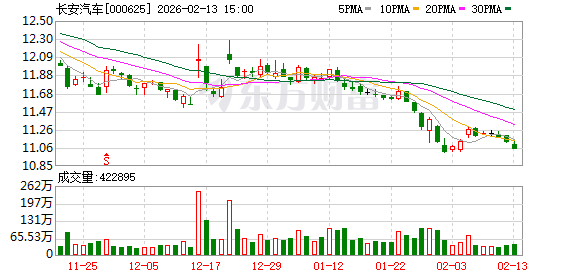
2月13日消息,据长安汽车不实信息举报中心公众号,近期,长安汽车就自媒体"武当云中客"、"小明同 学看车"涉嫌网络侵权的行为,向法院提起诉讼,现已立案受理。 长安汽车不实信息举报中心称,网络非法外之地,我们尊重并接受社会各界监督与建议,但也坚决打击 一切恶意捏造、抹黑诋毁的行为。如发现有损害长安汽车及旗下品牌声誉的线索,我们欢迎大家通 过"长安汽车不实信息举报中心"积极反馈。经核实有效后,将依据价值给予最高100万元奖励。 长安汽车不实信息举报中心称,网络非法外之地,我们尊重并接受社会各界监督与建议,但也坚决打击 一切恶意捏造、抹黑诋毁的行为。如发现有损害长安汽车及旗下品牌声誉的线索,我们欢迎大家通 过"长安汽车不实信息举报中心"积极反馈。经核实有效后,将依据价值给予最高100万元奖励。 责任编辑:李思阳 2月13日消息,据长安汽车不实信息举报中心公众号,近期,长安汽车就自媒体"武当云中客"、"小明同 学看车"涉嫌网络侵权的行为,向法院提起诉讼,现已立案受理。 责任编辑:李思阳 ...
长安汽车:销量增长目标明确,大额回购彰显长期发展信心-20260213
Shanxi Securities· 2026-02-13 07:25
Investment Rating - The report assigns an "Accumulate-A" rating for Changan Automobile (000625.SZ) [1] Core Views - Changan Automobile has set clear sales growth targets, with a planned buyback of A and B shares amounting to 1-2 billion yuan, reflecting confidence in long-term development and commitment to shareholder returns [5][6] - The company achieved a total sales volume of 2.913 million vehicles in 2025, marking an 8.5% year-on-year increase, with electric vehicle sales reaching 1.109 million units, a 51.1% increase, indicating that the new energy business is a core growth driver [7] - Changan aims for a sales target of 3.3 million vehicles in 2026, a 13.3% increase, with electric vehicle sales projected at 1.4 million units, a 26.2% increase [7] - The company plans to invest up to 6 billion yuan in a private placement to enhance competitiveness in the new energy vehicle market, with significant investments in new model development and smart platform projects [8] - Changan is also focusing on emerging industries such as humanoid robots and flying cars, aiming for mass production of humanoid robots by 2028 and commercial flying cars by 2030 [10] Financial Data Summary - Revenue projections for Changan are 165.225 billion yuan in 2025, 176.569 billion yuan in 2026, and 200.672 billion yuan in 2027, with corresponding net profits of 5.642 billion yuan, 6.515 billion yuan, and 8.073 billion yuan [11] - The report forecasts earnings per share (EPS) of 0.57 yuan for 2025, 0.66 yuan for 2026, and 0.81 yuan for 2027, with price-to-earnings (P/E) ratios of 20, 17, and 14 respectively [11] - The company’s gross margin is expected to improve from 15.0% in 2025 to 16.0% in 2027, while net profit margin is projected to rise from 3.4% to 4.0% over the same period [13][14]