
CHANGAN AUTOMOBILE-B(000625)

Search documents
长安刘玉清:协同研发、产业联动是高级别自动驾驶技术快速发展关键
Zhong Guo Qi Che Bao Wang· 2026-02-13 07:24
Core Insights - The core viewpoint of the articles emphasizes the rapid development of Level 3 (L3) autonomous driving technology by Changan Automobile, which is set to begin large-scale pilot operations by the end of 2025 in Chongqing, showcasing the company's advancements in autonomous driving technology [1][2]. Group 1: Development and Implementation - Changan Automobile's L3 autonomous vehicles are transitioning from single technology breakthroughs to a collaborative research and development model that emphasizes compliance and industry linkage, which is crucial for the rapid advancement of high-level autonomous driving technology in China [2][3]. - The company has expanded its safety requirements beyond the product itself to include functional safety, network security, data security, and risk prevention throughout the entire process, leading to recognition from regulatory bodies and the acquisition of the first batch of licenses [2][3]. Group 2: Collaborative Research and Industry Linkage - The rapid development of Changan's L3 autonomous driving technology demonstrates the feasibility of a collaborative research and development model that not only aids in the design and compliance of high-level autonomous driving but also supports the cultivation of interdisciplinary technical talent within the industry [3][4]. - The collaborative approach involves engineers from various disciplines working together to solve unknown problems, thereby enhancing their knowledge and skills in a cross-disciplinary context, which is essential for the advancement of autonomous driving technology [3][4]. Group 3: Problem-Solving in R&D - The development of autonomous driving technology faces numerous unknown factors, necessitating bold innovation and collaborative efforts to address these challenges. For instance, Changan's team innovatively proposed using elastic wave sensors to identify micro-collision events, a solution that had not been attempted in the industry [4][5]. - The team designed over 100 diverse data collection scenarios to ensure accurate sensor data collection under various conditions, overcoming challenges such as data distortion and adaptability to different weather conditions [5][6]. Group 4: Execution and Collaboration - The successful implementation of the collaborative research and development model requires strong execution capabilities, which Changan has established through a joint development mechanism with core suppliers to ensure performance consistency and compliance [6][7]. - During testing, the team identified a critical delay in the vehicle's response to sudden braking by preceding vehicles, leading to a collaborative effort with radar suppliers to enhance the system's performance [6][7]. Group 5: Industry Ecosystem and Future Outlook - The key to the rapid realization of high-level autonomous driving technology lies in technological advancements and reduced hardware costs, necessitating a collaborative approach among industry policies, technologies, and ecosystems to create a safe and reliable environment for autonomous driving [8].



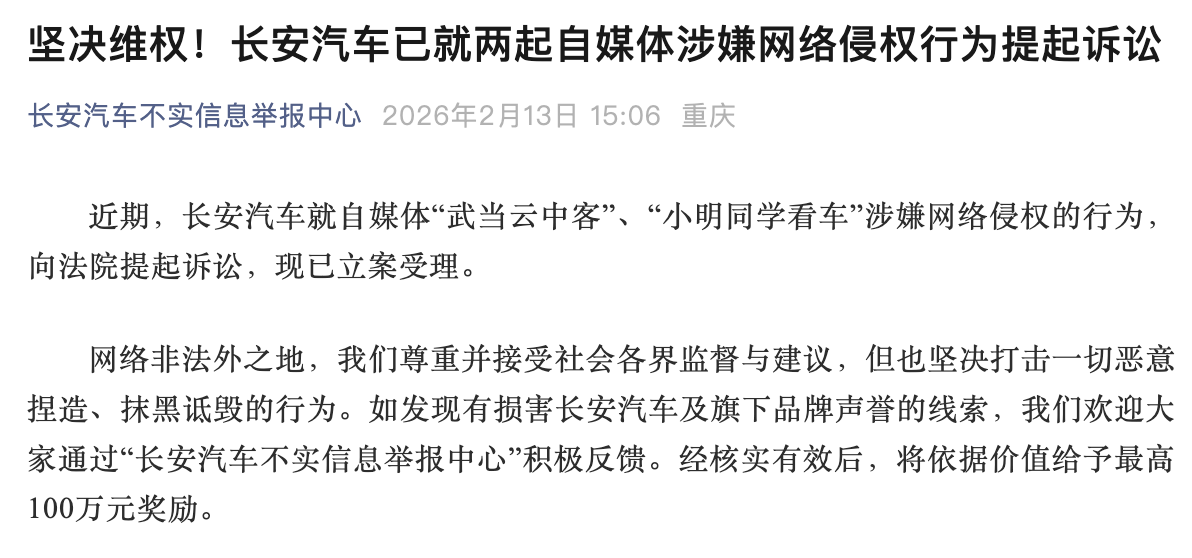
长安汽车已就两起自媒体涉嫌网络侵权行为提起诉讼
Xin Lang Cai Jing· 2026-02-13 07:15
2月13日,据长安汽车不实信息举报中心消息,近期,长安汽车就自媒体"武当云中客"、"小明同学看车"涉嫌网络侵权的行为,向法院提起诉讼,现已立案 受理。 ...
长安汽车(000625):销量增长目标明确,大额回购彰显长期发展信心
Shanxi Securities· 2026-02-13 06:05
Investment Rating - The report assigns an "Accumulate-A" rating to Changan Automobile (000625.SZ) for the first time [1][11]. Core Viewpoints - Changan Automobile has set clear sales growth targets, with a planned total sales volume of 3.3 million units in 2026, representing a year-on-year increase of 13.3%. The company aims to sell 1.4 million new energy vehicles (NEVs) in 2026, a growth of 26.2% [7]. - The company announced a share buyback plan of 1 to 2 billion yuan, which is expected to enhance investor confidence and reflects the company's commitment to long-term development and shareholder returns [5][6]. - Changan's new energy vehicle sales reached 1.109 million units in 2025, marking a significant year-on-year increase of 51.1%, indicating that the new energy business is becoming a core growth driver [7]. Summary by Relevant Sections Sales and Growth Targets - In 2025, Changan's total sales reached 2.913 million units, an increase of 8.5% year-on-year, achieving a nine-year high. The company plans to launch 43 new models over the next three years, covering over 140 countries and regions [7]. - The overseas sales target for 2026 is set at 750,000 units, a year-on-year increase of 17.7%, which is expected to become a new growth engine for the company [7]. Financial Performance and Projections - The projected revenues for Changan from 2025 to 2027 are 165.225 billion yuan, 176.569 billion yuan, and 200.672 billion yuan, respectively. The net profit for the same period is expected to be 5.642 billion yuan, 6.515 billion yuan, and 8.073 billion yuan, with corresponding EPS of 0.57, 0.66, and 0.81 yuan [11][13]. - The report indicates that the company will maintain a gross margin of around 15% in the coming years, with a gradual increase in net profit margin [13][15]. Investment in New Energy and Technology - Changan plans to raise up to 6 billion yuan through a private placement, with 4.5 billion yuan allocated for the development of new energy vehicles and smart platform projects [8]. - The company has received the first batch of L3-level autonomous driving product licenses and aims to enhance its R&D capabilities and smart testing capabilities through the construction of a global R&D center [8][10].
长安汽车金融谋划打造“智能产业金融平台”
Nan Fang Du Shi Bao· 2026-02-12 23:09
Core Insights - Changan Automobile Finance Co., Ltd. aims to become a leading technology automotive finance company, focusing on building an intelligent industrial finance platform as part of its strategic vision for 2026 [2][6] Business Performance - In 2025, the company achieved a 100% completion rate for both revenue and profit targets, with a credit issuance scale increasing by over 10% year-on-year and a 114% growth in new energy business, which now accounts for 33% of total business [2][4] - Cumulative credit issuance reached 550 billion yuan, with a year-on-year business volume growth of 7.41% [3][5] Strategic Focus - The company has developed a new planning blueprint for the "15th Five-Year Plan" period, emphasizing high-quality development goals and a focus on the automotive industry's financial services [2][4] - The company plans to enhance its strategic positioning by integrating financial tools with the entire value chain of the Changan Automobile Group, aiming for a multiplier effect in production and finance [7] Green Financing Initiatives - In 2025, the company issued 2.6 billion yuan in green asset-backed securities (ABS), contributing to significant reductions in energy consumption and CO2 emissions [3][4] Product Innovation - The company introduced innovative financial products, including a "7-year interest-free" option and a zero down payment product, which have effectively lowered the purchasing threshold for consumers [4][8] - A comprehensive financial product portfolio has been established, covering over 50 products across 14 categories, supporting more than 6,000 auto dealers and 4.5 million consumers [4][5] Technological Advancements - The company is enhancing its data-driven capabilities and user experience through a financial big data platform, achieving over 90% approval rates for key new energy products within half an hour [4][6] - The ongoing transformation into a data-driven organization is expected to improve efficiency and customer experience significantly [6][8] Risk Management and Compliance - The company is committed to strengthening compliance and consumer rights protection, which will be crucial for its long-term stability and growth [8]

张德勇辞任长安汽车总会计师,倪尔科接任
Bei Ke Cai Jing· 2026-02-12 13:48
编辑 岳彩周 校对 杨许丽 新京报贝壳财经讯(记者王琳琳)长安汽车2月12日发布公告,长安汽车董事、总会计师、董事会秘书 张德勇因工作变动,辞去所有职务,不再担任公司任何职位,将由倪尔科接任总会计师及董事会秘书, 并提名为董事候选人。 长安汽车公告称,张德勇持有公司股票377980股,将严格按照相关规定进行管理。新京报贝壳财经记者 从知情人士处获悉,张德勇将调任中国电气装备集团,担任总会计师。 据了解,倪尔科历任长安汽车财务部副部长、部长,重庆南方摩托车有限责任公司总经理助理、事业部 财务部部长、总会计师,长安汽车金融有限公司监事长、党委副书记、纪委书记等职务。目前未持有公 司股票,其董事任职尚需股东大会审议。 ...
汽车行业一周热点:1月乘用车零售下滑,出口创新高
Jing Ji Guan Cha Wang· 2026-02-12 13:26
Recent Events - In January 2026, domestic passenger car retail sales reached 1.544 million units, a year-on-year decline of 13.9%, primarily due to the effects of policy withdrawal [2] - The export market showed strong performance, with 576,000 passenger cars exported in January, marking a 52% year-on-year increase and setting a historical record for the same period, including 286,000 new energy vehicles, which saw a significant increase of 103.6% [2] - On February 6, autonomous driving company Pony.ai announced a strategic partnership with domestic GPU company Moore Threads to advance the large-scale application of Level 4 autonomous driving technology [2] Stock Performance - Zotye Auto (000980) announced on February 11 that it is fully committed to resuming production in its vehicle segment [3] - On February 12, Xinwanda (300207) reported that its subsidiary reached a settlement regarding battery cell quality issues with Weir Electric Vehicles, which is expected to impact the company's net profit attributable to shareholders by 500 million to 800 million yuan for 2025 [3] - Ford Motor Company reported a fourth-quarter adjusted EBIT of $1.04 billion on February 11, a significant year-on-year decrease of 51% [3] Financial Report Analysis - Ford's total revenue for the fourth quarter was $45.9 billion, a year-on-year decrease of 4.8%, with adjusted earnings per share at $0.13, down from $0.39 in the previous year, reflecting the challenges faced by U.S. automakers in their transition to electrification [4] - General Motors emphasized on February 11 that its localization rate in the Chinese supply chain has exceeded 95%, showcasing its deep localization strategy in the Chinese market [4] Strategic Advancements - Li Auto's CEO Li Xiang previewed the new Li Auto L9 on February 5, describing it as the "pioneering work of embodied intelligent robots" [5] - Xiaomi Auto announced on February 12 the first batch of its new generation SU7 to be available in 30 stores across 7 cities, with an expected launch in April [5] - Changan Automobile (000625) officially launched its global sodium battery strategy on February 5, unveiling the world's first mass-produced passenger vehicle powered by sodium batteries [5] - Multiple new energy vehicle startups announced a dense lineup of new product plans for 2026 [5]


长安汽车:聘任倪尔科为公司总会计师、董事会秘书
Mei Ri Jing Ji Xin Wen· 2026-02-12 13:24
(记者 王晓波) 因公司经营管理需要,公司董事会提名倪尔科先生为公司第九届董事会董事候选人。同时,经公司董事 会提名与薪酬考核委员会审查,董事会同意聘任倪尔科先生为公司总会计师、董事会秘书,任期自本次 董事会会议审议通过之日起至第九届董事会任期届满之日止。关于董事变更尚需提交公司股东会审议。 每经头条(nbdtoutiao)——打造百万元级尊界的江淮,迎来葛卫东、方文艳联手投资:两人各掏10亿 元,公司股价应声大涨!复盘历史:牛散参与定增有赚也有亏 每经AI快讯,长安汽车2月12日晚间发布公告称,公司董事会收到董事张德勇先生提交的书面辞职报 告。张德勇先生因工作变动,申请辞去公司董事、总会计师、董事会秘书职务。张德勇先生辞职不会影 响公司董事会工作的正常运行,辞职报告自送达公司董事会之日起生效。 ...
长安汽车:2月12日召开董事会会议
Mei Ri Jing Ji Xin Wen· 2026-02-12 12:52
(记者 王晓波) 每经头条(nbdtoutiao)——打造百万元级尊界的江淮,迎来葛卫东、方文艳联手投资:两人各掏10亿 元,公司股价应声大涨!复盘历史:牛散参与定增有赚也有亏 每经AI快讯,长安汽车2月12日晚间发布公告称,公司第九届第五十三次董事会会议于2026年2月12日 在长安汽车金融城会议室以现场结合视频方式召开。会议审议了《关于董事、高级管理人员变更的议 案》等文件。 ...
长安汽车(000625) - 关于公司董事、高级管理人员变更的公告
2026-02-12 12:45
重庆长安汽车股份有限公司 关于公司董事、高级管理人员变更的公告 证券代码:000625(200625) 证券简称:长安汽车(长安 B) 公告编号:2026-08 本公司及董事会全体成员保证信息披露的内容真实、准确、完整,没有虚假记载、 误导性陈述或重大遗漏。 意见的情形;与持有公司5%以上股份的股东、实际控制人、公司其他董事、高 级管理人员不存在关联关系;不是失信被执行人;符合有关法律、行政法规、 部门规章、规范性文件、《深圳证券交易所股票上市规则》及交易所其他相关 规定等要求的任职资格。倪尔科先生当选公司非独立董事后,第九届董事会中 兼任公司高级管理人员以及由职工代表担任的董事人数总计不超过公司董事 总数的二分之一,符合相关法律法规的要求。截至本公告披露日,倪尔科先生 暂未取得深圳证券交易所董事会秘书任职培训证明,其具有履行职责所必须的 5年以上财务、管理工作经验,具备董事会秘书任职能力。 关于董事变更尚需提交公司股东会审议。 董事会秘书倪尔科先生的联系方式如下: 一、董事、高级管理人员变更情况 2026 年 2 月 12 日,重庆长安汽车股份有限公司(以下简称"公司")董 事会收到董事张德勇先生提交的书面 ...
长安汽车(000625) - 第九届董事会第五十三次会议决议公告
2026-02-12 12:45
重庆长安汽车股份有限公司 第九届董事会第五十三次会议决议公告 本公司及董事会全体成员保证信息披露的内容真实、准确、完整,没有虚假记载、 误导性陈述或重大遗漏。 公司于 2026 年 2 月 12 日在长安汽车金融城会议室以现场结合视频方式召 开第九届董事会第五十三次会议,会议通知及文件于 2026 年 2 月 11 日通过邮 件等方式送达公司全体董事。会议应到董事 7 人,实际参加表决的董事 7 人。 会议由董事长朱华荣先生主持。本次会议的召开符合《公司法》和《公司章程》 等有关规定,会议形成的决议合法、有效。会议审议通过了以下议案: 1.审议通过了《关于董事、高级管理人员变更的议案》 证券代码:000625(200625) 证券简称:长安汽车(长安 B) 公告编号:2026-07 本议案已经公司董事会提名与薪酬考核委员会与审计委员会审议通过。 详细内容见同日披露于巨潮资讯网(www.cninfo.com.cn)及《中国证券 报》《证券时报》《证券日报》《上海证券报》的《关于公司董事、高级管理 人员变更的公告》(公告编号:2026-08)。 关于董事变更尚需提交公司股东会审议。 重庆长安汽车股份有限公司董事会 ...