FENGHUA(000636)

Search documents
涨!涨!涨!半导体行业掀涨价风暴
Xin Lang Cai Jing· 2026-02-11 10:16
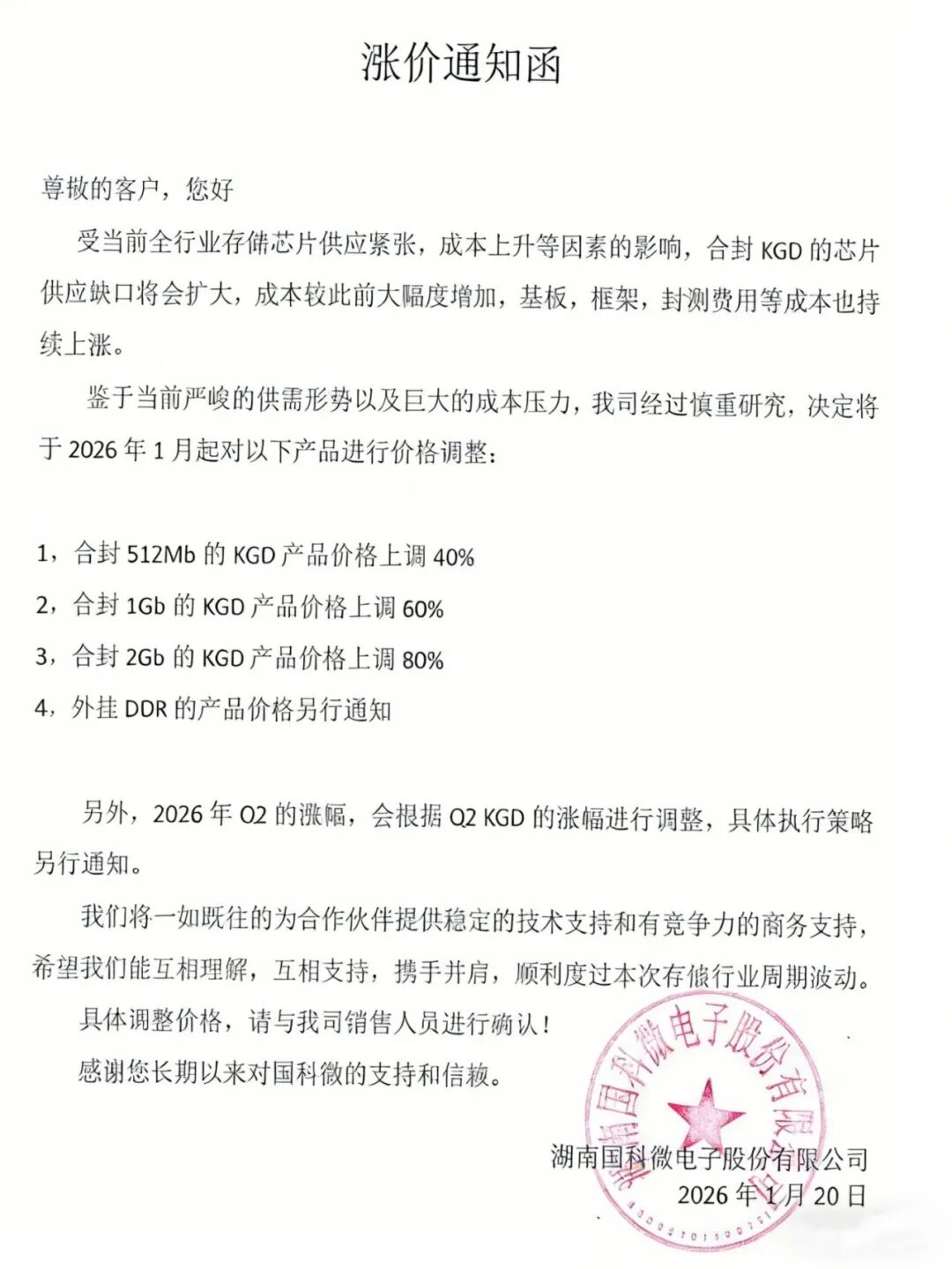
Core Viewpoint - The global semiconductor industry is experiencing a new wave of price increases across the entire supply chain, driven by surging AI demand and rising raw material costs [1][3][61]. Group 1: Price Increases in Domestic Semiconductor Companies - Over 20 semiconductor companies have officially announced price increases [2][62]. - Domestic chip manufacturers are significantly raising prices, with increases as high as 80% for certain products [4][63]. - Guokewai announced price hikes for its KGD storage products, with increases of 40% to 80% [6][66]. - Zhongwei Semiconductor is raising prices for MCU and NOR Flash products by 15% to 50% due to supply chain pressures [9][73]. - Biyiwei has also announced price increases across its entire product line, citing rising raw material costs [17][76]. Group 2: Price Increases in International Semiconductor Companies - International semiconductor giants are also raising prices, with ADI increasing prices by 15% to 30% starting February 1, 2026 [21][81]. - Infineon plans to raise prices for power switches and IC products due to increased demand from AI data centers [24][83]. - Texas Instruments is expected to raise prices by over 30% across nearly all categories due to rising costs [21][81]. Group 3: Price Increases in Wafer Foundry and Packaging - Wafer foundries are increasing prices, with TSMC raising advanced process prices by 3% to 10% [25][85]. - Packaging and testing services are seeing price increases of up to 30%, driven by high demand and capacity constraints [27][86]. Group 4: Impact of Raw Material Costs - The prices of precious metals like gold, silver, and copper are rising, significantly impacting chip manufacturing costs [57][116]. - The increase in raw material costs is leading to a ripple effect across the semiconductor supply chain, prompting many companies to raise their product prices [57][116]. Group 5: Effects on End Markets - The price increases in storage chips are affecting end markets, with PC manufacturers like Dell and Lenovo planning price hikes of 10% to 30% [59][118]. - In the smartphone sector, rising storage costs are pressuring new product pricing, particularly for low-end models [59][118]. - The automotive electronics sector is also feeling the impact, with companies like Xiaomi and NIO reporting cost pressures due to rising semiconductor prices [59][119].



AI需求激增 片式多层陶瓷电容器接棒内存上涨
Zhong Guo Zheng Quan Bao· 2026-02-09 23:42
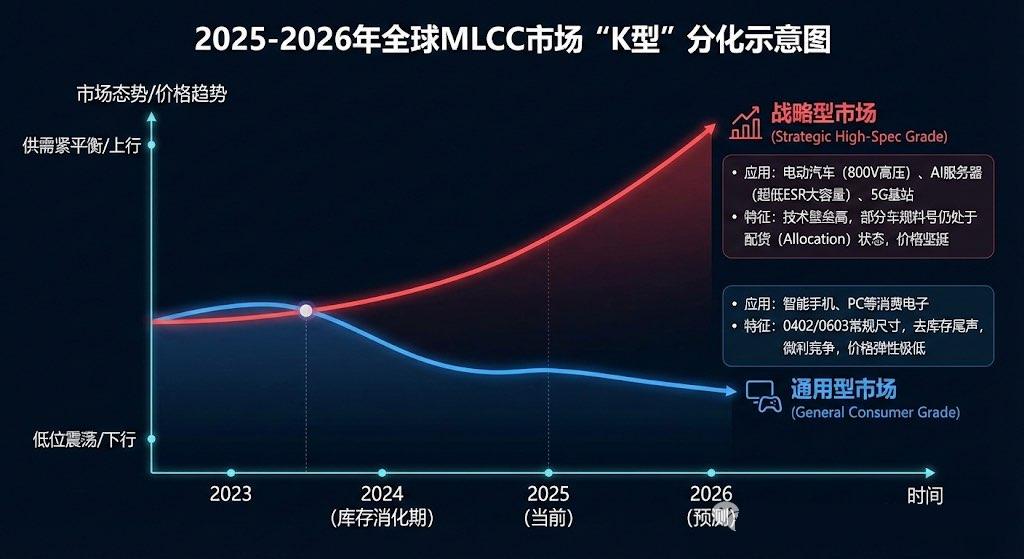
Core Viewpoint - The demand for MLCCs is surging due to the AI boom, leading to significant price increases and a positive market response, particularly for high-end products [1][2][5] Group 1: Price Trends and Market Response - Korean MLCC spot prices have risen nearly 20%, with expectations for continued increases in the short term [1][2] - Major MLCC manufacturers like Samsung Electro-Mechanics have seen stock prices rise significantly, with increases of over 11% this year [2] - The revenue of Samsung Electro-Mechanics reached a record high in Q4 2025, with a 22% year-on-year growth in its components division, which includes high-voltage and high-capacity MLCCs [3] Group 2: Supply and Demand Dynamics - The explosive growth in AI server demand is driving the need for high-end MLCCs, which are essential for stabilizing power supply and filtering interference signals in electronic devices [2][6] - High-end MLCCs are in short supply, with manufacturers like Murata Manufacturing and Samsung Electro-Mechanics operating at over 80% capacity [2] - AI servers require 3 times more MLCCs than standard servers, leading to a significant increase in demand [2][6] Group 3: Competitive Landscape - The top five global MLCC manufacturers, including Murata, Samsung Electro-Mechanics, and Taiyo Yuden, hold over 80% of the market share [4] - Chinese manufacturers have established a relative advantage in the mid-to-low-end MLCC market but are lagging in high-end product development [4] - Domestic companies like Sanhua Group and Fenghua Advanced Technology are accelerating their entry into the high-end market, focusing on sectors such as 5G, AI servers, and automotive electronics [4] Group 4: Industry Outlook and Segmentation - The MLCC industry is currently in an upward cycle, with a historical cycle lasting about 4 to 5 years [5] - The demand for high-end MLCCs is expected to explode due to AI applications, while traditional consumer electronics are facing a downturn [6] - The market for AI servers is projected to grow at an annual rate of 30%, with the MLCC market for AI servers expected to reach 3.3 times its 2025 size by 2030 [6][7]


AI需求激增 MLCC接棒内存上涨
Zhong Guo Zheng Quan Bao· 2026-02-09 20:25
Core Viewpoint - The price surge in the component supply chain, particularly for Multi-Layer Ceramic Capacitors (MLCC), is driven by the explosive growth in AI server demand, with expectations for continued price increases in the short term [1][2]. Group 1: Price Trends and Market Response - MLCC prices in South Korea have risen nearly 20%, with expectations for further increases [1]. - Capital markets have reacted positively, with significant stock price increases for leading MLCC companies such as Samsung Electro-Mechanics, which has risen over 11% this year, and other A-share companies like Fenghua Advanced Technology and Sanhua Group [1][2]. - The MLCC industry is expected to experience a bifurcation by 2026, with high-end product demand likely to surge due to the AI boom, while mid-to-low-end products face challenges from weak demand and rising costs [1][4]. Group 2: Demand Drivers and Production Capacity - The demand for high-end MLCCs is driven by AI servers, which require three times more MLCCs than standard servers, leading to supply constraints [2]. - Major manufacturers like Murata Manufacturing, Samsung Electro-Mechanics, and Taiyo Yuden are operating at over 80% capacity, with Murata expected to see a 20% to 25% increase in high-end MLCC orders in the first quarter [2][3]. - Samsung Electro-Mechanics reported record revenue in Q4 2025, with a 22% year-on-year increase in revenue from high-voltage and high-capacity MLCCs [2]. Group 3: Competitive Landscape and Domestic Market Position - The global MLCC market is dominated by major players, with the top five manufacturers, including Murata, Samsung, and Taiyo Yuden, holding over 80% market share [3]. - Chinese manufacturers have established a relative advantage in the mid-to-low-end MLCC market but are accelerating efforts to penetrate the high-end market [3]. - Companies like Sanhua Group and Fenghua Advanced Technology are focusing on high-end applications such as 5G communication, AI servers, and automotive electronics, with successful integration into supply chains of major manufacturers like BYD [3]. Group 4: Industry Outlook and Cyclical Trends - The MLCC industry is currently in an upward cycle, with a typical cycle lasting about 4 to 5 years, supported by demand from automotive electronics and AI servers [3][4]. - The industry is expected to experience significant differentiation, with high-end MLCC demand surging due to AI applications, while traditional consumer electronics face declining demand [4]. - The market for AI servers is projected to grow at an annual rate of 30%, with the MLCC market for AI servers expected to reach 3.3 times its 2025 size by 2030 [4][5].
被动元件,涨涨涨
3 6 Ke· 2026-02-09 01:13
Core Viewpoint - The recent price hikes in passive components, led by major players like Yageo and Walsin, indicate a significant shift in the market driven by supply-demand imbalances and rising raw material costs, particularly in high-end sectors like AI and electric vehicles [1][4][19]. Group 1: Price Adjustments - Yageo announced a price increase of 15%-20% for certain resistor products starting February 1, marking its third price adjustment in a short period [1]. - Walsin and Panasonic also announced price hikes of around 20% and 15%-30% respectively for various passive components, reflecting a broader trend among major manufacturers [1][2]. - Smaller manufacturers in China, such as Fenghua Advanced Technology and Shunluo Electronics, have also followed suit with price adjustments ranging from 5%-30% across multiple product categories [2][3]. Group 2: Supply Chain Dynamics - The passive component market is experiencing supply tightness, with lead times extending and some distributors pausing quotes due to uncertainty in price adjustments [3][4]. - Rising costs of raw materials, particularly precious metals like silver and palladium, have significantly increased production costs for passive components, with estimates suggesting a 20%-30% rise in production costs [5][6]. - Capacity constraints are exacerbated by major manufacturers shifting focus to high-end products, leading to a structural shortage in the mid-range market [7][8]. Group 3: Demand Drivers - The demand for passive components is being driven by the rapid growth of AI and electric vehicles, with AI servers requiring significantly more MLCCs than traditional servers [10][11]. - The automotive sector is also a major growth area, with electric vehicles using up to three times more passive components compared to traditional vehicles, creating a favorable environment for price increases [11][12]. - The overall market for passive components in China is projected to grow from 1237.65 billion yuan in 2023 to 2583.59 billion yuan by 2030, with a compound annual growth rate of 11.09% [13]. Group 4: Market Structure Changes - The current price hikes reflect a structural change in the passive components market, with high-end products experiencing significant demand while traditional consumer electronics face challenges [15][19]. - Domestic manufacturers in China are beginning to capture more market share, particularly in high-end segments, as they improve their technology and production capabilities [19][20]. - The geopolitical landscape and supply chain diversification are providing opportunities for Chinese manufacturers to enter high-end markets, as global players face capacity and delivery challenges [19][24]. Group 5: Future Outlook - The passive components market is expected to continue evolving, with AI and automotive electronics driving demand for high-value products [25][26]. - Companies need to focus on high-capacity, miniaturized, and reliable products to meet the changing market demands and maintain competitiveness [25][26]. - Collaboration across the supply chain will be crucial for manufacturers to overcome technical challenges and align with market needs [25][26].
广东风华高新科技股份有限公司
Shang Hai Zheng Quan Bao· 2026-02-08 18:00
Core Viewpoint - The announcement details a reduction in shareholding by major shareholders of Guangdong Fenghua High-tech Co., Ltd., which does not trigger a mandatory takeover bid and will not change the company's controlling shareholder or actual controller [3][4]. Group 1: Shareholding Changes - Guangdong Hengkuo Investment Co., Ltd., Guangdong Hengjiahe Investment Partnership (Limited Partnership), and Guangdong Hengjudai Enterprise Management Partnership (Limited Partnership) collectively held 63,874,344 shares, representing 5.520624% of the total share capital before the reduction [3][5]. - After the reduction, these shareholders hold 57,850,634 shares, which is 4.999998% of the total share capital, thus no longer qualifying as shareholders holding over 5% [4][5]. - The reduction involved a sale of 6,023,710 shares, accounting for 0.520626% of the total share capital, executed through centralized bidding from January 22, 2026, to February 5, 2026 [17]. Group 2: Compliance and Future Plans - The shareholding change complies with relevant laws and regulations, including the Securities Law of the People's Republic of China and the Interim Measures for the Administration of Share Reduction by Shareholders of Listed Companies [6][7]. - The shareholders have indicated that the reduction was due to their own funding needs and do not plan to increase or decrease their holdings in the next 12 months, although they reserve the right to do so based on future arrangements [16].
风华高科:持股5%以上股东减持602.37万股
Mei Ri Jing Ji Xin Wen· 2026-02-08 08:20
每经AI快讯,2月8日,风华高科(000636)公告称,股东恒阔投资、恒嘉合、恒聚达为一致行动人, 于2026年1月22日至2月5日通过集中竞价合计减持602.37万股,占总股本0.520626%。变动前,三者共持 股6387.43万股,占比5.520624%;变动后,三者持股降至5785.06万股,占4.999998%,不再是持股5%以 上股东。 ...
风华高科:持股5%以上股东减持602.37万股,不再超5%持股
Jin Rong Jie· 2026-02-08 08:04
风华高科公告称,股东恒阔投资、恒嘉合、恒聚达为一致行动人,于2026年1月22日至2月5日通过集中 竞价合计减持602.37万股,占总股本0.520626%。变动前,三者共持股6387.43万股,占比5.520624%; 变动后,三者持股降至5785.06万股,占4.999998%,不再是持股5%以上股东。本次减持符合法规,不 会导致公司控制权变更。 ...
风华高科(000636) - 简式权益变动报告书
2026-02-08 07:45
1 上市公司名称:广东风华高新科技股份有限公司 上市地点:深圳证券交易所 股票简称:风华高科 广东风华高新科技股份有限公司 简式权益变动报告书 股票代码:000636 信息披露义务人一名称:广东恒阔投资有限公司 法定代表人:张大伟 住所:广东省广州市越秀区天河路45号恒健大厦16楼 通讯地址:广东省广州市越秀区天河路45号恒健大厦16楼 信息披露义务人二(信息披露义务人一之一致行动人)名称:广东恒嘉合投 资合伙企业(有限合伙) 住所:梅州市梅江区彬芳大道中43号7楼710房 通讯地址:梅州市梅江区彬芳大道中43号7楼710房 信息披露义务人三(信息披露义务人一之一致行动人)名称:广东恒聚达企 业管理合伙企业(有限合伙) 住所:佛山市南海区桂城街道桂澜北路6号千灯湖创投小镇核心区三座 404-405 通讯地址:佛山市南海区桂城街道桂澜北路6号千灯湖创投小镇核心区三座 404-405 权益变动性质:持股比例减少 日期:2026 年 2 月 5 日 2 | 信息披露义务人声明 | | 3 | | --- | --- | --- | | 第一节 释义 | | 5 | | 第二节 信息披露义务人介绍 | | 6 | | ...
风华高科(000636) - 关于持股5%以上股东减持股份变动触及1%及5%的整数倍暨披露简式权益变动报告书的提示性公告
2026-02-08 07:45
证券代码:000636 证券简称:风华高科 公告编号:2026-01 广东风华高新科技股份有限公司 关于持股5%以上股东减持股份变动触及1%及5%的整数倍 暨披露简式权益变动报告书的提示性公告 公司股东广东恒阔投资有限公司、广东恒嘉合投资合伙企业(有限合伙)、 广东恒聚达企业管理合伙企业(有限合伙)保证向本公司提供的信息内容真实、 准确、完整,没有虚假记载、误导性陈述或重大遗漏。 3.本次权益变动不会导致公司控股股东及实际控制人发生变化。 ②本文下述部分数据表述时存在四舍五入,故可能存在尾数差异, 提请投资者注意。 本公司及董事会全体成员保证公告内容与信息披露义务人提供的信息一致。 特别提示: 1.本次权益变动系共同持有公司 63,874,344 股(占公司总股本比 例为 5.520624%,占剔除回购专用账户中的股份数量后总股本的比例 为 5.566438%)的股东广东恒阔投资有限公司(以下简称"恒阔投资")、 广东恒嘉合投资合伙企业(有限合伙)(以下简称"恒嘉合")、广 东恒聚达企业管理合伙企业(有限合伙)(以下简称"恒聚达")减 持广东风华高新科技股份有限公司(以下简称"风华高科"或"公司") 股份造成 ...
被动元件,涨涨涨!
半导体行业观察· 2026-02-08 03:29
Core Viewpoint - The recent price hikes in passive components, driven by supply-demand imbalances and rising raw material costs, indicate a significant transformation in the market dynamics of the passive components industry [6][9][12]. Price Adjustments - Yageo announced a price increase of 15%-20% for certain resistor products starting February 1, reflecting its position as a market leader with an 18% global market share [2]. - Other companies, including Walsin Technology and Panasonic, have also announced price hikes for various passive components, with increases ranging from 15% to 30% [2][3]. - The price adjustments are widespread, with many small and medium-sized manufacturers in China also raising prices by 5%-20% across multiple product categories [3]. Supply Chain Dynamics - The price increases are primarily driven by rising costs of raw materials such as silver, copper, and aluminum, which have seen significant price surges, with silver prices increasing over 140% in 2025 [7][9]. - The production costs for passive components have risen by 20%-30% due to these raw material price increases, prompting manufacturers to pass on costs to customers [7][9]. - Capacity constraints are exacerbating the situation, as many Japanese manufacturers have shifted focus to high-end products, reducing supply in the mid-to-low-end market [8][9]. Demand Drivers - The demand for passive components is being driven by the rapid growth of AI and electric vehicle markets, with AI server motherboards requiring significantly more MLCCs than traditional servers [10][11]. - The demand for passive components in electric vehicles is also increasing, with the number of MLCCs used per vehicle rising dramatically compared to traditional vehicles [10][11]. - The overall market for passive components in China is projected to grow from 1237.65 billion yuan in 2023 to 2583.59 billion yuan by 2030, with a compound annual growth rate of 11.09% [12]. Market Structure Changes - The current price hikes reflect a structural change in the passive components market, with high-end products for AI servers and electric vehicles experiencing significant demand while traditional consumer electronics face challenges [14][17]. - Domestic manufacturers are beginning to capture more market share, with companies like Walsin Technology and Sunlord Electronics seeing increased orders and expanding their production capabilities [18][19]. - The shift towards high-end products presents opportunities for domestic manufacturers to enter the supply chains of larger companies, especially as global manufacturers face capacity and delivery challenges [22][23].