
Northeast Securities(000686)

Search documents
量化资产配置系列之三:宏观因子组合及股债相关性再探索
NORTHEAST SECURITIES· 2025-08-06 07:45
- The report references the Fama-MacBeth method to simulate macro risk factors, transforming the logic of configuring macro risks through asset allocation into a logic of configuring macro risks by configuring assets[1][12][18] - Real macro factor data uses forecast values of relevant monthly macro indicators or asset monthly returns (interest rates/credit), performing univariate time series regression with each asset to obtain risk loadings, and applying a half-life weighting to historical loadings to smooth out instability caused by asset volatility[1][18][22] - The macro factor risk is decomposed into underlying asset portfolios to construct a macro factor risk parity portfolio[1][18][22] - The optimization results of risk parity for macro factors show certain economic growth elasticity, with both returns and volatility higher than those based on asset risk parity[2][39] - The report also discusses the factors influencing stock-bond correlation, referencing AQR's approach, which decomposes stock-bond correlation into economic growth volatility, inflation volatility, and the correlation between economic growth and inflation[3][42][43] - The study finds that economic growth volatility negatively contributes to stock-bond correlation, while interest rate volatility positively contributes, and the correlation between economic growth and interest rates is a positive contributing variable in domestic asset research[3][42][48] - Adding the inflation level factor further improves the explanatory power, with domestic data showing that the inflation level is a significant positive variable for stock-bond correlation[3][48][51] - Using a three-year historical window to calculate the coefficients of each variable, the study combines real values and consensus forecast data to calculate the change in stock-bond correlation for the next month, showing that the estimated and predicted values have the same trend and consistent signs with the real values[3][48][54] Quantitative Models and Construction Methods 1. **Model Name**: Macro-Factor Mimicking - **Construction Idea**: Transform the logic of configuring macro risks through asset allocation into configuring macro risks by configuring assets[1][12][18] - **Construction Process**: - Use forecast values of relevant monthly macro indicators or asset monthly returns (interest rates/credit) - Perform univariate time series regression with each asset to obtain risk loadings - Apply a half-life weighting to historical loadings to smooth out instability caused by asset volatility - Decompose macro factor risk into underlying asset portfolios to construct a macro factor risk parity portfolio[1][18][22] - **Formula**: $$ r_{t}=\alpha_{t}+B\cdot f_{t}+\varepsilon_{t} $$ $$ \Sigma=B\cdot F\cdot B^{T}+E $$ $$ \sigma_{P}{}^{2}\ =\ w^{T}\cdot\Sigma\ \cdot w=\ (w^{T}\cdot B)\cdot F\cdot(B^{T}\cdot w)+w^{T}\cdot E\cdot w $$ $$ \%\text{RC}\ =(w^{T}\cdot B)_{i}\cdot\frac{\partial\sigma_{P}}{\partial(w^{T}\cdot B)_{i}}/\sigma_{P}=\frac{(w^{T}\cdot B)_{i}\cdot(F\cdot(B^{T}\cdot w))_{i}}{w^{T}\cdot\Sigma\ \cdot w} $$ where B is the time-series calculated risk loadings, f is the factor returns, Σ is the asset risk matrix, and F is the macro factor return risk matrix[23][24] - **Evaluation**: The optimization results of risk parity for macro factors show certain economic growth elasticity, with both returns and volatility higher than those based on asset risk parity[2][39] Model Backtest Results 1. **Macro-Factor Mimicking Model**: - **Annualized Return**: 9.86% (12-month half-life), 9.46% (no half-life)[29] - **Annualized Volatility**: 9.55% (12-month half-life), 9.44% (no half-life)[29] - **Maximum Drawdown**: -14.30% (12-month half-life), -15.20% (no half-life)[29] - **2016 Return**: 37.24% (12-month half-life), 18.65% (no half-life)[29] - **2017 Return**: 2.17% (12-month half-life), 7.29% (no half-life)[29] - **2018 Return**: -5.02% (12-month half-life), -7.45% (no half-life)[29] - **2019 Return**: 14.61% (12-month half-life), 14.23% (no half-life)[29] - **2020 Return**: 12.20% (12-month half-life), 7.57% (no half-life)[29] - **2021 Return**: 14.63% (12-month half-life), 10.27% (no half-life)[29] - **2022 Return**: 0.36% (12-month half-life), 8.15% (no half-life)[29] - **2023 Return**: 5.41% (12-month half-life), 3.68% (no half-life)[29] - **2024 Return**: 6.83% (12-month half-life), 15.40% (no half-life)[29] - **2025.07.31 Return**: 7.44% (12-month half-life), 11.53% (no half-life)[29]

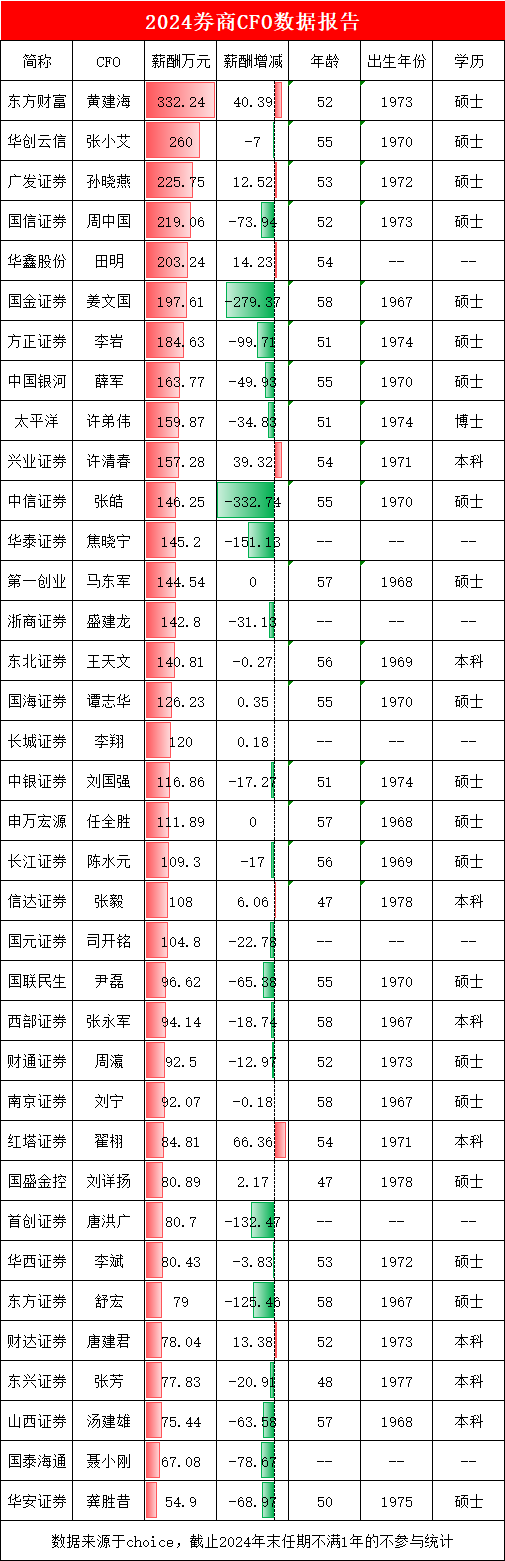
券商CFO盘点:长江证券财务总监陈水元56岁硕士学历年薪109万,比本科学历的东北证券CFO王天文薪酬低30万
Xin Lang Zheng Quan· 2025-08-04 07:51
资料显示,陈水元,男,1969年出生,工商管理硕士,会计师,经济师。现任长江证券副总裁兼财务总 监;武汉股权托管交易中心监事会主席,中国证券业协会财务会计专业委员会委员。曾任湖北证券有限 责任公司营业部财务主管、经纪事业部财务经理,长江证券有限责任公司经纪事业部总经理助理、经纪 业务74总部总经理助理、营业部总经理,长江证券股份有限公司营业部总经理、总裁特别助理、执行副 总裁、财务负责人、首席风险官、合规负责人,长江证券承销保荐有限公司董事,长信基金管理有限责 任公司监事。 | | | | 2024券商CF0数据报告 | | | | | --- | --- | --- | --- | --- | --- | --- | | 简称 | CFO | 薪酬万元 | 薪酬增减 | 年龄 | 出生年份 | 学历 | | 东方财富 | 黄建海 | 332. 24 | 40. 39 | 52 | 1973 | 硕士 | | 华创云信 | 张小艾 | 260 | -7 | 55 | 1970 | 硕士 | | 广发证券 | 孙晓菲 | 225. 75 | 12. 52 | 53 | 1972 | 硕士 | | 国信证券 | ...


券商CFO盘点:东北证券CFO王天文年薪140.8万,本科文凭在学历梯队中处于尾部
Xin Lang Zheng Quan· 2025-08-04 06:36
炒股就看金麒麟分析师研报,权威,专业,及时,全面,助您挖掘潜力主题机会! 作为上市公司核心管理层关键成员,财务总监CFO的地位与作用至关重要。新浪财经《2024年度A股 CFO数据报告》显示,2024年A股上市公司财务总监(CFO)群体薪酬规模合计达42.70亿元,平均年薪 为81.48万元。 专题:专题|2024年度A股CFO数据报告:美的集团钟铮年薪946万,比亚迪周亚琳896万 | | | | 2024券商CF0数据报告 | | | | | --- | --- | --- | --- | --- | --- | --- | | 简称 | CFO | 薪酬万元 | 薪酬增减 | 年龄 | 出生年份 | 学历 | | 东方财富 | 黄建海 | 332. 24 | 40. 39 | 52 | 1973 | 硕士 | | 华创云信 | 张小艾 | 260 | -7 | 55 | 1970 | 硕士 | | 广发证券 | 孙晓燕 | 225. 75 | 12. 52 | 53 | 1972 | 硕士 | | 国信证券 | 周中国 | 219.06 | -73.94 | 52 | 1973 | 硕士 | | 华鑫股 ...
东北证券:7月31日召开董事会会议
Mei Ri Jing Ji Xin Wen· 2025-08-04 05:53
Group 1 - Northeast Securities held its fifth temporary board meeting of the 11th session on July 31, 2025, to discuss the election of Chen Tiezhi as a member of the Strategic and ESG Management Committee [1] - For the year 2024, the revenue composition of Northeast Securities is as follows: Futures brokerage business accounts for 35.68%, securities brokerage business for 29.63%, proprietary trading for 22.65%, fund business for 10.34%, and asset management for 8.78% [1] Group 2 - A warning from a German executive in China highlights the dangers of free autonomous driving services, stating that it could lead to a disastrous price war across the industry [1]
东北证券:民爆行业壁垒高筑 行业持续推进智能化、无人化
智通财经网· 2025-08-04 03:56
Core Insights - The civil explosives industry has multiple barriers to entry, including production licensing, sales qualifications, engineering experience, and regional resources, leading to a continuous increase in industry concentration [2][3] - By 2024, the CR10 of the industry has reached 62.47%, exceeding the "14th Five-Year Plan" target [3] - The industry is experiencing a shift towards mixed explosives and electronic detonators, with significant advancements in smart manufacturing and international competitiveness [3][4] Industry Barriers - The civil explosives industry has high entry barriers due to production licensing constraints, with policies generally prohibiting the addition of new industrial explosives and detonator production capacity [2] - Sales qualifications emphasize safety records and technical compliance, making it difficult for new entrants to meet standards in the short term [2] - Companies need "dual first-class qualifications" to undertake quality downstream blasting services, creating experience barriers [2] Industry Trends - The concentration of civil explosive companies is increasing, with the top 10 companies achieving a combined production value of 26.048 billion yuan in 2024 [3] - The proportion of mixed explosives is expected to rise to over 35% by 2025, driven by their cost-effectiveness and safety advantages [3] - Electronic detonators have reached a 94% replacement rate for traditional detonators, with 309 million industrial detonators produced in the first half of 2025 [3] Technological Advancements - The industry is advancing towards smart and unmanned operations, with goals set for 2027 to have over 50% of companies achieving a maturity level of 3 in smart manufacturing [4] - The Ministry of Industry and Information Technology's 2025 plan encourages civil explosive companies to participate in the "Belt and Road" initiative, enhancing international competitiveness [4] Key Investment Targets - Recommended companies include Yipuli and Guangdong Hongda, while other companies such as Jiangnan Chemical and High Contest Civil Explosives are not covered as investment recommendations [5]
再战指数关键点位关口,复盘券商估值演绎:量能仍是关键变量
ZHONGTAI SECURITIES· 2025-08-03 13:39
Investment Rating - The report suggests a positive outlook for the brokerage sector, indicating that it is an opportune time to invest in underperforming brokerages [5][45]. Core Insights - The Shanghai Composite Index reached the 3500-point mark for the fifth time on July 10, 2025, with a notable increase in trading volume compared to previous attempts [5][8]. - Historical analysis shows that the index has previously struggled to maintain levels above 3500 points, with varying degrees of success in breaking through 4000 points in 2007 and 2015 [5][9]. - The current market is characterized by a "slow bull" trend, with over 90% of industry indices rising since the recent breakthrough, although many brokerages have already experienced significant gains [5][42]. Summary by Sections Historical Context - The report outlines the historical performance of the Shanghai Composite Index at the 3500-point threshold, noting that in 2007, the index quickly surpassed 4000 points after reaching 3500 [9]. - In 2015, the index again reached 3500 but did not yield significant excess returns for the brokerage sector due to prior gains [18][23]. - The 2021 attempt to maintain levels above 3500 resulted in a prolonged period of volatility without substantial upward momentum [31][35]. Current Market Analysis - As of July 30, 2025, the Shanghai Composite Index reached 3615 points, with the brokerage sector's price-to-book (PB) ratio at 1.46, indicating a lower valuation compared to historical averages [38]. - The average daily trading volume from July 1 to July 30, 2025, was 670.1 billion yuan, which is below the required levels to sustain upward momentum [42]. - The report highlights that the brokerage sector's performance has been mixed, with some firms like Zhongyin Securities seeing significant gains, while others lag behind [42][48]. Investment Recommendations - The report recommends focusing on leading brokerages such as Guotai Junan, CITIC Securities, and Dongfang Wealth, which are expected to benefit from increased market activity [5][45]. - It emphasizes the importance of trading volume as a key variable for sustaining market momentum and suggests that the current market conditions may favor a shift towards a more stable investment strategy [50][52].



东北证券: 东北证券股份有限公司2025年面向专业投资者公开发行短期公司债券(第五期)在深圳证券交易所上市的公告
Zheng Quan Zhi Xing· 2025-08-01 16:10
Core Points - Northeast Securities Co., Ltd. is set to publicly issue its fifth phase of short-term corporate bonds aimed at professional investors, which will be listed on the Shenzhen Stock Exchange starting August 4, 2025 [1][2] - The total issuance amount for this bond is RMB 1 billion, with a fixed interest rate of 1.70% and a maturity period of 291 days [2] Summary by Categories Bond Details - Bond Name: Northeast Securities Co., Ltd. 2025 Short-term Corporate Bonds (Fifth Phase) [1] - Bond Code: 524379 [2] - Credit Ratings: Issuer rating is AAA, and this bond is rated A-1 by United Ratings [2] - Total Issuance Amount: RMB 1 billion [2] - Bond Term: 291 days [2] - Interest Rate: 1.70% fixed [2] - Payment Frequency: Principal and interest paid at maturity [2] - Issuance Period: July 25, 2025 - July 28, 2025 [2] - Start Date of Interest: July 28, 2025 [2] - Maturity Date: May 15, 2026 [2] - Face Value: RMB 100 per bond [2] - Opening Reference Price: RMB 100 per bond [2]
东北证券:创业板2025年上半年各阶段项目分析报告
Sou Hu Cai Jing· 2025-08-01 11:06
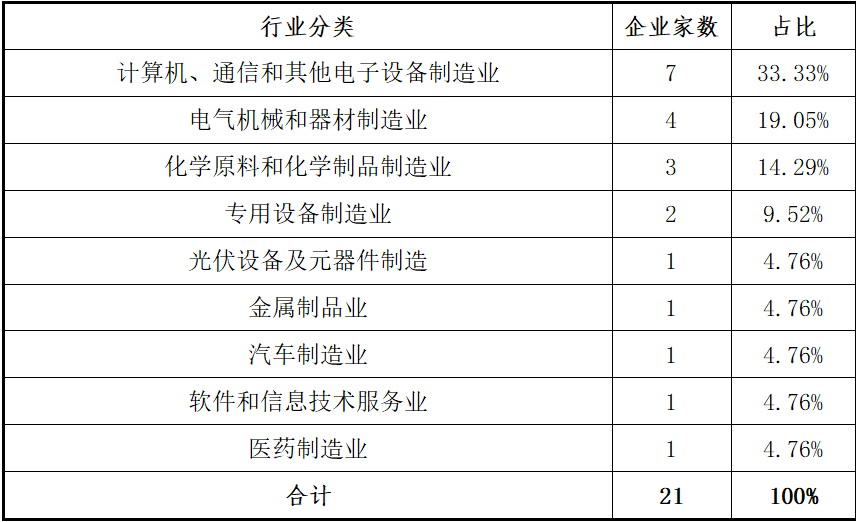
Core Insights - The report by Northeast Securities analyzes the status of the ChiNext market in the first half of 2025, detailing the number of companies accepted, approved, listed, and terminated, providing a comprehensive view of the current development trends in various stages of the ChiNext projects [1] Acceptance Analysis - A total of 21 new companies were accepted in the ChiNext during the first half of 2025, all of which are currently under review, with no new acceptances in the first half of 2024 [2] - The 21 companies span 9 different industries, with the largest representation in the computer, communication, and other electronic equipment manufacturing sector, accounting for 33.33% [3] - Among the 21 companies, 20 adopted the standard listing criteria for ChiNext, while 1 used the special voting rights listing criteria [3][4] Financial Data - The 20 companies that adopted standard listing criteria reported an average net profit of 19,680.60 million, with a median of 16,889.46 million, and the highest reaching 57,030.83 million [4][5] - All 20 companies reported revenues exceeding 40,000 million, with an average of 150,603.55 million and a median of 95,897.50 million [5] Regional Distribution - The 21 accepted companies are distributed across 8 regions, with Guangdong having the highest representation at 33.33% [5] Approved or Registered Companies Analysis - In the first half of 2025, 8 companies were approved or registered but not yet listed, a decrease from 19 in the first half of 2024 [6] - These 8 companies are involved in 6 different industries, with the electrical machinery and equipment manufacturing sector and the computer, communication, and other electronic equipment manufacturing sector each accounting for 25% [6] Listing Situation Analysis - A total of 20 companies were newly listed in the ChiNext during the first half of 2025, compared to 15 in the same period of 2024 [7] - The listed companies are also distributed across 9 industries, with the computer, communication, and other electronic equipment manufacturing, automotive manufacturing, and specialized equipment manufacturing sectors each having 4 companies [7][8] Termination Analysis - In the first half of 2025, 23 companies were terminated from the ChiNext, a significant decrease from 86 in the first half of 2024 [9] - The terminated companies span 12 different industries, with the computer, communication, and other electronic equipment manufacturing, automotive manufacturing, and software and information technology service sectors each having 3 companies [10][11] - Among the 23 terminated companies, 20 used standard listing criteria, 2 used special criteria, and 1 used red-chip criteria [11]
年内超20家券商裁撤60余家分支机构
Xin Lang Cai Jing· 2025-08-01 09:57
Group 1 - The core viewpoint of the article highlights the ongoing restructuring of brokerage branch layouts as firms aim to reduce costs and enhance efficiency, with over 20 brokerages having announced the closure of more than 60 branches by July 30 this year [2][3] - In July alone, three brokerages, including Founder Securities, announced the closure of their branches, with Founder Securities closing four branches, including its Henan branch [2][3] - The closures are primarily driven by high operational costs associated with physical branches, as well as a significant shift towards online trading platforms, which have become the mainstream mode of operation [3][5] Group 2 - Some brokerages are also actively expanding by opening new branches in regions with high business potential, such as the recent openings by Cheng Tong Securities and Wanlian Securities [5] - The restructuring of branch layouts is closely linked to the transformation towards wealth management, which is becoming increasingly important in the brokerage business model, contributing over 30% to brokerage income by 2024 [5][6] - Future adjustments in branch layouts are expected to focus on efficiency rather than scale, with a shift towards high-value, integrated service models, leveraging financial technology to enhance operations [6]







东北证券(000686) - 东北证券股份有限公司2025年面向专业投资者公开发行短期公司债券(第五期)在深圳证券交易所上市的公告
2025-08-01 08:56
(以下无正文) (本页无正文,为《东北证券股份有限公司 2025 年面向专业投资者公开发行短期公司债券 (第五期)在深圳证券交易所上市的公告》之盖章页) 东北证券股份有限公司(签章) 年 月 日 8 1 东北证券股份有限公司 2025 年面向专业投资者公开发行短 期公司债券(第五期)在深圳证券交易所上市的公告 根据深圳证券交易所债券上市的有关规定,东北证券股份有限公司 2025 年 面向专业投资者公开发行短期公司债券(第五期)符合深圳证券交易所债券上市 条件,将于 2025 年 8 月 4 日起在深圳证券交易所上市,并面向专业投资者中的 机构投资者交易,交易方式包括匹配成交、点击成交、询价成交、竞买成交和协 商成交。债券相关要素如下: | 债券名称 | 东北证券股份有限公司 2025 | | | | | 年面向专业投资者公开发行短期 | | --- | --- | --- | --- | --- | --- | --- | | | 公司债券(第五期) | | | | | | | 债券简称 | 东北 D5 | 25 | | | | | | 债券代码 | 524379 | | | | | | | 信用评级 | 主 ...