CITIC Steel(000708)

Search documents
特钢板块10月20日涨0.5%,久立特材领涨,主力资金净流入4469.37万元
Zheng Xing Xing Ye Ri Bao· 2025-10-20 08:21
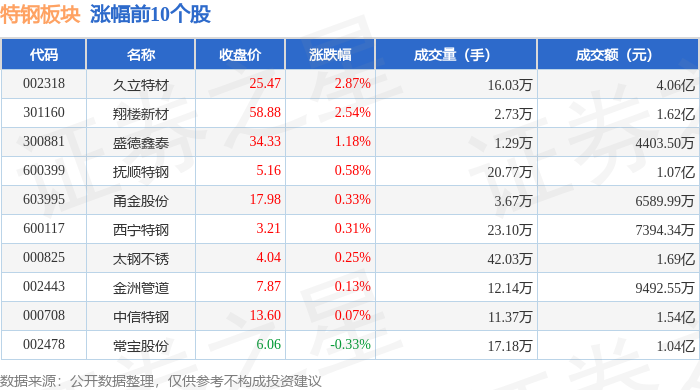
Core Insights - The special steel sector experienced a 0.5% increase on October 20, with Jiuli Special Materials leading the gains [1] - The Shanghai Composite Index closed at 3863.89, up 0.63%, while the Shenzhen Component Index closed at 12813.21, up 0.98% [1] Special Steel Sector Performance - Jiuli Special Materials (002318) closed at 25.47, with a rise of 2.87% and a trading volume of 160,300 shares, totaling a transaction value of 406 million yuan [1] - Xianglou New Materials (301160) closed at 58.88, up 2.54%, with a trading volume of 27,300 shares and a transaction value of 162 million yuan [1] - Shengde Zhengtai (300881) closed at 34.33, increasing by 1.18%, with a trading volume of 12,900 shares and a transaction value of 44.03 million yuan [1] - Fushun Special Steel (600399) closed at 5.16, up 0.58%, with a trading volume of 207,700 shares and a transaction value of 107 million yuan [1] - Other notable performances include Xining Special Steel (600117) at 3.21 (+0.31%), Taiyuan Iron & Steel (000825) at 4.04 (+0.25%), and Jinzou Pipeline (002443) at 7.87 (+0.13%) [1] Capital Flow Analysis - The special steel sector saw a net inflow of 44.69 million yuan from main funds, while retail funds experienced a net outflow of 37.27 million yuan [2] - The overall capital flow indicates a mixed sentiment among different investor types, with main funds showing interest while retail investors withdrew [2]




钢价小幅回落,关注“十五五“规划指引
Minsheng Securities· 2025-10-19 04:05
Investment Rating - The report maintains a "Buy" recommendation for several steel companies, including Hualing Steel, Baosteel, Nanjing Steel, and others [3][4]. Core Insights - Steel prices have slightly declined, with the price of 20mm HRB400 rebar in Shanghai at 3210 CNY/ton, down 50 CNY/ton from the previous week [1][11]. - The report highlights a decrease in steel production and inventory levels, with total production of the five major steel products at 8.57 million tons, a decrease of 63,600 tons week-on-week [2][3]. - The report emphasizes the importance of the upcoming "14th Five-Year Plan" meeting, which is expected to guide long-term economic development and capacity regulation in the steel industry [3][8]. Summary by Sections Price Trends - As of October 17, steel prices have shown a downward trend, with specific price changes for various steel products, including a 120 CNY/ton decrease for hot-rolled steel [1][12]. Production and Inventory - The total inventory of the five major steel products decreased by 23,800 tons to 11.2451 million tons, with a notable reduction in rebar inventory [2][3]. Profitability - Steel margins have decreased, with rebar, hot-rolled, and cold-rolled steel margins down by 36 CNY/ton, 55 CNY/ton, and 17 CNY/ton respectively [1][3]. Investment Recommendations - The report recommends several companies for investment, including Hualing Steel, Baosteel, and Nanjing Steel in the general steel sector, and specific companies in the special steel and pipe sectors [3][4].


特钢板块10月17日跌1.11%,久立特材领跌,主力资金净流出1.53亿元
Zheng Xing Xing Ye Ri Bao· 2025-10-17 08:28
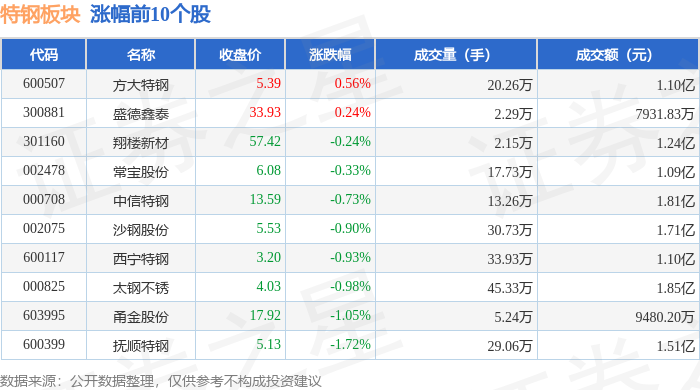
Core Insights - The special steel sector experienced a decline of 1.11% on October 17, with Jiuli Special Materials leading the drop at -3.36% [1][2] - The Shanghai Composite Index closed at 3839.76, down 1.95%, while the Shenzhen Component Index closed at 12688.94, down 3.04% [1] Stock Performance - The following stocks in the special steel sector showed varied performance: - Fangda Special Steel: Closed at 5.39, up 0.56% with a trading volume of 202,600 shares [1] - Jiuli Special Materials: Closed at 24.76, down 3.36% with a trading volume of 124,400 shares and a transaction value of 312 million [2] - Taiyuan Iron & Steel: Closed at 4.03, down 0.98% with a trading volume of 453,300 shares [2] Capital Flow - The special steel sector saw a net outflow of 153 million from institutional investors, while retail investors contributed a net inflow of 118 million [2] - The following stocks had significant capital flow: - Shengde Zhengtai: Net inflow from retail investors was 961,210, while institutional investors had a net outflow of 666,910 [3] - Xining Special Steel: Retail investors had a net inflow of 637,800, while institutional investors had a net outflow of 407,220 [3]


中信特钢跌2.00%,成交额1.35亿元,主力资金净流出924.05万元
Xin Lang Zheng Quan· 2025-10-16 05:10
Core Viewpoint - CITIC Special Steel's stock price has shown a year-to-date increase of 28.09%, with recent fluctuations indicating a slight decline in trading activity and net outflow of funds [2][1]. Company Overview - CITIC Special Steel, established on May 18, 1993, and listed on March 26, 1997, is located in Jiangyin, Wuxi, Jiangsu Province, and specializes in the production and sale of special steel products [2]. - The company's revenue composition includes special steel bars (39.23%), special seamless steel pipes (27.20%), special steel wires (13.11%), other (10.65%), and special plates (9.82%) [2]. Financial Performance - For the first half of 2025, CITIC Special Steel reported a revenue of 54.715 billion yuan, a year-on-year decrease of 4.02%, while the net profit attributable to shareholders was 2.798 billion yuan, reflecting a year-on-year increase of 2.67% [2]. - The company has distributed a total of 21.937 billion yuan in dividends since its A-share listing, with 9.952 billion yuan distributed over the past three years [3]. Shareholder Structure - As of June 30, 2025, CITIC Special Steel had 43,400 shareholders, an increase of 5.17% from the previous period, with an average of 116,344 circulating shares per shareholder, down by 4.92% [2]. - Major shareholders include Hong Kong Central Clearing Limited, holding 48.1504 million shares, and various ETFs such as Southern S&P China A-share Large Cap Dividend Low Volatility 50 ETF and Huatai-PineBridge CSI 300 ETF, which have seen changes in their holdings [3].
特钢板块10月15日涨0.8%,翔楼新材领涨,主力资金净流入899.31万元
Zheng Xing Xing Ye Ri Bao· 2025-10-15 08:27
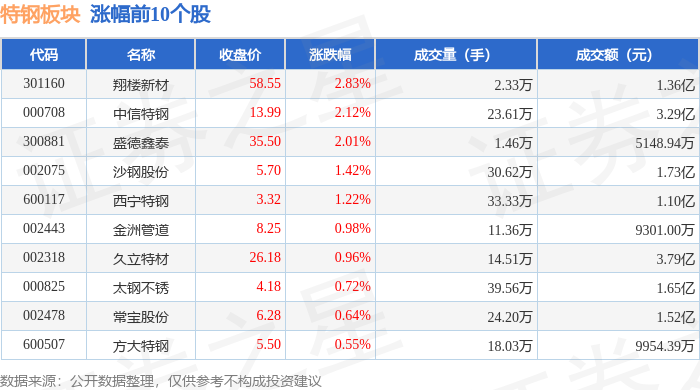
Core Viewpoint - The special steel sector experienced a 0.8% increase on October 15, with Xianglou New Materials leading the gains. The Shanghai Composite Index closed at 3912.21, up 1.22%, while the Shenzhen Component Index closed at 13118.75, up 1.73% [1]. Group 1: Stock Performance - Xianglou New Materials (301160) closed at 58.55, with a rise of 2.83% and a trading volume of 23,300 lots, amounting to 136 million yuan [1]. - CITIC Special Steel (000708) closed at 66.ET, increasing by 2.12% with a trading volume of 236,100 lots, totaling 329 million yuan [1]. - Shengde Yantai (300881) closed at 35.50, up 2.01% with a trading volume of 14,600 lots, amounting to 51.49 million yuan [1]. - Shagang Group (002075) closed at 5.70, rising by 1.42% with a trading volume of 306,200 lots, totaling 173 million yuan [1]. - Xining Special Steel (600117) closed at 3.32, up 1.22% with a trading volume of 333,300 lots, amounting to 110 million yuan [1]. - Jinzou Pipeline (002443) closed at 8.25, increasing by 0.98% with a trading volume of 113,600 lots, totaling 93.01 million yuan [1]. - Jiuli Special Materials (002318) closed at 26.18, up 0.96% with a trading volume of 145,100 lots, amounting to 379 million yuan [1]. - Taiyuan Iron & Steel (000825) closed at 4.18, rising by 0.72% with a trading volume of 395,600 lots, totaling 165 million yuan [1]. - Changbao Co. (002478) closed at 6.28, up 0.64% with a trading volume of 242,000 lots, amounting to 152 million yuan [1]. - Fangda Special Steel (600507) closed at 5.50, increasing by 0.55% with a trading volume of 180,300 lots, totaling 99.54 million yuan [1]. Group 2: Capital Flow - The special steel sector saw a net inflow of 8.99 million yuan from institutional investors, while retail investors contributed a net inflow of 6.64 million yuan. However, there was a net outflow of 15.64 million yuan from speculative funds [2][3]. - Xining Special Steel (600117) experienced a net outflow of 13.01 million yuan from institutional investors, while retail investors had a net inflow of 3.46 million yuan [3]. - Shagang Group (002075) had a net inflow of 9.45 million yuan from institutional investors, with a net outflow of 4.10 million yuan from retail investors [3]. - CITIC Special Steel (000708) saw a net inflow of 2.56 million yuan from institutional investors, while retail investors had a net inflow of 2.98 million yuan [3].

经纬江苏——方寸球衣上的制造密码
Zhong Guo Zheng Quan Bao· 2025-10-15 00:00
Core Insights - The evolution of sports jerseys in Jiangsu reflects the province's industrial transformation, showcasing a shift from traditional to high-tech materials and indicating a broader economic narrative of innovation and regional balance [2][4][6]. Industry and Company Developments - The transition from cotton to synthetic materials in sports jerseys illustrates a history of material science innovation, with polyester and nylon becoming mainstream, enhancing performance and comfort [4][5]. - Jiangsu's textile industry has evolved into a high-tech sector, capable of meeting international demands with rapid production timelines, highlighting the strength of its complete industrial chain [4][8]. - The introduction of smart fabrics, such as those developed by China Petrochemical's Yizheng Chemical Fiber, demonstrates advancements in textile technology, allowing for dynamic adjustments to temperature and humidity [5][6]. - The development of new materials is a strategic focus in Jiangsu, with significant investments in advanced materials like nanomaterials and green building materials, indicating a robust growth trajectory [7][8]. - The successful launch of the Changtai Yangtze River Bridge, utilizing high-strength materials from CITIC Pacific Special Steel, exemplifies Jiangsu's capabilities in producing high-performance materials for major infrastructure projects [8]. Regional Economic Balance - The performance of Jiangsu's football teams and their jerseys symbolizes the province's economic structure, with Suzhou leading in innovation, Nantong focusing on marine engineering, and Xuzhou emerging as a new industrial force [10][15][16]. - Jiangsu's economic strategy emphasizes systemic and collaborative development across regions, with Suzhou, Suzhong, and Subei each playing distinct roles in the overall economic landscape [10][12][13]. - The province's advanced manufacturing clusters, such as those in the automotive and semiconductor industries, showcase the benefits of regional collaboration and supply chain integration, enhancing competitiveness [18][20][21]. Innovation and Collaboration - Jiangsu's industrial ecosystem is characterized by deep integration of innovation and supply chains, fostering a dynamic environment for technological advancements and efficient production [19][21]. - The collaboration between traditional and emerging industries in Jiangsu is revitalizing sectors like textiles, demonstrating the potential for innovation through cross-industry partnerships [20][21]. - The establishment of innovation hubs, such as the Suzhou-Suqian industrial park, reflects a commitment to fostering research and development alongside manufacturing, enhancing the province's competitive edge [20][21].

经纬江苏
Zhong Guo Zheng Quan Bao· 2025-10-14 20:17
Core Insights - The evolution of sports jerseys in Jiangsu reflects the province's industrial transformation, showcasing advancements in material technology and the integration of various industries [1][2][4] Group 1: Industrial Evolution - The transition from cotton to synthetic materials in sports jerseys illustrates a history of material innovation, with polyester and nylon becoming mainstream [1][2] - Jiangsu's textile industry has evolved into a high-tech sector, with companies like Jiangsu Dongdu Textile Group completing international orders faster due to a complete industrial chain [2] - New materials, such as smart polyester fibers that adjust to environmental conditions, highlight the rise of advanced materials in Jiangsu [2][3] Group 2: Regional Economic Development - The 13 teams in the "Su Super" league symbolize the balanced economic development across Jiangsu, with each region playing a distinct role [4][5] - Southern Jiangsu acts as a "forward" with high-quality breakthroughs, while Central Jiangsu serves as a "midfield engine" for growth, and Northern Jiangsu emerges as a new force in industrial development [6][7] - The region's industrial clusters, such as the advanced manufacturing clusters in Suzhou and the medical high-tech zone in Taizhou, demonstrate the strategic importance of regional collaboration [5][6] Group 3: Supply Chain and Innovation - Jiangsu's industries benefit from deep collaboration between innovation and supply chains, creating a robust industrial network [8][9] - The automotive sector in Jiangsu, particularly in electric vehicles, showcases a successful model of local supply chain integration, with significant contributions from local manufacturers [8][9] - Traditional industries are revitalizing through partnerships with high-tech firms, leading to a new era of innovation and efficiency [9][10]
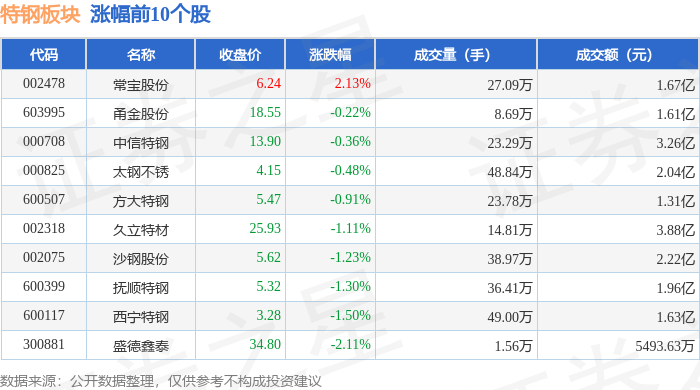
特钢板块10月14日跌0.81%,翔楼新材领跌,主力资金净流出4183.43万元
Zheng Xing Xing Ye Ri Bao· 2025-10-14 08:35
Market Overview - The special steel sector experienced a decline of 0.81% on October 14, with Xianglou New Materials leading the drop [1] - The Shanghai Composite Index closed at 3865.23, down 0.62%, while the Shenzhen Component Index closed at 12895.11, down 2.54% [1] Stock Performance - Notable stock performances in the special steel sector included: - Changbao Co., Ltd. (002478) rose by 2.13% to a closing price of 6.24 [1] - Xianglou New Materials (301160) fell by 5.32% to a closing price of 56.94 [2] - Other companies like Jiu Li Special Materials (002318) and Shagang Co., Ltd. (002075) also saw declines of 1.11% and 1.23%, respectively [1][2] Capital Flow - The special steel sector saw a net outflow of 41.83 million yuan from institutional investors and 46.63 million yuan from retail investors, while retail investors had a net inflow of 88.47 million yuan [2] - Specific stock capital flows included: - Changbao Co., Ltd. had a net inflow of 11.24 million yuan from institutional investors [3] - Xianglou New Materials experienced a net outflow of 11.70 million yuan from retail investors [3]
国泰海通:钢铁节后需求仍有望逐步恢复增长 龙头竞争优势与盈利能力更加凸显
Zhi Tong Cai Jing· 2025-10-14 03:21
Core Viewpoint - The steel industry is expected to gradually bottom out in demand, with supply-side market clearing beginning to appear, leading to a potential recovery in the industry's fundamentals. If supply policies are implemented, the contraction of supply may accelerate, facilitating quicker industry recovery [1]. Demand and Supply Analysis - Steel consumption for the week of October 6-10, 2025, was 7.5143 million tons, a decrease of 1.5339 million tons week-on-week. Construction steel consumption was 2.2262 million tons, down 1.0846 million tons, while plate steel consumption was 5.2881 million tons, down 0.4493 million tons. Steel production was 8.6331 million tons, a decrease of 0.0376 million tons, and total inventory rose to 16.0072 million tons, an increase of 1.2786 million tons [2]. - The operating rate of blast furnaces at 247 steel mills was 84.27%, down 0.02 percentage points week-on-week, while electric furnace operating rates were 60.26%, down 1.28 percentage points. Despite a marginal decline in demand due to the National Day holiday, the industry remains in a traditional peak season, with expectations for gradual recovery in steel demand and inventory reduction [2]. Profitability Trends - The average gross profit per ton for rebar was 167.1 CNY, an increase of 24.3 CNY week-on-week, while hot-rolled coil gross profit was 112.1 CNY, up 29.3 CNY. The profitability rate for 247 steel companies was 56.28%, a decrease of 0.43% [3]. - The expectation is for iron ore production to accelerate while demand remains limited, leading to a gradual easing of iron ore prices and improvement in cost constraints for the steel industry, with a potential recovery in profitability levels [3]. Future Outlook - The negative impact of the real estate sector on steel demand is expected to diminish, with stable growth anticipated in demand from infrastructure and manufacturing sectors. Steel exports maintained a year-on-year increase from January to August [4]. - Over 40% of steel companies are currently experiencing losses, but market clearing is beginning to occur. Recent policies aim to reduce production and promote a balance between supply and demand, supporting the expectation of supply contraction and gradual recovery in the steel industry's fundamentals [4]. Recommended Companies - Key recommendations include Baosteel (600019) for its technological and product structure leadership, Hualing Steel (000932) for its product structure upgrades, and Fangda Special Steel (600507) for its low-cost advantages. Other recommendations include CITIC Special Steel (000708) for its competitive advantages and high dividend yield, as well as upstream resource companies like Hebei Steel Resources (000923) and Dazhong Mining (001203) due to their long-term growth potential [5].


金工定期报告20251013:预期高股息组合跟踪
Soochow Securities· 2025-10-13 10:02
- Model Name: Expected High Dividend Portfolio; Model Construction Idea: The model uses a two-stage approach to construct the expected dividend yield indicator. The first stage calculates the dividend yield based on the annual report's profit distribution, and the second stage predicts and calculates the dividend yield using historical dividends and fundamental indicators. Additionally, two short-term factors affecting dividend yield—reversal factor and profitability factor—are used to assist in screening, and the selection is made from the CSI 300 constituent stocks to construct the expected high dividend portfolio. The portfolio holds 30 stocks each period and rebalances monthly[3][8] - Model Construction Process: 1. Exclude suspended and limit-up stocks from the CSI 300 constituent stocks to form the candidate stock pool[13] 2. Exclude the top 20% of stocks with the highest short-term momentum (i.e., the top 20% of stocks with the highest 21-day cumulative gains) from the stock pool[13] 3. Exclude stocks with declining profitability (i.e., stocks with a negative year-on-year growth rate of quarterly net profit)[13] 4. Rank the remaining stocks in the stock pool by expected dividend yield and select the top 30 stocks with the highest expected dividend yield to construct the portfolio equally weighted[9] - Model Evaluation: The model's historical performance is outstanding, with a cumulative return of 358.90% and a cumulative excess return of 107.44% relative to the CSI 300 Total Return Index. The annualized excess return is 8.87%, with a maximum rolling one-year drawdown of only 12.26% and a monthly excess win rate of 60.19%[11] Model Backtest Results - Expected High Dividend Portfolio, average return in September 2025: -5.35%, underperformed the CSI 300 Index by 8.09% and the CSI Dividend Index by 3.87%[3][14] - Best performing stocks in September 2025: CITIC Special Steel (3.81%), Yutong Bus (-0.35%), Industrial and Commercial Bank of China (-1.75%), Shuanghui Development (-1.90%)[15] Factor Construction and Evaluation - Factor Name: Expected Dividend Yield Factor; Factor Construction Idea: The factor is constructed by predicting dividend distribution using the method of dividend distribution combined with fundamental indicators. Two short-term factors affecting dividend yield—reversal factor and profitability factor—are used to assist in screening[14] - Factor Construction Process: 1. Calculate the dividend yield based on the annual report's profit distribution[8] 2. Predict and calculate the dividend yield using historical dividends and fundamental indicators[8] - Factor Evaluation: The factor is used to assist in screening and constructing the expected high dividend portfolio, which has shown outstanding historical performance[3][8] Factor Backtest Results - Expected Dividend Yield Factor, average return in September 2025: -5.35%, underperformed the CSI 300 Index by 8.09% and the CSI Dividend Index by 3.87%[3][14]