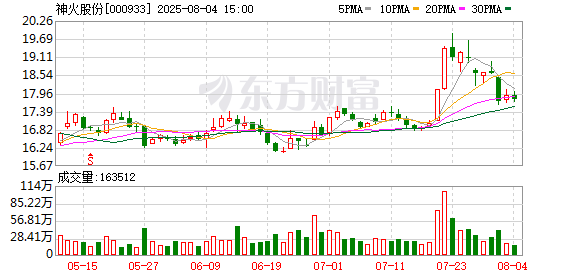
SHENHUO COAL&POWER(000933)

Search documents
神火股份20250730
2025-08-05 03:20
Summary of the Conference Call for Shenhuo Group Company Overview - Shenhuo Group is a key coal and aluminum processing enterprise in Henan Province, with core businesses in coal, electrolytic aluminum, and aluminum foil. By 2024, electrolytic aluminum revenue is expected to account for 68% of total revenue, while coal will contribute approximately 18% [2][8][12]. Core Business Insights - The company has established electrolytic aluminum production clusters in Xinjiang and Yunnan, with a total capacity of 1.7 million tons by the end of 2024, including 800,000 tons in Xinjiang and 900,000 tons in Yunnan. It also has a self-sufficiency capability for 400,000 tons of anode raw materials, showcasing a complete upstream and downstream integration [2][12]. - The company’s expense ratio is at a mid-low level, with a decreasing trend in total expenses, reaching 3.3% by the end of 2024. However, it remains at a mid-high level compared to peers due to high short-term and long-term borrowings, indicating potential for further reduction in debt ratios [10]. - The company emphasizes investor returns, with total dividends reaching 1.8 billion yuan in 2024, accounting for about 42% of profits. Cumulatively, dividends since listing amount to 9.43 billion yuan, or 33% of profits, with expectations for further increases in the payout ratio as profits improve [11]. Market Dynamics - The company benefits from low coal prices in Xinjiang, resulting in significantly lower production costs for electrolytic aluminum compared to other regions. The electricity cost per ton of electrolytic aluminum is approximately 1,300 yuan lower than in Yunnan and nearly 4,000 yuan lower than in Shandong. The Yunnan hydroelectric aluminum project enjoys a low-carbon premium, saving 11.2 tons of carbon emissions per ton produced [2][14][15]. Financial Performance - The company’s net profit attributable to shareholders has fluctuated in recent years, influenced by coal and alumina price volatility. The revenue structure shows that electrolytic aluminum and coal are the core products, with respective revenue contributions of 68% and 18% in 2024. The gross profit margins for electrolytic aluminum and coal are expected to be 80% and 14%, respectively [8][9]. - The sales gross margin has slightly decreased from 21.5% in 2020 to 21.23% in 2023, while the net profit margin has increased from 1.34% to 12.5% [9]. Strategic Developments - The company initiated a stock repurchase plan in April 2025, with a budget between 250 million and 450 million yuan, aiming to buy back approximately 12.5 million to 22.5 million shares, representing about 1% of total shares [7]. Industry Trends - The coal market in China has experienced significant changes since 2009, with various cycles of price fluctuations influenced by economic conditions and government policies. The current trend indicates a potential recovery in coal prices due to supply-side reforms and production adjustments [20][21]. - The company is positioned to benefit from the anticipated recovery in the coal market, particularly in the coking coal sector, as the government enforces production cuts on overcapacity mines [21]. Future Outlook - Shenhuo Group is expected to benefit from low electricity prices in Xinjiang and Yunnan, as well as the low-carbon premium from hydroelectric power. The aluminum foil business is projected to have significant growth potential, alongside improved profitability in the coal sector. Profit forecasts for 2025 to 2027 suggest net profits of 5.2 billion, 7 billion, and 8.5 billion yuan, with corresponding price-to-earnings ratios of 8.3, 6.8, and 6.1, indicating a relatively low valuation compared to peers [22][23].

DC 8月金股
2025-08-05 03:19
Summary of Conference Call Records Industry or Company Involved - The records cover various industries including macroeconomic trends, coal, healthcare, technology, and financial services. Specific companies mentioned include 乐普医疗 (Lepu Medical), 银河医疗 (Yinhe Medical), and 九方智投控股 (Jiufang Zhitu Holdings). Key Points and Arguments Macroeconomic Trends - The economic outlook remains stable, with potential price increases indicated by July's PMR data, suggesting a positive trend for August [1] - Attention is drawn to the easing of tariffs in the US-China trade negotiations, although uncertainties remain regarding the final outcomes [2][3] - The US economy shows resilience, with expectations of continued monetary policy adjustments [2][3] Market Sentiment - The market is expected to remain cautious in August, with potential corrections following previous optimistic expectations [4][5] - The index is projected to stabilize between 3,400 and 3,500 points, influenced by demand stimulation in sectors like robotics and consumption [4] Sector-Specific Insights - **Healthcare**: - 乐普医疗 is highlighted for its strong growth potential, particularly with its new product launches and market strategies aimed at capturing low-price segments [12][13][14] - The company is expected to achieve significant revenue growth, with projections of 40 to 50 billion in actual sales potential [13] - **Coal Industry**: - The coal sector is experiencing policy-driven price support, with expectations of price stabilization due to supply constraints [16][17] - Focus on焦煤 (coking coal) prices shows a significant rebound, with current prices rising from 1,200 to over 1,650 [18] - **Technology**: - The domestic AI sector is anticipated to grow, driven by increased demand for computing power and advancements in local technology [36][37] - Companies like 天湖通信 (Tianhu Communication) are positioned to benefit from the transition to 1.6T technology, with confirmed orders indicating strong future growth [39] - **Financial Services**: - 九方智投控股 is noted for its unique position in the financial information service sector, with a limited number of licenses available, enhancing its market potential [28][29] - The company is expected to benefit from increasing demand for investment education and advisory services as traditional investment channels shrink [28] Other Important Insights - The healthcare sector is seeing a shift towards new consumption patterns, with a focus on innovative products that meet emerging market needs [11][12] - The coal market is under scrutiny for its response to environmental policies, with expectations of price support mechanisms to stabilize the market [16][17] - The technology sector is experiencing a significant transformation, with AI and computing power becoming critical drivers of growth [36][37] Conclusion - The overall sentiment across various sectors indicates cautious optimism, with specific companies positioned to leverage market trends and policy changes for growth. The focus remains on innovation, market adaptability, and strategic positioning in response to evolving consumer demands and regulatory landscapes.





神火股份: 河南神火煤电股份有限公司关于持股5%以上股东减持股份预披露公告
Zheng Quan Zhi Xing· 2025-08-04 16:47
证券代码:000933 证券简称:神火股份 公告编号:2025-048 河南神火煤电股份有限公司 关于持股 5%以上股东减持股份预披露公告 商丘市普天工贸有限公司保证向本公司提供的信息内容真实、准确和完整,没有虚假 记载、误导性陈述或重大遗漏。 本公司及董事会全体成员保证信息披露的内容真实、准确和完整,没有虚假记载、误 导性陈述或重大遗漏。 特别提示: 持有河南神火煤电股份有限公司(以下简称"公司""本公司") 股份 191,750,885 股(占公司总股本的 8.58%,总股本以公司当前股本 (以下简称"普天工贸")计划在本公告披露之日起 15 个交易日后的 或大宗交易方式减持本公司股份不超过 20,000,000 股,占公司总股本 的 0.90%。 一、减持股东的基本情况 (一)股东名称:商丘市普天工贸有限公司 (二)股东持股情况:截至本公告披露日,普天工贸持有公司股 份 191,750,885 股,占本公司总股本的 8.58%;股份性质为"无限售条 件流通股"。 二、本次减持计划的主要内容 占公司总股本的 0.90%。 方式的,在任意连续 90 个自然日内,减持股份的总数不得超过公司股 份总数的 1%; ...

AMAC有色金属指数上涨0.81%,前十大权重包含天齐锂业等
Jin Rong Jie· 2025-08-04 15:12
Group 1 - The AMAC Nonferrous Metals Index increased by 0.81%, closing at 3387.8 points with a trading volume of 36.511 billion [1] - The AMAC Nonferrous Metals Index has risen by 8.81% in the past month, 21.63% in the past three months, and 21.46% year-to-date [1] - The index is based on the classification guidelines from the China Securities Association and includes 43 industry classification indices [1] Group 2 - The top ten holdings of the AMAC Nonferrous Metals Index include Northern Rare Earth (8.77%), China Aluminum (5.63%), and Huayou Cobalt (5.56%) [1] - The market capitalization distribution shows that 52.51% of the holdings are from the Shenzhen Stock Exchange, while 47.49% are from the Shanghai Stock Exchange [1] Group 3 - The industry composition of the AMAC Nonferrous Metals Index shows that raw materials account for 96.48%, industrials for 2.09%, information technology for 1.07%, and consumer discretionary for 0.36% [2]





8月4日增减持汇总




Xin Lang Cai Jing· 2025-08-04 14:43
据统计,8月4日,盘后包括达意隆、山外山、开普检测、吉宏股份、红旗连锁、通达股份、神火股份、 康泰医学、步科股份、飞鹿股份、能辉科技、晶雪节能、胜宏科技、赛腾股份、雪迪龙、中芯国际、工 大高科、成都先导、飞乐音响、华电辽能、三维股份、奥锐特在内的22家A股上市公司披露减持情况。 当日暂无A股上市公司披露增持情况。 | 1 | 达意障 | 董事兼高级管理人员吴小满计划减持不超过4.22万股股份 | | --- | --- | --- | | 2 | 山外山 | 大健康和力远健鲲合计减持2.26%公司股份 | | 3 | 开普检测 | 副总经理贺春、张冉拟减持不超过0.54%公司股份 | | 4 | 吉宏股份 | 毒事长干亚朋计划减持不超过304万股 | | 5 | 红旗连锁 | 永辉超市拟减持不超过1%股份 | | 6 | 通达股份 | 控股股东拟减持不超过3%公司股份 | | 1 | 神火股份 | 普天工贸拟减持0.90%公司股份 | | 8 | 康泰医学 | 持股5%以上股东及部分董事、高管拟减持不超过3.59%股份 | | 9 | 步科股份 | 控股股东上海步进计划减持不超过3%公司股份 | | 10 | ...
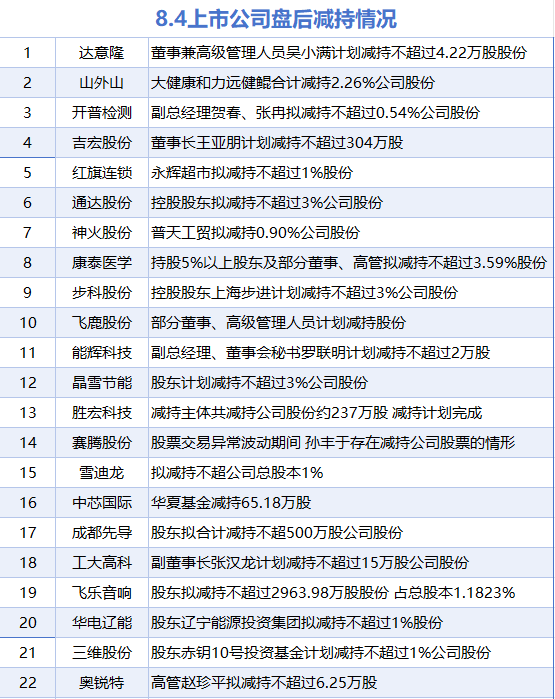
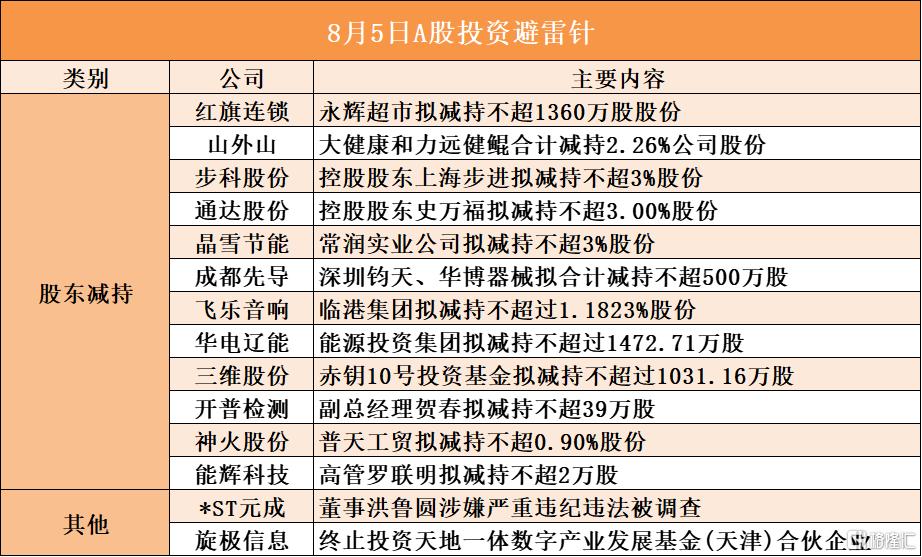
8月5日A股投资避雷针︱*ST元成:董事洪鲁圆涉嫌严重违纪违法被调查


Ge Long Hui A P P· 2025-08-04 14:15
Shareholder Reduction - Yonghui Supermarket plans to reduce its holdings by no more than 13.6 million shares in Hongqi Chain [1] - The controlling shareholder of Buke Co., Shanghai Bujin, intends to reduce its stake by no more than 3% [1] - The controlling shareholder of Tongda Co., Shi Wanfeng, plans to reduce its holdings by no more than 3% [1] - Changrun Industrial Company, a shareholder of Jingxue Energy, intends to reduce its stake by no more than 3% [1] - Shenzhen Jun Tian and Huabo Medical, shareholders of Chengdu Xian Dao, plan to collectively reduce their holdings by no more than 5 million shares [1] - Lingang Group, a shareholder of Feile Audio, intends to reduce its stake by no more than 1.1823% [1] - Energy Investment Group, a shareholder of Huadian Liaoning Energy, plans to reduce its holdings by no more than 14.7271 million shares [1] - Chiyao No. 10 Investment Fund, a shareholder of Sanwei Co., intends to reduce its stake by no more than 10.3116 million shares [1] - The deputy general manager of Kaipu Testing, He Chun, plans to reduce his holdings by no more than 390,000 shares [1] - Putian Gongmao, a shareholder of Shenhuo Co., intends to reduce its stake by no more than 0.90% [1] - Executive Luo Lianming of Nenghui Technology plans to reduce his holdings by no more than 20,000 shares [1] Other Notable Events - Director Hong Luyuan of *ST Yuancheng is under investigation for serious violations of discipline and law [1] - Xuan Zhi Information has terminated its investment in Tian Di Yi Ti Digital Industry Development Fund (Tianjin) Partnership [1]
神火股份:普天工贸拟减持公司不超0.9%股份
Zheng Quan Shi Bao Wang· 2025-08-04 13:21
人民财讯8月4日电,神火股份(000933)8月4日晚间公告,持股8.58%的股东商丘市普天工贸有限公司 (简称"普天工贸")计划15个交易日后的3个月内,以集中竞价或大宗交易方式减持公司股份不超过2000 万股(占公司总股本的0.90%)。 ...
神火股份:股东普天工贸拟减持不超0.90%公司股份
Di Yi Cai Jing· 2025-08-04 13:19
神火股份公告,股东商丘市普天工贸有限公司计划在本公告披露之日起15个交易日后的3个月内(即 2025年8月27日至2025年11月26日),以集中竞价或大宗交易方式减持本公司股份不超过2000万股,占 公司总股本的0.90%。 ...
神火股份(000933.SZ):普天工贸拟减持不超0.9%股份
智通财经网· 2025-08-04 13:16
神火股份(000933.SZ)发布公告,公司股东商丘市普天工贸有限公司(简称"普天工贸")计划在公告披露之 日起15个交易日后的3个月内(即2025年8月27日至2025年11月26日),以集中竞价或大宗交易方式减持公 司股份不超过2000万股,占公司总股本的0.90%。 ...
神火股份:股东商丘市普天工贸有限公司计划减持公司股份不超过2000万股
Mei Ri Jing Ji Xin Wen· 2025-08-04 13:14
Group 1 - The revenue composition of Shenhuo Co., Ltd. for the year 2024 is as follows: non-ferrous metals account for 67.97%, mining industry for 18.01%, electrolytic aluminum deep processing for 9.89%, trading for 1.89%, and other industries for 1.36% [1] Group 2 - Shenhuo Co., Ltd. announced that its shareholder, Shangqiu Putian Industrial and Trade Co., Ltd., plans to reduce its holdings by up to 20 million shares, which represents 0.9% of the company's total share capital, within a three-month period starting from August 27, 2025 [3]