Zhengzhou Qianweiyangchu Food (001215)

Search documents
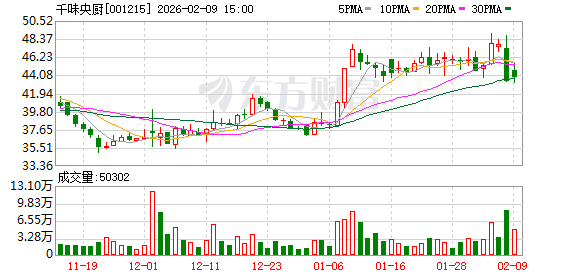
千味央厨:公司高度关注市场新趋势,将积极探索联名共创、场景化定制等模式
Zheng Quan Ri Bao Wang· 2026-02-09 11:50
Group 1 - The company is actively expanding its C-end market by collaborating with popular brands or IPs to launch trending products and planning products for the Spring Festival banquet scene [1] - The company is highly attentive to new market trends and will explore co-creation and scenario-based customization models [1]
千味央厨:公司持续深耕新零售平台,关注新零售渠道需求与消费趋势
Zheng Quan Ri Bao Wang· 2026-02-09 09:43
Group 1 - The core viewpoint of the article highlights that Qianwei Yangchun (001215) is actively engaging in the new retail channel by focusing on consumer trends and demands for new products [1] - The company is committed to continuous product development and launch in the new retail sector [1] - Qianwei Yangchun is exploring collaboration with popular brands or IPs to create trending products and is planning products for the Spring Festival banquet scene [1]
千味央厨:2026年公司将继续推动预制菜业务的发展
Zheng Quan Ri Bao· 2026-02-09 09:10
Core Viewpoint - The company emphasizes its commitment to product quality and compliance with standards in the prepared food industry, actively engaging in the development of new national standards [2] Group 1: Company Operations - The company has organized its R&D, production, and quality control departments to study the new national standards (draft) for prepared foods [2] - The production processes and recipes for core products such as fried dough sticks, rice cakes, and frozen prepared dishes adhere to current national standards and industry norms [2] Group 2: Market Performance - The company has seen a steady increase in product supply scale to B-end major clients, with sales volume to its five core direct customers growing by 4.87% year-on-year in the first half of 2025 [2] - The company plans to continue promoting the development of its prepared food business in 2026, with future revenue share and gross margin expectations to be disclosed in regular reports and announcements [2]

东海证券:预制菜国标推出 行业规范化里程碑
Zhi Tong Cai Jing· 2026-02-09 02:00
Core Insights - The implementation of national standards for prepared dishes is beneficial for the healthy development of the industry, with leading companies having advantages in production, transportation, quality control, and supply chain management, thus benefiting from the short-term normalization of the industry [1] - Long-term, the standardization of flavors and ease of preparation for B-end prepared dishes effectively addresses the core pain points of high labor costs and slow serving speeds in the catering industry, driven by the increase in chain restaurant rates [1] - The C-end prepared dishes have vast growth potential as consumer trust continues to rise [1] Group 1: Definition and Requirements - The draft clearly defines prepared dishes as pre-packaged dishes that require heating or cooking before consumption, excluding staple foods, fresh vegetables, ready-to-eat foods, and dishes made in central kitchens [2] - The use of preservatives is prohibited, and the use of food additives must be minimized, with a limited list of acceptable additives as per national standards [2] - The maximum shelf life for products is set to not exceed 12 months [2] - Detailed labeling requirements are established, including information on ingredients, composition, and preparation methods, allowing consumers to easily understand the product [2] Group 2: Consumer Rights and Transparency - The announcement promotes the protection of consumer rights and choices, encouraging food service providers to accept social supervision and take necessary measures to ensure transparency [3] - Food service providers are encouraged to clearly indicate the processing and preparation methods of dishes [3] - Various methods for disclosure, such as menus, ordering apps, and visible displays in stores, are suggested to enhance consumer understanding and trust in the products [3] Group 3: Industry Development and Investment Opportunities - The national standards for prepared dishes clarify requirements for production, storage, transportation, and labeling, raising industry entry barriers and operational costs, indicating a clear trend towards standardization [4] - This trend is expected to lead to increased industry concentration, with smaller companies potentially being eliminated, favoring leading companies with strong production capabilities and supply chain management [4] - The growth potential for C-end prepared dishes is significant, with strong brand companies likely to benefit first [4] - Investment recommendations include focusing on companies with clear capacity and channel advantages, such as Anjijia Food (603345) and Qianwei Central Kitchen (001215) [4]

食品加工板块2月4日涨1.12%,千味央厨领涨,主力资金净流入1857.41万元
Zheng Xing Xing Ye Ri Bao· 2026-02-04 08:56
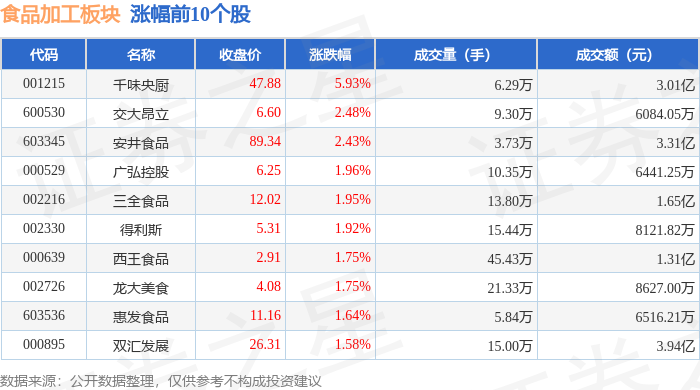
Market Overview - The food processing sector increased by 1.12% on February 4, with Qianwei Yangchu leading the gains [1] - The Shanghai Composite Index closed at 4102.2, up 0.85%, while the Shenzhen Component Index closed at 14156.27, up 0.21% [1] Stock Performance - Qianwei Yangchu (001215) closed at 47.88, up 5.93% with a trading volume of 62,900 shares and a transaction value of 301 million yuan [1] - Other notable performers included: - Jiaoda Onl (600530) at 6.60, up 2.48% [1] - Anjii Food (603345) at 89.34, up 2.43% [1] - Shuanghui Development (000895) at 26.31, up 1.58% with a transaction value of 394 million yuan [1] Capital Flow - The food processing sector saw a net inflow of 18.57 million yuan from institutional investors, while retail investors experienced a net outflow of 187.34 million yuan [2] - The capital flow for key stocks included: - Shuanghui Development with a net inflow of 35.67 million yuan from institutional investors [3] - Baba Food (605338) with a net inflow of 11.04 million yuan from retail investors [3] - Sanquan Food (002216) with a net inflow of 6.24 million yuan from institutional investors [3]


险资火力全开 近10亿扫货港股基石 密集调研310家A股公司
2 1 Shi Ji Jing Ji Bao Dao· 2026-02-03 23:43
Group 1 - The insurance capital is increasingly active in equity market allocation due to a low interest rate environment and asset scarcity, participating in cornerstone investments in Hong Kong stocks and conducting research on A-share companies [1][5] - Since the beginning of 2026, insurance capital has participated in cornerstone placements for 7 Hong Kong stocks, with a total subscription amount nearing 1 billion yuan, covering sectors from technology to consumer [1][2] Group 2 - Insurance capital is becoming a core player in Hong Kong's IPO market, utilizing cornerstone investments as a strategy to achieve significant investment returns while establishing a clear long-term asset allocation path [2][9] - A notable example is the IPO of Hunan Mingming Henmang Commercial Chain Co., which raised 3.336 billion HKD, attracting major institutions like Tencent and Temasek, with a total subscription amount of 195 million USD [2][10] Group 3 - Taikang Life is leading the charge in this wave of insurance capital moving south, participating in multiple IPOs across various sectors, with individual subscription amounts ranging from 78 million HKD to 233 million HKD [3][11] - The synchronized investment strategy among insurance companies indicates a focus on optimizing asset allocation and value recovery, particularly as the Hong Kong market is at a historical valuation low [11][12] Group 4 - Since 2025, insurance capital has significantly increased its participation in Hong Kong IPO cornerstone investments, with 20 cases and a total subscription amount of 4.679 billion HKD, reflecting a favorable market return [12] - Future trends suggest that as global liquidity improves, insurance capital will continue to accelerate its investments in the Hong Kong market, capitalizing on the valuation discrepancies and enhancing overall portfolio returns [12] Group 5 - In addition to Hong Kong, insurance capital is actively investing in A-shares, with 713 A-share companies appearing in the top ten shareholders list, and a notable increase in research activity on 310 A-share companies [6][13] - The focus on consumer sectors, particularly in the pre-made food industry, is evident, with companies like Qianwei Yangchu achieving a revenue increase of 1% year-on-year [13][14]

千味央厨:关于股份回购进展情况的公告
Zheng Quan Ri Bao· 2026-02-02 11:39
Group 1 - The company, Qianwei Yangchun, announced that as of January 31, 2026, it has repurchased a total of 1,241,200 shares through a dedicated repurchase account via centralized bidding transactions, which represents 1.28% of the company's total share capital [2]
千味央厨(001215) - 关于股份回购进展情况的公告
2026-02-02 08:00
证券代码:001215 证券简称:千味央厨 公告编号:2026-004 郑州千味央厨食品股份有限公司 关于股份回购进展情况的公告 本公司及其董事会全体成员保证信息披露内容的真实、准确和完整,没 有虚假记载、误导性陈述或重大遗漏。 郑州千味央厨食品股份有限公司(以下简称"公司")分别于 2025 年 4 月 25 日、2025 年 5 月 20 日召开第三届董事会第十九次会议和 2024 年年度股东会, 审议通过了《关于第二期以集中竞价交易方式回购公司股份方案的议案》,同意 公司使用自有资金和自筹资金(含银行股票回购专项贷款等)通过集中竞价交易 方式回购公司已发行的部分人民币普通股(A 股),用于股权激励或员工持股计 划。本次回购资金总额不低于人民币 4,000 万元(含)且不超过人民币 6,000 万 元(含),回购价格不超过人民币 43.21 元/股。回购股份的期限为自公司股东会 审议通过本回购方案之日起 12 个月内。具体内容详见公司 2025 年 4 月 26 日和 2025 年 5 月 24 日在巨潮资讯网(http://www.cninfo.com.cn)及《证券时报》《上 海证券报》上披露的《关于 ...
盒马、沃尔玛等新零售渠道成新增长极,千味央厨C端战略显成效
Quan Jing Wang· 2026-01-30 02:16
Core Insights - The pre-prepared food market is transitioning from an efficiency solution in the restaurant industry to a regular choice for family daily and festive needs, driven by the younger generation's changing consumption habits [1] - The market penetration of pre-prepared foods in China is currently only 10%-15%, compared to over 60% in mature markets like the US and Japan, indicating significant growth potential [1] Industry Overview - The development of the pre-prepared food industry is driven by both supply and demand sides, with the industrialization and standardization of restaurant kitchens and the rising demand for convenient cooking at home [1] - The upcoming national standards for pre-prepared foods signify a speeding up of industry normalization, benefiting leading companies with strict quality control systems [1][4] Company Strategy - Qianwei Central Kitchen (千味央厨) has established a dual-driven development strategy focusing on strengthening its B-end business while expanding into the C-end market through e-commerce and new retail channels [2] - The company has successfully introduced its products into mainstream new retail channels such as Hema, Walmart, and Yonghui, positively impacting its overall revenue [2] Financial Performance - In the first three quarters of 2025, Qianwei Central Kitchen achieved total revenue of 1.378 billion yuan, a year-on-year increase of 1%, with the third quarter revenue reaching 492 million yuan, up 4.27% year-on-year [2] - The performance of direct and new retail channels has outperformed distribution channels, with significant contributions from new retail clients like Hema [2] Market Positioning - Qianwei Central Kitchen is leveraging a multi-brand matrix to segment and cover the market, with brands like "Xingkefang" and "Yuzhicao" establishing flagship stores on major e-commerce platforms [3] - The company has the potential to enter high-end membership supermarkets like Sam's Club, which require high product differentiation and stable quality [3] Future Outlook - With the impending implementation of national standards, the trend towards industry normalization and increased concentration is expected to become clearer, enhancing Qianwei Central Kitchen's competitive advantages in the C-end market [4] - The company's growth potential is anticipated to be further released as it expands into more C-end new channels, indicating promising long-term growth opportunities [4]
餐饮细分精耕效率,餐供定制扩容可期
ZHONGTAI SECURITIES· 2026-01-28 00:25
Investment Rating - The report maintains an "Overweight" rating for the industry [4] Core Insights - The restaurant industry is experiencing a slowdown in revenue growth, with a shift towards efficiency in operations and a focus on customized meal supply [6][32] - The report identifies three potential development paths for the restaurant industry: high-quality and affordable offerings, automation and smart technology, and a focus on niche markets to meet diverse consumer needs [32][33] Summary by Sections Macro Perspective on Restaurant Trends - China's residents primarily rely on wage income, leading to a lower consumption tendency compared to developed countries [9][13] - The overall consumption inclination is affected by significant income inequality, with the top 1% of the population holding a substantial share of wealth [13][15] - The restaurant industry's revenue growth is expected to slow down significantly by 2025, with a notable decline in average spending per customer [15][17] Population Dynamics - China's total population has entered a phase of negative growth, with a significant concentration of young people in economically vibrant cities [18][20] - The labor force participation rate is declining, while the dependency ratio is increasing, indicating demographic challenges for the industry [20][23] Opportunities in the Restaurant Sector - The report draws parallels with Japan's consumption evolution, suggesting that China's restaurant industry can learn from Japan's experiences [31] - The three identified paths for growth include offering high-quality products at lower prices, leveraging automation, and focusing on specific consumer segments such as single-person households and the elderly [32][33] Restaurant Supply Chain Insights - The restaurant supply chain is complex, involving multiple stages from raw material procurement to end-user sales [33] - The market for restaurant supply chains is projected to grow, with an expected market size of 2.6 trillion yuan in 2024, reflecting an 8.1% year-on-year increase [35][36] Market Structure and Competition - The restaurant market is characterized by high closure rates and a fragmented landscape, with many small-scale chains dominating the market [37][38] - The supply side is marked by a lack of concentration, leading to weak bargaining power for suppliers [38] Labor Market Challenges - The restaurant industry faces rising labor costs and high turnover rates, with significant implications for operational efficiency [43][46] - The introduction of smart devices and semi-finished products is seen as a strategy to mitigate labor challenges and enhance efficiency [46][48]