
Tech-Bank(002124)

Search documents
天邦食品(002124) - 2025年11月份商品猪销售情况简报
2025-12-07 08:15
证券代码:002124 证券简称:天邦食品 公告编号:2025-080 天邦食品股份有限公司 2025 年 11 月份商品猪销售情况简报 本公司及董事会全体成员保证信息披露内容的真实、准确和完整,没 有虚假记载、误导性陈述或者重大遗漏。 一、商品猪销售情况 公司 2025 年 11 月份销售商品猪 67.79 万头(其中仔猪销售 25.73 万头),销售收 入 65,403.19 万元,销售均价 12.11 元/公斤(商品肥猪均价为 11.63 元/公斤),环比变 动分别为-1.18%、7.66%、2.85%。 2025 年 1-11 月销售商品猪 600.11 万头(其中仔猪销售 215.56 万头),销售收入 734,643.00 万元,销售均价 14.95 元/公斤(商品肥猪均价为 13.78 元/公斤),同比变动 分别为 10.13%、-7.65%、-16.70%。 上述数据统计口径仅包括公司控股子公司,未包括公司参股公司。参股公司 2025 年 11 月份销售各类商品猪合计 132,231 头。 上述数据未经审计,与定期报告披露的数据之间可能存在差异,因此仅作为阶段 性数据供投资者参考。 二、风险提 ...

天邦食品叫停募投项目 上市猪企集体补流“过冬”
Bei Jing Shang Bao· 2025-12-02 12:44
Core Viewpoint - The pig farming industry is experiencing a "winter" period, leading to multiple listed companies, including Tianbang Food, terminating fundraising projects to conserve cash for survival [2][4]. Company Summary - Tianbang Food announced the termination of the "Tianbang Shares Smart Pig Farm Upgrade Project" on December 1, 2023, after increasing the total investment commitment from 872 million yuan to 1.306 billion yuan [3]. - The company raised 1.187 billion yuan through a private placement in December 2023, with 872 million yuan initially allocated for the project [3]. - As of November 24, 2025, the project had only seen an investment progress of 11.19%, with a total investment of 146 million yuan [3]. - Tianbang Food plans to temporarily use 1.16 billion yuan of idle fundraising for working capital [3]. Industry Summary - The pig farming industry has seen significant capacity expansion since 2020, resulting in oversupply and persistently low pig prices [6]. - As of December 2, 2023, the prices for external and internal three-yuan pigs had decreased by 30.32% and 30.28% year-on-year, respectively, reaching 11.47 yuan/kg and 11.49 yuan/kg [6]. - Other listed pig companies, such as Tangrenshen and Yisheng, have also terminated fundraising projects and redirected funds to working capital due to similar market conditions [6][7]. - The collective strategy of "fundraising for liquidity and contraction for survival" reflects a consensus among companies that short-term pig prices are unlikely to rebound, emphasizing the importance of cash flow for survival [7].

天邦食品叫停募投项目,上市猪企集体补流“过冬”
Bei Jing Shang Bao· 2025-12-02 12:37
Core Viewpoint - The pig farming industry is experiencing a prolonged downturn, leading multiple listed companies, including Tianbang Food, to terminate fundraising projects and redirect funds to maintain liquidity during this challenging period [2][3][5]. Group 1: Company Actions - Tianbang Food announced the termination of the "Tianbang Co., Ltd. Intelligent Pig Farm Upgrade Project," reallocating remaining funds to supplement liquidity [2][3]. - The project saw its total investment commitment increase from 872 million yuan to 1.306 billion yuan, but only 146 million yuan had been invested by November 2025, reflecting a mere 11.19% progress [3]. - Other companies, such as Tangrenshen and Yisheng Shares, have also halted fundraising projects and redirected funds to maintain liquidity, indicating a broader trend in the industry [6][7]. Group 2: Industry Context - Since 2020, the pig farming industry has expanded significantly, resulting in oversupply and persistently low pig prices, with prices dropping by over 30% year-on-year as of December 2, 2025 [5][6]. - The industry is currently in a capacity adjustment phase, with companies facing limited capacity utilization and financial strain due to low prices [3][4]. - Analysts suggest that maintaining cash flow is crucial for survival during this downturn, as companies with sufficient liquidity can delay culling sows and wait for price recovery, while those without may be forced to sell at lower prices, exacerbating the market decline [6][7].
猪价“旺季不旺”全行业亏损,天邦食品按下投资“暂停键”
Di Yi Cai Jing· 2025-12-02 10:32
Core Viewpoint - The ongoing decline in pig prices and the industry's deep losses have led Tianbang Food to halt its capital expansion plans, reflecting a broader trend among listed pig companies to prioritize cash flow and survival strategies in a challenging market environment [1][2][4]. Company Summary - Tianbang Food announced the termination of its "Smart Pig Farm Upgrade Project," which was initially planned to invest 1.306 billion yuan, with only 146 million yuan (approximately 11% of the total) invested so far [1][2]. - The company is facing a tight cash flow situation, with a debt ratio of 70.27% as of September 30, 2025, and a significant short-term debt repayment gap exceeding 3 billion yuan [2][3]. - The company reported a 5.98% year-on-year decline in revenue to 6.719 billion yuan for the first three quarters of 2025, with a staggering 80.65% drop in net profit [3]. Industry Summary - The pig farming industry is experiencing severe challenges due to oversupply, with prices remaining low and the entire sector currently in a loss-making state [1][5]. - As of December 2, 2023, the average price of live pigs was reported at 11.47 yuan per kilogram, reflecting a year-on-year decrease of 30.32% and a month-on-month decrease of 7.95% [5]. - Analysts indicate that the supply-demand imbalance persists, with the overall market remaining loose, and there are no signs of a price turnaround in the near future [6][7].
养殖业板块12月2日跌1.06%,正邦科技领跌,主力资金净流出1.45亿元
Zheng Xing Xing Ye Ri Bao· 2025-12-02 09:05
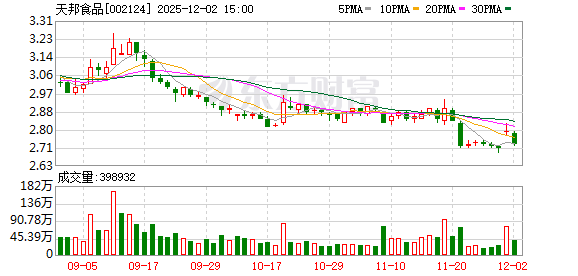
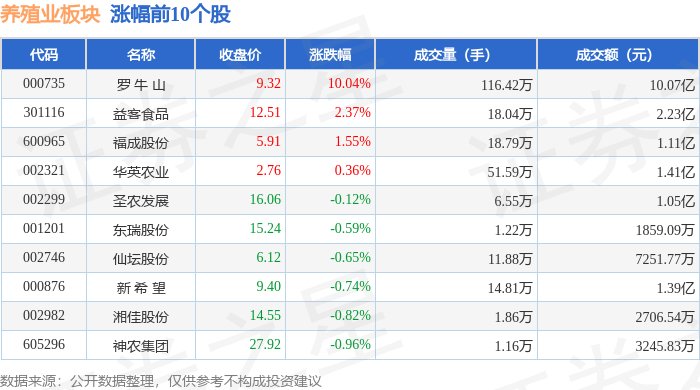
Core Insights - The aquaculture sector experienced a decline of 1.06% on December 2, with Zhengbang Technology leading the drop [1] - The Shanghai Composite Index closed at 3897.71, down 0.42%, while the Shenzhen Component Index closed at 13056.7, down 0.68% [1] Stock Performance - Notable gainers included: - Luoniushan (Code: 000735) with a closing price of 9.32, up 10.04% and a trading volume of 1.1642 million shares, totaling 1.007 billion yuan [1] - Yike Food (Code: 301116) closed at 12.51, up 2.37% with a trading volume of 180,400 shares, totaling 223 million yuan [1] - Major decliners included: - Zhengbang Technology (Code: 002157) closed at 3.11, down 3.12% with a trading volume of 2.3669 million shares, totaling 74.71 million yuan [2] - Tianbang Food (Code: 002124) closed at 2.73, down 2.15% with a trading volume of 398,900 shares, totaling 1.107 million yuan [2] Capital Flow - The aquaculture sector saw a net outflow of 145 million yuan from institutional investors, while retail investors contributed a net inflow of 151 million yuan [2] - The detailed capital flow for selected stocks showed: - Luoniushan had a net inflow of 105 million yuan from institutional investors, while retail investors had a net outflow of 60.46 million yuan [3] - Wens Foodstuffs (Code: 300498) experienced a net inflow of 58.02 million yuan from institutional investors, with retail investors also showing a net outflow of 34.94 million yuan [3]


预重整延期叠加猪价低迷 天邦食品拟终止13亿元数智化猪场升级项目
Mei Ri Jing Ji Xin Wen· 2025-12-02 00:28
Core Viewpoint - Tianbang Food has decided to terminate the "Smart Pig Farm Upgrade Project" due to slow progress and unfavorable market conditions in the pig farming industry, which has led to financial strain and a strategic shift in company operations [1][3]. Group 1: Project Termination - The company announced the termination of the project that had a total committed investment of 1.306 billion yuan, with only 146 million yuan invested as of November 24, representing a mere 11.19% of the planned investment [1][2]. - The remaining raised funds will be kept in a dedicated account and temporarily used to supplement working capital [1][2]. Group 2: Financial Strain and Industry Conditions - The pig farming industry has been facing overcapacity and low prices, resulting in widespread losses, with Tianbang Food's net profit for Q3 showing a loss of 92.49 million yuan, a year-on-year decline of 118.48% [4][5]. - The average price of market pigs has decreased from 14.60 yuan/kg in July to 11.34 yuan/kg in October, indicating a downward trend in pricing [5]. - The company is currently in a pre-restructuring phase, with a high debt ratio of 70.27% and current liabilities significantly exceeding current assets [4]. Group 3: Future Plans and Adjustments - Tianbang Food plans to adjust its funding usage as needed and will continue to upgrade necessary pig farms through self-funding or supplier financing [3]. - The company has no new project plans until the end of 2025, focusing on stabilizing its current operations [3].
天邦食品(002124.SZ):终止募集资金投资项目
Ge Long Hui A P P· 2025-12-01 13:14
Group 1 - The company has decided to terminate the "Tianbang Co., Ltd. Intelligent Pig Farm Upgrade Project" due to considerations of current industry capacity regulation, market economic environment, and the progress of fundraising investment projects [1] - The decision also reflects the company's cash flow situation and its current reality of being in a pre-restructuring phase [1]
天邦食品:终止募集资金投资项目
Ge Long Hui· 2025-12-01 13:10
Group 1 - The company has decided to terminate the "Tianbang Co., Ltd. Intelligent Pig Farm Upgrade Project" due to considerations of current industry capacity regulation, market economic environment, and the progress of fundraising investment projects [1] - The decision also reflects the company's cash flow situation and its current reality of being in a pre-restructuring phase [1]
天邦食品(002124) - 中国银河证券股份有限公司关于天邦食品股份有限公司终止募集资金投资项目的核查意见
2025-12-01 11:32
中国银河证券股份有限公司 关于天邦食品股份有限公司 终止募集资金投资项目的核查意见 中国银河证券股份有限公司(以下简称"银河证券"、"保荐人"或"保荐机 构")作为天邦食品股份有限公司(以下简称"天邦食品"或"公司")2023 年度向 特定对象发行股票(以下简称"本次发行")的持续督导机构,根据《证券发行 上市保荐业务管理办法》、《上市公司募集资金监管规则》、《深圳证券交易所股票 上市规则》、《深圳证券交易所上市公司自律监管指引第 1 号——主板上市公司规 范运作》等有关规定,对天邦食品终止募集资金投资项目的情况进行了认真、审 慎的核查,具体核查情况如下: 一、募集资金基本情况 经中国证券监督管理委员会《关于同意天邦食品股份有限公司向特定对象发 行股票注册的批复》(证监许可〔2023〕1515 号)核准,公司采用向特定对象发 行的方式发行人民币普通股(A 股)股票,每股面值为人民币 1.00 元,发行数量 382,741,206.00 股,发行价格为每股人民币 3.13 元,募集资金总额为人民币 1,197,979,974.78 元,减除发行费用人民币 11,425,835.30 元后,募集资金净额为 1,1 ...
天邦食品(002124) - 董事和高级管理人员薪酬管理制度(2025年12月)
2025-12-01 11:32
第一章 总 则 董事和高级管理人员薪酬管理制度 二〇二五年十二月 董事和高级管理人员薪酬管理制度 董事和高级管理人员薪酬管理制度 天邦食品股份有限公司 第一条 为了进一步完善天邦食品股份有限公司(以下简称"公司")董事、高级 管理人员的薪酬管理,建立科学有效的激励与约束机制,有效调动公司董事与高级管理 人员的工作积极性,提高公司的经营管理效益,根据《中华人民共和国公司法》等法律 法规、规范性文件及《公司章程》规定,结合公司实际情况,制订本制度。 第二条 本制度适用对象为公司董事和高级管理人员,具体包括以下人员: 公司薪酬与绩效考核委员会负责审查董事及高级管理人员的薪酬方案,并进行 考核。 第三章 薪酬的构成与标准 第五条 公司董事薪酬: (一)董事:包括内部董事和外部董事。外部董事指不在公司担任除董事以外职务 的董事;内部董事指在公司担任其他职务的董事; (二)高级管理人员:指公司总经理、副总经理、财务负责人、董事会秘书等《公 司章程》规定的高级管理人员。 第三条 公司董事和高级管理人员薪酬管理制度遵循以下原则: 第二章 管理机构 第四条 股东会作为公司的最高权力机构,负责审议批准本制度的实施、变更和 终止。 ...